Flexure Fixtures for Large and Brittle Specimens

Trust
Flexure Fixtures for Large and Brittle Specimens

Standards

Precision Flexure Fixtures for High-Load Testing of Ceramics, Composites, and Concrete

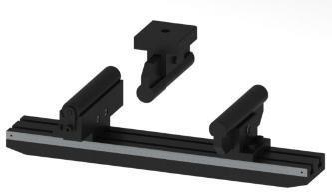
NextGen Flexure fixture - NGA206B

NextGen offers a specialized range of flexure fixtures designed for accurate high-force flexural testing of metals, ceramics, composites, and construction materials. Compatible with hydraulic universal testing machines, these fixtures meet rigorous standards such as GB/T 2542, GB/T 4111, GB/T 50081, and JC/T 239, providing reliable performance for industrial, academic, and quality control applications. With maximum capacities up to 2000 kN, these fixtures are built to handle demanding flexural evaluations, from single-point to four-point test configurations.

Engineered with adjustable span ranges and precision alignment, NextGen’s flexure fixtures accommodate many specimen sizes and shapes. Models in this category support standard specimen formats (e.g., 5.9 × 5.9 × 23.6″ (150×150×600 mm), 3.9 × 3.9 × 15.7″ (100×100×400 mm)) and allow integration of optional digital indicators to measure elastic modulus. Whether you're testing concrete beams, laminated composites, or advanced ceramics, these fixtures deliver accurate, repeatable results in ambient conditions.


Flexure Fixture Models

Two fixtures cover the range, and the load rating is not what separates them: both are rated to 2000 kN. The span is. The first works on roller supports for three- and four-point bending of metal, ceramic and composite bars.

Model NGA206B

Flexure Fixture

The NGA206B Flexure Fixture is built for high-capacity flexure testing of metallic, ceramic, and composite specimens. With a rated capacity of ≤2000 kN, this fixture provides reliable three-point or four-point bending evaluations using roller supports. The system is compliant with standards such as GB/T2542, GB/T4111, and JC/T 239, and features a lightweight lower grip and precision mandrel and roller components for adaptable testing.

Table 1. NGA206B Flexure Fixture
Parameter Specification
Application Flexure test for metal, composite, ceramic, etc.
Maximum Force ≤ 2000 kN
Lower Grip Weight 51 lbs (23 kg)
Connection Upper: Fixing block and screw
Lower: Positioning pin
Working Temperature Ambient
Standard GB/T2542, GB/T4111, JC/T 239
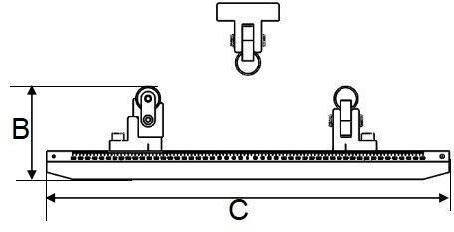
Lower Grip Height (B) 5.1″ (130 mm)
Lower Grip Width (C) 22.6″ (574 mm)
Minimum Test Space 11″ (280 mm)
Roller 1 (Φ × Length) Φ1.4 × 8.3″ (35 × 210 mm)
Roller 2 (Φ × Length) Φ1.2 × 6.3″ (30 × 160 mm)
Mandrel Diameter (included) Φ32, Φ60, Φ88, Φ160
NextGen Flexure fixture - NGA206B - SizeDimensions B and C used in Table 1.

When the specimen is a full-size concrete beam and the span has to change with it, the second fixture applies. Both its upper and lower spans adjust, and it accepts the optional digital indicator and elastic modulus device.

Model NGB206A

4-Point Flexure Fixture

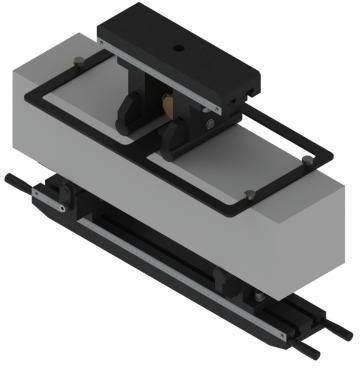
The NGB206A 4-Point Flexure Fixture is engineered for precise flexural testing of composite materials, concrete, and construction components. Designed to handle forces up to 2000 kN, this fixture complies with GB/T 50081 and offers fully adjustable lower and upper spans for flexible specimen sizing. It supports large concrete specimens and is optionally equipped with a digital indicator and elasticity modulus measurement device, making it suitable for both R&D and quality control applications.

NextGen 4-point flexure fixture - NGB206A for hydraulic machines
Table 2. NGB206A 4-Point Flexure Fixture
Parameter Specification
Application Flexure test for composite, concrete, construction material
Maximum Force ≤ 2000 kN
Upper Grip Weight 26 lbs (12 kg)
Lower Grip Weight 44 lbs (20 kg)
Connection Upper: Fixing block and screw
Lower: Positioning pin
Working Temperature Ambient
Standard GB/T 50081
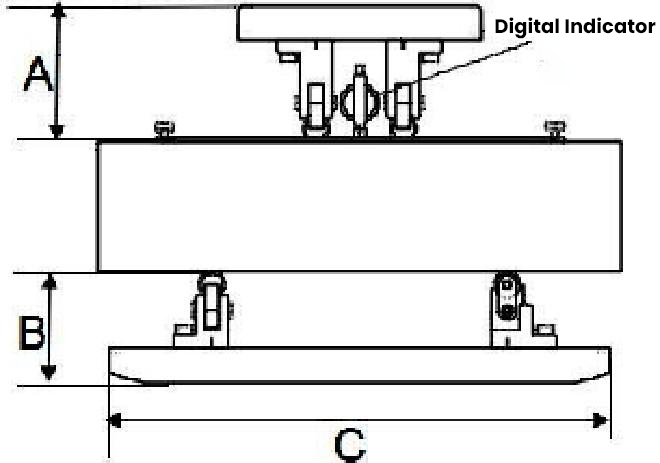
Upper Grip Height (A) 6.2″ (157 mm)
Lower Grip Height (B) 5″ (127 mm)
Lower Grip Width (C) 22.6″ (574 mm)
Lower Span (adjustable) 60 - 480 mm
Upper Span (adjustable) 60 - 180 mm
Minimum Test Space 17.7″ (450 mm)
Concrete Specimen Sizes 5.9 × 5.9 × 23.6″ (150×150×600 mm)
5.9 × 5.9 × 21.7″ (150×150×550 mm)
3.9 × 3.9 × 15.7″ (100×100×400 mm)
Optional Add-ons Digital indicator & elasticity modulus device
NextGen 4-point flexure fixture - NGB206A - SizeDimensions A, B and C used in Table 2.

NextGen’s flexure fixtures for hydraulic UTMs offer outstanding adaptability, mechanical strength, and test control. With secure fixing systems, variable support spans, and standardized compatibility, these solutions are a critical tool for evaluating structural integrity and deformation behavior. For organizations requiring precise flexural strength analysis, NextGen provides dependable equipment tailored for long-term use and strict compliance. Contact NextGen Material Testing Inc. to find the right flexure fixture solution for your setup.

For Laboratories

Need Additional Quality Control Equipment to Build Your Laboratory?

Flexural and bend testing is only one part of a complete quality control laboratory. NextGen can help you equip your entire lab with impact testers, notching and broaching systems, cooling chambers, tensile testers, hardness testers, specimen preparation equipment, and other supporting solutions, all coordinated as one complete project.

  • One partner to equip your complete laboratory
  • Installation, training, calibration
  • Support for the life of the equipment

FAQs

Flexural strength is the failure load multiplied by the support span, divided by the beam width and the square of its depth. That is the GB/T 50081 formula for third-point loading, and it gives the tensile stress in the bottom face across the middle third at failure.

The span in the formula is the lower span set on the fixture, and the load is the peak force the testing machine records. Width and depth are measured on the beam itself, not read from the mold size, because a small difference in depth shifts the result noticeably once it is squared.

The standard counts a beam only when the fracture lies between the two upper loading lines. If one beam of the three breaks outside them, the set is judged on the other two, provided they agree within 15 percent of the lower value. If two break outside, the set does not count and new beams are cast.

Use the 150×150×600 mm or 150×150×550 mm beam where your specification allows it, because GB/T 50081 treats that section as the standard specimen. The fixture takes both lengths, and it also takes the 100×100×400 mm beam, which the standard accepts as a non-standard size.

A result from the smaller beam is multiplied by a size factor of 0.85 to put it on the same basis as the standard beam. Smaller beams tend to read higher, and the factor corrects for that. For concrete of grade C60 and above the standard prefers the full-size beam, because the factor for high-strength mixes has to be set by trial.

The smaller beam suits trial batches. Coarse aggregate size sets the smallest section allowed, so a mix with large stone goes into the full-size mold. Both beams break on the same fixture once the spans are reset.

The specimen decides, because both fixtures carry up to 2000 kN (449,618 lbf) in a hydraulic universal testing machine and differ in how they support and span the specimen.

The first sits on roller supports and runs three- or four-point bending on bars of metal, ceramic and composite. The second is a four-point fixture for full-size concrete beams, with upper and lower spans that both adjust to the beam.

Both mount the same way, with a fixing block and screw at the top and a positioning pin at the bottom, and both are built for ambient temperature.

Include your specimen sizes and the standard you work to in a quote request, and our engineers will confirm which fixture suits them and how it fits your frame.

The beam goes on two lower rollers and is loaded through two upper rollers at the third points, the arrangement GB/T 50081 uses for flexural strength. Three beam sizes fit the fixture: 150 × 150 × 600 mm, 150 × 150 × 550 mm and 100 × 100 × 400 mm.

The standard sets the support span at three times the beam depth, with the two loads dividing it into equal thirds. The lower span adjusts from 60 to 480 mm and the upper span from 60 to 180 mm, so both beam depths can be set up on the same fixture.

The frame needs at least 450 mm of test space for this fixture, and its upper and lower halves weigh 12 kg (26 lbs) and 20 kg (44 lbs). For elastic modulus as well as strength, it takes an optional digital indicator and elasticity modulus device.

For ASTM C78 beams at up to 100 kN, our 3-point and 4-point bending fixtures include a four-point fixture for concrete.

It meets GB/T 2542, the Chinese test methods for wall bricks, GB/T 4111 for concrete blocks and bricks, and JC/T 239. The two GB/T methods include a flexural strength test on the units, since a brick or block in a wall has to resist bending as well as compression.

Masonry units are brittle and fail with very little deflection, so a fair result depends on stable supports and an even load line across the unit. The fixture carries two roller sets, Ø35 × 210 mm and Ø30 × 160 mm.

It needs a minimum of 280 mm of test space in the frame. The lower half weighs 23 kg (51 lbs) and measures 574 mm wide and 130 mm high.

Related Products

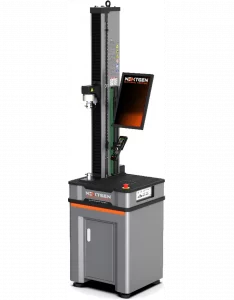
NG-EML Series A – Single-Column Universal Testing Machine (50 N – 5 kN)

NG-EML Series A – Single-Column Universal Testing Machine (50 N – 5 kN)

NG-EML Series A is a compact single-column benchtop universal testing machine for low-force tensile, compression, and flexural testing. Covering 50 N to 5 kN capacity options, it is suited for rubber, plastics, adhesives, films, foams, wires, metals, composites, and consumer products. Its electromechanical frame, high-speed servo actuation, GenTest software, and standards support make it practical for R&D and routine QC.

Read more
NG-EML Series B – Dual-Column Universal Testing Machine (100 N – 10 kN)

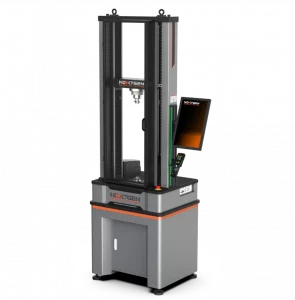
NG-EML Series B – Dual-Column Universal Testing Machine (100 N – 10 kN)

NG-EML Series B is a dual-column benchtop electromechanical universal testing machine for precision testing from 100 N to 10 kN. Built for research and industrial labs, it supports tension, compression, flexural, and component testing of composites, high-strength metals, polymers, films, foams, and rubber. Its compact rigid frame, advanced control accuracy, and GenTest software help deliver repeatable results in limited lab space.

Read more
NG-EML Series C – Dual-Column Universal Testing Machine (5–50 kN)

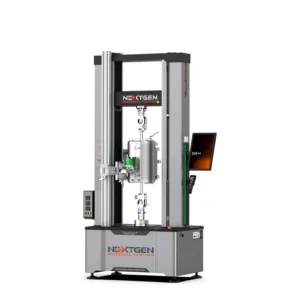
NG-EML Series C – Dual-Column Universal Testing Machine (5–50 kN)

NG-EML Series C is a dual-column electromechanical universal testing machine available in bench-top and floor-standing formats from 5 kN to 50 kN. Built for tension, compression, flexural, shear, and peel testing, it combines Class 0.5 accuracy, a servo direct-drive system, high-rigidity frame, touchscreen control, and GenTest software to support precise testing of metals, composites, rubber, plastics, and polymers.

Read more
NG-EML Series D – Floor-Standing Universal Testing Machine (50–1000 kN)

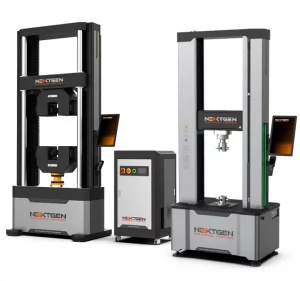
NG-EML Series D – Floor-Standing Universal Testing Machine (50–1000 kN)

NG-EML Series D is a heavy-duty floor-standing electromechanical universal testing machine for high-capacity tensile, compression, and flexural testing. Available from 50 kN to 1000 kN, it is built for high-strength steels, advanced composites, alloys, and challenging research materials. Its rigid dual-column frame, servo direct-drive system, closed-loop control, safety protections, and GenTest software support stable, accurate testing.

Read more
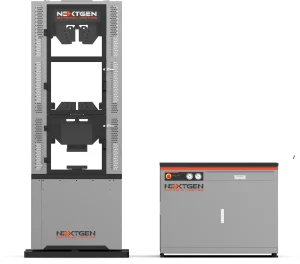
NG-SHM Series A – Servo-Hydraulic Universal Testing Machine (300–3000 kN)

NG-SHM Series A – Servo-Hydraulic Universal Testing Machine (300–3000 kN)

NG-SHM Series A is a high-force servo-hydraulic universal testing machine for static mechanical testing of metals and structural components. Available from 300 kN to 3000 kN, it uses a high-stiffness multi-column frame and dual-zone layout for tensile and compression work. Hydraulic wedge grips, extensometer compatibility, and GenTest software support testing of rebar, fasteners, chains, welds, castings, and large metallic specimens.

Read more
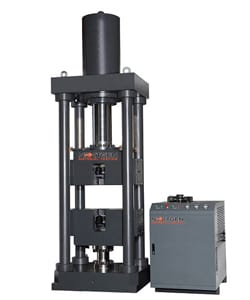
NG-SHM Class DP – Servo-Hydraulic Universal Testing Machine

NG-SHM Class DP – Servo-Hydraulic Universal Testing Machine

NG-SHM Class DP is a high-force servo-hydraulic testing machine with an upper actuator, single-zone test space, and side-action hydraulic wedge grips. Available in 600 kN, 1000 kN, and 2000 kN capacities, it supports tension, compression, bending, and shearing tests on metals and structural specimens. Its automatic clamping adjustment, dual-direction grip alignment, precision transducer, and long-travel cylinder help deliver stable, repeatable results.

Read more
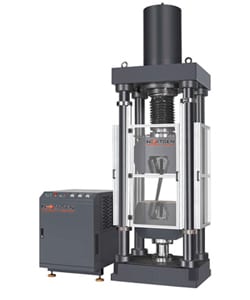
NG-SHM Class D – Servo-Hydraulic Universal Testing Machine

NG-SHM Class D – Servo-Hydraulic Universal Testing Machine

NG-SHM Class D is a servo-hydraulic universal testing machine for high-force mechanical testing of metals and structural components. Available in 600 kN, 1000 kN, and 2000 kN capacities, it uses an upper actuator and single-zone test space for tension, compression, bending, and shearing. Its long-travel cylinder, wedge hydraulic grips, and rigid guidance system make it suitable for extra-long, high-elongation specimens.

Read more
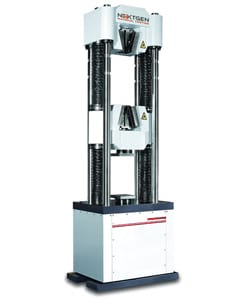
NG-SHM Class C – Servo-Hydraulic Universal Testing Machine

NG-SHM Class C – Servo-Hydraulic Universal Testing Machine

NG-SHM Class C is a servo-hydraulic universal testing machine for high-force metal testing, with capacity options of 600 kN and 1000 kN. Its longer jaw face is designed for tensile testing of stranded steel wire, while the 6-column frame, dual-zone test space, hydraulic wedge grips, quick-return valve, and precision load cell support accurate, repeatable testing of rebar, fasteners, chains, welds, and castings.

Read more
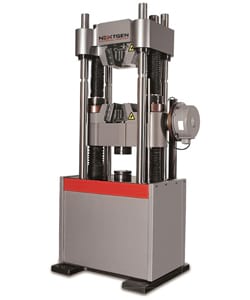
NG-SHM Class B – Servo-Hydraulic Universal Testing Machine

NG-SHM Class B – Servo-Hydraulic Universal Testing Machine

NG-SHM Class B is a high-force servo-hydraulic universal testing machine for tensile, compression, and flexural testing of metals and other high-strength materials. Available from 300 kN to 3000 kN, it uses a rigid multi-column frame, dual-zone test space, hydraulic wedge grips, and precise load-cell measurement to support reliable testing of fasteners, rebar, chains, welds, castings, and structural components.

Read more
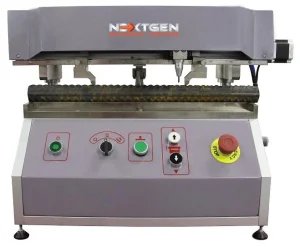
GenMark 500 – Automatic Gauge Length Marking Machine

GenMark 500 – Automatic Gauge Length Marking Machine

The GenMark 500 is a full-automatic gauge length marking machine for metal bar, rebar and wire rod, applying the reference marks used to determine elongation after fracture. A servo-driven lead screw sets 5 mm or 10 mm spacing and a pneumatic tungsten steel needle marks specimens up to 500 mm gauge length, supporting ISO 6892-1 and ASTM E8/E8M workflows. Adjustable marking force, quick needle changes, and fixtures for both round and flat samples keep specimen preparation consistent across operators and shifts.

Read more
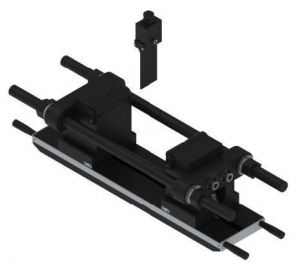
Heavy-Duty Bending Fixtures for Hydraulic Flexural Testing

Heavy-Duty Bending Fixtures for Hydraulic Flexural Testing

Heavy-duty bending fixtures support high-force flexural testing of metals, composites, ceramics, reinforcing bars, and structural materials on hydraulic universal testing machines. Designed for loads up to 2000 kN, they use secure fixing blocks, positioning-pin connections, adjustable mandrel options, and wide test spaces to maintain stability. GB/T 232, GB1499.1, and GB1499.2 compliance helps laboratories perform accurate, repeatable bend evaluations.

Read more
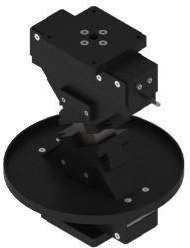
Splitting Fixtures for Rock and Concrete Testing

Splitting Fixtures for Rock and Concrete Testing

Splitting fixtures for indirect tensile testing are designed for rock, concrete, and composite specimens tested on hydraulic universal testing machines. Built for demanding geotechnical, mining, and structural-materials laboratories, they provide stable specimen support, rugged construction, and secure mounting under high loads. Compatibility with cylindrical and cubic samples, GB/T 23561.11 alignment, and capacities up to 2000 kN support repeatable shear and splitting evaluations.

Read more