Splitting Fixtures for Rock and Concrete Testing

Trust
Splitting Fixtures for Rock and Concrete Testing

Standards

Heavy-Duty Splitting Fixtures for Rock and Composite Shear Testing

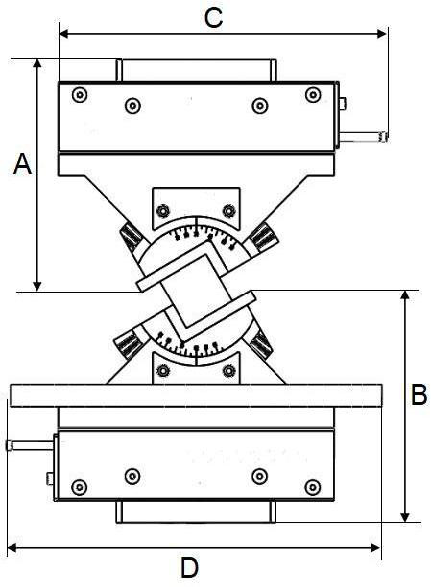
NextGen Rock shear fixture - NGA206B - Size

NextGen’s category of high-capacity splitting fixtures is engineered for shear and splitting tests on rock, concrete, and composite specimens. These fixtures are purpose-built for use with hydraulic universal testing machines in demanding environments such as geotechnical labs, mining research centers, and structural materials testing facilities. Designed for compatibility with international standards like GB/T 23561.11, they ensure precise and repeatable performance under loads up to 2000 kN or more.

Each fixture in this category features rugged construction, secure mounting systems (including flanges and positioning pins), and flexible specimen accommodation - supporting standard sizes such as Φ50×50 mm and 50×50×50 mm. Whether testing natural rock or engineered composites, these solutions provide the mechanical stability and test consistency required for accurate material analysis.


The line is built around a single fixture rated to 2000 kN. What decides whether it fits your lab is not the load alone but the mounting and the specimen: it hangs from a flange at the top and a positioning pin at the bottom, needs 17.7″ (450 mm) of test space, and takes cylindrical or cubic samples at the sizes given in the table.

Model NGA206B

Rock Shear Fixture

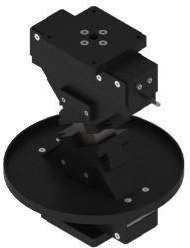
The NGA206B Rock Shear Fixture is a high-capacity splitting system designed specifically for shear strength testing of rock specimens. With a rated capacity of ≤ 2000 kN, it supports both cylindrical and cubic sample formats, for versatility across geological testing laboratories. The fixture conforms to GB/T 23561.11 standards and is built for use under ambient temperature conditions. Its dual-grip system (flange on top and positioning pin on bottom) ensures stability and accuracy throughout each test cycle.

NextGen Rock shear fixture - NGA206B
Table 1. NGA206B Rock Shear Fixture
Parameter Specification
Application Shear test for rocks
Maximum Force ≤2000 kN
Weight Upper Grip: 57 lbs (26 kg)
Lower Grip: 62 lbs (28 kg)
Connection Upper: Flange
Positioning pin
Working Temperature Ambient
Standard GB/T 23561.11
Height (A / B) 8.3″ (210 mm) (Upper and Lower)
Width (C / D) Upper: 12.2″ (310 mm)
Lower: 13.8″ (350 mm)
Minimum Test Space 17.7″ (450 mm)
Specimen Size Φ50 × 50 mm
50 × 50 × 50 mm

NextGen’s splitting fixture line offers trusted performance for advanced shear and splitting applications under high loads. With heavy-duty design, compatibility with hydraulic UTMs, and adherence to global standards, these fixtures are used for laboratories and industries focused on evaluating the structural integrity of tough materials. Contact NextGen Material Testing Inc. to find the right splitting fixture setup for your testing needs.

For Laboratories

Need Additional Quality Control Equipment to Build Your Laboratory?

Gripping and fixturing is only one part of a complete quality control laboratory. NextGen can help you equip your entire lab with impact testers, notching and broaching systems, cooling chambers, tensile testers, hardness testers, specimen preparation equipment, and other supporting solutions, all coordinated as one complete project.

  • One partner to equip your complete laboratory
  • Installation, training, calibration
  • Support for the life of the equipment

FAQs

GB/T 23561.11 sets out three ways to measure the shear strength of coal and rock: a test on standard specimens, a test on non-standard specimens and a double-shear test. Our splitting fixture conforms to the standard and takes its cylinder and cube formats.

The standard-specimen test is for rock that can be machined into regular specimens. The non-standard method is written for soft, weak coal and rock that cannot be machined to that shape, and the double-shear test is used where the shear strength itself is the only result required.

The current edition is GB/T 23561.11-2024, in force since August 1, 2024, and it replaced the 2010 edition. Contracts and older reports may cite either, so name the edition and the method your project calls for, and our team will confirm the fixture setup against them before delivery.

A series of shear tests gives the cohesion and the angle of internal friction of the rock, the two parameters of the Mohr-Coulomb strength criterion. Each specimen gives one pair of normal and shear stress at failure, and the pairs from a series define the line that sets both values.

Cohesion is the shear strength the rock carries with no normal stress across the plane. The friction angle describes how quickly that strength grows as the normal stress rises. Geotechnical and mining engineers enter both into stability analyses and numerical models of rock masses.

Because every point on the line comes from a separate specimen, the specimens in one series should come from the same core run or block and be cut to the same size. The scatter in the results then reflects the rock rather than the preparation, and the fitted values hold up when the series is repeated.

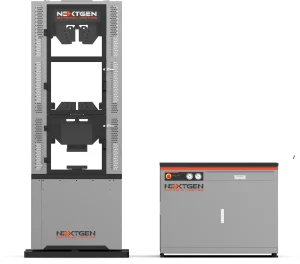
Hard rock reaches very high forces at failure, and the fixture is purpose-built for hydraulic universal testing machines, the frames made to carry that kind of load. A servo-hydraulic frame also holds its load rate steadily from first contact to the moment the specimen fails.

Rock fails in a brittle way. Strain energy stored in the frame and the fixture releases at once when the specimen breaks, and a stiff, heavy-duty setup stores less of it, so the failure is cleaner and the peak force is easier to capture.

Size the frame and its load cell above the highest failure load you expect, and remember that soft rock may fail at a small fraction of it, where a lower load range reads more finely. Our servo-hydraulic static testing machines are the hydraulic frames in our range, and our team matches one to the rock types your laboratory tests.

Cylinders start at a coring machine, which drills core from block samples, and then go to a core cutting machine and a grinder. Our CoreTrim 3000 cuts core to length, and our core grinding machines finish the end faces.

Cubes are sawn from block samples, and our masonry saw does the rough cutting before the faces are ground. Preparing both formats on the same set of machines keeps a test series consistent, because every specimen goes through the same cut and the same grind.

The whole line, from the laboratory coring machine to the grinders, is in our rock specimen preparation range. We can deliver it together with the hydraulic frame and the fixture, with installation and training for the complete setup and support for the life of the equipment.

The two measure different shear strengths. The splitting fixture tests machined specimens of the rock itself on a universal testing machine to GB/T 23561.11. A rock shear box shears a sample along a discontinuity, such as a joint or a bedding plane, under a normal load applied by its own ram.

The difference matters in design work. The strength of intact rock governs how a pillar, a foundation block or the rock around an opening carries load, while a rock mass with open joints usually slides along those joints first, at a much lower stress.

Many laboratories need both results. Our Rock Shear Box runs the direct shear test on discontinuities in the field or in the laboratory, while the splitting fixture handles the standard cylinders and cubes on the frame, so together they describe the rock and its joints.

It measures the shear strength of rock. The fixture is a heavy-duty splitting system built for shear testing of rock specimens to GB/T 23561.11, part of the Chinese series of methods for the physical and mechanical properties of coal and rock.

Shear strength describes how much stress rock can carry along a plane before it slides. With the compressive and tensile strength of the same rock, it gives engineers the parameters they use to assess the stability of slopes, tunnels and underground openings.

The fixture is rated to 2000 kN (449,618 lbf) and works at ambient temperature. It is built for geotechnical laboratories and mining research centers as well as structural materials testing facilities, and the rest of a rock laboratory is covered in our rock mechanics testing equipment range.

It needs a hydraulic universal testing machine with at least 450 mm of test space. The upper half hangs from a flange and the lower half locates on a positioning pin, a dual-grip arrangement that keeps the setup stable through each test.

Both halves are 210 mm high. The upper half is 310 mm wide and weighs 26 kg (57 lbs), and the lower half is 350 mm wide and weighs 28 kg (62 lbs), so plan for a two-person lift or a hoist when you install it.

Name your frame model when you request a quote, and we will confirm that the flange and pin interface fits before the fixture ships.

It takes cylinders of Ø50 × 50 mm and cubes of 50 × 50 × 50 mm, the two standard formats for this fixture.

Cylinders are usually cut from drill core and cubes sawn from block samples, and the standard sets how both are prepared and measured. Shear strength is calculated from the failure load and the area of the shear plane, so accurate dimensions matter as much as the force reading, and flat, square faces keep the load from starting on one edge.

We can also supply the specimen preparation equipment for your laboratory, coordinated as one project with the testing machine and the fixture.

Related Products

NG-SHM Series A – Servo-Hydraulic Universal Testing Machine (300–3000 kN)

NG-SHM Series A – Servo-Hydraulic Universal Testing Machine (300–3000 kN)

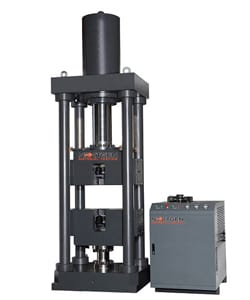
NG-SHM Series A is a high-force servo-hydraulic universal testing machine for static mechanical testing of metals and structural components. Available from 300 kN to 3000 kN, it uses a high-stiffness multi-column frame and dual-zone layout for tensile and compression work. Hydraulic wedge grips, extensometer compatibility, and GenTest software support testing of rebar, fasteners, chains, welds, castings, and large metallic specimens.

Read more
NG-SHM Class DP – Servo-Hydraulic Universal Testing Machine

NG-SHM Class DP – Servo-Hydraulic Universal Testing Machine

NG-SHM Class DP is a high-force servo-hydraulic testing machine with an upper actuator, single-zone test space, and side-action hydraulic wedge grips. Available in 600 kN, 1000 kN, and 2000 kN capacities, it supports tension, compression, bending, and shearing tests on metals and structural specimens. Its automatic clamping adjustment, dual-direction grip alignment, precision transducer, and long-travel cylinder help deliver stable, repeatable results.

Read more
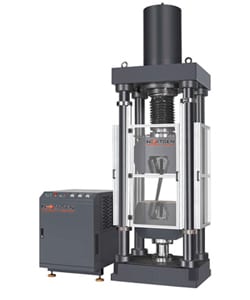
NG-SHM Class D – Servo-Hydraulic Universal Testing Machine

NG-SHM Class D – Servo-Hydraulic Universal Testing Machine

NG-SHM Class D is a servo-hydraulic universal testing machine for high-force mechanical testing of metals and structural components. Available in 600 kN, 1000 kN, and 2000 kN capacities, it uses an upper actuator and single-zone test space for tension, compression, bending, and shearing. Its long-travel cylinder, wedge hydraulic grips, and rigid guidance system make it suitable for extra-long, high-elongation specimens.

Read more
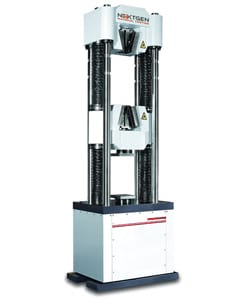
NG-SHM Class C – Servo-Hydraulic Universal Testing Machine

NG-SHM Class C – Servo-Hydraulic Universal Testing Machine

NG-SHM Class C is a servo-hydraulic universal testing machine for high-force metal testing, with capacity options of 600 kN and 1000 kN. Its longer jaw face is designed for tensile testing of stranded steel wire, while the 6-column frame, dual-zone test space, hydraulic wedge grips, quick-return valve, and precision load cell support accurate, repeatable testing of rebar, fasteners, chains, welds, and castings.

Read more
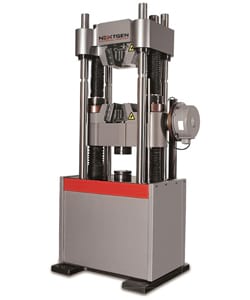
NG-SHM Class B – Servo-Hydraulic Universal Testing Machine

NG-SHM Class B – Servo-Hydraulic Universal Testing Machine

NG-SHM Class B is a high-force servo-hydraulic universal testing machine for tensile, compression, and flexural testing of metals and other high-strength materials. Available from 300 kN to 3000 kN, it uses a rigid multi-column frame, dual-zone test space, hydraulic wedge grips, and precise load-cell measurement to support reliable testing of fasteners, rebar, chains, welds, castings, and structural components.

Read more
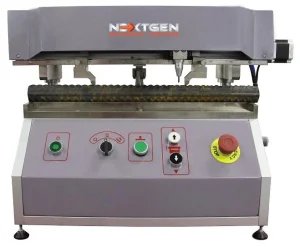
GenMark 500 – Automatic Gauge Length Marking Machine

GenMark 500 – Automatic Gauge Length Marking Machine

The GenMark 500 is a full-automatic gauge length marking machine for metal bar, rebar and wire rod, applying the reference marks used to determine elongation after fracture. A servo-driven lead screw sets 5 mm or 10 mm spacing and a pneumatic tungsten steel needle marks specimens up to 500 mm gauge length, supporting ISO 6892-1 and ASTM E8/E8M workflows. Adjustable marking force, quick needle changes, and fixtures for both round and flat samples keep specimen preparation consistent across operators and shifts.

Read more
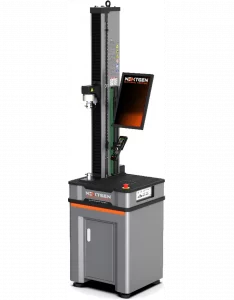
NG-EML Series A – Single-Column Universal Testing Machine (50 N – 5 kN)

NG-EML Series A – Single-Column Universal Testing Machine (50 N – 5 kN)

NG-EML Series A is a compact single-column benchtop universal testing machine for low-force tensile, compression, and flexural testing. Covering 50 N to 5 kN capacity options, it is suited for rubber, plastics, adhesives, films, foams, wires, metals, composites, and consumer products. Its electromechanical frame, high-speed servo actuation, GenTest software, and standards support make it practical for R&D and routine QC.

Read more
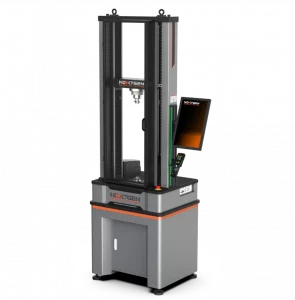
NG-EML Series B – Dual-Column Universal Testing Machine (100 N – 10 kN)

NG-EML Series B – Dual-Column Universal Testing Machine (100 N – 10 kN)

NG-EML Series B is a dual-column benchtop electromechanical universal testing machine for precision testing from 100 N to 10 kN. Built for research and industrial labs, it supports tension, compression, flexural, and component testing of composites, high-strength metals, polymers, films, foams, and rubber. Its compact rigid frame, advanced control accuracy, and GenTest software help deliver repeatable results in limited lab space.

Read more
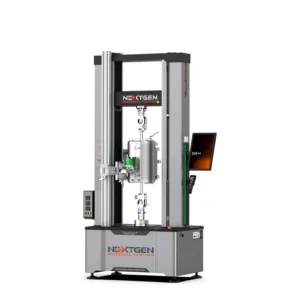
NG-EML Series C – Dual-Column Universal Testing Machine (5–50 kN)

NG-EML Series C – Dual-Column Universal Testing Machine (5–50 kN)

NG-EML Series C is a dual-column electromechanical universal testing machine available in bench-top and floor-standing formats from 5 kN to 50 kN. Built for tension, compression, flexural, shear, and peel testing, it combines Class 0.5 accuracy, a servo direct-drive system, high-rigidity frame, touchscreen control, and GenTest software to support precise testing of metals, composites, rubber, plastics, and polymers.

Read more
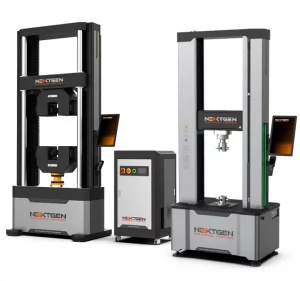
NG-EML Series D – Floor-Standing Universal Testing Machine (50–1000 kN)

NG-EML Series D – Floor-Standing Universal Testing Machine (50–1000 kN)

NG-EML Series D is a heavy-duty floor-standing electromechanical universal testing machine for high-capacity tensile, compression, and flexural testing. Available from 50 kN to 1000 kN, it is built for high-strength steels, advanced composites, alloys, and challenging research materials. Its rigid dual-column frame, servo direct-drive system, closed-loop control, safety protections, and GenTest software support stable, accurate testing.

Read more
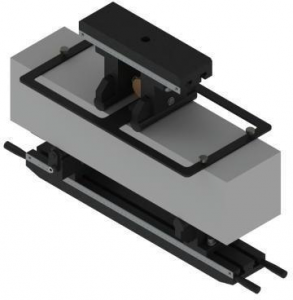
Flexure Fixtures for Large and Brittle Specimens

Flexure Fixtures for Large and Brittle Specimens

These flexure fixtures are designed for precise bending tests on large, brittle, or high-strength specimens, including metals, ceramics, composites, concrete, and construction materials. Compatible with hydraulic universal testing machines, they support single-point, three-point, and four-point bending configurations with adjustable spans and roller supports. Capacities up to 2000 kN help laboratories evaluate flexural strength, deformation behavior, and structural integrity.

Read more
GenTest v3.0 Software for Universal Testing Machines

GenTest v3.0 Software for Universal Testing Machines

GenTest v3.0 is NextGen’s data acquisition and test control software for universal testing machines, built around method-driven workflows for tensile, compression, and flexural testing. It connects setup parameters, live channels, curves, calculations, recorded data, and report outputs within one test record, helping laboratories standardize operator inputs, control steps, results review, and documentation across servo-hydraulic and electromechanical UTM stations.

Read more