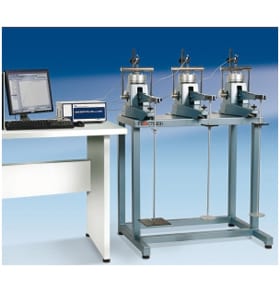
NG-Oedometer – Front-Loading Consolidation Oedometer

Soil Mechanics Testing Equipment
Standards
- AASHTO T 216
- ASTM D2435
- ASTM D3877
- ASTM D4546
- BS 1377-5
- NF P94-090-1
- NF P94-091
- UNE 103-405
- UNE 103-602
Description
The front loading oedometer determines the rate and magnitude of consolidation of a soil specimen restrained laterally and subjected to successive increments of vertical load. It is the classic consolidation frame: load is applied through a lever arm carrying dead weights.
The frame is rigid aluminium alloy, chosen so that it does not distort under load, because any deflection in the frame is read as settlement of the specimen. The lever arm assembly runs in precision self-aligning bearings and has three hanger positions giving ratios of 9:1, 10:1 and 11:1.
Fitted with linear potentiometric transducers, the oedometers connect to a data acquisition unit, so a mechanical frame still produces a digital record. It works to ASTM D2435 and BS 1377-5 among others.
Maximum Load4,074 lbs (1,848 kg) at 11:1
Stress on 20 cm²9.061 MPa
Lever Ratios9:1, 10:1, 11:1
Weight46 lbs (21 kg)
NG-Oedometer Main Features
A consolidation frame is judged on stiffness and on how little it asks of the operator between load steps.
Compact frame
A small footprint per position, which matters when a laboratory runs a bank of oedometers side by side.
Three lever ratios
Hanger positions for 9:1, 10:1 and 11:1, so the same weight set covers a wider range of stresses.
Screw jack support
Takes the load while the specimen and cell are being set up.
One cell for two tests
The same cell serves the standard consolidation test and the permeability test.
Digital record
Linear potentiometric transducers connect to the data acquisition and processing system.
Consolidation cells, dial gauge or displacement transducer, weight sets and bench are not included and are ordered separately.
NG-Oedometer Technical Specifications
The maximum load is quoted at the 11:1 ratio, on a 20 cm² specimen, which is the combination that produces the highest stress.
| Item | NG-Oedometer |
|---|---|
| Maximum loading at 11:1 beam ratio | 4,074 lbs (1,848 kg), corresponding to 9.061 MPa (92.40 kgf/cm²) on a 20 cm² specimen of 50.47 mm diameter |
| Lever arm ratios | 9:1, 10:1 and 11:1 |
| Overall dimensions, height less hanger × width × length | 19.7 × 7.9 × 29.5″ (500 × 200 × 750 mm) |
| Approximate weight | 46 lbs (21 kg) |
Weight Application Guide
Which weight set a laboratory needs depends on the cell, the beam ratio and the pressure the standard asks for. The guide below pairs them; an X marks the set used for that combination.
| Cell model | Area | Beam ratio | Max. pressure | Weight set 26-WF0230/C2 | Weight set 26-WF0230/D2 | Add. weight 8 × 27-WF0275/A | Total weight |
|---|---|---|---|---|---|---|---|
| WF0320 | 20 cm² | 1:10 | 71 lbs (32 kg)/cm² | X | — | — | 141 lbs (64 kg) |
| WF0320 | 20 cm² | 1:10 | 141 lbs (64 kg)/cm² | X | — | X | 282 lbs (128 kg) |
| WF0321 | 31.7 cm² | 1:11 | 44 lbs (20 kg)/cm² | X | — | — | 141 lbs (64 kg) |
| WF0321 | 31.7 cm² | 1:11 | 141 lbs (64 kg)/cm² | X | — | X | 282 lbs (128 kg) |
| WF0325 | 40 cm² | 1:10 | 35 lbs (16 kg)/cm² | X | — | — | 141 lbs (64 kg) |
| WF0325 | 40 cm² | 1:10 | 71 lbs (32 kg)/cm² | X | — | X | 282 lbs (128 kg) |
| WF0326 | 44.16 cm² | 1:9 | 35 lbs (16 kg)/cm² | — | X | — | 176 lbs (80 kg) |
| WF0326 | 44.16 cm² | 1:9 | 71 lbs (32 kg)/cm² | — | X | X | 353 lbs (160 kg) |
| WF0335 | 100 cm² | 1:10 | 18 lbs (8 kg)/cm² | — | X | — | 176 lbs (80 kg) |
| WF0335 | 100 cm² | 1:10 | 35 lbs (16 kg)/cm² | — | X | X | 353 lbs (160 kg) |
Where the loading steps themselves have to be automatic, that is the ACE computerized oedometer.
Have Questions or Need to Confirm a Detail?
Send us the specimen diameter and the maximum stress your standard calls for, and we will confirm the lever ratio, the cells and the weight set. A quick request online with those two numbers is enough.
For Laboratories
Need Additional Quality Control Equipment to Build Your Laboratory?
Consolidation testing is only one part of a complete quality control laboratory. NextGen can help you equip your entire lab with oedometers and consolidation systems, direct shear machines, triaxial systems, vane apparatus, moisture balances, and other supporting solutions, all coordinated as one complete project.
- One partner to equip your complete laboratory
- Installation, training, calibration
- Support for the life of the equipment
FAQs
The NG-Oedometer measures how far a soil specimen settles under load and how quickly it gets there. The specimen is restrained laterally in a consolidation cell and loaded vertically in successive increments, so it can only compress in one direction, much as a clay layer does beneath a wide foundation or an embankment.
Load comes from dead weights on a lever arm, the classic arrangement for a consolidation frame. Each increment stays in place while settlement is read against time, and the record gives both the magnitude of compression and the rate at which pore water drains out of the soil.
The frame works to ASTM D2435 and BS 1377-5, among other standards. Geotechnical engineers use the results to estimate how much a structure on clay will settle and how long that settlement will take to develop.
The NG-Oedometer applies up to 1,848 kg (4,074 lbs) to the specimen. That rating is quoted at the 11:1 beam ratio, the highest of the three positions on the lever arm.
On a 20 cm² specimen of 50.47 mm diameter, this load produces a vertical stress of 9.061 MPa, or 92.40 kgf/cm². It is the highest stress the frame reaches, because it combines the largest lever ratio with the smallest specimen area in the cell range.
A larger specimen sees a lower stress under the same force, since the load is spread over more area. Where a test schedule has to finish at high pressure, as it often does on stiff or heavily overconsolidated clays, the smaller cell is the one that carries the specimen past its preconsolidation pressure and well into the virgin compression range.
The lever arm has three hanger positions, giving beam ratios of 9:1, 10:1 and 11:1. The weight on the hanger is multiplied by the chosen ratio, so each kilogram on the hanger puts 9, 10 or 11 kilograms of force on the specimen.
Moving the hanger changes the applied stress without changing the weights. The same weight set therefore covers a wider band of stresses, which means fewer weights on the shelf and gives the operator a second way to reach an awkward increment.
The arm assembly runs in precision self-aligning bearings. Keeping the arm true on its pivot means the force reaching the specimen follows the weight times the ratio at the first light increment as well as at the last heavy one, which is what makes the stress at each step a known value.
Because any deflection in the frame would be read as settlement of the specimen. The transducer or dial gauge follows the movement of the loading cap, and it cannot tell whether that movement came from the soil compressing or from the frame bending under the load.
The NG-Oedometer frame is made of rigid aluminum alloy, chosen so that it does not distort under load. Late in each increment the settlement between readings is very small, often a few hundredths of a millimeter, so a stiff frame keeps the recorded curve a picture of the soil alone.
Stiffness matters across the whole schedule. A frame that stays square from the lightest increment to the heaviest gives readings that can be compared directly from one step to the next, and the compression curve of the soil is built from exactly those comparisons.
The weight application guide for the NG-Oedometer covers five cells: the WF0320 with a 20 cm² specimen area, the WF0321 at 31.7 cm², the WF0325 at 40 cm², the WF0326 at 44.16 cm² and the WF0335 at 100 cm². Cells are ordered separately, so a laboratory chooses the sizes its specimens need.
The cell area decides how high the stress can go. With the full weight combination in the guide, the 20 cm² cell reaches 64 kgf/cm², the 40 cm² and 44.16 cm² cells reach 32 kgf/cm², and the 100 cm² cell reaches 16 kgf/cm².
Small cells reach the highest stresses and suit stiff soils. The 100 cm² cell takes a larger specimen, which captures more of the fabric of a soft or fissured soil at lower stress. Other frames and consolidation equipment are in our oedometer range.
The weight set follows from the cell. The 20 cm², 31.7 cm² and 40 cm² cells use weight set 26-WF0230/C2, which totals 64 kg, while the 44.16 cm² and 100 cm² cells use weight set 26-WF0230/D2, which totals 80 kg.
For the higher pressures in the guide, eight additional weights, part 27-WF0275/A, are added to either set. They double the total to 128 kg with the C2 set and to 160 kg with the D2 set, and the maximum pressure on the specimen doubles with them.
The guide pairs each cell with a beam ratio as well: 10:1 for the 20 cm², 40 cm² and 100 cm² cells, 11:1 for the 31.7 cm² cell and 9:1 for the 44.16 cm² cell. The cell, the ratio and the weight set are therefore chosen together, and weight sets are ordered separately from the frame.
Fitted with linear potentiometric transducers, the NG-Oedometer connects to a data acquisition and processing system. The frame stays mechanical, with dead weights doing the loading, while settlement is captured as a digital record instead of a column of handwritten dial readings.
The record helps most in the first minutes of each increment, when settlement changes fastest and manual readings at short time intervals are hard to take. A logged curve of settlement against time is what the coefficient of consolidation is fitted from, by the log-time or square-root-of-time method.
A dial gauge suits laboratories that prefer manual readings, and either instrument is ordered separately from the frame. Where the loading steps themselves have to be automatic as well, we supply the ACE computerized oedometer.
Yes. On the NG-Oedometer the same cell serves the standard consolidation test and the permeability test, so one set of cells covers both methods on the frame.
Permeability of a consolidating clay is low and changes as the soil compresses. Running the permeability test in the consolidation cell puts it under a known vertical stress from the lever arm, so the result can be tied to the stress and void ratio of the soil at that stage, which is how it behaves in the ground.
Consolidation and permeability methods are grouped together in BS 1377-5, one of the standards the frame works to. The measured permeability sits naturally beside the consolidation results, since both describe how readily water leaves the soil under load.
The screw jack takes the load while the specimen and cell are being set up. With the jack carrying the lever arm, the operator can seat the cell, place the loading cap and zero the transducer or dial gauge before the specimen starts to compress.
Once everything is in place, lowering the jack transfers the load to the specimen in one controlled movement. The start of the increment is then clear on the time record, and that matters because the first readings of each step are taken within seconds of loading.
A consolidation frame is judged on stiffness and on how little it asks of the operator between load steps. The jack is part of that second quality: the arm is supported mechanically during setup, so the operator has both hands free for the cell and the instrument.
Each NG-Oedometer frame measures 500 × 200 × 750 mm (19.7 × 7.9 × 29.5″), height less hanger by width by length, and weighs about 21 kg (46 lbs). The narrow width is what sets the spacing when frames stand side by side.
Consolidation tests are slow. Under the common schedule in ASTM D2435 each increment stays on for about 24 hours, and a full loading and unloading sequence runs for a week or more, so laboratories run several frames at once rather than one test after another.
The compact frame keeps the footprint per position small, which lets a bank of oedometers fit along a standard laboratory bench. The bench is ordered separately, and our team can plan the layout together with the rest of your soil mechanics laboratory.
The frame is the loading unit, and four items are ordered with it: consolidation cells, a dial gauge or displacement transducer, a weight set and a bench. Keeping them separate lets a laboratory build each frame around its own specimens and reading method.
The cells follow from the specimen diameters in your standard or project specification. The weight set follows from the cells and from the highest pressure in the loading schedule, and the reading instrument depends on whether settlement is logged or read by hand.
Give us the specimen diameter and the highest stress you need through our online quote form, and our engineers will confirm the lever ratio and put the cells, weights and instruments into one offer for the frame.
Related Products
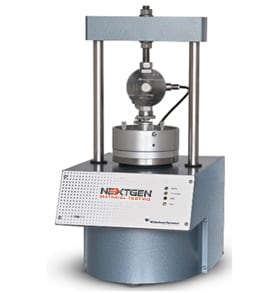
ACE - Automatic Computerized Oedometer
ACE is an automatic computerized oedometer for determining the rate and magnitude of soil consolidation under controlled vertical loading. Its compact load frame, dual pneumatic cylinders, high-precision servo-valve load control, and automated load or swelling modes improve repeatability and reduce operator intervention. The system supports geotechnical consolidation and swell testing workflows aligned with ASTM, AASHTO, NF, and UNE standards.
Read more