Plastic Testing Equipment
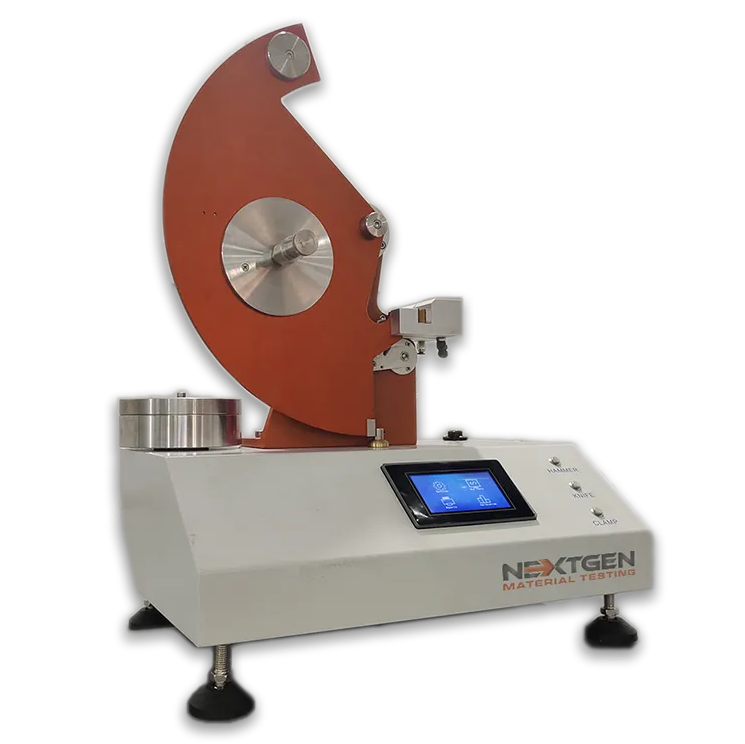
Plastic film and sheeting usually fail by tearing once a nick or a perforation starts, and tear resistance is the property that decides how far the tear runs. NextGen supplies Elmendorf pendulum testers for plastic film, sheeting, paper and textiles, working to ASTM D1922 and ISO 6383-2 for film and sheeting and ASTM D1424 for fabrics.
The range covers Elmendorf testers with interchangeable pendulums and a high-energy model with pneumatic clamping for tougher materials, both calculating tear force automatically. Testers are installed and calibrated on site, your team is trained on specimen cutting and pendulum selection, and support continues for the life of the instrument.
For Laboratories
One partner to equip your complete plastics laboratory
Tear testing is one station of a plastics laboratory. NextGen equips the rest of it too, from tensile and flexural testing to impact, melt flow, HDT and Vicat systems, and stays responsible for it after delivery.
- Equipment, fixtures and software
- Installation, training, calibration
- Lifetime technical support
GenElm Series – Elmendorf Tearing Tester
GenElm Series is an Elmendorf tearing tester for measuring tear resistance of plastic film, sheeting, textiles,…
View product
Get quote
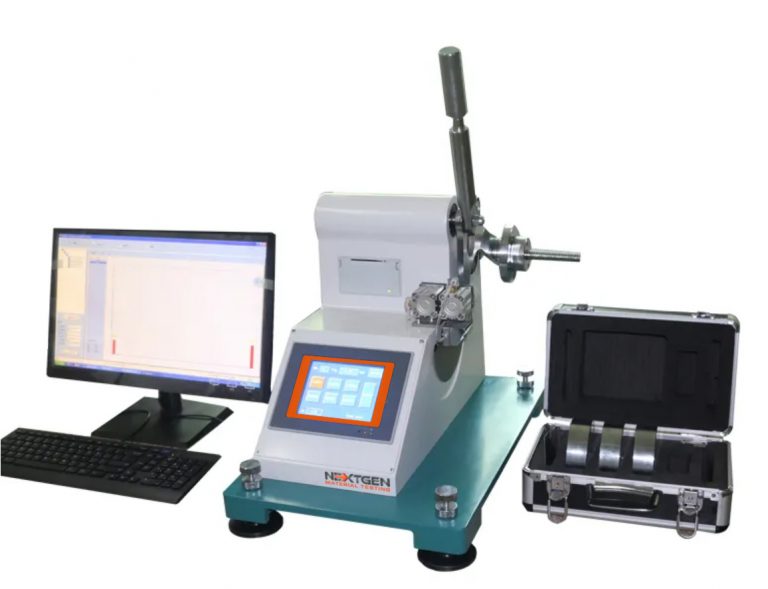 High-Energy Elmendorf Tearing Tester
NG-HE Elmendorf is a high-energy tearing strength tester for plastics, films, textiles, paper, and other flexible…
View product
Get quote
 GenElm Series – Elmendorf Tearing Tester
GenElm Series is an Elmendorf tearing tester for measuring tear resistance of plastic film, sheeting, textiles,…
Tear testing
 High-Energy Elmendorf Tearing Tester
NG-HE Elmendorf is a high-energy tearing strength tester for plastics, films, textiles, paper, and other flexible…
Tear testing
Nothing matches that filter. Show all products
FAQs
A falling pendulum continues a tear that a slit has started in a clamped specimen, which is the pendulum method of the Elmendorf test. The GenElm series clamps the specimen pneumatically and releases the pendulum automatically, so the start of each test is uniform, and it calculates and records results without manual processing.
Request a quote for the pendulum range your films need.
The 64 N model has pendulums of 16, 32 and 64 N and suits packaging films, textiles and paper products. The 128 N model adds a 128 N pendulum for tougher or more technical materials. The High-Energy Elmendorf also covers up to 128 N. All of them measure with an accuracy of ±0.2% of full scale.
ASTM D1922 covers propagation tear resistance of plastic film and thin sheeting, and ISO 6383-2 covers the Elmendorf method for plastics film and sheeting. The GenElm series also supports JIS K 7128-2 and NF T54 141 for film and sheeting, ASTM D1424 for fabrics and ASTM D689 for paper.
Plastic film and sheeting, and also paper, fabrics, nonwoven textiles, thin foils, electrical tape and metal foil. The GenElm clamps the specimen with a 7.0 mm gap, makes a 20 mm slit and tears it over 43 mm, and an automatic cutter prepares specimens with a consistent shape and size for repeatable results.
The GenElm series calculates the mean, minimum, maximum, standard deviation and coefficient of variation on the device. The high-energy tester lets you select N, cN, gf or lbf and converts automatically. The GenElm sends results to a PC or printer over RS232 and is supplied with inspection and calibration documents, and the high-energy tester prints reports and has transfer software for the computer.