Plastic Testing Equipment
Products
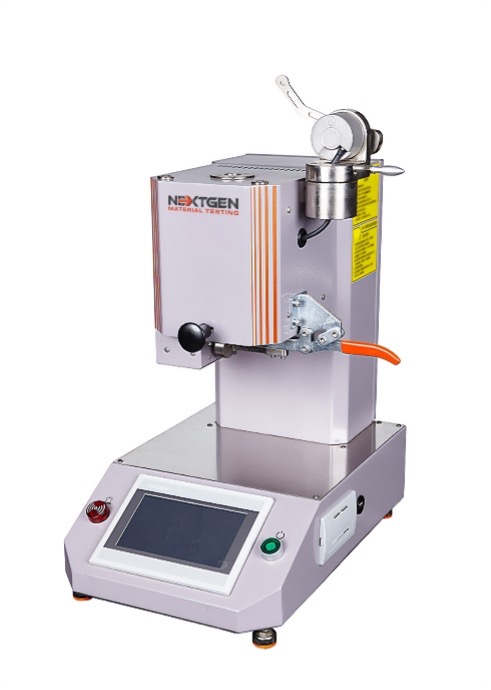
Melt flow rate tells a processor how a thermoplastic will behave in the extruder or the mold, and it is one of the most common checks on batch consistency and processability. NextGen supplies melt flow indexers that measure melt flow rate by mass and melt volume rate by volume, working to ASTM D1238 and ISO 1133.
The indexer controls the barrel temperature precisely, measures piston travel optically and cuts the extrudate automatically, so the operator loads the material and the instrument does the timing. Results are calculated and printed at the instrument. It is installed and calibrated on site, your team is trained on the method, and support continues for its life.
For Laboratories
One partner to equip your complete plastics laboratory
Melt flow testing is one station of a plastics laboratory. NextGen equips the rest of it too, from tensile and flexural testing to impact, HDT and Vicat systems, and stays responsible for it after delivery.
- Equipment, fixtures and software
- Installation, training, calibration
- Lifetime technical support
Nothing matches that filter. Show all products
FAQs
Report what your specification names. MFR is a mass result and MVR is a volume result, and both are covered by ASTM D1238 and ISO 1133. The indexer switches freely between the mass method and the volume method, and an optional encoder on the measuring rod records piston displacement for MVR tests.
Temperature runs from 50 to 450°C (122 to 842°F). Loads combine the 325 g piston with dead weights to give 1,200, 2,160, 3,800, 5,000, 10,000 and 21,600 g, and the 10 kg and 21.6 kg loads are optional. The measuring range is 0.1 to 2000 g/10 min.
Request a quote and we will confirm the weights and dies for your resin.
The standard die has a 2.095 mm bore and is 8 mm long, nitrided to at least 700 HV. Optional dies with 1.05 mm and 1.18 mm bores are available. A die plug on the side of the oven blocks the die outlet before the test begins, which prevents rapid sample loss on materials with high melt flow rates.
Temperature stability, piston load and cut timing. The barrel holds temperature within ±0.5°C over four hours, optical displacement measurement resolves piston travel to 0.003 mm, and timing resolves to 0.01 second while the automatic cutter cuts at set intervals. A preheating alarm tells the operator when to place the weights.
The melt flow indexer is designed for convenient cleaning, and a cleaning set comes with it: a barrel cleaning brush and rod, a die cleaning tool, a sample feeder and funnel, a scraper and a go/no-go gauge. A funnel-shaped mouth makes feeding straightforward, and a detachable die support plate reduces the risk of sample accumulation and jams.