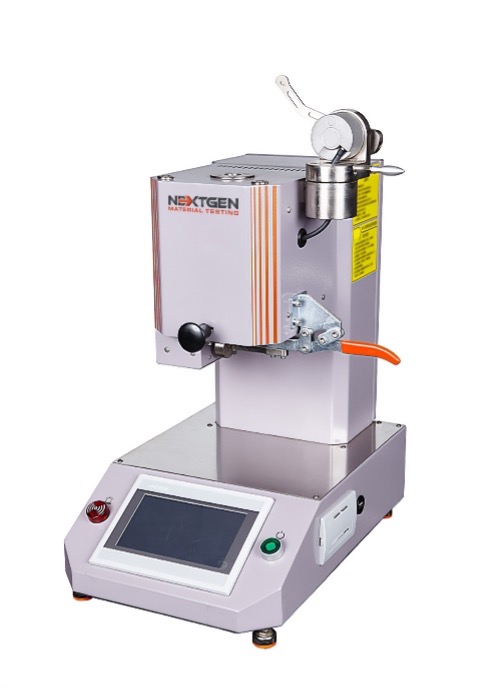
JIS K 7210 is a plastics test method used to measure melt flow performance of thermoplastics—commonly reported as melt mass-flow rate (MFR) and, where applicable, melt volume-flow rate (MVR). It is widely used for incoming material verification, production control, and comparing resin grades intended for extrusion or injection molding.
If you need help matching your resin type and test conditions to the correct JIS K 7210 part and configuration, contact our team for practical guidance before specifying equipment.
JIS K 7210: Plastics — determination of MFR and MVR of thermoplastics
JIS K 7210 defines standardized procedures for determining how a molten thermoplastic flows through a capillary die under controlled temperature and load using an extrusion plastometer (often called a melt flow indexer). Results are commonly used as a quick, repeatable indicator of processing consistency and batch-to-batch variation.
JIS K 7210 is organized as a multi-part standard, with separate parts addressing standard test conditions and additional handling for materials sensitive to time–temperature history and/or moisture.
Quick definition
What it measures: Melt flow behavior of thermoplastics as MFR (mass per time) and/or MVR (volume per time) under specified temperature and applied load.
Typical output: MFR reported in g/10 min; MVR reported in cm³/10 min (or equivalent), when that method is used.
Primary instrument: Extrusion plastometer / melt flow index tester with a heated barrel, die, and calibrated load system.
What This Standard Covers
JIS K 7210 covers procedures for loading a thermoplastic into a temperature-controlled barrel, applying a specified load, and measuring the extrudate flow rate through a standardized die.
Depending on the selected procedure, the test may be run as a “cut-and-weigh” method (mass-based MFR) and/or as a volume-flow method (MVR) using instrumented displacement measurement. The relevant part and method selection depend on the material behavior and the reporting requirement in the purchase specification.
Why This Standard Matters in Testing
Melt flow results are often used as a fast screening tool to confirm resin processability and consistency. In many manufacturing environments, MFR/MVR is tied to process windows (temperature, screw speed, back pressure) and to practical outcomes such as fill behavior, surface appearance, or dimensional stability.
Because melt flow is sensitive to test temperature, applied load, and material conditioning, matching the cited JIS K 7210 method to the exact requirement in the customer or internal specification is critical for meaningful comparisons.
Common Materials, Product Types, or Applications Covered
JIS K 7210 is primarily used for thermoplastic raw materials and compounds, such as pellet, granulate, or similar feedstock forms used in:
- Injection molding and extrusion resin qualification
- Incoming resin inspection and certificate-of-analysis checks
- Production lot release testing and process drift monitoring
- R&D comparisons of formulations, stabilizer packages, or recycled-content blends
It is most commonly specified for commodity and engineering thermoplastics where melt flow is used as a routine control metric.
Common Test or Verification Workflow
In practice, JIS K 7210 testing is typically run as a controlled, repeatable bench procedure with defined temperature, load, and timing.
Common workflow: Stabilize instrument temperature, charge the barrel with the sample, apply the specified load, allow the prescribed dwell/conditioning period, extrude through the die, collect extrudate by timed intervals or cut-off sequence, and calculate/report MFR (and MVR when required).
Lab caution: Materials that are moisture-sensitive or sensitive to residence time can show significant variation unless conditioning, handling, and timing are tightly controlled—this is a key reason the JIS K 7210 series includes a part focused on time–temperature history and/or moisture sensitivity.
Equipment Commonly Used for This Standard
JIS K 7210 most directly drives selection of a melt flow index test system and the accessories needed to control timing and measurement quality.
Common equipment: Melt flow index tester (extrusion plastometer), calibrated test weights/load set, die and piston, temperature control system, cut-off/cutting tool (manual or automatic), balance for mass measurements, and cleaning tools for barrel/die maintenance.
Common options that affect purchasing: Manual vs. automatic cut-off, encoder-based displacement measurement for MVR, integrated timing and reporting, test-condition libraries, and features that improve repeatability for sensitive materials (for example, tighter temperature stability and more controlled timing sequences).
If you are selecting an indexer configuration (manual vs. automated, MFR-only vs. MFR/MVR, reporting needs), you can request a detailed quote for a setup matched to your required test conditions and throughput.
How to Read This Designation or Revision
JIS melt flow requirements are commonly cited by the base designation plus a part number when applicable (for example, JIS K 7210-1 or JIS K 7210-2), and many specifications also include a publication year.
Revision sensitivity: For melt flow testing, the exact cited part/edition can affect procedural details (especially timing/conditioning and how sensitive materials are handled). When results must be comparable across suppliers or sites, align the cited part/edition and the specified temperature/load conditions in the same document set.
Related Standards, Methods, or Frameworks
Melt flow requirements are often referenced alongside other regional or international melt flow methods used for similar purposes in resin purchasing and QA documentation.
Commonly cross-referenced methods: ISO 1133 series (melt mass-flow rate and melt volume-flow rate) and ASTM D1238 (melt flow rates of thermoplastics by extrusion plastometer).
When documents reference more than one system (JIS/ISO/ASTM), confirm the test condition details—temperature, load, and method selection—rather than assuming direct interchangeability.
Talk with us about JIS K 7210 equipment and setup
For help choosing a melt flow index tester configuration, automation level, and reporting package that fits your JIS K 7210 requirement, talk with our team and share the material type plus the specified temperature and load conditions.