Laboratory Vane Apparatus

Soil Mechanics Testing Equipment
Standards





Description
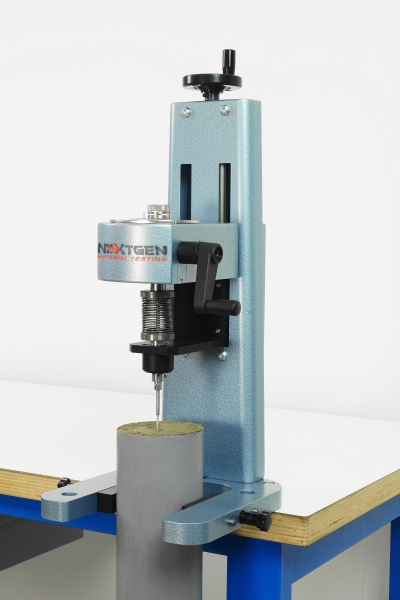
The laboratory vane apparatus measures the shear strength of soft soil quickly and directly, by rotating a cruciform vane in the specimen until the soil fails around it. The design follows an original concept of the Transport and Road Research Laboratory in the United Kingdom.
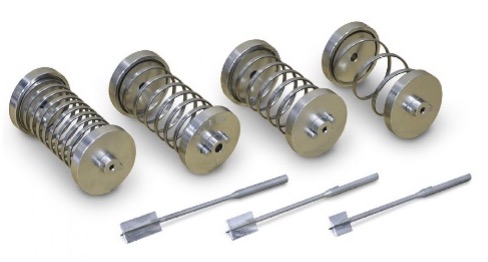
It is supplied with the standard 12.7 mm square vane and a set of four calibrated springs, so the range of the instrument is changed by changing the spring rather than the apparatus. Other vane sizes are available for softer or stiffer material.
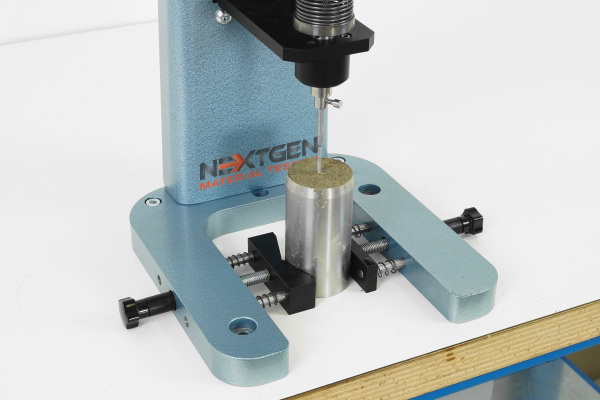
Testing is carried out either directly on the sample or inside the sampling tube. For the second case the NG-WF1738 attachment, for 38 and 3.9″ (100 mm) diameter sampling tubes, is recommended. The method follows ASTM D4648 and BS 1377-7.
Standard Vane12.7 × 12.7 mm
SpringsFour, calibrated
Weight24.25 lbs (11 kg)
Vane Apparatus Main Features
The instrument earns its place by being quick and portable, which is what a site laboratory needs from a strength measurement.
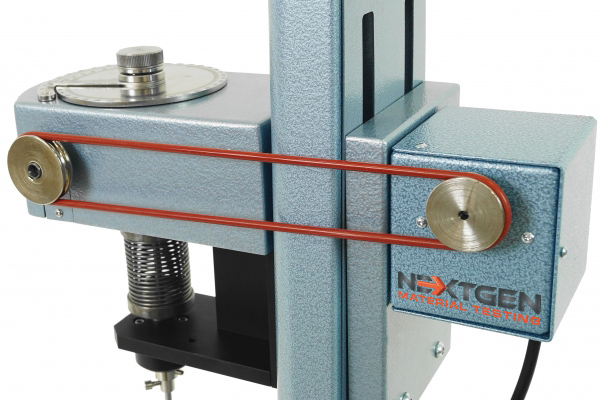
Manual or motorized
Both versions are available; the motorizing unit is supplied as accessories NG-WF1730/2, /3 and /4.
Portable
Lightweight and compact, suitable for site work as well as for the main laboratory.
Rapid method
A convenient and fast determination of the shear strength of soft soils.
Proven
Straightforward to use, with many hundreds of units in operation today.
Sample tubes up to 3.9″ (100 mm) are accommodated with a special attachment, and sample jars or special containers hold the specimen firmly during testing, which removes one of the common sources of error in the result.
Vane Apparatus Technical Specifications
A bench instrument that a technician can carry to a site in one hand.
| Item | NG-VaneApp |
|---|---|
| Standard configuration | Vane 12.7 × 12.7 mm, four calibrated springs with deflection and load |
| Dimensions (H × W × D) | 24.45 × 9.85 × 11.1″ (62 × 25 × 28 cm) |
| Approximate weight | 24.25 lbs (11 kg) |
Where the strength has to be measured on a defined shear plane rather than in situ, that is the job of a direct shear machine.
Have Questions or Need to Confirm a Detail?
Tell us the tube diameters you sample into and whether the work is on site or on the bench, and we will confirm the vane, the springs and the attachment. Send a quick request online.
For Laboratories
Need Additional Quality Control Equipment to Build Your Laboratory?
Vane shear testing is only one part of a complete quality control laboratory. NextGen can help you equip your entire lab with oedometers and consolidation systems, direct shear machines, triaxial systems, vane apparatus, moisture balances, and other supporting solutions, all coordinated as one complete project.
- One partner to equip your complete laboratory
- Installation, training, calibration
- Support for the life of the equipment
FAQs
The Laboratory Vane Apparatus has dimensions of 24.45 inches in height, 9.85 inches in width, and 11.1 inches in depth, or equivalently, 62 cm high, 25 cm wide, and 28 cm deep. These compact dimensions contribute to apparatus usability and portability. This allows it to be easily integrated into various testing setups, both in the field and in the laboratory.
The relatively small footprint of the Laboratory Vane Apparatus makes it ideal for use in locations with limited space, such as small laboratories or crowded project sites. Additionally, its compact size facilitates easy storage and transportation, increasing its convenience for geotechnical professionals who need to conduct tests at multiple locations or under varying environmental conditions. This size optimization means that despite its robust functionality, the apparatus remains a practical choice for diverse soil testing applications.
Click here to learn more about the product or here to receive a personalized quote.
The Laboratory Vane Apparatus is highly efficient and capable of conducting hundreds of operations in a day. This efficiency makes it an invaluable tool for projects requiring extensive soil testing within tight schedules. The apparatus's design allows for rapid setup and testing, which significantly speeds up the process of determining soft soil shear strength.
This capability is especially beneficial in large-scale geotechnical surveys or when multiple test sites are involved. The apparatus can quickly move from one testing point to another, providing immediate feedback on soil stability and properties. This quick testing ability ensures that engineers and researchers can make informed decisions promptly, facilitating faster project progression and helping to meet deadlines.
The Laboratory Vane Apparatus' capacity to perform numerous tests in a day without compromising accuracy or reliability underscores its role as a critical asset in soil testing, particularly in environments where understanding soil behavior under different conditions is a necessity for safety and compliance.
Click here to learn more about the product or here to receive a personalized quote.
The Laboratory Vane Apparatus offers great versatility in testing, as it can conduct evaluations either directly on the soil sample or within a sampling tube. Flexibility is essential for adapting to different testing conditions and requirements. Conducting tests directly on the sample is typically preferred for immediate assessments at the site, providing quick insights into the soil's shear strength which is particularly useful for onsite decision-making and evaluations.
Alternatively, using the sampling tube method allows for controlled testing conditions where samples can be preserved and transported to a laboratory for detailed analysis. This method is beneficial for comprehensive studies where maintaining sample integrity from the field to the lab is crucial. The ability to switch between these testing modes makes the Laboratory Vane Apparatus an invaluable tool for a broad range of applications, from preliminary field studies to detailed geotechnical research, ensuring that accurate and reliable shear strength measurements are available regardless of the testing environment.
Click here to learn more about the product or here to receive a personalized quote.
The Laboratory Vane Apparatus is specifically designed to offer a convenient and rapid method for determining the shear strength of soft soils, making it a valuable tool in geotechnical engineering and soil science. This convenience stems from the apparatus' straightforward operational design. This allows for quick setup and immediate testing on-site or within a controlled laboratory environment.
The apparatus uses a vane inserted into the soil, either directly or through a sampling tube, to measure the torque required to shear the soil at a certain depth. This method is particularly efficient because it directly assesses soil shear strength without extensive sample preparation or complex procedures. The testing process is quick, often taking only minutes to complete, which is ideal for projects with tight schedules or when multiple soil tests are required.
Furthermore, the Laboratory Vane Apparatus' ability to quickly provide accurate measurements of shear strength makes it an indispensable tool for assessing soil stability. It is also indispensable for evaluating landslide risks and planning construction projects in soft soil areas.
Click here to learn more about the product or here to receive a personalized quote.
What attachment is available for accommodating larger sample tubes in the Laboratory Vane Apparatus?
For testing larger soil samples, the Laboratory Vane Apparatus can be equipped with a special attachment designed to accommodate sample tubes with dimensions up to 100 mm. With this attachment, it is possible to securely and effectively test the shear strength of larger diameter tubes, which are commonly used for gathering soil samples from varying depths and are commonly used for soil sampling from multiple locations.
The availability of this attachment increases the flexibility and applicability of the Laboratory Vane Apparatus, making it possible to analyze many kinds of soil types and conditions. This is especially useful for projects that require detailed soil profile analysis across different geological layers. Through the use of this attachment, the apparatus is capable of providing accurate and reliable results in a wide range of geotechnical testing situations, so that it remains a valuable and adaptable tool for geotechnical testing.
Click here to learn more about the product or here to receive a personalized quote.
Yes, a motorized unit is available as an optional accessory for the Laboratory Vane Apparatus, optimizing its functionality and efficiency in conducting shear strength tests. The available motorized units are accessories NG-WF1730/2, NG-WF1730/3, and NG-WF1730/4. Each unit is designed to fit seamlessly into the apparatus, providing automated operations that facilitate consistent and precise measurements.
The integration of a motorized unit allows for the automation of the vane rotation process, providing uniform test speeds and accurate torque application, which are important for reliable results. This automation is particularly valuable in reducing operator fatigue and error, especially during extensive testing sessions or when high accuracy is required. The motorized units simplify the testing process and enhance reproducibility, making them indispensable for laboratories and field operations seeking to uphold stringent testing standards and improve overall workflow efficiency.
Click here to learn more about the product or here to receive a personalized quote.
The Laboratory Vane Apparatus offers many advantages due to its lightweight, compact, and portable design. This design makes it an ideal tool for both on-site testing and use in a main laboratory setting, providing flexibility and ease of transport. Being lightweight and compact allows users to easily move the apparatus between different testing sites or within different areas of a laboratory, enhancing operational efficiency.
For field applications, portability is extremely valuable, as it facilitates quick setup and testing at remote locations or in environments where access might be restricted. This enables immediate assessment of soil properties on construction sites, in environmental studies, or during geological surveys, providing important data without the delay of transporting samples back to a central lab.
In a laboratory setting, the compact size of the apparatus means that it does not require excessive space, making it suitable for use in facilities with limited room. Its portability also allows for flexible lab organization and adaptation of the workspace according to specific projects or testing requirements.
Click here to learn more about the product or here to receive a personalized quote.
Yes, the Laboratory Vane Apparatus is available in both manual and motorized versions, catering to different testing preferences and requirements. The manual version allows for hands-on control during testing, which is ideal for applications where direct manipulation is preferred or where simplicity and cost-effectiveness are prioritized. This version requires the operator to manually rotate the vane, which is suitable for smaller-scale or less frequent testing scenarios.
On the other hand, the motorized version offers automated vane rotation control, thereby improving test consistency and repeatability. This version is particularly beneficial for larger projects or continuous and uniform testing. The motorized apparatus provides precise control over speed and torque, leading to more accurate and reliable results. Having both options available makes the Laboratory Vane Apparatus highly versatile, allowing it to be adapted to a broad spectrum of geotechnical testing environments and user preferences.
Click here to learn more about the product or here to receive a personalized quote.
For optimal performance when using the Laboratory Vane Apparatus to test within sampling tubes, the NG-WF1738 Attachment is highly recommended. This attachment is specifically designed to accommodate sampling tubes with diameters of 38 mm and 100 mm, providing a secure and precise fit for the apparatus during testing.
The NG-WF1738 Attachment facilitates accurate alignment and stable insertion of the vane into the sampling tube, which is crucial for reliable shear strength measurements. By stabilizing the apparatus and minimizing any potential movement or misalignment during the test, this attachment improves the accuracy and repeatability of the results. It is a key component for geotechnical professionals who require precise data from their soil samples, particularly when these samples are obtained at depths or at locations where direct testing is not feasible. Using this attachment ensures that the Laboratory Vane Apparatus performs at its best, delivering accurate and precise measurements crucial for soil stability assessments and other related studies.
Click here to learn more about the product or here to receive a personalized quote.
The Laboratory Vane Apparatus has an approximate weight of 24.25 pounds or about 11 kilograms. This lightweight design contributes significantly to the apparatus's portability and ease of use in various testing environments. Being relatively light allows it to be easily transported between different test sites or moved around in a laboratory setting without requiring extensive manpower or special equipment.
This manageable weight means that the apparatus can be quickly set up and used on-site, facilitating immediate testing and analysis. This is beneficial in field applications where testing needs to be conducted at multiple locations or in situations where quick response times are critical. The lightweight nature of the Laboratory Vane Apparatus makes it an ideal choice for geotechnical professionals who require a dependable and easily transportable tool for conducting soil shear strength tests.
Click here to learn more about the product or here to receive a personalized quote.
The design of the Laboratory Vane Apparatus is based on an original concept developed by the Transport and Road Research Laboratory of the United Kingdom. This foundational concept has shaped the apparatus to be a reliable tool for measuring soil shear strength, particularly in soft soil conditions. The original design has been refined and adapted over the years to increase its accuracy and versatility, making it a staple in both geotechnical field studies and laboratory testing.
The apparatus's ability to test soil directly or within sampling tubes adds to its practicality, allowing flexible testing scenarios. This design is instrumental in providing accurate assessments of soil stability, which are essential for planning and executing construction projects, analyzing soil subsidence, and conducting environmental impact assessments. The apparatus's design makes sure that it not only meets the technical needs of engineers and researchers but also meets established standards, providing dependable and precise results.
Click here to learn more about the product or here to receive a personalized quote.
Yes, the Laboratory Vane Apparatus is designed to comply with BS 1377:7, which outlines the methods for determining soil shear strength using a vane test. This standard is necessary for assessing soil mechanical properties, particularly their ability to resist shearing under direct strain. Compliance with BS 1377:7 means that the Laboratory Vane Apparatus can accurately measure the shear strength of soft soils, an important aspect of geotechnical engineering.
Based on this standard, the apparatus provides reliable and consistent results, making it a valuable tool in both field and laboratory settings. It is especially useful in applications such as site assessment for foundation design, landslide risk evaluation, and other soil stability analyses. Having a variety of vane sizes and an option for a motorized unit further expands the capabilities of the apparatus, allowing it to accommodate a wide range of testing requirements while maintaining compliance with strict industry standards.
Click here to learn more about the product or here to receive a personalized quote.
Yes, sample jars and special containers are available as optional accessories for the Laboratory Vane Apparatus. These accessories are designed to firmly hold the soil specimen during testing, which is important for maintaining the integrity and stability of the sample. By securing the specimen in place, these jars and containers help eliminate potential errors in accuracy that can occur due to sample movement or displacement under the forces applied during the shear strength testing process.
The availability of these containers guarantees that the Laboratory Vane Apparatus can provide highly reliable and accurate test results. They are especially useful in cases where soil samples are prone to disturbance or where precision is critical. The use of these jars and containers allows researchers and engineers to conduct tests with enhanced confidence in the consistency and repeatability of their data, making the Laboratory Vane Apparatus a more useful tool.
Click here to learn more about the product or here to receive a personalized quote.
Yes, the Laboratory Vane Apparatus is designed to meet the requirements of ASTM D4648, which is the standard test method for determining soil shear strength by the vane shear test. Using either manual or motorized vane apparatuses, this standard is necessary for testing the shear strength of cohesive soils in a laboratory setting.
Compliance with ASTM D4648 means that the Laboratory Vane Apparatus can accurately measure soil shear strength properties, which is crucial for geotechnical engineering applications such as evaluating soil stability and understanding soil behavior under various load conditions. The apparatus's capability to comply with this standard guarantees reliable and consistent results, making it a valuable tool for soil testing in both research and practical engineering projects. By following the procedures outlined in ASTM D4648, users can guarantee that their testing aligns with internationally recognized methods.
Click here to learn more about the product or here to receive a personalized quote.
The Laboratory Vane Apparatus, model NG-VaneApp, comes equipped with standard configurations that ensure precision and reliability in measuring soil shear strength. The apparatus includes a vane measuring 12.7 mm x 12.7 mm, which is a critical component for directly inserting into the soil to determine shear strength accurately.
In addition to the vane, the apparatus is equipped with four calibrated springs to measure deflection and load. These springs are crucial for accurately gauging the torque applied to the vane as it rotates within the soil, which directly correlates with the soil's shear strength. The calibration of the springs guarantees precise and consistent measurements, providing reliable data for geotechnical analysis.
These standard configurations make the Laboratory Vane Apparatus a robust tool for conducting shear strength tests on soft soils, offering a straightforward and effective method for geotechnical professionals to assess soil properties in different environments.
Click here to learn more about the product or here to receive a personalized quote.
Related Products
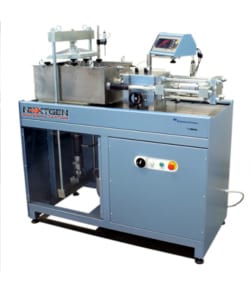
Shearmatic 300 - Large Shear Testing Machine
Shearmatic 300 is a large automatic shear testing machine for soils, geosynthetics, industrial slag, shale, brick rubble, and materials containing large particles. It accepts samples up to 300 mm square, applies 100 kN shear and vertical force, and supports ASTM D3080, ASTM D6243, BS 1377-7, EN ISO 12957, and ASTM D5321 workflows for representative shear-strength and interface-friction evaluation.
Read more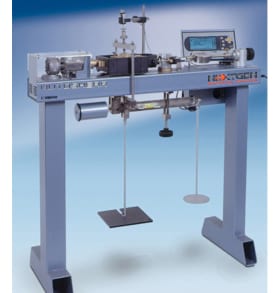
Automatic Shear Testing Machine
The Automatic Shear Testing Machine, also known as NG-Shear DGEN, is built for direct shear testing of soil under consolidated drained conditions. It automates test running from consolidation to failure, helping reduce manual intervention while maintaining controlled speed. NF P94-071 compliance, closed-loop control, automatic operation, and geotechnical-focused design support soil stability assessment for foundations, slopes, embankments, and retaining structures.
Read more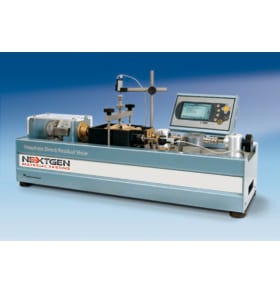
Shearmatic - Automatic Shear Testing Machine
Shearmatic is an automatic shear testing machine for soil laboratories performing direct and residual shear tests. Its microprocessor control manages the stepper motor, axial pressure, force, displacement, safety system, and test stages through a closed-loop setup. Automatic pneumatic consolidation steps, no dead weights, 5 kN horizontal force, 8 kN vertical force, programmable speeds, RS-232 output, and high-resolution transducers improve repeatability.
Read more