Soil Mechanics Testing Equipment
Shear strength is the parameter that stability and bearing calculations rest on, and soil laboratories measure it in two main ways. Direct shear fails a specimen along a single plane in a box while a normal load is held, and it remains the most common strength test in a soil laboratory. It follows ASTM D3080 for consolidated drained conditions, with BS 1377-7 and AASHTO T 236 as related references. The laboratory vane takes a different route: a cruciform vane rotates in the specimen until the soil fails around it, which gives a quick undrained strength figure for soft, saturated fine-grained soil under ASTM D4648.
Bench machines run the test under microprocessor control with closed loop speed control up to 11 mm/min, and they record force and displacement throughout. Some apply the normal load with dead weights on a lever, and others use a pneumatic closed loop so that consolidation steps and shearing run as one unattended sequence. A large floor-standing machine takes coarse material and geosynthetic interfaces on samples up to 300 mm square. The vane apparatus is portable and suits site work as well as the main laboratory. Machines are installed and calibrated by NextGen engineers, operators are trained, and support continues for the life of the equipment.
For Laboratories
One partner to equip your complete soil mechanics laboratory
Soil testing rarely stops at one machine. NextGen equips the whole geotechnical laboratory, from consolidation and shear testing to triaxial systems, vane apparatus and moisture determination, and stays responsible for it after delivery.
- Equipment, fixtures and software
- Installation, training, calibration
- Lifetime technical support
5 kN
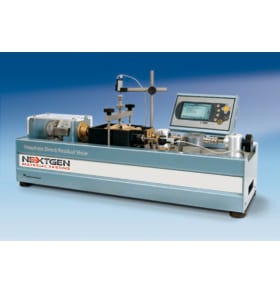
Shearmatic - Automatic Shear Testing Machine
Shearmatic is an automatic shear testing machine for soil laboratories performing direct and residual shear tests.
View product
Get quote
Most requested
 5000 N
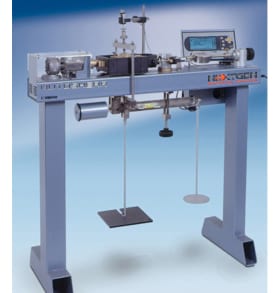
Automatic Shear Testing Machine
The Automatic Shear Testing Machine, also known as NG-Shear DGEN, is built for direct shear testing of soil under…
View product
Get quote
Most requested
5000 N
Automatic Shear Testing Machine
The Automatic Shear Testing Machine, also known as NG-Shear DGEN, is built for direct shear testing of soil under…
View product
Get quote
Most requested
 100 kN
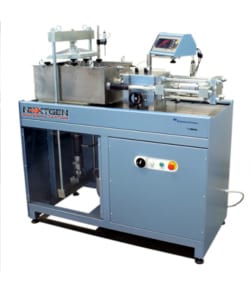
Shearmatic 300 - Large Shear Testing Machine
Shearmatic 300 is a large automatic shear testing machine for soils, geosynthetics, industrial slag, shale, brick…
View product
Get quote
Most requested
100 kN
Shearmatic 300 - Large Shear Testing Machine
Shearmatic 300 is a large automatic shear testing machine for soils, geosynthetics, industrial slag, shale, brick…
View product
Get quote
Most requested
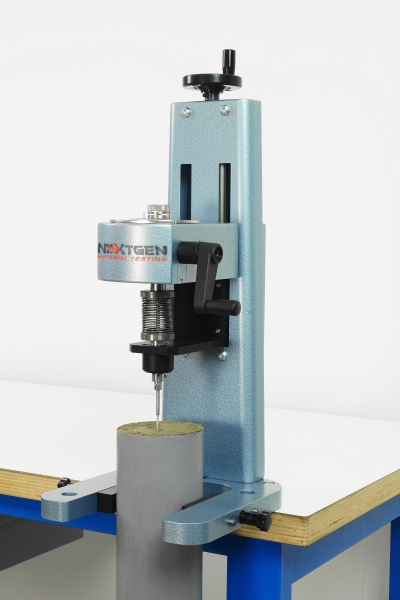 Laboratory Vane Apparatus
The Laboratory Vane Apparatus measures undrained shear strength of soft cohesive soils directly in a sample or…
View product
Get quote
Shearmatic - Automatic Shear Testing Machine5 kN
Shearmatic is an automatic shear testing machine for soil laboratories performing direct and residual shear tests.
Direct shear testing
Automatic Shear Testing Machine5000 N
The Automatic Shear Testing Machine, also known as NG-Shear DGEN, is built for direct shear testing of soil under…
Direct shear testing
Shearmatic 300 - Large Shear Testing Machine100 kN
Shearmatic 300 is a large automatic shear testing machine for soils, geosynthetics, industrial slag, shale, brick…
Direct shear testing
Laboratory Vane Apparatus
The Laboratory Vane Apparatus measures undrained shear strength of soft cohesive soils directly in a sample or…
View product
Get quote
Shearmatic - Automatic Shear Testing Machine5 kN
Shearmatic is an automatic shear testing machine for soil laboratories performing direct and residual shear tests.
Direct shear testing
Automatic Shear Testing Machine5000 N
The Automatic Shear Testing Machine, also known as NG-Shear DGEN, is built for direct shear testing of soil under…
Direct shear testing
Shearmatic 300 - Large Shear Testing Machine100 kN
Shearmatic 300 is a large automatic shear testing machine for soils, geosynthetics, industrial slag, shale, brick…
Direct shear testing
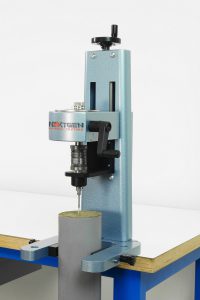 Laboratory Vane Apparatus
The Laboratory Vane Apparatus measures undrained shear strength of soft cohesive soils directly in a sample or…
Vane shear testing
Laboratory Vane Apparatus
The Laboratory Vane Apparatus measures undrained shear strength of soft cohesive soils directly in a sample or…
Vane shear testing
Nothing matches that filter. Show all products
FAQs
Start with the specimen. The two bench machines cover 60 and 100 mm laboratory specimens, while the Shearmatic 300 takes samples up to 300 mm square, reducible to 150 mm, for coarse or non-uniform material. Between the bench machines, the Shearmatic removes dead weights and runs consolidation steps automatically, and the NG-Shear DGEN uses dead weights on a lever. Tell us the material, the largest particle and the standard, and we will confirm the box and inserts.
The Shearmatic 300 is the machine for it. Its page lists ASTM D5321 and EN ISO 12957 for interfaces between soil and geosynthetics; its product page also lists ASTM D6243, the method for geosynthetic clay liners. The 300 mm sample size gives a more representative result on non-uniform material and is the practical way to measure the friction angle between two materials.
The vane apparatus measures the shear strength of soft soil by rotating a cruciform vane until the soil fails. It comes with a standard 12.7 mm square vane and four calibrated springs, and other vane sizes are available. Testing can be done directly on the sample or inside the sampling tube using an attachment. It weighs about 11 kg, runs manually or motorized, and follows ASTM D4648 and BS 1377-7.
The Shearmatic does: its pneumatic closed loop applies the axial pressure, and it needs a supply of up to 10 bar, with a working pressure of up to 8 bar. The NG-Shear DGEN applies vertical load with dead weights on a lever, and the Shearmatic 300 applies its consolidation steps hydraulically. Check which loading system suits the services your laboratory already has before choosing between them.
Yes. The NG-Shear DGEN and the Shearmatic 300 can be set to different speeds and travel, forward and reverse, for residual shear, and the Shearmatic runs direct and residual shear tests with up to 10 forward and reverse cycles. Data is downloaded over the RS 232 port into the direct and residual shear Geo-Analysis templates, so both results are reported from the same machine. Ask for the Shearmatic details if you report both.