Soil Mechanics Testing Equipment
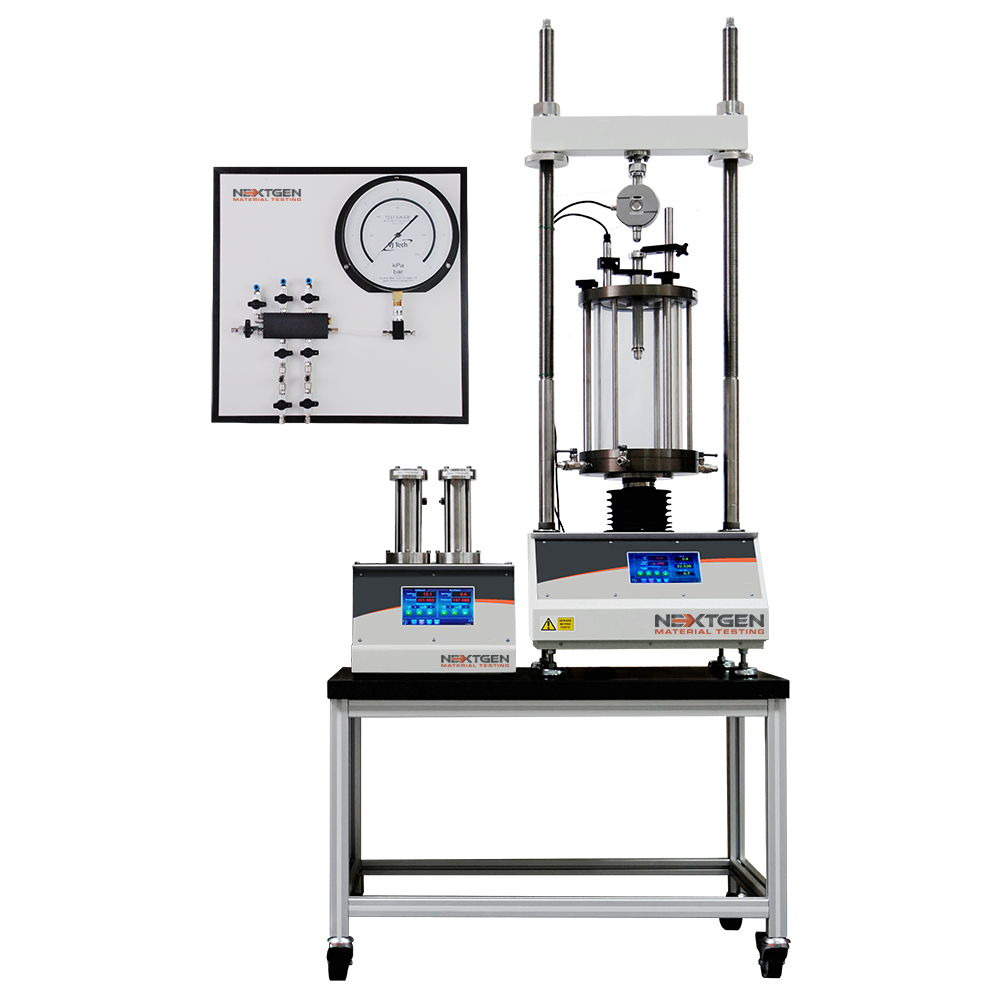
A triaxial test loads a cylindrical soil specimen axially while fluid pressure confines it in a cell, so drainage, pore pressure and stress path can be controlled in a way a shear box cannot. The drainage condition decides the method. ASTM D4767 covers consolidated undrained compression with pore pressure measurement, ASTM D2850 the unconsolidated undrained test and ASTM D7181 the consolidated drained test. Where the question is behavior under repeated loading, such as earthquake response, traffic loading or machine foundations, load-controlled cyclic testing to ASTM D5311 applies. Results are reported in total stress or, when pore pressure is measured, in effective stress, and intact, compacted and reconstituted specimens can all be tested.
The systems here are configured around the work rather than sold as one fixed machine. Specimen diameters, load capacity and cell pressure are chosen to suit the soil, and cells can be fitted with internal load cells, pore pressure transducers and local strain sensors. Pressure controllers regulate cell pressure and back pressure, and software handles saturation, consolidation, stress path and cyclic stages, with live results and reports on a PC. Static systems are built to be left to run through a long test, and dynamic systems hold a commanded waveform cycle after cycle. Installation, calibration and training are provided by NextGen engineers.
For Laboratories
One partner to equip your complete soil mechanics laboratory
Soil testing rarely stops at one machine. NextGen equips the whole geotechnical laboratory, from consolidation and shear testing to triaxial systems, vane apparatus and moisture determination, and stays responsible for it after delivery.
- Equipment, fixtures and software
- Installation, training, calibration
- Lifetime technical support
Most requested
 500 kN
Automatic Triaxial Testing System
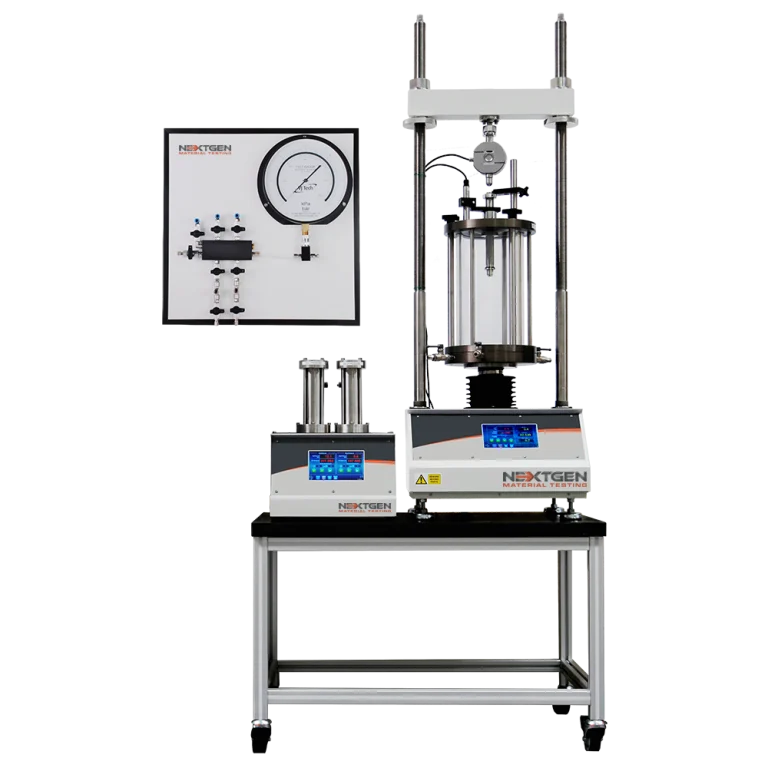
The Automatic Triaxial Testing System is designed for fully automated total and effective stress testing of soil…
View product
Get quote
500 kN
Automatic Triaxial Testing System
The Automatic Triaxial Testing System is designed for fully automated total and effective stress testing of soil…
View product
Get quote
 Dynamic Triaxial Testing System
Dynamic Triaxial Systems 1000 kPa are designed for advanced soil testing under controlled cyclic and dynamic loading…
View product
Get quote
Dynamic Triaxial Testing System
Dynamic Triaxial Systems 1000 kPa are designed for advanced soil testing under controlled cyclic and dynamic loading…
View product
Get quote
500 kN
Automatic Triaxial Testing System
The Automatic Triaxial Testing System is designed for fully automated total and effective stress testing of soil…
View product
Get quote
Dynamic Triaxial Testing System
Dynamic Triaxial Systems 1000 kPa are designed for advanced soil testing under controlled cyclic and dynamic loading…
View product
Get quote
 Automatic Triaxial Testing System500 kN
The Automatic Triaxial Testing System is designed for fully automated total and effective stress testing of soil…
Triaxial testing
Automatic Triaxial Testing System500 kN
The Automatic Triaxial Testing System is designed for fully automated total and effective stress testing of soil…
Triaxial testing
 Dynamic Triaxial Testing System
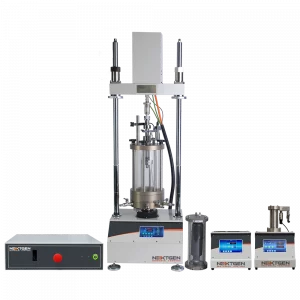
Dynamic Triaxial Systems 1000 kPa are designed for advanced soil testing under controlled cyclic and dynamic loading…
Triaxial testing
Dynamic Triaxial Testing System
Dynamic Triaxial Systems 1000 kPa are designed for advanced soil testing under controlled cyclic and dynamic loading…
Triaxial testing
Nothing matches that filter. Show all products
FAQs
It depends on the drainage the soil will see in service. ASTM D2850 is the UU test, with no drainage and a total stress result, often used for short-term loading. ASTM D4767 is the CU test, which consolidates first and measures pore pressure, so effective stress parameters can be derived. ASTM D7181 is the CD test, sheared slowly enough to drain, for long-term or slow loading. The automatic system covers all three.
The automatic system answers questions about strength and consolidation: CD, CU and UU tests, stress path and slow cyclic testing up to 0.1 Hz depending on amplitude. The dynamic system answers questions about repeated loading, from 5 kN at 5 Hz to 50 kN at 20 Hz, with displacement of plus or minus 35 mm and waveforms such as sinusoidal, haversine and user defined. Frequency and load capacity are chosen together: the higher the force, the lower the frequency.
Both systems list specimen diameters from 35 mm up to 300 mm, including 38, 50, 63.5, 70, 75, 100 and 150 mm, and other sizes are available on request. The specimen size also decides the load frame and the cell pressure range, so they are ordered as a set. Tell us your diameters and the highest cell pressure your work needs, and we will configure the automatic system around them.
External load cells of 5, 10, 20 or 50 kN serve standard UU, CIU and CID tests. Internal submersible load cells are required for anisotropic and K0 consolidation and for extension tests. Pore water pressure uses external transducers with a de-airing block, or internal transducers at mid-height on the sample. A transducer access ring, interchangeable top caps and base pedestals and a de-aired water tank complete the set. The list is chosen with the order.
Both systems run on Clisp Studio. On the automatic system it handles test setup and monitoring, real-time display of results, post-test analysis and export of detailed reports, over USB or Ethernet to a PC. On the dynamic system it covers saturation, isotropic, anisotropic and K0 consolidation, static loading, stress path and cyclic shear. The automatic system can also run standalone from its touchscreen, with data exported to a PC.