Cement & Concrete Testing Equipment
How fast cement hydrates, and how quickly it gains early strength, depends on how finely it has been ground. The Blaine air permeability method puts a number on that fineness by timing airflow through a packed bed of powder and reporting it as specific surface area. NextGen supplies digital and automatic Blaine apparatus for cement works, precast plants and construction laboratories, working to EN 196-6 and ASTM C204.
The digital apparatus keeps the classical procedure with an electronic reading, while the automatic version handles fluid aspiration, timing and K constant calibration on its own, which takes operator judgement out of the result. Both are installed and calibrated by our engineers, your team is trained on the procedure, and support continues for the life of the instrument.
For Laboratories
One partner to equip your complete concrete laboratory
Fineness testing is one station of a cement laboratory. NextGen equips the rest of it too, from mortar mixers and curing cabinets to Vicat setting time and autoclave testing, and stays responsible for it after delivery.
- Equipment, fixtures and software
- Installation, training, calibration
- Lifetime technical support
Most requested
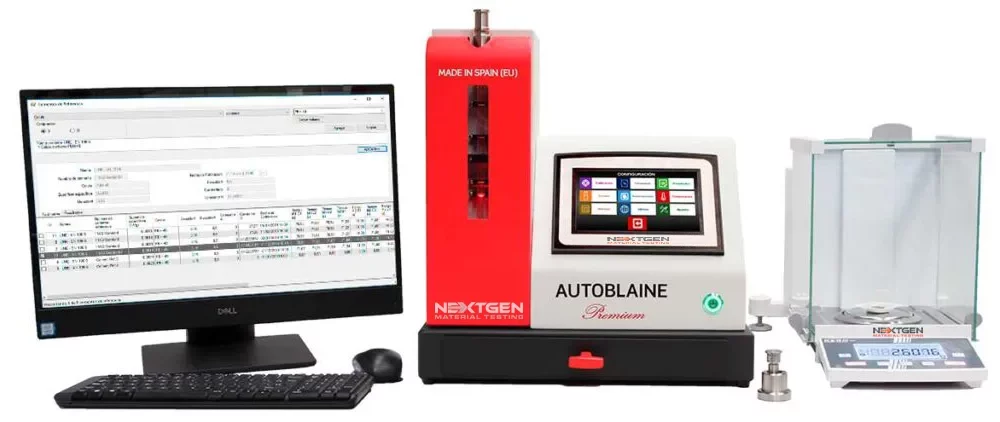
 BlaineGen Plus – Automatic Blaine Apparatus
BlaineGen Plus is an automated Blaine apparatus for determining cement fineness by the air permeability method.
View product
Get quote
BlaineGen Plus – Automatic Blaine Apparatus
BlaineGen Plus is an automated Blaine apparatus for determining cement fineness by the air permeability method.
View product
Get quote
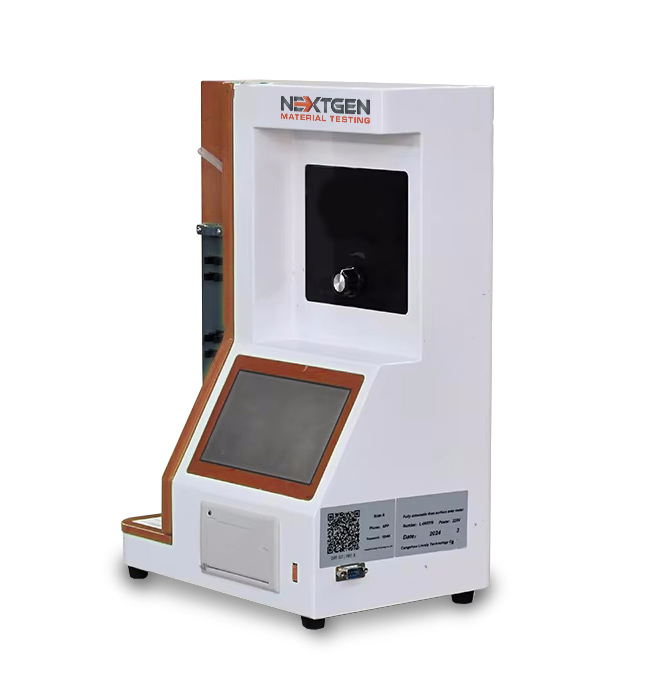 BlaineGen Classic – Digital Blaine Apparatus
BlaineGen Classic is a digital Blaine apparatus for measuring cement, lime, and powder fineness by the air…
View product
Get quote
BlaineGen Classic – Digital Blaine Apparatus
BlaineGen Classic is a digital Blaine apparatus for measuring cement, lime, and powder fineness by the air…
View product
Get quote
BlaineGen Plus – Automatic Blaine Apparatus
BlaineGen Plus is an automated Blaine apparatus for determining cement fineness by the air permeability method.
View product
Get quote
BlaineGen Classic – Digital Blaine Apparatus
BlaineGen Classic is a digital Blaine apparatus for measuring cement, lime, and powder fineness by the air…
View product
Get quote
 BlaineGen Plus – Automatic Blaine Apparatus
BlaineGen Plus is an automated Blaine apparatus for determining cement fineness by the air permeability method.
Fineness testing
BlaineGen Plus – Automatic Blaine Apparatus
BlaineGen Plus is an automated Blaine apparatus for determining cement fineness by the air permeability method.
Fineness testing
 BlaineGen Classic – Digital Blaine Apparatus
BlaineGen Classic is a digital Blaine apparatus for measuring cement, lime, and powder fineness by the air…
Fineness testing
BlaineGen Classic – Digital Blaine Apparatus
BlaineGen Classic is a digital Blaine apparatus for measuring cement, lime, and powder fineness by the air…
Fineness testing
Nothing matches that filter. Show all products
FAQs
Cement is compacted in a permeability cell to a bed of defined porosity, and a fixed volume of air is drawn through it. The time the air takes to pass between two reference levels, or the resistance to flow, gives the specific surface in m2/kg or cm2/g. The method follows EN 196-6 and ASTM C204, with a manual reference method and a qualified automatic option. Plant labs use the number to control milling uniformity.
Yes. The Blaine method is used for the fineness of cement and of other powdery products, expressed as specific surface. The BlaineGen Classic applies it to Portland cement, lime and similar powders, and the BlaineGenPLUS states the same principle for the particle size of other powder materials. The BlaineGenPLUS stores up to 20 cement types, each with its own calculation method, and up to 5 Blaine cells.
The Plus is automatic: it aspirates the fluid, times the fall with optical sensors to 0.01 s, calculates the K constant and stores up to 1,000 tests, with PC export through USB. The Classic is digital, with air transit time recorded electronically over 0.1 s to 500 s, conventional cell handling and a fixed calculation routine. Choose the Classic for routine determinations in a smaller laboratory and the Plus for throughput and records.
Yes. Air permeability is temperature dependent, and the standards assume a stable environment. The BlaineGenPLUS measures temperature to 0.1 °C, warns when the probe reading falls outside the range the standard sets, and gives best results in a controlled-temperature room. The BlaineGen Classic lists an operating range of 8 to 34 °C (46 to 93 °F) and asks for a stable temperature with no strong draughts around the instrument.
The BlaineGenPLUS ships as a complete bench: a glass U-shaped manometric tube, a stainless steel Blaine cell with plunger, perforated disc and a certificate of volume, a cell support, an extractor, 50 mL of manometric liquid, 1,000 filter papers, tools and a funnel, three 5 g reference Portland cements and a calibration certificate against NIST standard Portland cement. Spare filter discs, cells and the reference material are reordered by reference number.