GenRebound – Vertical Rebound Resilience Tester

Rubber Testing Equipment
Standards





Description
Resilience is how much of a drop’s energy a material gives back. Two instruments are offered for it on this page: a digital ball rebound tester for foams and polyurethane, and the analogue GenRebound for rubber compounds. They differ in what falls, from how high, and in how the result is read.
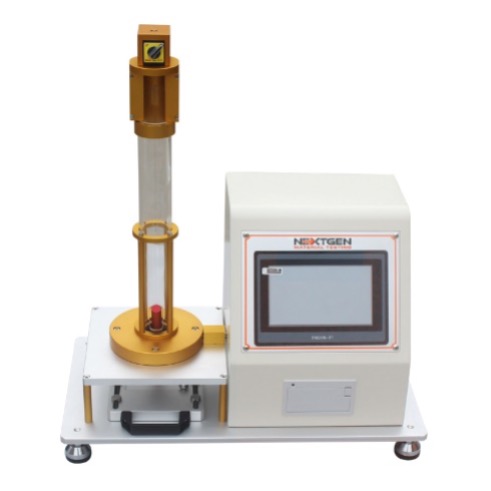
Digital Ball Vertical Rebound Resilience Tester
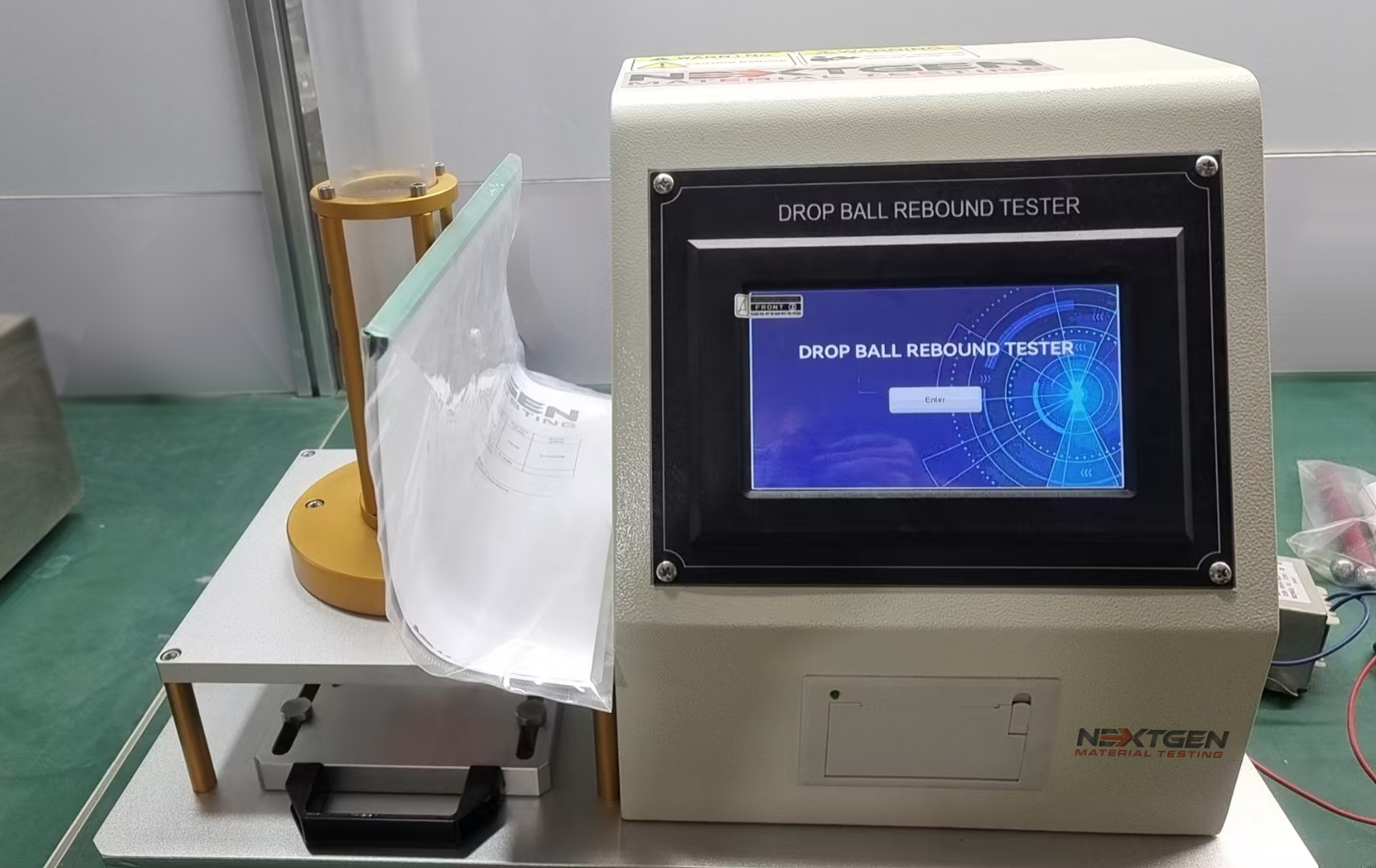
A 16 mm magnetic ball is dropped freely onto the specimen from 19.7″ (500 mm). The console shows each measured value and works out the average as a percentage; a sensor near the holder returns the ball to its starting position once the test is done. The unit comes certified to ASTM D3574.
Operation
Plug and play, with a short measuring cycle and no calibration requirement.
Readout
Test cycle, measured values, median in %, status and operating instructions on a four-line LCD.
Connection
USB port.
The film below shows the digital model at work.
The vertical rebound resilience tester in operation.
Specifications for the digital model.
| Item | Value |
|---|---|
| Drop distance of steel ball | ISO 8307 and ASTM D3574: 19.7″ (500 mm); GB/T 6670: 18.1″ (460 mm) +0.5% |
| Diameter of steel ball | Ø16 −0.1 mm |
| Steel ball quality | 16.7 g |
| Accuracy of rebound rate of falling ball | <1.5% |
| Sample size | 3.9 × 3.9 × 2″ (100 × 100 × 50 mm) |
| Power supply | 1 ph, AC 220 V / 50 Hz |
Analogue Ball Rebound Resilience Tester
GenRebound tests the resilience of rubber compounds. The machine is levelled, the plunger is raised to a set height and released onto the specimen for a given number of impacts. Only the fourth, fifth and sixth impacts count: the first three are discarded and the average of the remaining three is the result. Test films are placed 14 mm from the edge of the specimen. The instrument earns its place in the production of compounds meant to absorb vibration or shock, as ASTM requires.
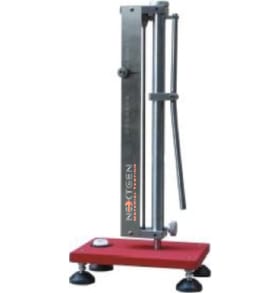
The analogue GenRebound.
Specifications for the analogue model.
| Item | Value |
|---|---|
| Drop height | 15.7″ (40 cm) |
| Hammer weight | 28 g |
| Dimensions (W × D × H) | 8.3 × 5.9 × 20.7″ (21 × 15 × 52.5 cm) |
| Weight | 18 lbs (8 kg) |
Have Questions or Need to Confirm a Detail?
Tell us whether you test foam or rubber and we will point you at the right one of the two. A quick request online gets a written answer.
For Laboratories
Need Additional Quality Control Equipment to Build Your Laboratory?
Rebound resilience testing is only one part of a complete quality control laboratory. NextGen can help you equip your entire lab with rheometers and viscometers, abrasion and flex testers, ageing and salt spray chambers, hardness and rebound testers, specimen cutting presses, and other supporting solutions, all coordinated as one complete project.
- One partner to equip your complete laboratory
- Installation, training, calibration
- Support for the life of the equipment
FAQs
Rubber compound resiliency is examined via GenRebound. The machine must be positioned horizontally, with the plunger lifted to a predetermined height. After that, the plunger is let go onto the sample for a specific amount of impact.
Here is how you properly maintain NextGen’s Vertical Rebound Resilience Tester – GenReboun:
- Check the verticality of the hammer guide before the test.
- Check if the machine is level before the test.
- The instrument can't be lubricated, otherwise, it will affect its performance.
- Keep the appearance of the machine clean and organized.
- Please operate and maintain by professionals only.
Click here to obtain a personalized quote.
The ISO standard known as ISO 10012:2003, Measurement management systems - Requirements for measurement processes and measuring equipment, lays out general requirements and offers instructions for the management of measurement processes and metrological confirmation of measuring equipment used to support and demonstrate compliance with metrological requirements. In order to ensure that metrological standards are met, it describes the quality management requirements of a measurement management system that can be utilized by an organization that performs measurements as part of its overall management system.
It is not intended for ISO 10012:2003 to be used as a prerequisite for proving compliance with ISO 9001, ISO 14001, or any other standard. The use of ISO 10012:2003 as input for fulfilling the needs of measurement management systems in certification operations is open to interested parties.
There are further standards and guidelines for specific factors influencing measurement outcomes, such as the specifics of testing procedures, staff competency, and interlaboratory comparisons.
The requirements of ISO/IEC 17025 are not to be replaced or supplemented by ISO 10012:2003.
NextGen’s Vertical Rebound Resilience Tester – GenRebound complies with ISO 10012 standard
Click here to obtain a personalized quote.
- Prepare the test piece:
- Determination of the position of the test piece: Select the test piece from the dispersed position of the same batch of materials.
- Test piece production: Cut the test piece into two pieces of standard disc core test piece with a thickness of 12.5mm and a diameter of 28mm.
- Operation steps:
- Confirmation before operation:
- Check if the machine is level. If the machine is not in the horizontal state, adjust the machine to the level through the adjustable feet.
- Confirm that the slider is vertical.
- Clamp the test piece: Loosen the fixing screw of the machine stand and move the test piece up to the position where the rubber test piece can be placed. After pressing the rubber, lock the fixing screw.
- Confirmation before operation:
- Start the test:
- Move the hammer along the slide bar to the highest point, use the trigger to fix the hammer.
- Press the lever, the hammer will naturally fall to the test piece along the slide bar and the height will be the rubber rebound height.
Note:
- The same test piece is tested six times, the first three times are predicted first, no need to record the value, and then the adjustment handle is locked.
- After predicting three times, test again three times and record the rebound heights h1, h2, h3.
- Only when the test piece is clamped, the test can be carried out, otherwise the hammer and the base will be damaged.
- Recording method: The bounce height is read from the scale.
Note:
- When reading, the line of sight should be perpendicular to the scale to avoid errors in the test results.
- When reading a value, generally retain 1 decimal place, and the second digit is rounded.
- The scale next to the slide bar of the machine, each scale is 4mm.
- Results Processing Take the average of the first three test results
Rubber Rebound Height (W)= (h1 + h2 + h3)/3
Click here to obtain a personalized quote.
The relationship or ratio between the energy that is returned and the energy that is impacted between a force, such as a dropped hammer, and the test specimen is known as rebound resilience. In order to determine whether your material is ready for its intended application, the energetic reaction to an impact, often caused by a hammer, is measured and then assessed in accordance with the goals and quality control requirements.
By measuring the vertical rebound of a dropped plunger with a specified mass and shape, the ASTM D2632 test determines the impact resilience of solid rubber. Then, resilience is calculated as the difference between the hammer's drop height and rebound height. Again, variations in temperature and the depth of the plunger's entry are sensitive to the resilience measurement.
Although ASTM D2632 is used to create and compare materials, it is frequently inapplicable to the testing of end-use performance. Additionally, it does not apply to the testing of coated fabrics or cellular rubbers, yet it is suited for those types of tests.
NextGen’s Vertical Rebound Resilience Tester – GenReboun complies with ASTM D2632 standard
Click here to obtain a personalized quote.
Rubber compound resiliency is examined via GenRebound. The machine must be positioned horizontally, with the plunger lifted to a predetermined height. The measurements are based on hits four, five, and six. The test result is then determined by taking the average of the three (3) measurements. The equipment is very helpful in producing compounds that meet ASTM criteria for vibration or shock absorption.

Function of each component:
- Scale, index: The rebound height of the main inspection materials.
- Adjustable Handle: Adjust the position of the pointer.
- Slider: The steering hammer acts as a guide.
- Punching: Impact on the test piece.
- Pole: Support the entire machine.
- Pull rod: Start the hammer to test.
- Horizontal foot: Adjust the level of the machine. When the bubble in the horizontal ball is in the center, the machine is in a level state.
- Fixing screw: Adjust the height of the test piece holder to place the test piece.
Click here to obtain a personalized quote.
This test instrument was created using ASTM-D2632, ISO-10012, and other standard documents, and it is primarily used to measure the rebound height of hard rubber materials. It cannot be used to measure the rebound height of soft rubber or glued leather. In units are the test results. Although the test method can be used to identify and research materials, it cannot directly assess final performance.
Adaptive Vertical Rebound Using the free fall weight method, the tester evaluates the rubber materials' elasticity. Adjust the instrument's horizontal position first, and only after that elevate the drop weight to the desired height. Make sure the drop point is 14 millimetres from the test piece's edge when you set it down. The average of the fourth, fifth, and sixth rebound heights was recorded; the first three trials were not used.
NextGen's Vertical Rebound Resilience Tester machine uses the vertical free fall hammer method to observe its rebound height.
Click here to obtain a personalized quote.
|
Sample thickness |
12.5mm |
|
Sample Diameter |
¢28mm |
|
Falling height |
400mm |
|
Hammer weight |
(28g±0.5)g |
|
Volume |
250x150x525mm |
|
Machine weight |
8kg |
This test apparatus was created using ASTM-D2632, ISO-10012, and other standard papers, and it is primarily used to measure the rebound height of hard rubber materials. It cannot be used to measure the rebound height of soft rubber or glued leather.
Installation:
- Operating environment conditions: The required temperature is (23 ± 2) ° C, and the humidity is (65 ± 5) RH%
- The instrument should be placed on a flat platform of 25cm x 15cm or more.
Click here to obtain a personalized quote.
Standard test method for Rubber Property Standard Test Method—Resilience By Vertical Rebound
This test procedure entails measuring the vertical rebound of a dropped mass in order to determine the impact resilience of solid rubber.
Cellular rubbers and coated fabrics cannot be tested using this test procedure.
Test Method D1054 provides a description of a common test procedure for rubber impact resilience and penetration using a rebound pendulum.
The values given in SI units should be taken as the norm. Parenthetical values are provided only for informational purposes.
If there are any safety concerns, they are not all claimed to be addressed by this standard. The user of this standard is responsible for establishing suitable safety and health procedures and determining whether any regulatory restrictions apply prior to using.
NextGen’s Vertical Rebound Resilience Tester – GenReboun complies with ASTM D2632 standard
Click here to obtain a personalized quote.
The scale on the Vertical Rebound tester is based on 4mm intervals (per section). This scale also indicates the percentage of height post bounce.
For example, if it bounces up to 30, the result is 30%.
Related Products
Linear Abrasion Tester
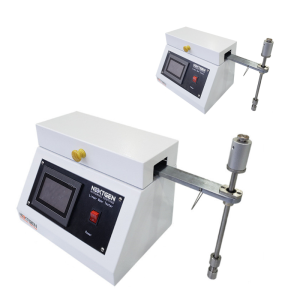
The Linear Abrasion Tester evaluates abrasion resistance, scratch resistance, and color transfer performance under dry or wet test conditions. Designed for samples of many shapes and surface profiles, it is suitable for plastics, rubber, leather, textiles, coatings, automotive parts, printed patterns, and electroplated components. Touchscreen operation and controlled linear motion help laboratories assess surface durability with repeatable, practical results.
Read more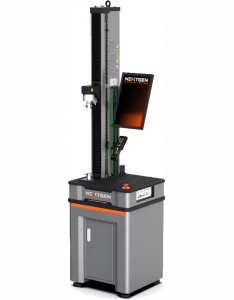
NG-EML Series A – Single-Column Universal Testing Machine (50 N – 5 kN)
NG-EML Series A is a compact single-column benchtop universal testing machine for low-force tensile, compression, and flexural testing. Covering 50 N to 5 kN capacity options, it is suited for rubber, plastics, adhesives, films, foams, wires, metals, composites, and consumer products. Its electromechanical frame, high-speed servo actuation, GenTest software, and standards support make it practical for R&D and routine QC.
Read more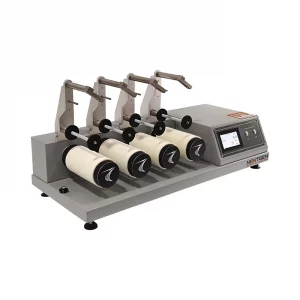
ICI/Mace Snag Tester
The ICI / Mace Snag Tester evaluates the snagging resistance of fabrics by simulating real-world wear in a controlled laboratory setup. Using a rotating drum and mace-style hammer action, it creates repeatable snagging conditions so samples can be compared against reference fabrics. Compliance with ASTM D3939, JIS L1058, and GB/T 11047 makes it suitable for textile durability and quality-control testing.
Read more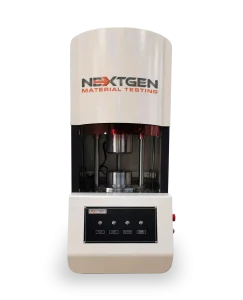
Moving Die Rheometer (MDR)
The Moving Die Rheometer is a rotorless rubber rheometer for assessing curing and processing characteristics of vulcanized rubber compounds. It measures torque response during oscillation in a sealed heated cavity, generating cure curves and parameters such as ML, MH, and cure times. ASTM D5289, ISO 6502, DIN 53529 compliance, database storage, Excel export, diagnostics, and programmable strain support reliable QC and R&D analysis.
Read more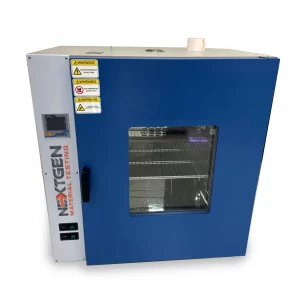
NG-AGOV-ADV – High-Temperature Aging Oven
NG-AGOV-ADV is a high-temperature aging oven for testing how rubber, plastics, elastomers, insulating materials, and similar products respond to long-term heat exposure. It simulates accelerated aging, thermal stability, and heat resistance conditions up to 300°C using forced convection, PID control, programmable cycles, stainless chamber construction, adjustable trays, over-temperature protection, and real-time monitoring. ISO 188, ASTM D573, IEC 60216-4-1, and GB/T 3512 support compliance workflows.
Read more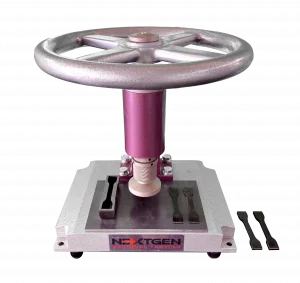
NG-T-Press M Series – Manual Cutting Press for Rubber Specimens
NG-T-Press M Series is a compact manual cutting press for preparing rubber, tape, and specialty material specimens for tensile and mechanical testing. With optional knives for standards such as ASTM D412, ASTM E8, ASTM B557, and ASTM A370, plus 30 kN punching force, quiet operation, and a 25 mm stroke, it helps labs create accurate, repeatable test samples with minimal setup.
Read more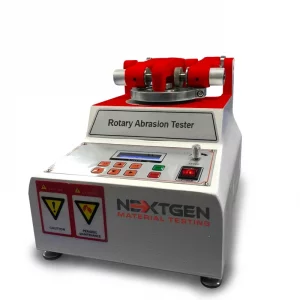
Rotary Abrasion Tester (Single and Dual Wheel)
NextGen’s Rotary Abrasion Tester is available in single- and dual-wheel configurations for evaluating surface wear resistance on rubber, plastics, fabrics, paper, coatings, leather, floor tiles, glass, plywood, and related materials. Controlled rotating speed, specified loads, abrasion wheels, LCD touchscreen counting, and automatic shutdown help laboratories compare weight loss, wear index, and surface durability under repeatable abrasion conditions.
Read more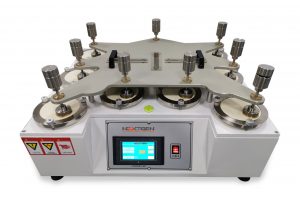
9-Station Martindale Abrasion Tester
GenDale 9-Station Martindale Abrasion Tester measures abrasion resistance and appearance change in shoe fabrics, linings, coated fabrics, textiles, and related materials. Its Martindale rubbing motion supports wet or dry testing, with PLC programmable control, adjustable speed, touchscreen operation, and simultaneous specimen handling to improve throughput. Standards alignment with ISO 12947, ISO 5470-2, and ISO 20344 makes it useful for footwear and textile QC.
Read more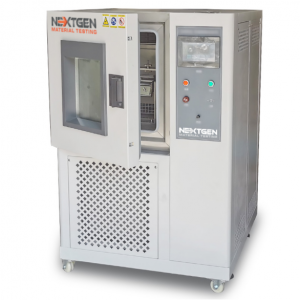
GenRoss-CH – Ross Flex Tester with Low-Temperature Chamber
GenRoss-CH is a Ross flex tester with an integrated low-temperature chamber for evaluating cold resistance and folding durability of shoes and shoe materials. With a -20°C to +150°C temperature range, programmable temperature control, 90° bending angle, adjustable cycling speed, and capacity for up to six test pieces, it supports repeatable footwear and rubber material testing under controlled conditions.
Read more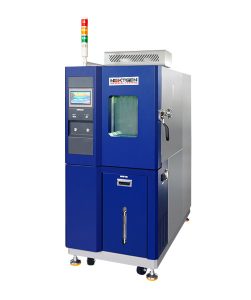
NG-EC Series – Environmental Test Chambers (100–1000 L)
NextGen NG-EC Environmental Chambers provide controlled temperature and humidity conditions for material, product, and quality-control testing. Available in 100, 150, 225, 408, and 1000 L sizes, they feature insulated steel construction, stainless interior walls, mechanical compression refrigeration, circulating air ducts, adjustable sample racks, a viewing window, and 7-inch touchscreen control to support stable, repeatable environmental simulation.
Read more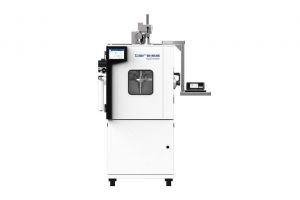
digiChamber – Temperature-Controlled Hardness Tester
digiChamber is a temperature-controlled rubber hardness testing system designed by Bareiss for Shore A and IRHD N testing under extreme environmental conditions. It combines an automatic test sequence, large 200-liter chamber, 7-inch touchscreen, digiCenter software, and multi-sample tray handling to evaluate rubber parts at controlled temperatures, helping automotive, tire, and quality-control labs verify hardness performance under realistic thermal stress.
Read more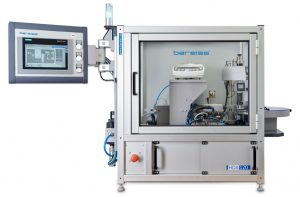
HDA 120 – Hardness and Density Automation System
HDA 120 is a semi-automatic hardness and density automation system for rubber and plastic sample characterization. It can handle up to 20 samples, perform three hardness measurements on a rotary table, and transfer specimens for density determination using a pneumatic gripping system. Data interfaces, touchscreen operation, ISO-compliant methods, and automated handling help improve throughput, traceability, and repeatability.
Read more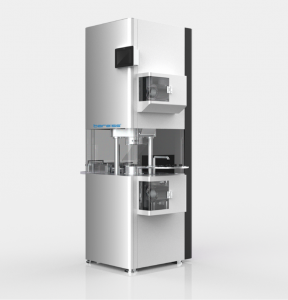
RPA Ultra – Rubber Process Analyzer
RPA Ultra is an advanced rubber process analyzer rheometer for measuring dynamic and static properties of raw rubber compounds and elastomers during processing and cure. Its closed-cavity moving die design, direct-drive deformation control, broad torque range, frequency capability up to 100 Hz, and high-pressure pneumatic sealing help labs characterize viscoelastic behavior, cure response, modulus, viscosity, tan δ, and processing performance.
Read more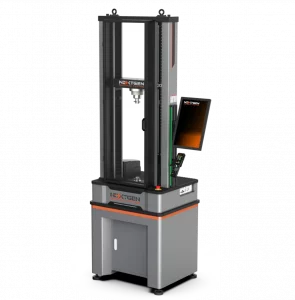
NG-EML Series B – Dual-Column Universal Testing Machine (100 N – 10 kN)
NG-EML Series B is a dual-column benchtop electromechanical universal testing machine for precision testing from 100 N to 10 kN. Built for research and industrial labs, it supports tension, compression, flexural, and component testing of composites, high-strength metals, polymers, films, foams, and rubber. Its compact rigid frame, advanced control accuracy, and GenTest software help deliver repeatable results in limited lab space.
Read more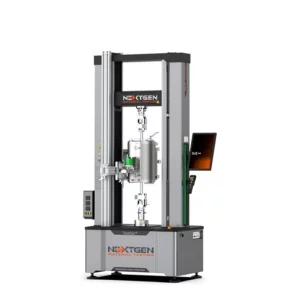
NG-EML Series C – Dual-Column Universal Testing Machine (5–50 kN)
NG-EML Series C is a dual-column electromechanical universal testing machine available in bench-top and floor-standing formats from 5 kN to 50 kN. Built for tension, compression, flexural, shear, and peel testing, it combines Class 0.5 accuracy, a servo direct-drive system, high-rigidity frame, touchscreen control, and GenTest software to support precise testing of metals, composites, rubber, plastics, and polymers.
Read more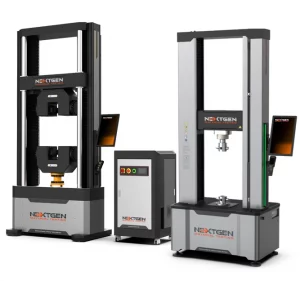
NG-EML Series D – Floor-Standing Universal Testing Machine (50–1000 kN)
NG-EML Series D is a heavy-duty floor-standing electromechanical universal testing machine for high-capacity tensile, compression, and flexural testing. Available from 50 kN to 1000 kN, it is built for high-strength steels, advanced composites, alloys, and challenging research materials. Its rigid dual-column frame, servo direct-drive system, closed-loop control, safety protections, and GenTest software support stable, accurate testing.
Read more
GenTest – Advanced UTM Testing Software
GenTest is NextGen’s advanced UTM testing software for electromechanical universal testing machines, managing test setup, live control, data acquisition, calculations, curves, and reporting from one method-driven environment. Preconfigured ASTM, ISO, DIN, EN, and BS templates help operators load the correct control mode, speeds, gauge length, formulas, and result fields for tensile, compression, and flexural tests.
Read more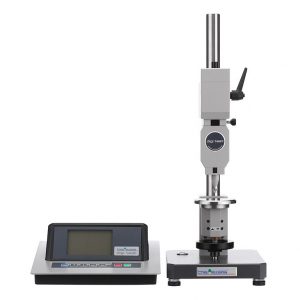
Automatic Shore, IRHD and VLRH Hardness Testing System
Digi Test II is an automatic Shore, IRHD, and VLRH hardness testing system for rubber, plastics, foams, elastomers, O-rings, tubes, hoses, and shaped parts. It combines an electronic control unit, loading module, test stand, and interchangeable measuring heads with automatic range recognition, programmable measuring time, USB output, and low-operator-influence operation. DIN, ISO, ASTM, BS, and DAkkS certificate support strengthen repeatability.
Read more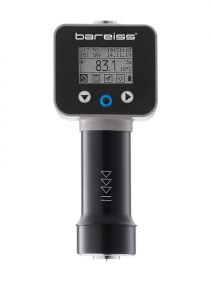
Portable Shore Durometer System with Test Stand
HPE III is an advanced portable Shore durometer system for hardness testing of rubber, plastics, and related materials. It measures hardness while also displaying specimen or environmental temperature and humidity, helping users track conditions during testing. A large LCD display, aluminum casing, patented ergonomic hand grip, USB connection, historical data display, rechargeable operation, and compatible manual or automatic test stands improve repeatability.
Read more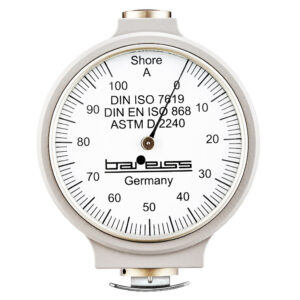
Analogue Shore Durometer with Test Stand
The Classic Analogue Shore Durometer is a German-manufactured hardness tester for rubber and plastic materials, available with manual or automatic test stand options. Known as a long-standing Shore hardness benchmark, it supports portable measurements, ergonomic operation, reference blocks, control rings, calibration accessories, and DAkkS/DKD certificate options. DIN 53505, EN ISO 868, ASTM D2240, and JIS K 6253 compatibility supports reliable verification.
Read more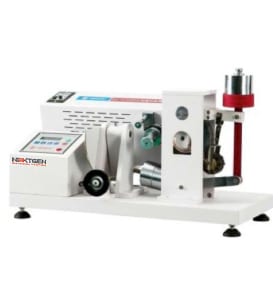
Akron Abrasion Tester
GenKron Akron Abrasion Tester measures abrasion resistance by tracking volumetric loss from a rotating specimen exposed to a standard grinding wheel. Designed for harder rubber materials such as shoe soles, tires, and similar compounds, it uses controlled rubber wheel speed, grinding speed, adjustable inclination, specified loading, and LCD cycle counting to support repeatable wear comparisons in rubber product development and quality control.
Read more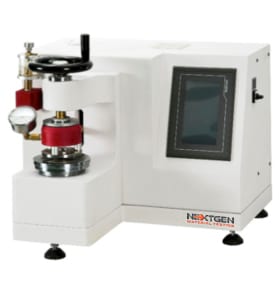
Fabric Burst Strength Tester
GenBurst is a burst strength tester for measuring the rupture resistance of fabric, leather, paper, and similar sheet materials under hydraulic pressure. Available in manual and automatic models, it uses a hydraulic diaphragm system with pressure transducers, capacity up to 100 kgf/cm², and ISO 2759 and ASTM D2210 compliance to support standardized durability, packaging, textile, and quality-control testing.
Read more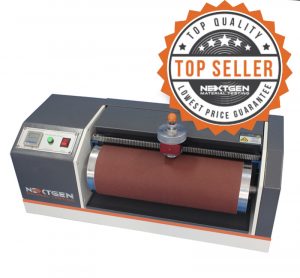
DIN Abrasion Tester
GenDin is a DIN abrasion tester for measuring abrasion resistance of vulcanized rubber, thermoplastic elastomers, footwear materials, tires, seals, and other rubber components exposed to frictional wear. The test moves a specimen across an abrasive sheet on a rotating drum and reports volume loss or abrasion index. ASTM D5963, ISO 4649, DIN 53516, EN ISO 20344, and SATRA TM174 support standardized comparisons.
Read more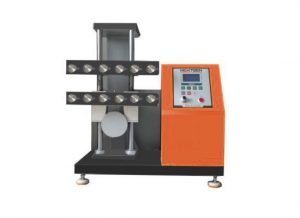
Demattia Flex Cracking Tester
GenFlex Demattia Flex Cracking Tester evaluates the ability of rubber products to withstand repeated flexing without developing cracks. It simulates standard flexing conditions of speed, stroke, and deformation to assess flex endurance in rubber and elastomer specimens. With selectable specimen formats, high-cycle LCD counting, controlled reciprocating motion, and stable fixture spacing, it helps laboratories compare compound durability for products exposed to repeated bending.
Read more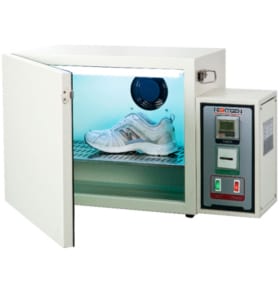
Discoloration Meter
The Discoloration Meter simulates sunlight and heat exposure to evaluate how fabrics, rubber, plastics, and other materials resist fading or discoloration. Available in compact and larger chamber configurations, it uses UV lamps, controlled temperature up to 200°C, sample racks, and an LED control display to support repeatable colorfastness testing for quality control, material comparison, and durability evaluation under accelerated environmental conditions.
Read more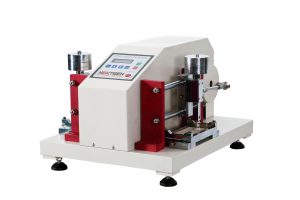
GenCrock – Electric Crocking Tester
GenCrock is an electric crocking tester for evaluating color transfer and fading on fabric, leather, and dyed surfaces after dry or wet rubbing. The specimen is fixed to the base and rubbed with a controlled abrasive hammer carrying wet or dry cloth. This repeatable setup helps laboratories rate dyeing quality, colorfastness, and surface durability for textile, leather, and product QC.
Read more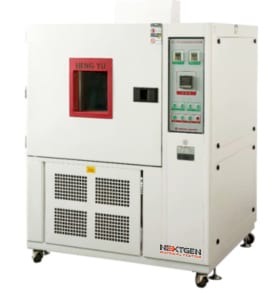
GenFreeze – Freezing Tester
GenFreeze is a freezing tester for evaluating rubber, leather, plastics, PU leather, footwear materials, and related products under cold-climate conditions. It allows operators to adjust flexing or impact-style fixtures according to the test demand, then expose specimens inside a controlled low-temperature chamber. Stainless construction, PID control, safety protection, viewing window, lighting, and intelligent power-failure recovery support repeatable cold-resistance testing.
Read more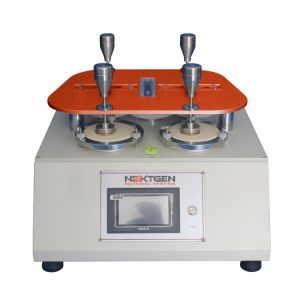
GenDale – Martindale Abrasion Tester
GenDale is a Martindale abrasion tester for evaluating abrasion resistance and visible wear in shoe fabrics, linings, textiles, and related materials. It tests up to four specimens at once using controlled multi-directional rubbing motion, with results based on the number of cycles until wear or hole formation appears. The system supports footwear, textile, and material QC labs needing repeatable durability comparisons.
Read more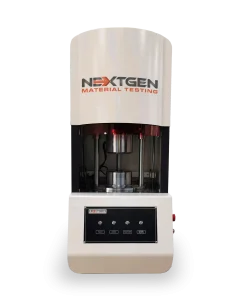
GenMooney – Mooney Viscosity Testing Machine
GenMooney is a Mooney viscosity testing machine for measuring viscosity, scorch behavior, and stress relaxation in unmixed or mixed unvulcanized natural, synthetic, and regenerated rubber. It combines fast heating, stable temperature control, high-precision torque measurement, automated calibration, data acquisition, and software reporting to support ASTM D1646, ISO 289, ISO 667, and GB/T 1233 workflows in rubber QC and formulation development.
Read more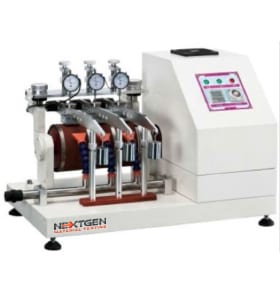
GenNBS – NBS Rubber Abrasion Tester
GenNBS is an NBS rubber abrasion tester for evaluating abrasion resistance of vulcanized rubber and related compounds, especially shoe soles and heels. It measures volumetric loss as specimens contact standardized abrasive media mounted on a rotating cylinder. Intelligent power-failure recovery, 45±5 rpm rotation, three specimen load sets, LCD counting, #40 grinding paper, and ASTM D1630 and D394 support make it useful for standardized rubber wear testing.
Read more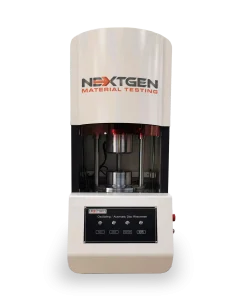
Oscillating Disc Rheometer (ODR)
NG-ODR is an oscillating disc rheometer for measuring curing and processing characteristics of rubber compounds. It records torque response as a rubber sample is held in a heated sealed cavity and sheared by an oscillating disc, producing vulcanization curves and key parameters for QC, research, and production. Database storage, Excel export, curve comparison, statistical tools, and ASTM D2084, ASTM D5289, and ISO 6502 support reliable analysis.
Read more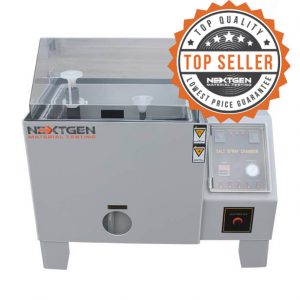
GenSalt – Salt Spray Tester
GenSalt is a salt spray tester for accelerated corrosion testing of metals, coated components, paints, varnishes, electroplating, anodizing, and rust-prevention treatments. It simulates controlled salt-fog exposure to evaluate how materials and protective finishes withstand corrosive environments. ASTM B117 alignment, reinforced PVC construction, SUS304 saturated air tank, precision air-pressure control, titanium heating tube, timing memory, and safety alarms support reliable long-duration QC testing.
Read more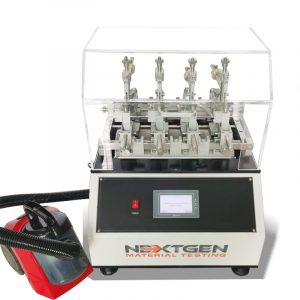
GenWyze – Wyzenbeek Abrasion Tester
GenWyze is a certified Wyzenbeek abrasion tester for measuring abrasion resistance of fabrics, upholstery materials, and selected coated or metallic surfaces. The specimen is pulled over a curved frame and rubbed against an abradant until visible wear appears, with results reported in cycles or double rubs. Four test chambers, adjustable load, ASTM D4157, ASTM D3597, ISO 12402-7, and automotive-method compatibility support standardized durability comparisons.
Read more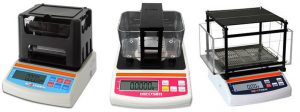
Digital Densimeter System
NextGen Digital Densimeter Systems measure density, specific gravity, volume, and related material properties for rubber, plastics, tires, shoe materials, composites, leather, elastomers, and other solids. Using high-accuracy digital measurement with instant readout, storage, RS-232 output, temperature and medium settings, and Archimedes-based buoyancy methods, they help QC and R&D labs produce fast, repeatable density data under ASTM, ISO, JIS, and GB/T standards.
Read more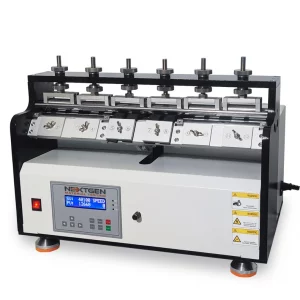
Ross Flex Tester
Ross Flex Tester evaluates the resistance of vulcanized and synthetic elastomers to cut growth and flex cracking under repeated bending. Designed for shoe soles and flexible sheet-like materials such as PU, PVC, TPR foams, rubber, leather, textiles, and plastics, it bends specimens through 90° over a 10 mm rod. Digital control, memory function, vacuum holding, and 6- or 12-grip configurations support repeatable testing.
Read more