Manual Vicat Apparatus

Cement & Concrete Testing Equipment
Standards






Description
The Manual Vicat Apparatus determines the setting time of cement paste, the measurement that tells a site how long a mix stays workable and when it has hardened enough to move on. It is used for research, for quality inspection and for compliance work in concrete formulation.
Two figures come out of the test. The initial setting time marks the point at which the paste begins to solidify: the 1 mm needle can no longer penetrate to within 5 to 7 mm of the bottom of the mould. The final setting time is reached when the 1 mm needle still marks the surface but the 5 mm attachment no longer leaves an impression.
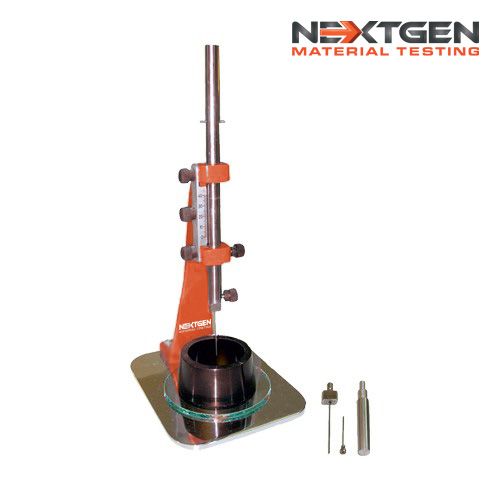
The frame, designated VicatGen/M, is a metal stand carrying a sliding rod. An adjustable indicator moves over a graduated scale, and the needle or plunger screws into the bottom of the rod to make up a test weight of 300 g. It works to EN 196-3, ASTM C191 and the related lime and gypsum standards.
Test Weight300 g
Weight6.6 lbs (3 kg)
Height12.52″ (31.8 cm)
Accessories and What the Test Needs
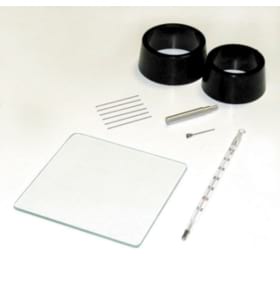
The frame is supplied on its own, because the needles, moulds and plates that go with it are decided by the standard you report to.
EN accessories
Basic EN accessory set, reference NG-L028.
ASTM and AASHTO accessories
Accessory set to the North American methods, reference NG-L0028/A.
Ordered separately
The frame VicatGen/M is supplied without accessories, so the set is chosen with the order rather than assumed.
Beyond the apparatus itself, a setting time determination needs the following on the bench.
| Item | Why it is needed |
|---|---|
| Manual Vicat apparatus | Carries the rod, the needle and the graduated scale |
| Balance | Weighing the cement and the mixing water to the accuracy the method requires |
| Measuring roller | Measuring out the mixing water |
| Stopwatch | Timing from the moment water meets cement, which is where the setting clock starts |
| Glass dish | Holding and handling the paste during preparation |
| Enamel tray | Working surface for mixing and for the mould |
| Trowel | Filling and levelling the mould before the first penetration |
Manual Vicat Apparatus Technical Specifications
A bench instrument in every sense: it takes a corner of a laboratory table and needs no services.
| Item | Manual Vicat Apparatus |
|---|---|
| Dimensions (W × D × H) | 5.9 × 7.5 × 12.52″ (15 × 19 × 31.8 cm) |
| Weight | 6.6 lbs (3 kg) |
| Test weight | 300 g including needle and rod |
Where setting time is run many times a day, or where the result has to be free of operator timing, the Automatic Vicat Apparatus performs the same determination under motor control and stores the data.
Have Questions or Need to Confirm a Detail?
Tell us which standard your setting times are reported against and we will quote the frame with the matching accessory set rather than leaving you to work out the reference. A quick request online is enough to start.
For Laboratories
Need Additional Quality Control Equipment to Build Your Laboratory?
Cement and concrete testing is only one part of a complete quality control laboratory. NextGen can help you equip your entire lab with mortar mixers, climatic curing cabinets, Blaine fineness apparatus, Vicat setting-time apparatus, autoclaves, and other supporting solutions, all coordinated as one complete project.
- One partner to equip your complete laboratory
- Installation, training, calibration
- Support for the life of the equipment
Related Products
Automatic Vicat Apparatus
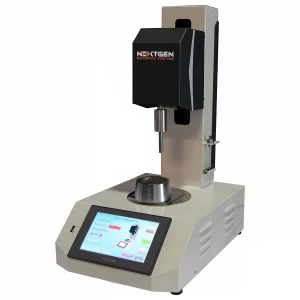
The Automatic Vicat Apparatus determines cement paste standard consistency and setting time with less operator intervention than a manual frame. It uses automated position calibration, position memory, frictionless needle drop, high-precision LVDT displacement measurement, touchscreen operation, and onboard storage for up to 200 test groups. Support for ASTM C187, ASTM C191, EN 196-3, and related methods makes it practical for cement QC labs.
Read more