Cement & Concrete Testing Equipment
Setting time tells a cement plant and a construction site how long a paste stays workable and when it has hardened enough to move on. The Vicat test measures it on cement paste: a weighted needle falls into the paste at intervals, and the depth it reaches shows the initial and final set. The work starts with normal consistency, the water demand that gives a paste of reference stiffness, which is covered by ASTM C187. Time of setting follows ASTM C191 in North American practice and EN 196-3 in European practice, and the two read the endpoints differently, so a report should name the method it followed.
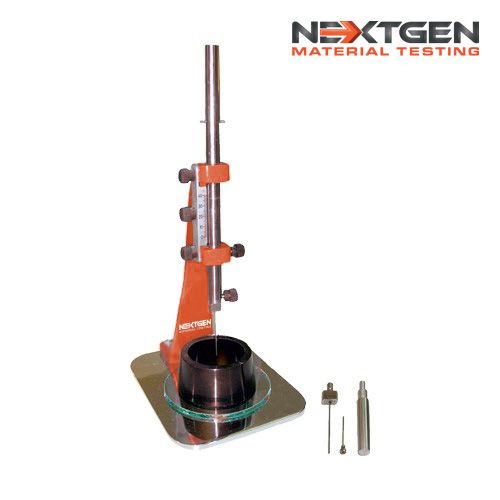
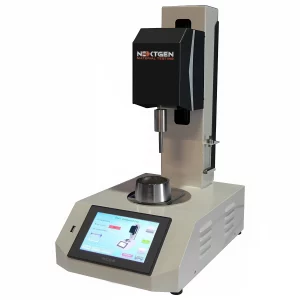
The Vicat frame carries a sliding assembly of 300 g with a needle or plunger, and it comes as a manual apparatus or an automatic one. The manual frame is a bench instrument with a graduated scale that an operator reads at set intervals. The automatic instrument replaces the arm and eye with a motor drive and a displacement sensor, stores the test data and exports it to report software. Accessory sets differ for the EN method and for the ASTM and AASHTO methods, so they are chosen with the order. Installation, calibration and operator training come from NextGen engineers, and support continues for the life of the instrument.
For Laboratories
One partner to equip your complete concrete laboratory
Concrete testing rarely stops at one machine. NextGen equips the whole laboratory, from mortar mixing and climatic curing to Blaine fineness, Vicat setting time and autoclave testing, and stays responsible for it after delivery.
- Equipment, fixtures and software
- Installation, training, calibration
- Lifetime technical support
Most requested
 Automatic Vicat Apparatus
The Automatic Vicat Apparatus determines cement paste standard consistency and setting time with less operator…
View product
Get quote
Most requested
Manual Vicat Apparatus
The Manual Vicat Apparatus is used to determine cement and concrete setting time through controlled penetration of a…
View product
Get quote
Automatic Vicat Apparatus
The Automatic Vicat Apparatus determines cement paste standard consistency and setting time with less operator…
View product
Get quote
Most requested
Manual Vicat Apparatus
The Manual Vicat Apparatus is used to determine cement and concrete setting time through controlled penetration of a…
View product
Get quote
 Automatic Vicat Apparatus
The Automatic Vicat Apparatus determines cement paste standard consistency and setting time with less operator…
Cement and concrete testing
 Manual Vicat Apparatus
The Manual Vicat Apparatus is used to determine cement and concrete setting time through controlled penetration of a…
Cement and concrete testing
Nothing matches that filter. Show all products
FAQs
Choose by how often the test runs and who is free to run it. A manual apparatus needs someone at the bench every ten or fifteen minutes for several hours, which suits occasional testing and teaching. The automatic instrument lifts and drops the needle under motor control, holds the same 300 g sliding assembly, stores 200 test groups and exports by RS485. Daily quality control, several cements in parallel or an accredited scope point to the automatic version.
The manual apparatus page describes initial set as the point where the 1 mm needle can no longer penetrate to within 5 to 7 mm of the bottom of the mould, and final set when the needle marks the surface but the 5 mm attachment leaves no impression. ASTM C191 takes initial set at 25 mm penetration, interpolated between readings. The numbers describe the same physical event but are not interchangeable in a specification, so name the method.
Water content changes paste stiffness and so changes setting behavior, so it has to be standardized rather than judged by feel. ASTM C187 finds the water needed for normal consistency, and EN 196-3 has its own procedure. The Automatic Vicat Apparatus determines both the standard water consistency requirement and the setting time, by measuring penetration depth in pastes with different water contents to find the water demand.
The manual frame is supplied without needles, moulds and plates, because the standard decides them: an EN accessory set (NG-L028) or an ASTM and AASHTO set (NG-L0028/A). On the bench you also need a balance, a measuring roller for the water, a stopwatch started when water meets cement, a glass dish, an enamel tray and a trowel. Tell us which standard you report to and we will quote the matching accessory set.
No. Cement Vicat testing drops a weighted needle into cement paste and times how far it sinks. The plastics test is Vicat softening temperature, where a needle rests on a specimen under a fixed load while the temperature rises, and the softening point is the temperature at which it penetrates 1 mm. They use different apparatus and different standards. The plastics method is explained in the NextGen blog on HDT and Vicat.