Rubber Testing Equipment
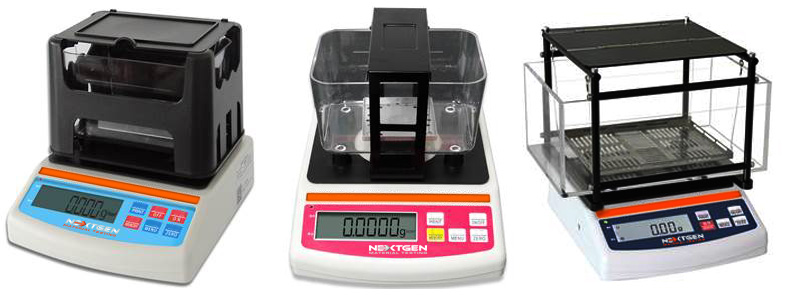
Density is one of the quickest checks that a compound matches its recipe and that one batch matches the last. It is measured on cured rubber, plastics and elastomers by weighing the specimen in air and in a liquid, and NextGen supplies density systems for this method working to ASTM D792, ISO 2781 and ISO 1183.
The range covers digital densimeters that read density and specific gravity directly, with storage and data output, and an automated station that handles hardness and density testing of a sample batch. Systems are installed and calibrated on site, your team is trained on the method and on handling specimens, and support continues for the life of the instrument.
For Laboratories
One partner to equip your complete rubber laboratory
Density testing is one station of an elastomer laboratory. NextGen equips the rest of it too, from tensile frames to cure testing, hardness, abrasion and specimen preparation, and stays responsible for it after delivery.
- Equipment, fixtures and software
- Installation, training, calibration
- Lifetime technical support
Most requested
 Digital Densimeter System
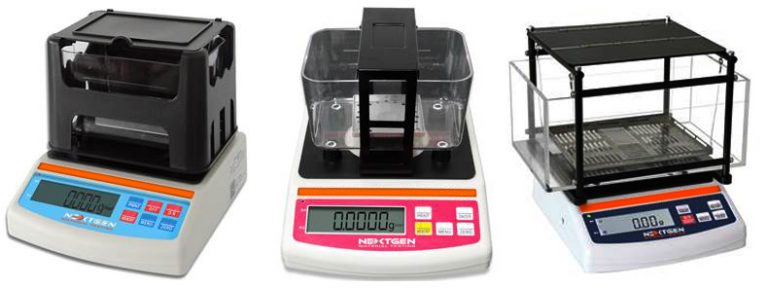
NextGen Digital Densimeter Systems measure density, specific gravity, volume, and related material properties for…
View product
Get quote
 HDA 120 – Hardness and Density Automation System
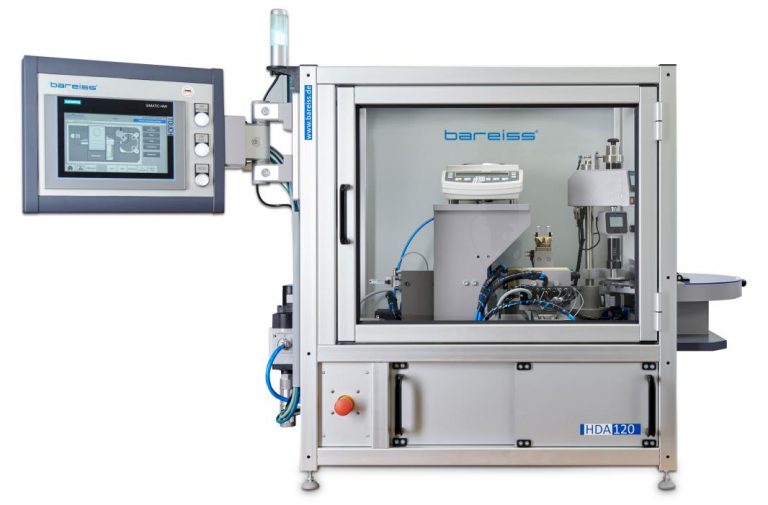
HDA 120 is a semi-automatic hardness and density automation system for rubber and plastic sample characterization.
View product
Get quote
Digital Densimeter System
NextGen Digital Densimeter Systems measure density, specific gravity, volume, and related material properties for…
View product
Get quote
HDA 120 – Hardness and Density Automation System
HDA 120 is a semi-automatic hardness and density automation system for rubber and plastic sample characterization.
View product
Get quote
 Digital Densimeter System
NextGen Digital Densimeter Systems measure density, specific gravity, volume, and related material properties for…
Density measurement
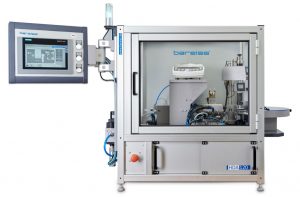 HDA 120 – Hardness and Density Automation System
HDA 120 is a semi-automatic hardness and density automation system for rubber and plastic sample characterization.
Hardness testing
Nothing matches that filter. Show all products
FAQs
ISO 2781 is the rubber method, for solid vulcanized and thermoplastic rubber. ASTM D792 covers solid plastics, and ISO 1183 covers non-cellular plastics. The densimeter and the HDA 120 are both listed under ISO 2781. Check which document your specification cites, and contact our team if it names a method for another material.
After the hardness readings, a pneumatic gripper moves the sample to a station where it is weighed in air, then immersed in distilled water by a rising water bath that moves up at least twice to remove air bubbles. The water level and temperature are checked for each measurement, and the highest wet weight is used. Density resolution is 0.001 kg/dm³, as listed on the HDA 120 page.
Solid mode reports density, specific gravity and volume of solid, granular and floating objects, and mixing ratio mode gives the content of a two-material mixture when both densities are known. The display also shows volume change rate, high and low limits can sound an alarm for sample qualification, and ten groups of data can be stored, including DIN volume abrasion loss. Output goes to a PC or printer over RS-232.
Water or other liquids can serve as the medium, and the medium temperature can be set from 0 °C to 49 °C. The medium density setting accepts values up to 19.999, and the instrument offers temperature compensation and air buoyancy compensation. It reads densities both above and below 1, so floating samples can be measured with the anti-floating frame supplied.
The models on the digital densimeter page differ in the weight they take and the precision they hold. NG-DM-A150 takes 150 g at 0.0002 g/cm³, NG-DM-A300 takes 300 g at 0.001, NG-DM-A600 takes 600 g at 0.0002, NG-DM-A1200 takes 1200 g at 0.001, and NG-DM-A3000 takes 3000 g at 0.001. The rest of the specification is common to the series.