Rubber Testing Equipment
A shoe sole or a molded rubber part can pass every static test and still crack after thousands of bends in service. Flex testing reproduces that bending in the laboratory, so a crack starts and grows under controlled stroke and speed and compounds can be ranked by how long they last. NextGen works to ASTM D430, ASTM D813 and ASTM D1052 for these methods.
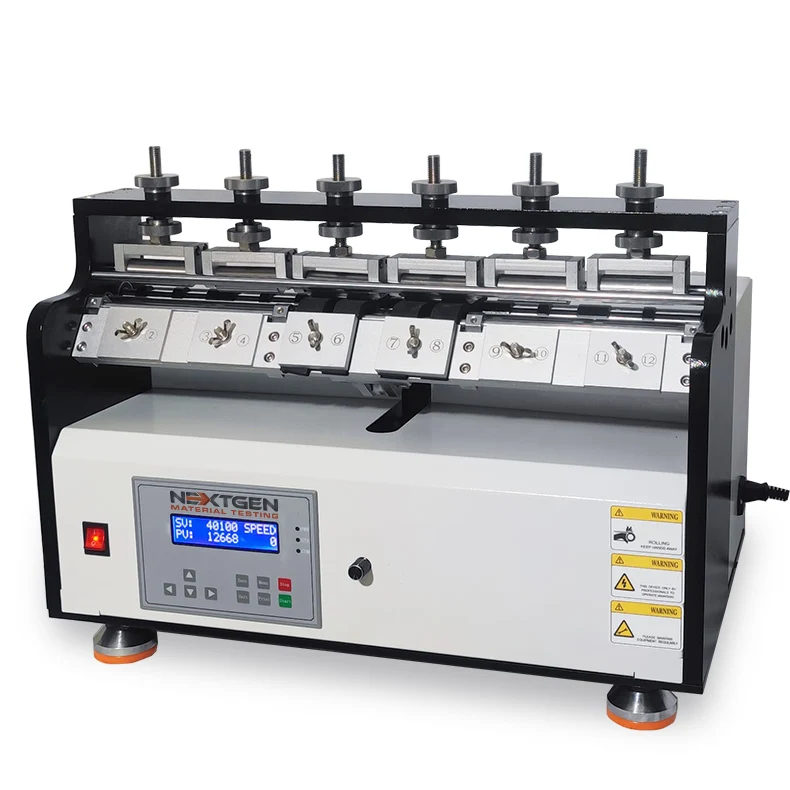
The range covers De Mattia testers for flex cracking and cut growth, Ross flex testers that bend soles and sheet materials through a right angle over a rod, and a Ross tester with its own low-temperature chamber for cold flex resistance. Testers are installed and calibrated on site, your team is trained on specimen preparation and cycle counts, and support continues for the life of the instrument.
For Laboratories
One partner to equip your complete rubber laboratory
Flex testing is one station of an elastomer laboratory. NextGen equips the rest of it too, from tensile frames to cure testing, hardness, abrasion and specimen preparation, and stays responsible for it after delivery.
- Equipment, fixtures and software
- Installation, training, calibration
- Lifetime technical support
Most requested
 Demattia Flex Cracking Tester
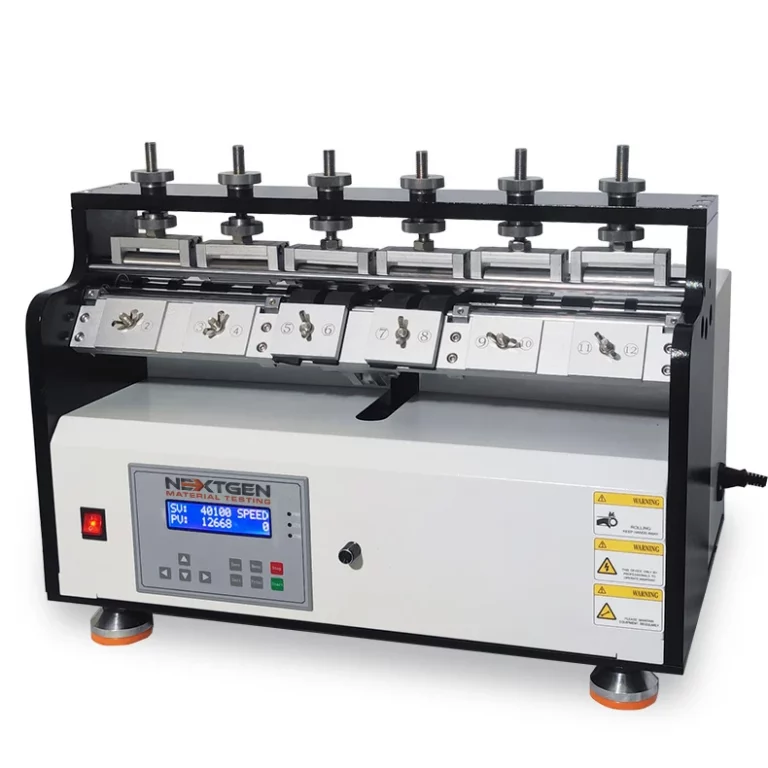
GenFlex Demattia Flex Cracking Tester evaluates the ability of rubber products to withstand repeated flexing without…
View product
Get quote
Most requested
 Ross Flex Tester
 evaluates the resistance of vulcanized and synthetic elastomers to cut growth and flex cracking…
View product
Get quote
 GenRoss-CH – Ross Flex Tester with Low-Temperature Chamber
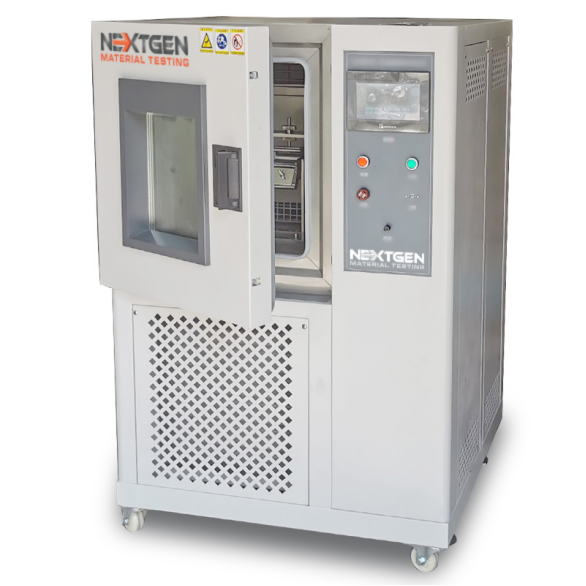
GenRoss-CH is a Ross flex tester with an integrated low-temperature chamber for evaluating cold resistance and…
View product
Get quote
Demattia Flex Cracking Tester
GenFlex Demattia Flex Cracking Tester evaluates the ability of rubber products to withstand repeated flexing without…
View product
Get quote
Most requested
Ross Flex Tester
Ross Flex Tester evaluates the resistance of vulcanized and synthetic elastomers to cut growth and flex cracking…
View product
Get quote
GenRoss-CH – Ross Flex Tester with Low-Temperature Chamber
GenRoss-CH is a Ross flex tester with an integrated low-temperature chamber for evaluating cold resistance and…
View product
Get quote
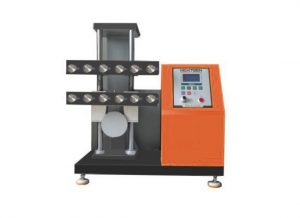 Demattia Flex Cracking Tester
GenFlex Demattia Flex Cracking Tester evaluates the ability of rubber products to withstand repeated flexing without…
Flex cracking testing
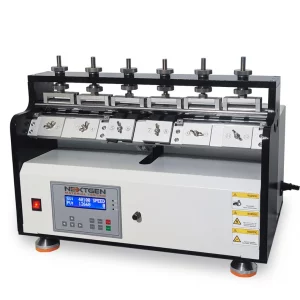 Ross Flex Tester
 evaluates the resistance of vulcanized and synthetic elastomers to cut growth and flex cracking…
Flex cracking testing
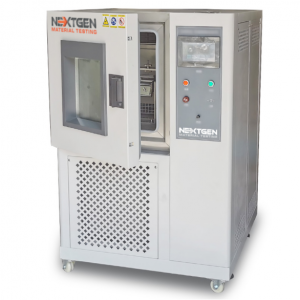 GenRoss-CH – Ross Flex Tester with Low-Temperature Chamber
GenRoss-CH is a Ross flex tester with an integrated low-temperature chamber for evaluating cold resistance and…
Flex cracking testing
Nothing matches that filter. Show all products
FAQs
The Demattia tester is listed under ASTM D813, ASTM D430, ISO 132 and EN ISO 20344. The Ross flex tester is listed under ASTM D1052, ISO 5423 and SATRA TM 60, and the GenRoss-CH adds SATRA TM 92 and HG/T 2411. Contact our team to match a callout to a model.
ASTM D430 covers this case. Its Type I methods create separation in rubber-fabric combinations through controlled bending, and its Type II methods create cracking on the surface of rubber through repeated bending or extension. NextGen's standard page lists tires, belts and rubber-textile composite constructions among its common applications, so confirm which type and endpoint your specification calls for before choosing a tester.
The GenRoss-CH flexes six test pieces of 152 × 25 mm inside a chamber with a range of -20 °C to +150 °C and a temperature fluctuation of ±0.5 °C or less. Cooling from +25 °C to -40 °C takes about 50 minutes without a load, and the counter runs to 9,999,999 cycles. It is used for the cold resistance and folding resistance of shoes and shoe materials.
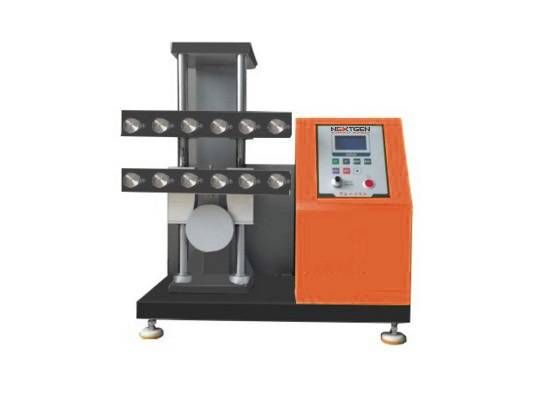
One end of the specimen is clamped and the pierced end sits between two rollers, so each cycle bends the pierced area 90° over a 10 mm rod at 1.7 ±0.08 Hz. After a set number of cycles the operator measures the length of the notch and rates the material by how fast it grew. The NG-ROSS-6 holds six test films and the NG-ROSS-12 holds twelve films or six outsoles.
The choice follows the specimen. On the Demattia tester, GenFlex-B1 takes a long strip of 154 × 25 × 6.3 mm, runs a 57 mm stroke and cycles at 300 ±10 cpm. GenFlex-B2 takes a wider 108 × 70 mm piece, moves it 44 mm and cycles faster, at 340 to 400 ±10 cpm. Both stop automatically when the specimen gives way.