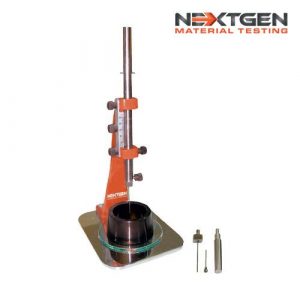
EN ISO 9597 is a cement testing standard used to determine standard consistence, setting times, and soundness (expansion stability) of cement paste. It is commonly referenced for quality control, specification compliance, and production monitoring of common cements.
If you need help matching your lab setup to the exact cited edition (and confirming which procedures are considered reference versus permitted alternatives), you can talk with our team about your application.
EN ISO 9597: Cement — Test methods — Determination of setting time and soundness
This standard defines laboratory methods used to evaluate key early-age cement paste behavior: how much water is needed to reach a defined paste consistency, how quickly the paste transitions from plastic to set, and whether the cement exhibits excessive expansion (unsoundness) under specified conditions.
In many purchasing and QA/QC environments, these results are used as acceptance checks against a cement specification, as well as trend indicators for process control.
Quick definition
Document type: Test methods for cement paste consistency, setting time, and soundness.
Typical use: Routine cement QC/QA to assess whether a cement meets setting-time requirements and expansion (soundness) limits, using standardized apparatus and procedures.
What it produces: Standard consistence (water demand for the specified paste condition), initial and final setting times, and a soundness/expansion outcome based on the specified method.
What this standard covers
EN ISO 9597 addresses three closely related cement paste checks that are commonly paired in cement quality programs:
- Determination of standard consistence of cement paste (a defined reference paste condition used for subsequent checks).
- Determination of initial and final setting times.
- Determination of soundness (a measure of expansion stability under the stated test conditions).
The standard also recognizes that some alternative procedures or equipment may be used when permitted, but reference procedures are used for dispute resolution.
Why this standard matters in testing
Setting behavior and soundness are early indicators of cement performance and production consistency. In practical terms, they help cement producers and users manage:
- Workability and finishing windows: Setting-time results support batching and placement planning.
- Compliance and acceptance: Many cement specifications include setting-time and soundness limits, and this standard provides a standardized way to demonstrate conformity.
- Stability risk: Soundness testing helps identify cements that may exhibit undesirable expansion, supporting durability and dimensional stability expectations.
Common materials, product types, or applications covered
This standard is applied to common cements and to other cementitious materials when their governing specifications call up the methods.
Common applications: Cement manufacturing QC, incoming cement inspection for concrete and precast operations, and lab benchmarking for R&D or troubleshooting when early-age performance shifts.
Common test or verification workflow
While exact procedural details depend on the cited edition, a typical workflow guided by this standard looks like:
- Prepare cement paste and determine water content required to reach the defined standard consistence.
- Using the standardized apparatus, determine initial and final setting times based on penetration criteria at specified intervals.
- Run the soundness check using the specified mould/fixture and conditioning sequence, then record the expansion outcome.
Reporting sensitivity: Results are strongly dependent on apparatus condition, operator technique, environmental conditions, and timing discipline. When results are used for compliance, the exact edition and reference procedure details matter.
Equipment commonly used for this standard
EN ISO 9597 points to standardized cement paste test equipment rather than a universal testing machine. Laboratories typically configure a small, dedicated work area with consistent environmental control and timing discipline.
Common equipment: Vicat apparatus (manual or automatic, as allowed by the cited procedure), Vicat moulds and needles/attachments, Le Chatelier soundness mould and related fixtures, a balance suitable for cement paste batching, mixing tools, timing devices, and conditioning capability appropriate to the method.
Practical selection note: If you are equipping for compliance work, prioritize traceable dimensional conformity of moulds/needles, repeatable penetration measurement, and an equipment package that supports the reference procedure for dispute cases. If you are comparing manual versus automatic Vicat options or need a full cement setting/soundness bench, you can request a detailed quote for a configuration matched to your throughput and reporting needs.
How to read this designation or revision
Core designation: “EN ISO 9597” indicates a European adoption of ISO 9597.
Year/edition: The standard is commonly cited with a publication year (for example, ISO 9597:2008). Your purchase order, quality plan, or customer specification should state the exact edition because permitted equipment options, reference-versus-alternative rules, and reporting expectations can be edition-dependent.
Related standards, methods, or frameworks
EN ISO 9597 is typically invoked by cement product specifications and quality programs that require standardized checks for setting time and soundness. When reviewing requirements, look for companion references that define cement type, sampling, or acceptance limits, then ensure the cited test-method edition aligns with the contract or regulatory requirement.
Get help selecting a compliant cement setting & soundness setup
If you are equipping a lab for EN ISO 9597 work—especially when results will be used for acceptance or dispute resolution—we can help you map the cited edition to an equipment list, accessories, and calibration approach. Share your throughput targets and the edition you need, and contact our team for guidance.