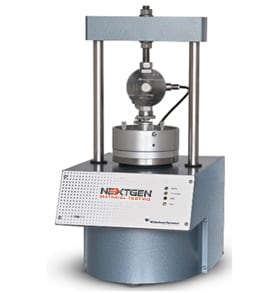
Soil Mechanics Testing Equipment
Soils settle under load, and the oedometer measures how much and how fast. A specimen restrained laterally is loaded vertically in successive increments while water drains through its faces, and the compression and its rate are recorded. The results feed settlement and consolidation-rate estimates for foundations, embankments and structural fills. Incremental consolidation is described in ASTM D2435 and BS 1377-5, and the standard gives two alternative procedures: one with constant load-increment durations and one that advances each increment after primary consolidation. A consolidation series can run for days, so frame stiffness, load accuracy and how little the operator has to touch between steps decide how repeatable the series is.
Two loading methods are offered. The classic frame uses a lever arm carrying dead weights, with a rigid aluminum alloy structure and three lever ratios so one weight set covers a wider stress range. Pneumatic loading removes the weights: a servo-controlled air system applies the increments automatically, around the clock, with results shown live on a PC. Both accept standard consolidation cells in a range of specimen sizes, and both can produce a digital record. The same cell on the front-loading frame serves the consolidation test and the permeability test. Cells, gauges or transducers and software are ordered to suit the specimens. Installation, calibration and training come from NextGen engineers.
For Laboratories
One partner to equip your complete soil mechanics laboratory
Soil testing rarely stops at one machine. NextGen equips the whole geotechnical laboratory, from consolidation and shear testing to triaxial systems, vane apparatus and moisture determination, and stays responsible for it after delivery.
- Equipment, fixtures and software
- Installation, training, calibration
- Lifetime technical support
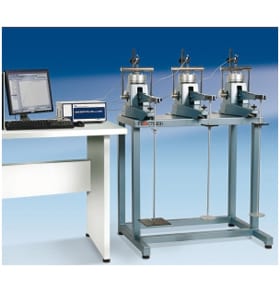 NG-Oedometer – Front-Loading Consolidation Oedometer
NG-Oedometer is a front-loading consolidation test system for determining the rate and magnitude of soil…
View product
Get quote
Most requested
ACE - Automatic Computerized Oedometer
ACE is an automatic computerized oedometer for determining the rate and magnitude of soil consolidation under…
View product
Get quote
NG-Oedometer – Front-Loading Consolidation Oedometer
NG-Oedometer is a front-loading consolidation test system for determining the rate and magnitude of soil…
Consolidation testing
ACE - Automatic Computerized Oedometer
ACE is an automatic computerized oedometer for determining the rate and magnitude of soil consolidation under…
Consolidation testing
NG-Oedometer – Front-Loading Consolidation Oedometer
NG-Oedometer is a front-loading consolidation test system for determining the rate and magnitude of soil…
View product
Get quote
Most requested
ACE - Automatic Computerized Oedometer
ACE is an automatic computerized oedometer for determining the rate and magnitude of soil consolidation under…
View product
Get quote
NG-Oedometer – Front-Loading Consolidation Oedometer
NG-Oedometer is a front-loading consolidation test system for determining the rate and magnitude of soil…
Consolidation testing
ACE - Automatic Computerized Oedometer
ACE is an automatic computerized oedometer for determining the rate and magnitude of soil consolidation under…
Consolidation testing
Nothing matches that filter. Show all products
FAQs
The argument for the automatic ACE is time rather than accuracy alone: a consolidation series runs for days, and every load change made by hand is a chance for it to drift. The ACE runs 24 hours a day and one PC controls up to 60 units. The front-loading frame covers the same standards at a lower cost per position and has a compact footprint, which suits a bank of frames.
Yes. The NG-Oedometer can be fitted with linear potentiometric transducers and connected to a data acquisition unit, so a mechanical frame still produces a digital record. The ACE takes a displacement transducer and a load cell on two analogue channels, with closed loop feedback, and shows results live on the PC. Data can then be processed with Geo-Analysis templates that conform to BS or ASTM standards.
Five cell models cover specimens from 50.47 mm diameter and 20 mm height (20 cm2) through 63.50 mm, 71.40 mm and 75 mm to a 112.80 mm diameter specimen of 25 mm height (100 cm2). The ACE frame accepts standard cells from 50.47 to 112.80 mm diameter, and the NG-Oedometer weight guide lists the same five cell models. Each cell on the ACE carries its own calibration disk.
Compressed air. The ACE loads through a high precision pneumatic servo-valve and needs an air supply of up to 10 bar. Where the laboratory has no air line, the NG-D2015 compressor of 13.2 gallons (50 L) can be used. Consolidation cells, Geo-Analysis templates, test software and the PC are not included and are ordered separately, so tell us the specimen sizes and how many positions you plan to run.
The NG-Oedometer has three hanger positions on the lever arm, giving ratios of 9:1, 10:1 and 11:1, so the same weight set covers a wider range of stresses. The maximum load is quoted at 11:1: 1,848 kg, which is 9.061 MPa on a 20 cm2 specimen of 50.47 mm diameter. A weight application guide on the page pairs each consolidation cell with its beam ratio and weight set.