ASTM D2435/D2435M is a laboratory test method for measuring one-dimensional consolidation behavior of soils under incremental (stepwise) vertical loading while lateral strain is restrained and drainage is provided axially. It is widely used to support settlement and consolidation-rate evaluations for geotechnical design.
If you need help matching this method to your sample type, loading schedule, or reporting expectations on a specific project, you can talk with our team about the best-fit test setup and workflow.
ASTM D2435/D2435M-25: Standard Test Methods for One-Dimensional Consolidation Properties of Soils Using Incremental Loading
This standard describes incremental loading consolidation testing (often performed in an oedometer/consolidation cell) to characterize both the magnitude of compression and the time-dependent rate of deformation under applied vertical stress.
It includes two alternative approaches (Test Method A and Test Method B) that differ primarily in how time–deformation readings are collected and how load increments are advanced.
Quick definition
Document type: Standard test methods.
In plain terms: Measures how a soil specimen compresses over time under stepwise vertical loading, with drainage allowed vertically and sideways deformation prevented.
What this standard covers
ASTM D2435/D2435M covers procedures for determining consolidation behavior when a soil specimen is laterally restrained and drained axially while vertical stress is applied in increments (controlled-stress loading).
The standard describes two alternatives:
- Test Method A: Uses constant load-increment durations (commonly 24 hours or multiples). Timed readings are required on a minimum of two increments; results provide a compression curve with deformations that include both primary consolidation and secondary compression during the increment.
- Test Method B: Requires time–deformation readings on all increments and advances increments after primary consolidation is reached (or at constant times as described in Method A). This approach is used when time-rate information and secondary compression characterization are needed as part of the test output.
Project-defined inputs: The requesting agency typically specifies the load increment magnitudes, sequence, any rebound/unload cycle location, and (for Method A) which increments require time–deformation readings.
Why this standard matters in testing
Incremental loading consolidation results are commonly used in engineering interpretation to estimate the magnitude and rate of settlement under applied loads (for example, structural fills, embankments, and foundations). The measured deformation response is sensitive to specimen disturbance, saturation condition, increment selection, and the duration used at each stress level.
Because time-rate outputs depend on interpreting deformation-versus-time behavior (rather than directly measuring pore water pressure), it is especially important to align the chosen method, timing approach, and specimen condition with the intended use of the data.
Common materials, product types, or applications covered
ASTM D2435/D2435M is most commonly applied to fine-grained soils tested as intact (undisturbed) specimens that were naturally deposited in water and are saturated. It may also be applied to compacted soils or soils formed by other processes (such as weathered/residual soils), but the evaluation of time-rate behavior is typically tied to fully saturated conditions and may require additional care in interpretation for other soil types.
Common applications: Consolidation/settlement characterization for geotechnical design, earthwork performance evaluation, and laboratory assessment of compressibility under stepwise loading.
Common test or verification workflow
While the standard document defines the detailed procedure and reporting, a typical ASTM D2435/D2435M workflow includes preparing a laterally confined specimen in a consolidation cell, applying vertical stress in increments, and recording deformation with time to build the compression curve and (where applicable) time-rate parameters.
Common workflow elements: specimen trimming and seating in a rigid ring, axial drainage through porous media, incremental loading/unloading as specified, time–deformation data collection, and calculation/reporting aligned to the selected method and interpretation approach.
Equipment commonly used for this standard
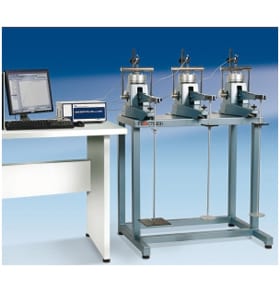
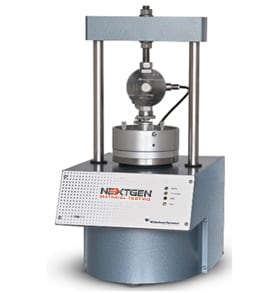
ASTM D2435/D2435M is commonly run on a consolidation (oedometer) test system designed to apply controlled vertical stress increments while measuring small deformations over time.
Common equipment families: consolidation load frames (deadweight lever arm, pneumatic, or servo-controlled loading), consolidation cells with rigid confining rings, porous stones and filter media for axial drainage, displacement measurement (dial indicator or LVDT) with stable mounting, and data acquisition/software for timed readings.
If you are configuring a consolidation system around load capacity, number of stations, automated loading, and timed data capture, you can request a detailed quote for an equipment package that fits the way your lab runs D2435/D2435M programs.
How to read this designation or revision
D2435/D2435M: An ASTM Committee D18 soil and rock standard issued in a dual-units format (inch-pound and SI). The “/M” designation indicates the metric companion designation used with the same technical content.
-25: The year suffix identifies the edition year of the document being cited. Test requirements, calculations, and reporting details can vary by edition, so procurement documents and lab reports should cite the complete designation (including the year) used for the work.
Related standards, methods, or frameworks when useful
ASTM D4186/D4186M: Referenced within ASTM D2435/D2435M for one-dimensional consolidation testing performed using controlled-strain loading (as contrasted with incremental controlled-stress loading).
Get help selecting a D2435/D2435M consolidation setup
For labs adding stations, moving from manual to automated increments, or tightening time–deformation data capture, we can help align frame type, displacement measurement, and control/software features to your preferred D2435/D2435M workflow. To compare configurations and pricing, ask for a quote.