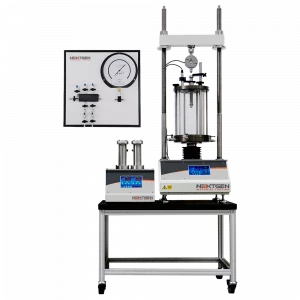
ASTM D7181-20 is a standard test method for running a consolidated drained (CD) triaxial compression test to determine drained shear strength and stress–strain behavior of soil specimens.
It is commonly used in geotechnical lab programs that support foundation design, slope/embankment stability, and earth pressure evaluations where drainage during loading is a reasonable field assumption. If you need help matching your project goals to a CD triaxial test setup and reporting basis, talk with our team.
ASTM D7181-20 — Standard Test Method for Consolidated Drained Triaxial Compression Test for Soils
This method covers triaxial compression testing of cylindrical specimens (intact or reconstituted) that are consolidated and then sheared in compression under drained conditions using strain-controlled axial loading.
The test is typically selected when the design needs effective-stress strength parameters under conditions where pore pressures can dissipate during shearing (that is, excess pore pressure is intended to be negligible during the shear phase).
Quick definition
Document type: Test method.
What it measures: Drained shear strength behavior and stress–strain response from a CD triaxial compression test, using measurements such as axial load, axial deformation, and volumetric change to calculate stresses/strains and support strength interpretation.
Common output targets: Data used to develop effective-stress strength relationships (often used to support Mohr-type strength envelope development outside the test method itself).
What This Standard Covers
ASTM D7181-20 describes a drained triaxial compression approach where a soil specimen is first consolidated under a specified effective confining stress and then sheared at a controlled axial strain rate slow enough to allow drainage during shear.
The standard is focused on producing test data (loads, deformations, and volume change) that can be used to calculate principal stresses and stress–strain relationships for the tested conditions. Interpreting results into design parameters and envelopes is typically performed by qualified engineering staff and is not the same as running the bench procedure.
Why This Standard Matters in Testing
CD triaxial results are widely used when project decisions depend on effective-stress strength under drained loading—especially for long-term or slow-loading conditions where pore pressures are expected to dissipate.
This method can be time-intensive for low-permeability or cohesive soils because consolidation and drained shearing may require extended durations to maintain drained conditions.
Common Materials, Product Types, or Applications Covered
Common materials: Intact and reconstituted soil specimens prepared as cylindrical test specimens.
Common applications: Geotechnical characterization supporting embankment/slope stability checks, earth pressure evaluations, and foundation design where drained strength is appropriate for the design case.
Common Test or Verification Workflow
Most ASTM D7181-20 programs follow a pattern of specimen preparation, consolidation under a specified effective stress condition, then drained shearing at a controlled axial deformation rate while recording the required measurements.
Common workflow elements: Define target effective consolidation stresses (often multiple levels using separate specimens), consolidate to the target condition, verify drainage behavior during shear through appropriate control/measurement, and report stresses/strains and volume change behavior for the specified conditions.
Practical note: Because the method is sensitive to drainage conditions and rate control, equipment capability and control stability (pressure and deformation) are central to getting usable data.
Equipment Commonly Used for This Standard
ASTM D7181-20 typically points to a triaxial testing system that can apply confining pressure, control axial deformation (strain-controlled loading), and measure specimen response during consolidation and shear.
Common equipment families: Triaxial load frame (strain-controlled), triaxial cell and accessories, pressure/volume control for cell and drainage/back-pressure functions as applicable, axial load measurement (load cell), axial deformation measurement (displacement transducer/LVDT), and volumetric change measurement suitable for drained testing.
Quoting caution: The best configuration depends on specimen size range, pressure capacity, required resolution for volume change and deformation, and whether your workflow needs automated pressure/volume controllers and integrated data acquisition. If you are specifying a new system or upgrading controls, you can request a detailed quote based on your specimen size and pressure range.
How to Read This Designation or Revision
In ASTM D7181-20, the “D” indicates an ASTM standard in the soil/rock/materials area, “7181” is the unique standard number, and “-20” indicates the year of the referenced edition (2020).
ASTM standards may also be cited with additional notation in other contexts (such as a year in parentheses for reapproval or an editorial-change marker). When a project specification cites ASTM D7181, always confirm the exact year/edition required before locking in procedures, reporting expectations, or acceptance language.
Related Standards, Methods, or Frameworks
ASTM D7181-20 is commonly used alongside other geotechnical laboratory standards that address terminology, lab qualification/competency expectations, and reporting/rounding practices.
Often referenced alongside: ASTM D653 (soil and rock terminology), ASTM D3740 (practice addressing competence for agencies performing soil and rock testing), and ASTM D6026 (practice for significant digits and rounding in geotechnical data).
Get help selecting a D7181-20 triaxial system configuration
If you are building or modernizing a CD triaxial workflow—cell pressure range, specimen size, sensors, and pressure/volume control package—our team can help translate your D7181-20 test plan into an equipment configuration and accessories list. Share your requirements and contact our team.