Automatic Triaxial Testing System

Soil Mechanics Testing Equipment
Standards
ASTM D7181-20, ASTM D1883-07, ASTM D2166, ASTM D2850, ASTM D4767




Description
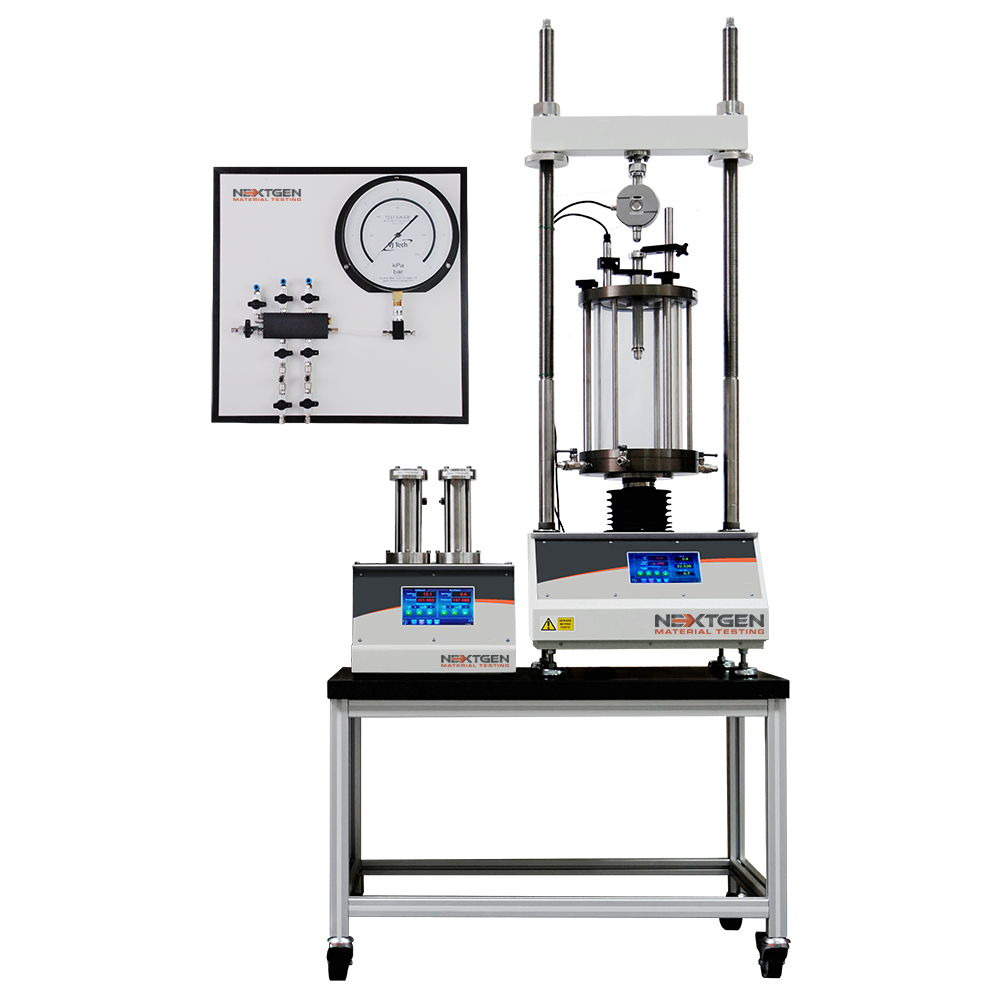
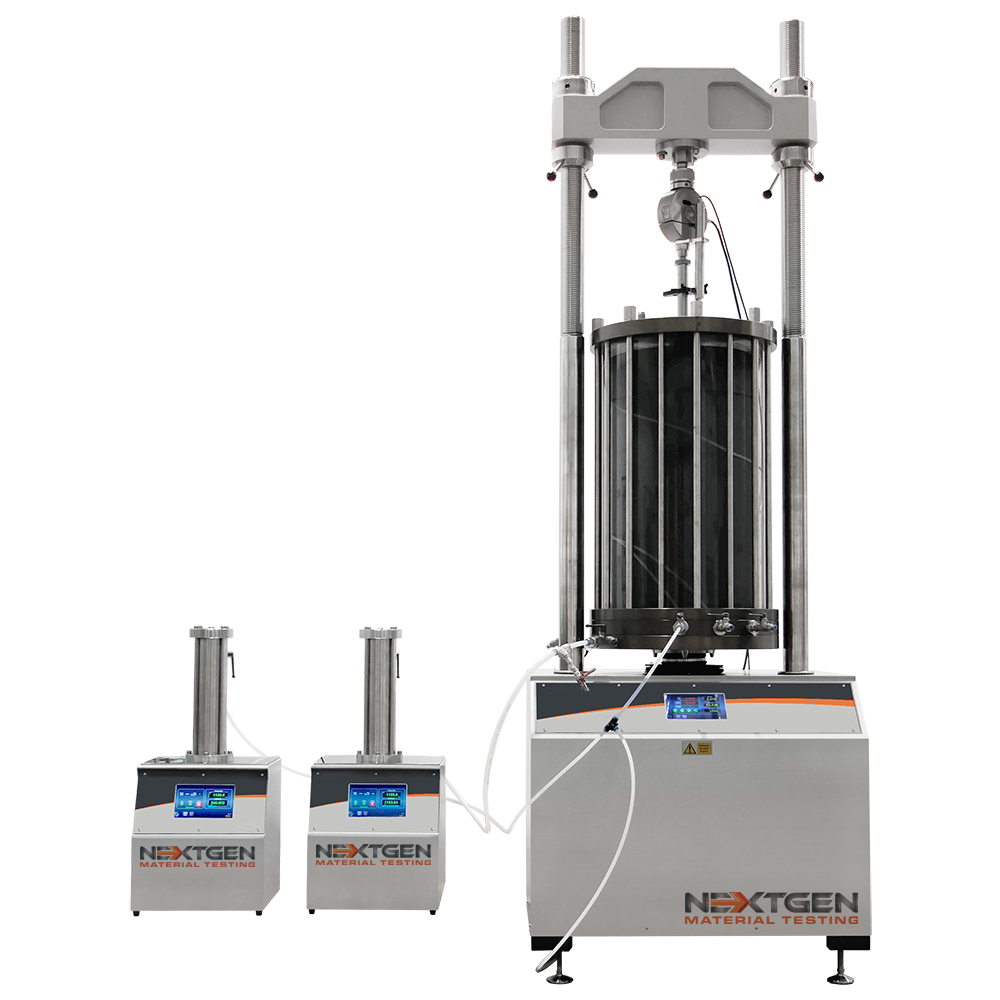
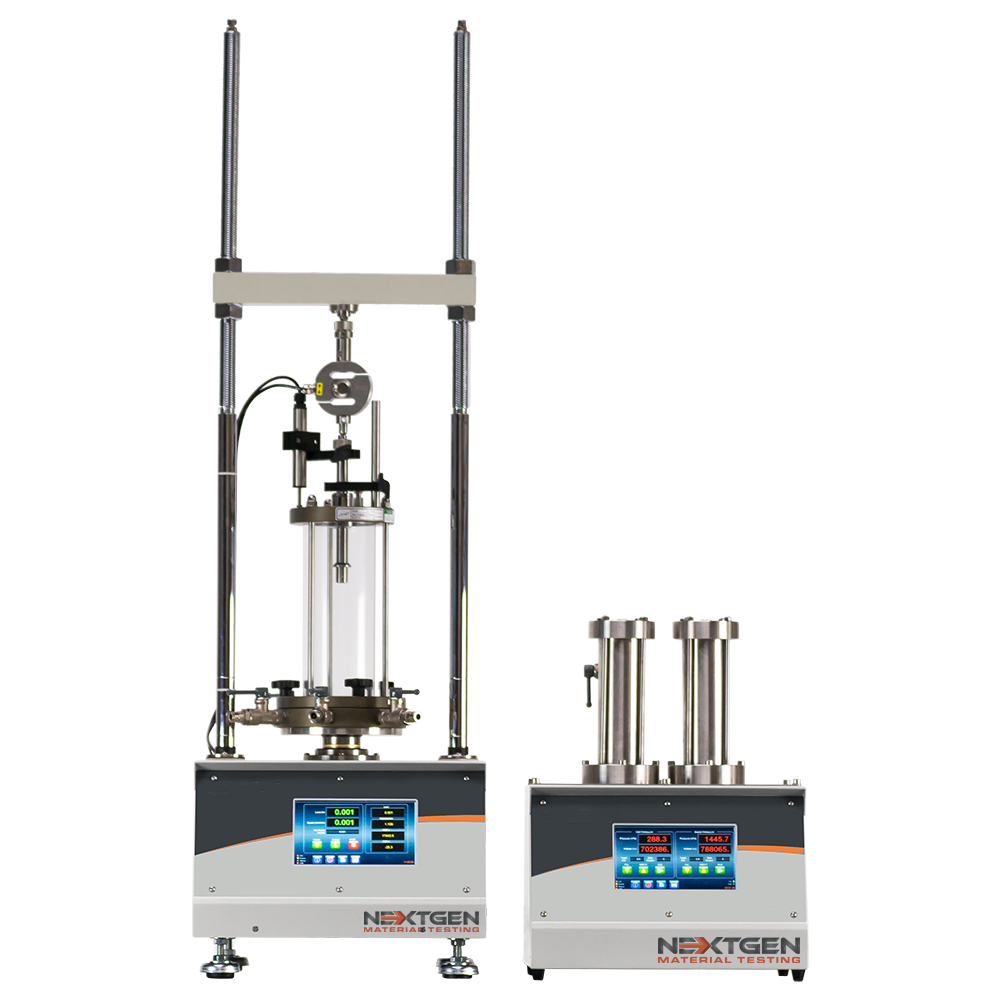
Our Automatic Triaxial Testing System is expertly designed to deliver fully automated total and effective triaxial testing for samples with diameters up to 300 mm and loads reaching up to 250 kN. This static triaxial system efficiently performs a range of tests, including Consolidated Drained (CD), Consolidated Undrained (CU), Unconsolidated Undrained (UU), Stress Path tests, and Slow Cyclic Testing at frequencies up to 0.1 Hz, depending on the amplitude.
Central to the system is the Pro Dual Automatic Pressure Controller, engineered to control and measure both cell and back pressure, as well as volume, for pressures up to 3500 kPa. For projects requiring even higher pressures, we offer advanced systems tailored to your specific needs. Moreover, the static triaxial system is seamlessly integrated with our advanced Clisp Studio software, providing a user-friendly interface for test setup and monitoring via USB or Ethernet connection.
The Clisp Studio software enables real-time display of test results and comprehensive post-test analysis, allowing for the generation and export of detailed reports for further evaluation on a PC. Hence, this combination of precision engineering and advanced software ensures that the Pro Automatic Triaxial Testing System delivers reliable, accurate results for all your geotechnical testing needs.
Automatic Triaxial Testing System Features
-
Advanced stress path control, including K0, anisotropic, and Slow Cyclic testing up to 0.1 Hz, dependent on amplitude.
-
Equipped with 9 analogue and 1 digital channel input for comprehensive data acquisition.
-
Built-in logger providing high-speed sensor data conversion with 24-bit resolution, capable of up to 5000 samples per second.
-
Closed-loop control for precise management of displacement, load, speed, and pressure modes.
-
Flexibility to adjust PID settings for a wide range of samples, accommodating both stiff and soft soils.
-
Auto engage function for easily applying seating loads.
-
Soft limits are adjustable for all channels to ensure precision and safety.
-
Standalone use via a touchscreen display, with data export capabilities to a PC.
-
Built-in live data table and graphing features for real-time monitoring.
-
Automatic protection for both mechanical and sensor limits, with built-in auto-reverse from limit switch activation.
-
Multiple units can be controlled from a single PC through LAN or Ethernet/USB hub connections.
-
USB or Ethernet connectivity for PC control.
Automatic Triaxial Testing System Technical Specifications
| Model | Pro Automatic Triaxial Testing System |
| Load Range (kN) | 10, 50, 100, 250, 500 |
| Pressure Range | 1, 3.5, 7, 14, 70 |
| Sample Sizes diameter (mm) | 35, 38, 50, 63.5, 70, 75, 100, 150, 300, 315 mm dia (Other sizes available upon request) |
| PC Connectivity |
USB or Ethernet |
Static Triaxial System Accessories
-
External Displacement Sensors: Available in various displacement ranges, common sizes (mm) are 10, 25, 50, 100.
-
External Load Cells: Used for standard UU, CIU, and CID tests. Available capacities (kN) are 5, 10, 20, and 50.
-
Internal Submersible Load Cells: Our Internal Submersible Load Cells are expertly pressure compensated and strategically positioned within the Triaxial Cell or Pressure Chamber, making them essential for advanced geotechnical testing. These load cells are specifically required for conducting Anisotropic/k0 Consolidation and Extension Tests, ensuring precise and reliable data. Available in a range of load capacities, including 5 kN, 10 kN, 25 kN, and 50 kN, these versatile load cells cater to various testing needs. Additional sizes can be provided upon request to meet the specific requirements of your geotechnical projects.
-
External Pressure Transducers: Used for PwP measurement. Require a De-airing Block.
-
Internal Pressure Transducers: Allows for mid-height PwP Measurement. The sensor is mounted directly on the Sample.
-
Transducer Access Ring: Upgrades your Triaxial Cell to acccommodate internal sensors, allowing the cables to exit the Chamber without leakage.
-
Top Cap & Base Pedestals (Triaxial): Our Top Caps and Base Pedestals are designed for versatility, available in a variety of sizes to ensure seamless interchangeability within your Triaxial Cell. The Top Caps are offered in multiple types to suit different testing requirements, including Domed (Compression only), Fixed (Compression and Extension), and Suction (Compression and Extension). This flexibility allows for precise and efficient adaptation to various geotechnical testing scenarios, enhancing the overall performance and reliability of your testing equipment.
-
Internal Submersible LVDT Kit (Triax): Includes one radial caliper, two axial brackets, and three LVDT sensors.
-
Bender Elements: Vertical and Horizontal positions.
-
De-aired water system: De-aired water tank (4.2 Gal / 19 liter capacity) availability in hard anodised or stainless steel for durability. Vacuum pump is required, ordered separately.
-
Automatic Solenoid Valve: The Solenoid Valve is a key component for achieving complete automation in your geotechnical testing processes. By automatically opening and closing valves, it eliminates the need for manual intervention, streamlining operations and enhancing efficiency. This automation is seamlessly managed through advanced software integration, ensuring precise control and reliability throughout your testing procedures.
-
APC Water & Air Distribution Panel: Our system assists users in efficiently filling and emptying Pressure Controllers, Triaxial Cells, and other pressure chambers. We offer a variety of panel sizes designed to connect multiple devices, providing flexibility and ease of use. These panels can be supplied with or without a mechanical pressure gauge, offering an independent reference point for enhanced accuracy and reliability in your geotechnical testing setup.
-
Porous Stones
-
Filter Paper
Automatic Triaxial Testing System Value in the Market
The Triaxial Testing System is a game-changer in the geotechnical testing market, offering a blend of cutting-edge technology, automation, and flexibility that addresses the diverse needs of soil mechanics testing. Its value lies in the ability to conduct a wide range of tests—including CD, CU, UU, and K0 tests. All of this simultaneously with ensuring high precision and reliability. The system’s advanced software integration allows for real-time monitoring and data analysis, significantly reducing the time and effort required for manual operations.
Speaking of value in the market, this means enhanced efficiency, greater accuracy, and the ability to handle complex testing scenarios with ease. The Triaxial Testing System’s capacity to deliver consistent and repeatable results makes it a crucial tool for geotechnical engineers and researchers. This leads to more informed decision-making in construction, infrastructure development, and other areas where soil stability and performance are critical. Thus, our Triaxial Testing System is a valuable asset in the competitive landscape of geotechnical testing equipment.
Related Products
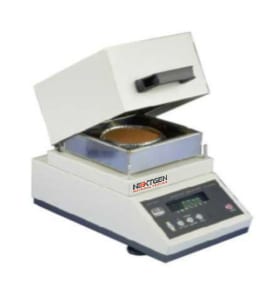
Moisture Determination Balance - GenMoist
GenMoist is designed to automatically and simultaneously dry and weight a solid sample for the determination of moisture content. The machine provides a continuous direct readout for both the weight and the percentage moisture loss through the entire cycle. It has a build-in timer.
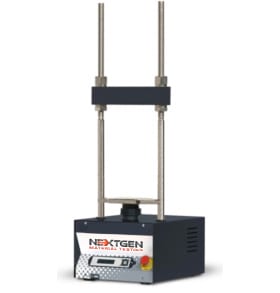
MULTISPEED Digital Automatic Universal Tester for Displacement Controlled Tests
The new MULTISPEED tester is the ideal solution for Road testing laboratory. The 50 kN capacity and the fully variable test speed of 0.2 to 51 mm/min make it possible to perform not only the CBR and Marshall tests, but many other applications as for instance Indirect Tensile test, Quick Triaxial tests, Unconfined and Uniaxial soil testing and, in general, all test to be performed under displacement control. The machine can be equipped with analogical or digital load/displacement measurement systems as well as with the specific accessories, to suit either the field or central laboratory requirement.
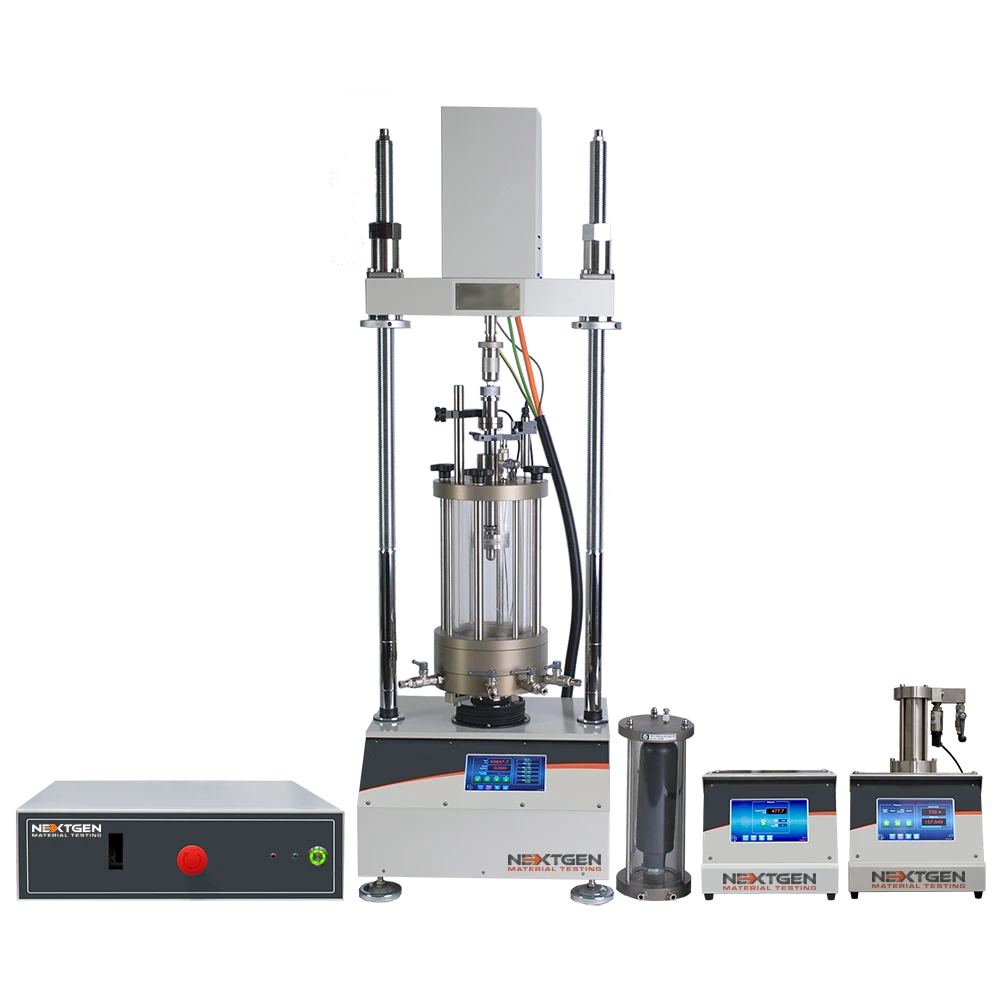
Dynamic Triaxial Systems 1000 kPa
Dynatriax systems are ideal for commercial and research laboratories for the following applications: Liquefaction potential, Strength degradation due to cyclic loading, Shear modulus and damping ratio, resilient modulus, Effects of blasting in mines and quarries, Effect of ocean waves on costal and off shore structures.
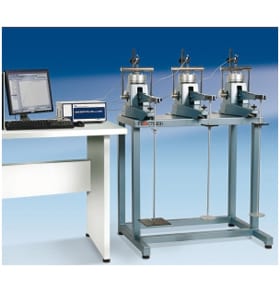
NG-Oedometer - Front Loading Oedometers - Consolidation Test
This test determines the rate and magnitude of consolidation of a soil specimen restrained laterally and subjected to a number of successive increments of vertical loads.
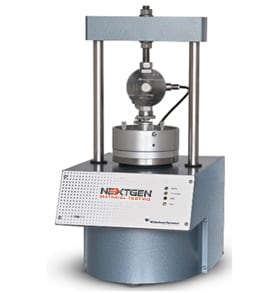
ACE - Automatic Computerized Oedometer
ACE - is the most advanced automatic computerized oedometer for testing soil consolidation that can measure the response of soil specimens.
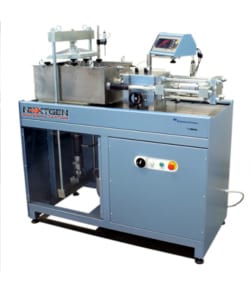
Shearmatic 300 - Large Shear Testing Machine
The SHEARMATIC 300 automatic machine is ideal for testing geosyntetics and also soil and other materials that contain large particles of up to 20 mm largest dimension. Sample size up to 300 mm square can be tested, with inserts allowing the testing of smaller sample sizes. See accessories.
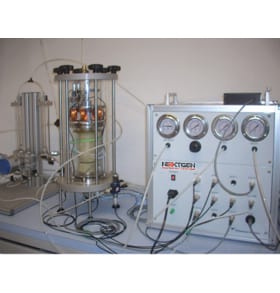
Resonant Column and Torsional Shear Tester
RESONANT COLUMN combines the features of both resonant column and torsional shear into a single unit including the current driven motor to apply torsional load to sample, a series of transducers with signal conditioning, a cell and back pressure electro-pneumatic control system and a data logger.
Automatic Shear Testing Machine
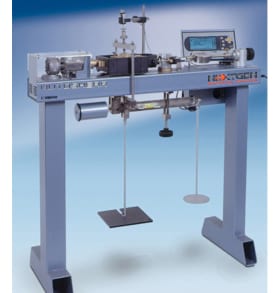
The microprocessor control system, therefore, allows the machine to work as an automatic stand-alone unit: the test measurements (force and displacements) a re directly displayed and stored in memory according to pre-set recording modes. The PC is only temporary required to download the test data via the RS 232 port once the test is completed. The data can be processed by the Direct and residual shear Geo-Analysis templates. See accessories.
Shearmatic - Automatic Shear Testing Machine
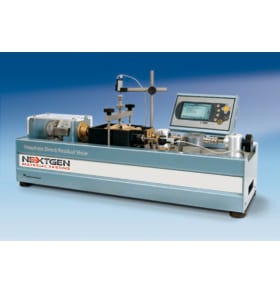
This microprocessor based advanced model, is a stand-alone machine, driven by a high-resolution stepper motor with epicyclical reduction gear with reduced backlash. Incorporate a pneumatic closed loop system for the automatic application of the axial pressure by a high performance pressure regulator, with the main advantage of eliminating the manual loading of the dead weights. Excellent and high resistance techno-polymeric material has been adopted for the carriage of the shear box. It offers excellent resistance to corrosion, wear and tear and is resistant to all chemicals found in a soil specimen. The carriage is lightweight and easy to clean.
Laboratory Vane Apparatus
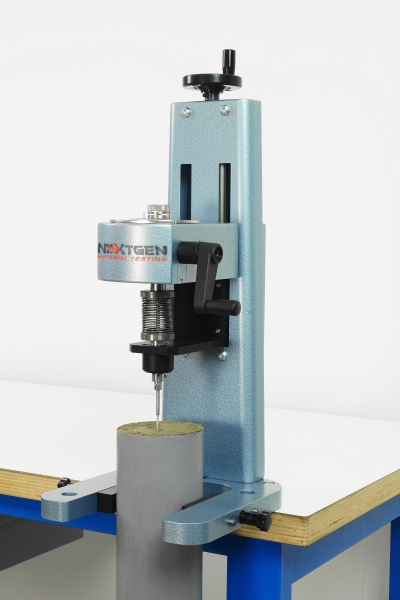
The laboratory vane apparatus is based on an original concept of the Transport and Road Research Laboratory of the United Kingdom. It offers versatility with a variety of vane sizes available. Typically it comes with the standard 12.7 mm square vane along with a set of four calibrated springs. Testing can be conducted either directly on the sample or within the sampling tube. For the latter, the NG-WF1738 Attachment for 38 and 100 mm diameter sampling tubes is recommended for optimal performance.