Heat deflection temperature, HDT, is the temperature at which a plastic bar under a set flexural stress bends by the amount the standard defines while the bath around it heats at a constant rate. It shows how much heat a material can take while it still carries load, and it is measured to ASTM D648 in North America and to ISO 75 internationally.
What the HDT Test Measures
In an HDT test a rectangular bar rests on two supports in the edgewise position and a loading nose applies a fixed flexural stress at mid span. The specimen sits in a heat transfer liquid that heats at a controlled linear rate, and the temperature is recorded when the deflection reaches the endpoint the method sets. The result is a single temperature, which makes grades and suppliers easy to compare.
HDT is a comparison value rather than a service temperature. A molded part differs from the test bar in thickness, molding stresses and the load it carries, so two materials with the same HDT can still behave differently in use. Laboratories use HDT for material selection, product qualification, incoming inspection and checking that a batch matches its datasheet.
Standards for HDT Testing
ASTM D648 is the North American reference method for deflection temperature under flexural load. ISO 75 is published in parts: ISO 75-1 sets out the general method, ISO 75-2 covers most plastics and ebonite, and ISO 75-3 covers high-strength thermosetting laminates and long-fibre-reinforced plastics, which are tested on a longer span. A result is only meaningful together with the method and the stress level used, so both are reported with every value.
What Affects HDT Results
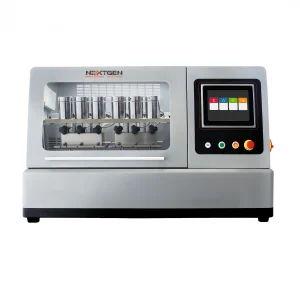
The stress level, the heating rate and the specimen dimensions all move the result. The bath has to stay even around every specimen during the ramp, and deflection has to be read by the instrument rather than by eye. On the NG-HDT a Class A PT100 sensor follows the bath temperature, an LVDT tracks deflection, and turbulence suppression with cyclic heating keeps the bath steady while it heats.
HDT Testing Equipment from NextGen
The NG-HDT runs HDT and Vicat on one frame, with preset methods for ASTM, ISO and GB/T standards and custom methods for internal procedures or customer specifications. A long-span option covers ISO 75-3 specimens. An external chiller, oil-vapor extraction and nitrogen protection of the oil surface suit laboratories that run high-temperature tests every day. See the NG-HDT HDT/Vicat testing machine.