Vicat Softening Temperature (VST) Testing Equipment

Vicat Softening Temperature (VST) Testing Equipment

Vicat softening temperature, VST, is the temperature at which a flat-tipped needle under a set load sinks into a thermoplastic specimen to the depth the standard defines while the bath heats at a constant rate. It marks the point where the material starts to soften, and it is measured to ASTM D1525 and ISO 306, with a separate method for pipes and fittings.

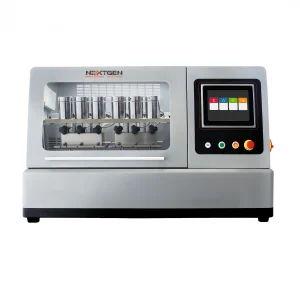
Vicat testing at NextGen runs on the NG-HDT HDT/Vicat testing machine. Several specimens are tested in one oil bath run, and the needle load, heating and penetration reading follow the preset method chosen on the touchscreen, so the endpoint does not depend on the operator. Heat deflection runs on the same frame. The machine is installed and calibrated on site, your team is trained on it, and support continues for its life.

Read More...


What the Vicat Test Measures

In a Vicat test the specimen lies flat in the bath and a needle with a small flat tip rests on it under a fixed load. The bath heats at a controlled linear rate, and the instrument records the temperature at which the needle has penetrated to the depth the method sets. Because the needle measures local softening rather than the bending of a bar, Vicat and HDT give different temperatures for the same material and answer different questions.

Vicat Testing for Pipes and Fittings

Thermoplastic pipes and fittings are often specified by their Vicat softening temperature. ISO 2507 sets the method and conditions for samples taken from pipes and fittings, so the result reflects the material as it was processed into the product rather than a separately molded plaque. GB/T 8802 covers the same application.

Standards for Vicat Testing

ASTM D1525 is the North American reference method and ISO 306 the international one. Both define standard combinations of load and heating rate, so the condition set is reported together with every result, and values measured under different conditions are not compared directly.

What Affects Vicat Results

Load, heating rate and specimen thickness all change the result, and a specimen that is not flat or not seated squarely gives an early reading. A steady bath matters as much as the needle: on the NG-HDT a Class A PT100 sensor follows the bath temperature and an LVDT reads penetration, so the endpoint is detected by the instrument.

Vicat Testing Equipment from NextGen

The NG-HDT has built-in presets for ASTM D1525, ISO 306, ISO 2507 and GB/T Vicat methods, and custom methods with user-defined load, heating rate and endpoint for internal procedures. Test data can be saved, searched and exported over Ethernet. See the NG-HDT HDT/Vicat testing machine.

For Laboratories

One partner to equip your complete plastics laboratory

Vicat testing is one station of a plastics laboratory. NextGen equips the rest of it too, from tensile and flexural testing to impact, hardness and melt flow systems, and stays responsible for it after delivery.

  • Equipment, fixtures and software
  • Installation, training, calibration
  • Lifetime technical support

Build My Plastics Lab