Rock Shear Box Apparatus

Trust
Rock Shear Box Apparatus

Standards

Ultimate User-Friendliness
Leading Dependability and Reliability
NIST Certified Consumables
Strict Compliance with Industry Standards
Stocked Consumables and Spares
Trusted After Sales Technical Support
Lifetime Product Support Advantage

Description

This apparatus was originally developed at Imperial College, London, by Professor E. Hoek. It is a simple and practical method of determining the strength and slope stability of rock, both in the field and in the laboratory, and it is the equipment behind the direct shear test on rock discontinuities described in ASTM D5607.

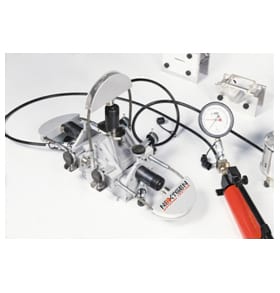
The shear box accepts samples no larger than 4.5 × 4.9″ (115 × 125 mm), or cores up to 4″ (102 mm) diameter. It is built in two halves: the upper half is connected to two rams that give a reversible shearing action, and the lower half to a ram that applies the normal load. Loads are read from Bourdon tube gauges, or taken from pressure transducers into an external data logger.

The normal loading system carries an adjustable low friction pressure maintainer. It absorbs the volume change of the specimen while shearing is under way, which is what keeps the vertical stress constant through the test rather than letting it drift as the specimen dilates. Read more in our rock mechanics blog.

Gauge Range50 kN
Core DiameterØ4″ (102 mm)
Versions2
Weight99 lbs (45 kg)

NG-ShearBox Versions

Two versions are available. They run the same test on the same frame, and differ in how the readings are taken: by eye from digital gauges, or electrically into a logger.

NG-ShearBox/A
Supplied with five digital gauges, 25 × 0.001 mm, four vertical and one horizontal; two mould formers; two hand operated pumps for lateral and vertical load, fitted with Bourdon gauges. The vertical load pump carries a pressure maintainer to hold the load uniform through the test.
NG-ShearBox/D
Supplied with five potentiometric transducers with 25 mm travel, four vertical and one horizontal; two mould formers; two hand operated pumps for lateral and vertical load with Bourdon gauges; and two pressure transducers that take the load values directly into an external data logger, supplied as an accessory. The vertical load pump carries the same pressure maintainer.

The /D version is the one to choose when the test has to produce a recorded curve rather than a set of readings written down by the operator; the multipurpose data logger for automatic data acquisition is ordered with it.


NG-ShearBox Technical Specifications

The frame is small enough to be carried to a site, which is the point of the design: the same box is used in the field and on the bench.

Specification NG-ShearBox
Gauges range 50 kN × 1 kN
Maximum sample size 4.5 × 4.9″ (115 × 125 mm), or cores up to Ø4″ (Ø102 mm)
Overall dimensions, frame only 18.1 × 9.8 × 23.6″ (46 × 25 × 60 cm)
Approximate weight 99 lbs (45 kg)

Where the strength of the intact rock is wanted rather than the strength of a joint, the point load tester gives an index in the field with almost no specimen preparation.

Have Questions or Need to Confirm a Detail?

Tell us whether you read the test by gauge or log it, and the size of the samples you shear, and we will confirm which version fits and what the logger has to handle. Send a quick request online with those two details.

For Laboratories

Need Additional Quality Control Equipment to Build Your Laboratory?

Rock shear testing is only one part of a complete quality control laboratory. NextGen can help you equip your entire lab with coring machines, core cutters and grinders, point load testers, shear box apparatus, abrasivity testers, and other supporting solutions, all coordinated as one complete project.

  • One partner to equip your complete laboratory
  • Installation, training, calibration
  • Support for the life of the equipment

Related Products

CoreGrind 3000 – Automatic Core Grinding Machine

CoreGrind 3000 – Automatic Core Grinding Machine

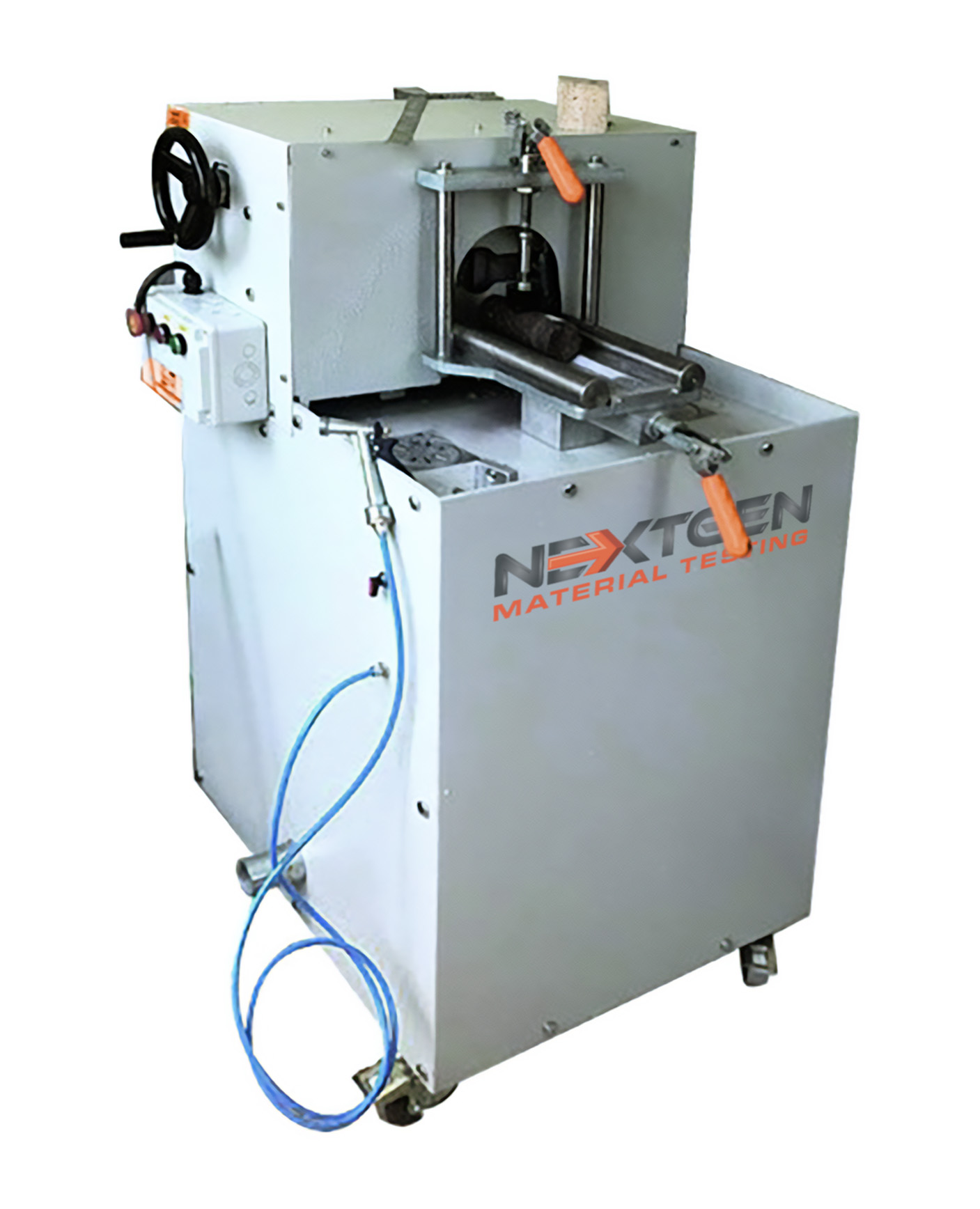
CoreGrind 3000 is a fully automatic core grinding machine for preparing rock core specimens before geotechnical and rock mechanics testing. It uses a 7-inch touchscreen control system, pneumatic sample locking, recipe-based operation, adjustable grinding steps, recirculating water spray for dust control, process memory, and diamond blade life monitoring to improve repeatability, safety, and throughput in sample preparation workflows.

Read more

NG-CoreGrind 1000 – Semi-Automatic Core Grinding Machine

NG-CoreGrind 1000 – Semi-Automatic Core Grinding Machine

NG-CoreGrind 1000 is a semi-automatic core grinding machine for preparing rock and concrete specimens as an alternative to traditional rubber or sulfur capping. Designed for quality-control and geotechnical laboratories, it helps produce flatter, more consistent specimen ends before compression and rock mechanics testing. Its controlled grinding workflow supports safer, cleaner preparation while improving repeatability compared with manual end finishing or capping methods.

Read more

West Cerchar Abrasivity Index Tester

West Cerchar Abrasivity Index Tester

The West Cerchar Abrasivity Index Tester measures rock abrasivity for mining, tunneling, and underground construction applications. Built around ASTM D7625-10, it uses a stationary stylus, 70 N deadweight, rigid load frame, clamping vice, and two-axis cross table for controlled scratch testing. A 0.01 mm graduated knob, optional indenter visualization system, spare indenters, and sharpening tool support repeatable CAI determination.

Read more

Rock Core Cutter and Masonry Saw

Rock Core Cutter and Masonry Saw

The Rock Core Cutter and Masonry Saw is a universal cutting system for concrete, rock cores, and irregular rock samples. Available with 450 mm or 600 mm blade configurations, it supports geometrically defined specimen preparation for geotechnical, construction, and research laboratories. Water circulation, secure clamping, deep cutting capacity, and optional custom fixtures help produce cleaner cuts while protecting specimen integrity.

Read more

Portable Point Load Tester

Portable Point Load Tester

The Point Load Tester is a portable rock strength testing system for fast field and laboratory assessment of core samples and irregular rock fragments. It determines the point load strength index to help estimate UCS, classify rock, assess anisotropy, identify weathering zones, and predict drilling behavior. A reinforced horizontal frame, carbide loading heads, digital force measurement, LCD readout, and battery power support reliable on-site geotechnical testing.

Read more

CoreTrim 3000 – Core Cutting Machine

CoreTrim 3000 – Core Cutting Machine

CoreTrim 3000 is a fully automatic core cutting machine for preparing cylindrical rock specimens before laboratory testing. It cuts cores from 38 to 100 mm diameter, handles up to three 100 × 200 mm samples per cycle, and completes automatic cycles in about 120 seconds. Electronic control, water spray dust reduction, 0.1° cutting angle accuracy, and automatic blade return support repeatable sample preparation.

Read more

Laboratory Coring Machine and Bits

Laboratory Coring Machine and Bits

The Laboratory Coring Machine and Bits system is designed for extracting clean cylindrical cores from rock, concrete, and similar hard materials. With an 1800 W motor, two coring speeds, a 28–60 mm coring range, secure clamping, and a transparent protective cylinder, it helps geotechnical and construction-materials laboratories prepare stable, accurately sized specimens for compression, analysis, and quality-control testing.

Read more

NG-CoreGrind 2000 – Double-Faced Rock Core Grinder

NG-CoreGrind 2000 – Double-Faced Rock Core Grinder

NG-CoreGrind 2000 is a double-faced rock core grinder for preparing flat, parallel specimen ends before rock mechanics and concrete testing. It is built to grind and polish rock cores, concrete specimens, natural stone, and ceramic materials with controlled, repeatable surface finishing. Suitable for geotechnical, construction-materials, and research laboratories, it supports standards-oriented sample preparation where geometry, alignment, and end-face quality directly affect test accuracy.

Read more