
Metal Testing Equipment
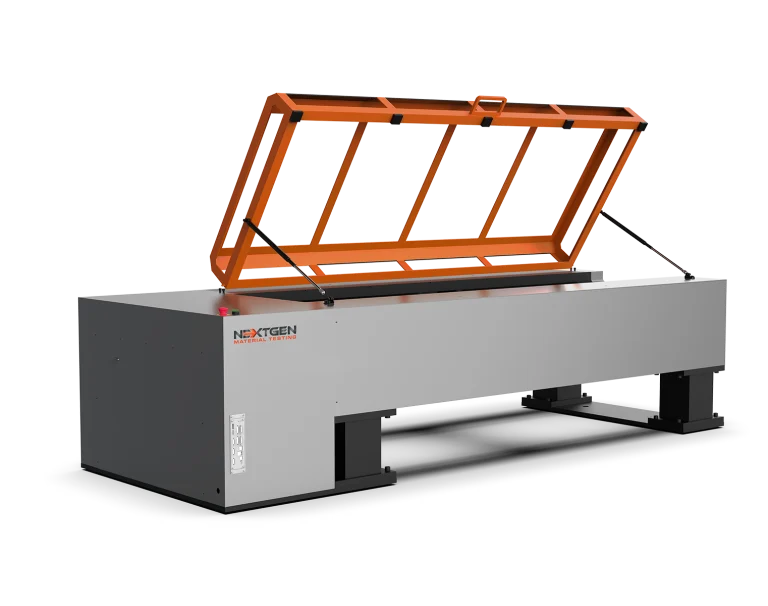
Some specimens cannot be tested standing up. Strand, cable, chain, webbing and pipe need travel measured in metres rather than centimetres, and a vertical column has nowhere to put it. A horizontal frame lays the test out along the floor instead. NextGen builds horizontal machines for that work, verified to ISO 7500-1 and ASTM E4.
The frame carries long travel while keeping the load path straight, and takes the same grips, load cells and software used across the rest of the range, so methods and records stay consistent with the vertical machines beside it. Installation, calibration and operator training are done on site, and support continues for the life of the frame.
For Laboratories
One partner to equip your complete metals laboratory
A horizontal frame covers one part of a metals laboratory. NextGen equips the rest of it too, from impact and hardness testing to metallography and specimen preparation, and stays responsible for it after delivery.
- Equipment, fixtures and software
- Installation, training, calibration
- Lifetime technical support
Nothing matches that filter. Show all products
FAQs
Choose horizontal when specimen length, weight, geometry or expected elongation makes vertical testing impractical. Strand, cable, chain, webbing and pipe need travel measured in meters, and a horizontal bed lets long products lie along the frame instead of being lifted into a column. It also improves loading access and supports guarding for high-force breaking tests.
Supported methods include ASTM E8/E8M and ISO 6892-1 for tension, ASTM A931 and ISO 3108 for wire rope breaking force, and EN ISO 15630-1 for reinforcing bars. Force is verified to ASTM E4 and ISO 7500-1. Force reading accuracy is within 1 percent, Class 1.
The test area can be fitted with protective shielding or a fully enclosed protective frame, depending on force capacity and specimen type. Safety functions can include overload protection, travel limits, emergency stop controls, guarded test areas and protective covers for breaking load tests, which matters for ropes, chains, cables and slings that can release stored energy at failure.
Force capacity, test bed length, crosshead or cylinder stroke, test width, grips, fixtures, guarding, control system and reporting can all be adapted to the specimen geometry, the test method and the facility layout, and custom capacities are available beyond the reference range. Describe your specimen and force for a configuration.
The H-205 is a 200 kN electromechanical screw-driven machine with a maximum sample length of 3,000 mm. The H-206 is a 2,000 kN electro-hydraulic machine with a tensile space of up to 5,000 mm, and the H-506A is a 5,000 kN hydraulic machine with 600 to 5,000 mm of tensile space. All three are reference configurations and can be adapted.