
Round specimens are turned rather than milled, and the finish left on the gauge length matters as much as the diameter: tool marks give a crack somewhere to start and pull the result down. NextGen supplies CNC lathes that produce round tensile specimens to ASTM E8 and to ASTM B557 for aluminium and other non-ferrous alloys.
The classic model suits a laboratory preparing specimens between other work, while the industrial model is built for continuous production, with higher spindle speed and a larger coolant capacity. Programs for the standard geometries come ready to run, machines are installed and commissioned by our engineers, and support continues for the life of the lathe.
For Laboratories
One partner to equip your complete metals laboratory
Round specimen preparation is where a tensile laboratory starts. NextGen equips the rest of it too, from flat specimen preparation to tensile and impact testing, hardness and metallography, and stays responsible for it after delivery.
- Equipment, fixtures and software
- Installation, training, calibration
- Lifetime technical support
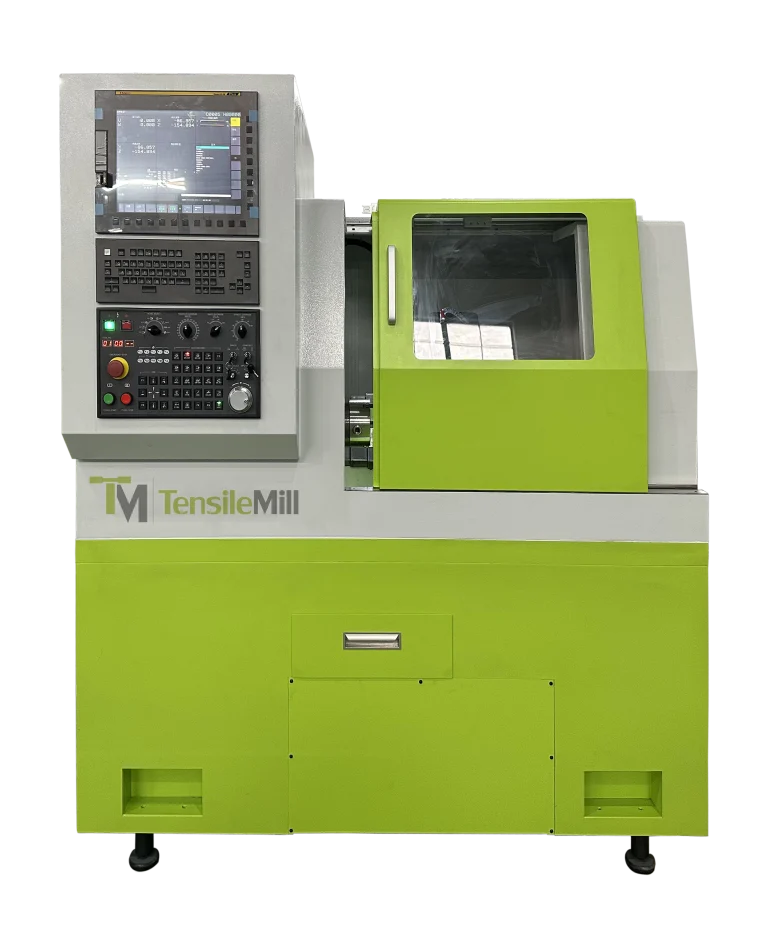 4000 rpm
TensileTurn CNC Classic Upgrade – Round Tensile Specimen Preparation Machine
TensileTurn CNC Classic Upgrade is a compact CNC lathe for accurate, repeatable preparation of round tensile…
View product
Get quote
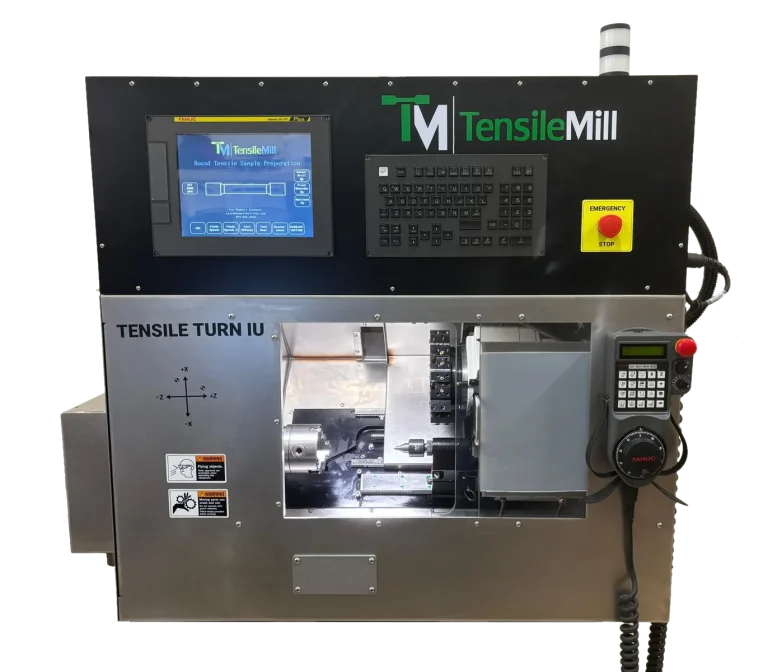 3500 rpm
TensileTurn CNC Industrial Upgrade – Round Tensile Specimen Preparation Machine
TensileTurn CNC Industrial Upgrade is a compact CNC lathe for preparing standardized round tensile specimens in…
View product
Get quote
 TensileTurn CNC Classic Upgrade – Round Tensile Specimen Preparation Machine4000 rpm
TensileTurn CNC Classic Upgrade is a compact CNC lathe for accurate, repeatable preparation of round tensile…
Round specimen preparation
 TensileTurn CNC Industrial Upgrade – Round Tensile Specimen Preparation Machine3500 rpm
TensileTurn CNC Industrial Upgrade is a compact CNC lathe for preparing standardized round tensile specimens in…
Round specimen preparation
Nothing matches that filter. Show all products
FAQs
The classic model suits a laboratory preparing specimens between other work, while the industrial model is built for continuous production. The Classic Upgrade has a 15 in FANUC touchscreen and runs on single-phase 220 V with a pneumatic connection, while the Industrial Upgrade runs on 220 V AC at 20 A. Request a quote.
Standard round bars, sub-size specimens, threaded-end tensile bars, button-head and fatigue specimens can all be produced. A technician without a machining background can prepare them from the touchscreen library, while a machinist keeps full FANUC CNC control for general turning, and the dimensions repeat across batches so results stay comparable.
They hold round tensile specimen formats from ASTM E8 and ASTM B557, which covers aluminum and magnesium alloys, along with commonly used ISO and DIN profiles. Custom dimensions are entered on the same touchscreen, so internal methods and special geometries can be programmed without writing a part program.
Both machines accept round, square or irregular starting stock. The Industrial Upgrade turns most metallic materials, including heat-treated steels, copper, nickel and aluminum and magnesium alloys, and specialty grades such as Inconel. The Classic Upgrade takes diameters up to 1.5 in (45 mm) and cuts material up to 55 HRC.
On the TensileTurn CNC Industrial Upgrade, center drilling standardizes the first step of round specimen preparation, which is where a lot of variation starts. It gives the stock a consistent workholding and alignment point before the gauge section is turned, so the cut starts from the same reference on each specimen.