Metal Testing Equipment
Impact toughness changes with temperature, so a Charpy specimen has to be at the required test temperature when the pendulum strikes it. Both ASTM E23 and ISO 148-1 workflows therefore condition specimens in a bath or chamber before testing, and materials such as carbon and stainless steels, aluminum alloys and nickel-based alloys are often tested at sub-zero temperatures to find the brittle-to-ductile transition. Purchasing documents often fix the test temperature as well as the standard, so the chamber has to reach and hold the temperature the specification names. A chamber for this job has to cool every specimen uniformly, hold a stable setpoint, and tell the operator when the target temperature has been reached.
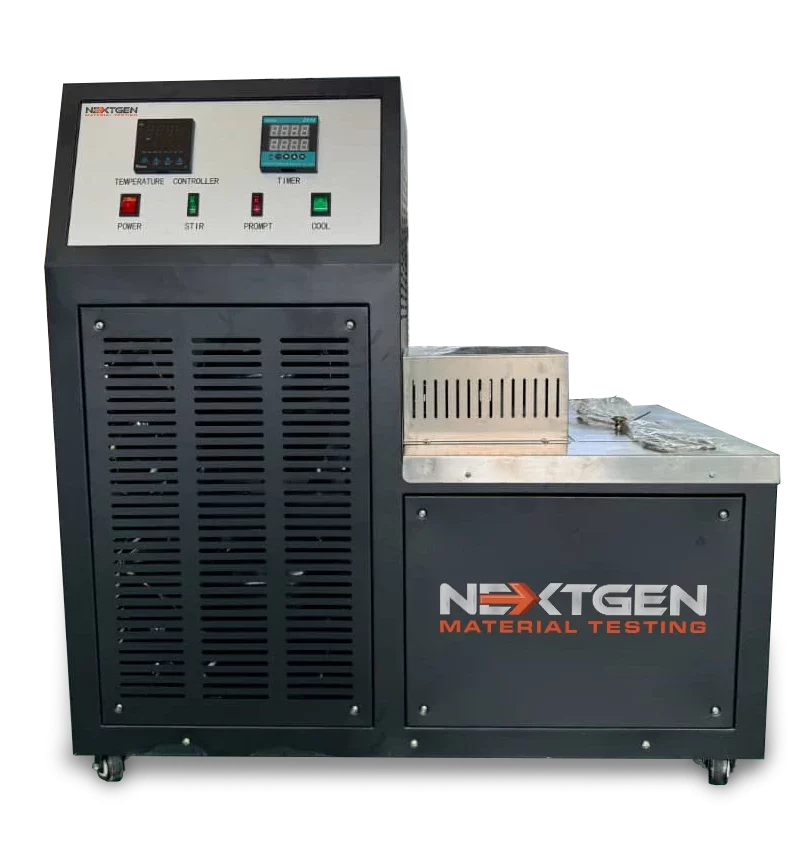
NextGen supplies conditioning chambers for Charpy and Izod specimens. One is a dual-function cabinet that combines a compressor-cooled chamber and a heated chamber, so a batch can be soaked cold or stabilized hot without moving to a second machine. A series of low-temperature chambers reaches progressively lower setpoints, using compressor refrigeration at the milder end and liquid nitrogen at the lowest. The cooling side stirs the bath so that every specimen sits at the same temperature, and the heated side circulates air with a fan. Controllers hold the setpoint to within ±0.5°C on the cooling side and ±1°C on the heated side, equipment is installed on site, operators are trained, and support continues for the life of the chamber.
For Laboratories
One partner to equip your complete metals laboratory
Impact testing is one station of a metals quality control laboratory. NextGen equips the rest of it too, from notching and specimen preparation to tensile testing, hardness and metallography, and stays responsible for it after delivery.
- Equipment, fixtures and software
- Installation, training, calibration
- Lifetime technical support
Most requested
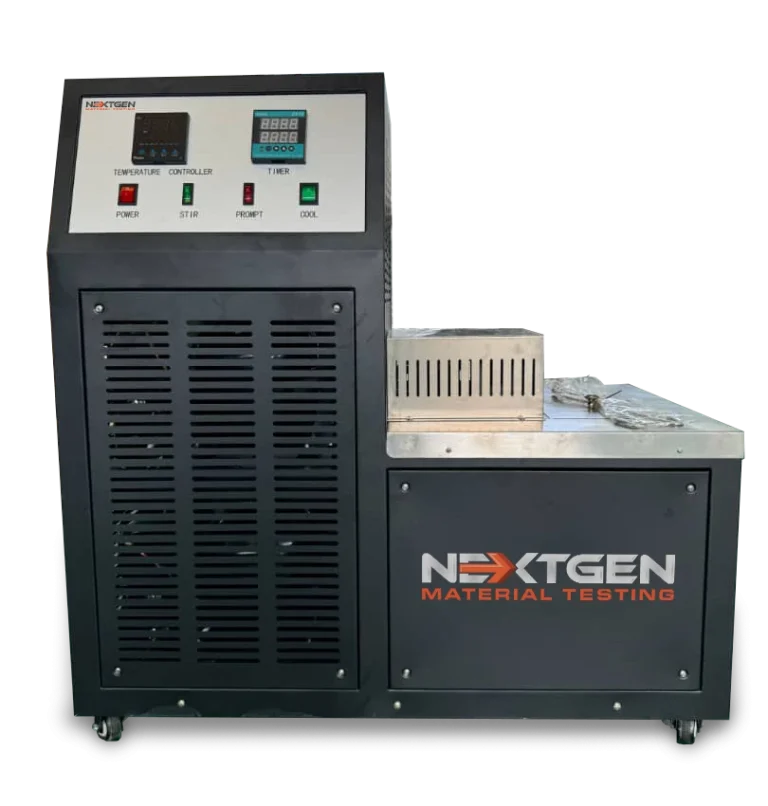 GenChamber – Impact Specimen Cooling and Heating Chamber
GenChamber is an impact specimen cooling and heating temperature chamber for conditioning Charpy and Izod specimens…
View product
Get quote
GenChamber – Impact Specimen Cooling and Heating Chamber
GenChamber is an impact specimen cooling and heating temperature chamber for conditioning Charpy and Izod specimens…
View product
Get quote
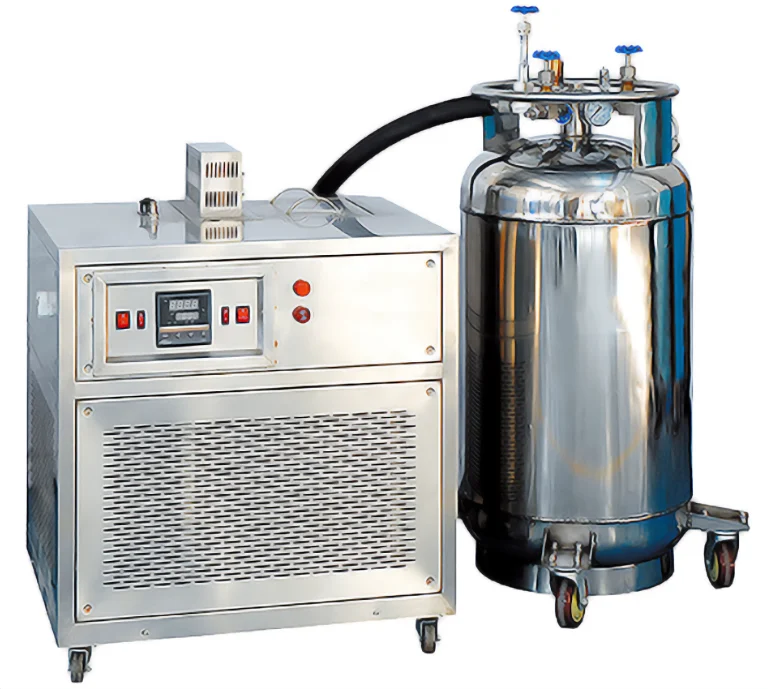 NG-ISCC Series – Impact Specimen Cooling Chamber
NG-ISCC Series is a low-temperature chamber for conditioning Charpy impact specimens before pendulum impact testing.
View product
Get quote
NG-ISCC Series – Impact Specimen Cooling Chamber
NG-ISCC Series is a low-temperature chamber for conditioning Charpy impact specimens before pendulum impact testing.
View product
Get quote
GenChamber – Impact Specimen Cooling and Heating Chamber
GenChamber is an impact specimen cooling and heating temperature chamber for conditioning Charpy and Izod specimens…
View product
Get quote
NG-ISCC Series – Impact Specimen Cooling Chamber
NG-ISCC Series is a low-temperature chamber for conditioning Charpy impact specimens before pendulum impact testing.
View product
Get quote
 GenChamber – Impact Specimen Cooling and Heating Chamber
GenChamber is an impact specimen cooling and heating temperature chamber for conditioning Charpy and Izod specimens…
Specimen conditioning
GenChamber – Impact Specimen Cooling and Heating Chamber
GenChamber is an impact specimen cooling and heating temperature chamber for conditioning Charpy and Izod specimens…
Specimen conditioning
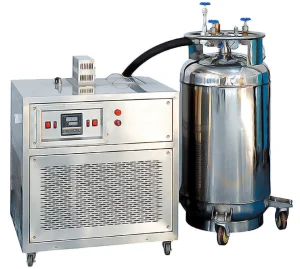 NG-ISCC Series – Impact Specimen Cooling Chamber
NG-ISCC Series is a low-temperature chamber for conditioning Charpy impact specimens before pendulum impact testing.
Specimen conditioning
NG-ISCC Series – Impact Specimen Cooling Chamber
NG-ISCC Series is a low-temperature chamber for conditioning Charpy impact specimens before pendulum impact testing.
Specimen conditioning
Nothing matches that filter. Show all products
FAQs
Start from the lowest temperature your method calls for. Choose the GenChamber if you also test above ambient, since it heats to 100°C, or an NG-ISCC model if you need -100°C or -196°C. Control accuracy is within 0.5°C on the cooling side of both. Request a quote with your standard and temperature.
Only for the lowest setpoints. In the NG-ISCC series, the -60°C and -80°C models cool with a compressor and need only a power connection, while the -100°C and -196°C models use liquid nitrogen, so a supply has to be arranged. The GenChamber reaches -80°C with a compressor.
The GenChamber cools at roughly 2°C per minute from 30°C to 0°C, 1.5°C per minute from 0°C to -20°C, 1°C per minute from -20°C to -60°C and 0.7°C per minute from -60°C to -80°C. A programmable timer from 1 to 99 minutes and an alarm at the target temperature help control the soak. Tell us your temperature and batch size to plan the soak time.
The GenChamber cooling chamber uses ethyl alcohol, with at least 99.5 percent purity recommended, and its heating chamber uses air. The NG-ISCC series uses ethanol or another non-freezing solution. Liquid nitrogen models also need a nitrogen supply planned alongside the chamber. Match the medium to the model, because the stirring keeps the bath uniform and makes soaking repeatable across a batch.
The GenChamber holds 60 to 120 standard 10 x 10 x 55 mm specimens, and it ships with three sample baskets for the low-temperature chamber and three for the high-temperature chamber. Both chambers work independently, so one can run cold while the other stabilizes hot.