Metal Testing Equipment
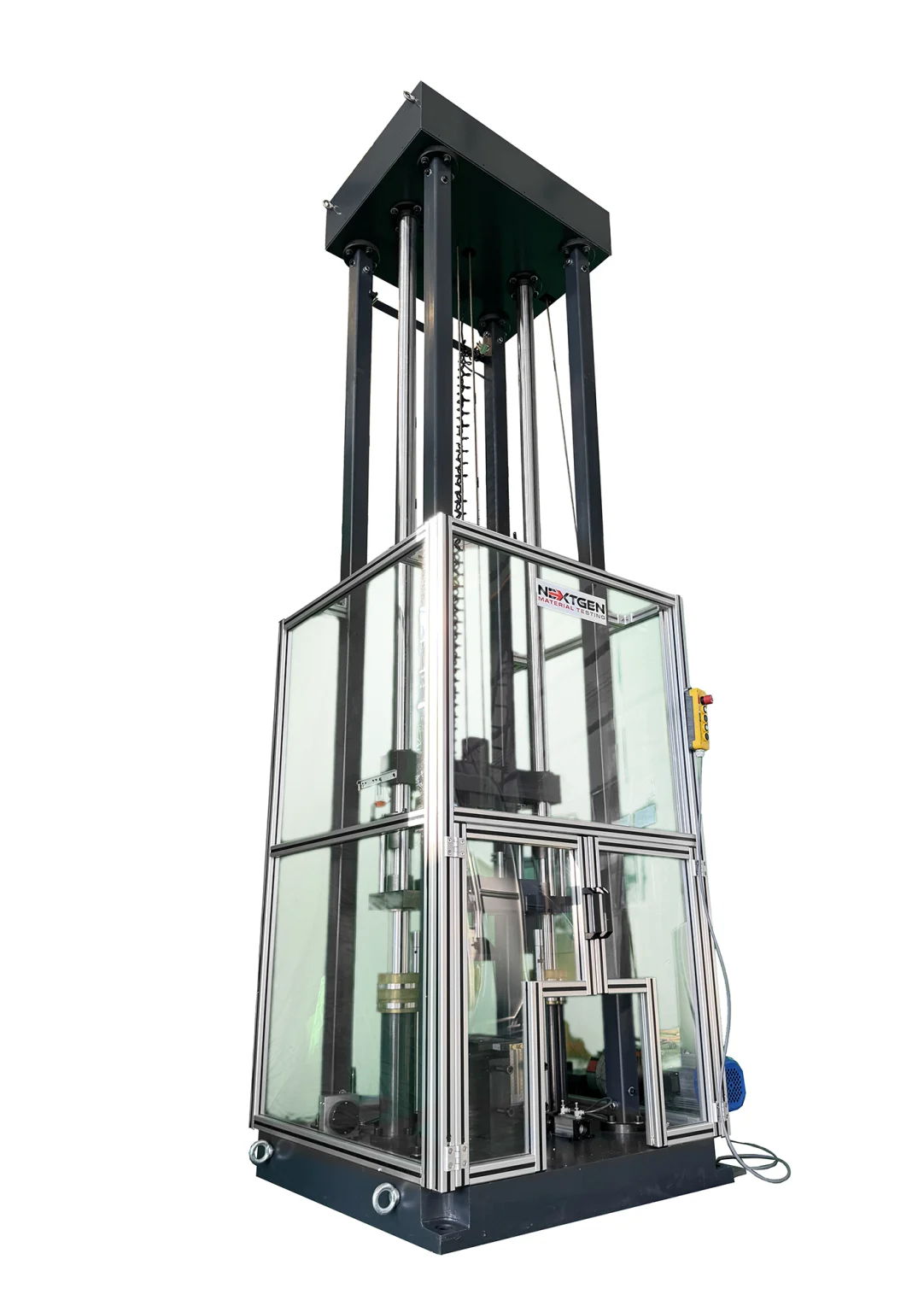
A drop weight impact tester lifts a hammer of known mass to a set height and lets it fall onto a specimen, so the impact energy is set by the mass and the height rather than read from a swing. The method suits tests that a small notched bar cannot represent: the nil-ductility transition of thick ferritic steel plate, finished conduit and enclosures, composite laminates, rigid sheet and assembled components. Steel plate is tested to ASTM E208, which determines the nil-ductility transition temperature, while electrical products follow UL safety standards that fix the hammer, anvil and drop height for each product.
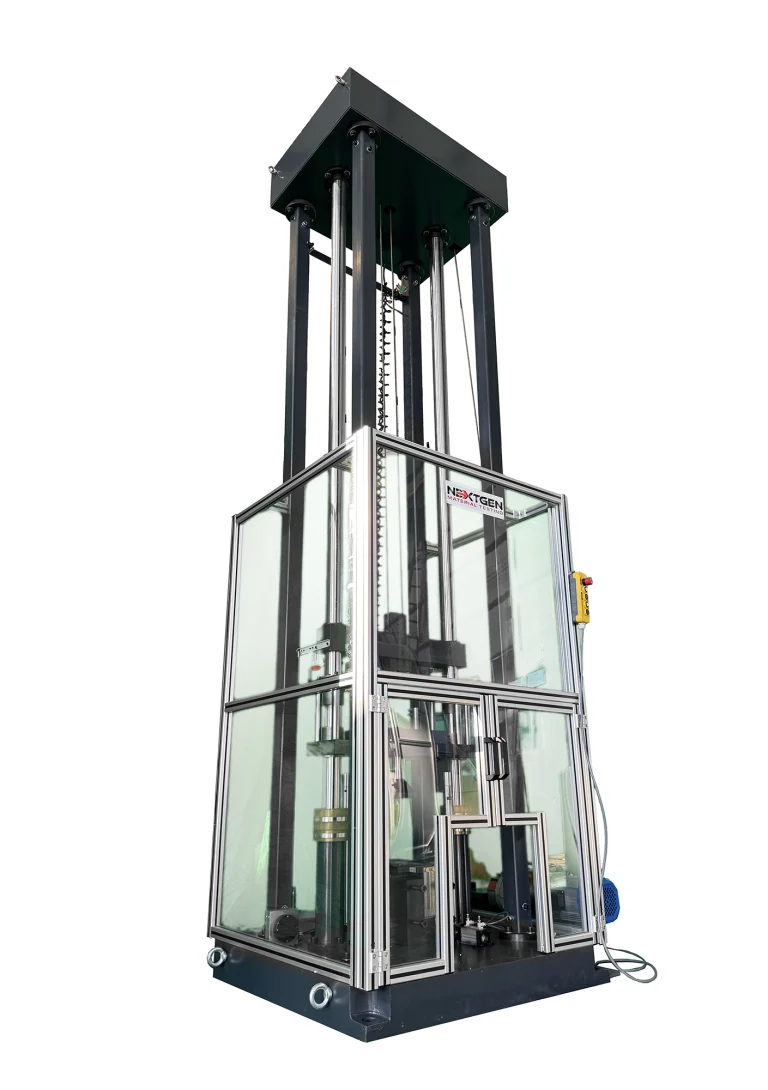
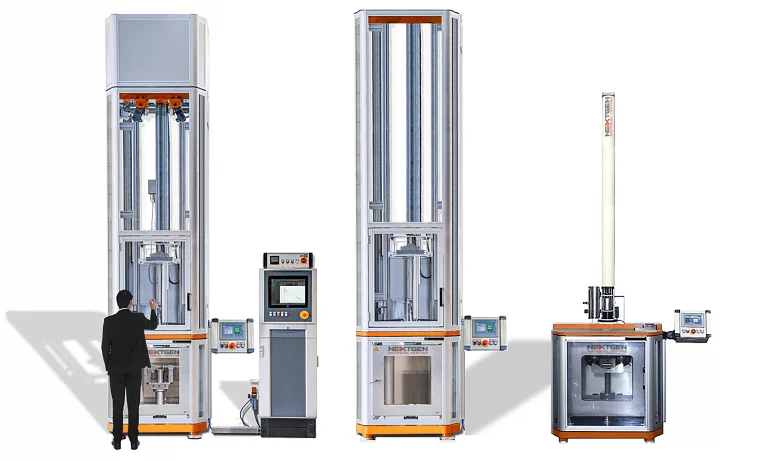
NextGen drop weight testers are PLC-controlled, with motorized lifting, automatic release and a safety enclosure around the impact zone. Software calculates the energy from the hammer mass and the drop height, and on the DWT-1800 a device that prevents a second strike keeps the specimen to a single impact. The range runs from a heavy industrial frame with energies up to 1800 J to vertical low-capacity systems up to 2000 J that can be fitted with instrumentation and temperature conditioning. Foundation, power and compressed-air requirements are confirmed before delivery. Machines are installed on site, operators are trained, and support continues for the life of the equipment.
For Laboratories
One partner to equip your complete metals laboratory
Impact testing is one station of a metals quality control laboratory. NextGen equips the rest of it too, from notching and specimen preparation to tensile testing, hardness and metallography, and stays responsible for it after delivery.
- Equipment, fixtures and software
- Installation, training, calibration
- Lifetime technical support
 DWT-1800 – Computer-Controlled Drop Weight Impact Tester
DWT-1800 is a computer-controlled drop weight impact testing machine for evaluating impact resistance in metal and…
View product
Get quote
DWT-1800 – Computer-Controlled Drop Weight Impact Tester
DWT-1800 is a computer-controlled drop weight impact testing machine for evaluating impact resistance in metal and…
View product
Get quote
 NG-FWT1 and NG-FWT2 – Drop Weight Impact Testers
NG-FWT1 and NG-FWT2 are low-capacity vertical drop weight impact testers for controlled falling-weight tests up to…
View product
Get quote
NG-FWT1 and NG-FWT2 – Drop Weight Impact Testers
NG-FWT1 and NG-FWT2 are low-capacity vertical drop weight impact testers for controlled falling-weight tests up to…
View product
Get quote
 DWT-1800 – Computer-Controlled Drop Weight Impact Tester
DWT-1800 is a computer-controlled drop weight impact testing machine for evaluating impact resistance in metal and…
Drop weight impact testing
DWT-1800 – Computer-Controlled Drop Weight Impact Tester
DWT-1800 is a computer-controlled drop weight impact testing machine for evaluating impact resistance in metal and…
Drop weight impact testing
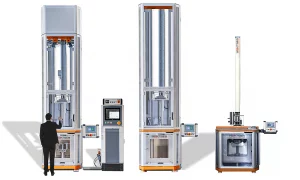 NG-FWT1 and NG-FWT2 – Drop Weight Impact Testers
NG-FWT1 and NG-FWT2 are low-capacity vertical drop weight impact testers for controlled falling-weight tests up to…
Drop weight impact testing
NG-FWT1 and NG-FWT2 – Drop Weight Impact Testers
NG-FWT1 and NG-FWT2 are low-capacity vertical drop weight impact testers for controlled falling-weight tests up to…
Drop weight impact testing
Nothing matches that filter. Show all products
FAQs
A pendulum swings from a fixed height and measures the energy a notched bar absorbs. A drop weight tester sets the energy itself: you enter the hammer mass and either the drop height or the target energy, and the software calculates the other value. That makes it suited to plate, pipe, conduit, composites and components. Request a quote to match a machine to your test.
Yes. The DWT-1800 is commonly used to assess the nil-ductility transition (NDT) temperature of ferritic steel plates, profiles, forged steel and cast components. ASTM E208 defines the method, which is run as a series of tests at stepped temperatures, so the specimens must be conditioned to each temperature before the drop.
With the matching hammers and anvils, the DWT-1800 performs impact tests for UL 651, UL 1, UL 360, UL 1660, UL 797, UL 6, UL 1242, UL 1569, UL 514C, UL 514D and UL 2239. Each standard sets the hammer, anvil, drop height and specimen conditioning, for example UL 651 for rigid PVC conduit.
The NG-FWT systems deliver controlled drop weight impacts up to 2000 J on plastics, rigid sheet, composite laminates, structural metals and finished parts. Options include instrumented force measurement at up to 4 MHz, cooling down to -90°C, a temperature chamber or furnace, and robotic operation. Tell us the energy range and specimen type for a recommended configuration.
The customer prepares a concrete foundation for the main unit and the winch to the foundation drawing, a 3-phase, 220 V, 60 Hz supply rated for 16 A, a compressed-air supply, a hoist for the 2,000 kg main unit and a room at least 6,000 mm high. The site should be free of vibration and dust, at 15 to 25°C and below 70 percent humidity.