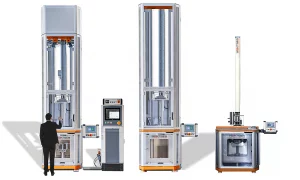
ASTM D3763 is a test method for measuring the high-speed puncture response of plastics using load and displacement sensors. It is commonly used when teams need an instrumented, load–deformation curve under impact conditions rather than a simple pass/fail puncture result.
If you need help matching the standard’s setup to your material form, thickness, or velocity range, talk with our team about your application before finalizing a test plan.
Standard Test Method for High Speed Puncture Properties of Plastics Using Load and Displacement Sensors
ASTM D3763 focuses on instrumented puncture impact behavior, producing a load-versus-deformation response at high test speeds. The method is used to compare materials and support engineering decisions where impact and multi-axial deformation are relevant.
Quick definition
Document type: Test method.
Primary output: Instrumented impact response (load vs. deformation) during a puncture event at controlled velocity.
Common use: Comparing puncture impact performance and rate sensitivity across rigid plastic materials or product designs.
What This Standard Covers
ASTM D3763 covers determination of puncture properties of rigid plastics over a range of test velocities using instrumentation that records force and displacement during impact.
The results are intended to be suitable for engineering design and for material-to-material comparisons when test conditions are controlled.
Why This Standard Matters in Testing
High-speed puncture behavior can differ significantly from quasi-static performance, especially for polymers that show strain-rate sensitivity. ASTM D3763 supports decision-making by capturing the full impact event response rather than relying only on a single endpoint value.
This method is also commonly used to compare formulations, processing changes, or design revisions where puncture resistance and energy absorption under impact are critical.
Common Materials, Product Types, or Applications Covered
ASTM D3763 is typically applied to rigid plastic materials and rigid plastic components where puncture or multi-axial impact loading can occur.
Common application examples: Rigid housings, protective covers, panels, and other molded or formed parts where impact puncture resistance is a design or quality requirement.
Common Test or Verification Workflow
A typical ASTM D3763 workflow includes preparing specimens, clamping the specimen in a support fixture, and striking it with an instrumented puncture tup at a specified speed while recording load and displacement versus time.
Practical comparison caution: Because puncture response can be thickness-dependent and not necessarily linear with thickness, comparisons are normally made between specimens of essentially the same thickness unless a material-specific thickness relationship has been established.
Velocity/energy control: The test setup is commonly configured so the impact event is properly captured without excessive loss of velocity before peak load, supporting more consistent interpretation across runs.
Equipment Commonly Used for This Standard
ASTM D3763 is commonly associated with an instrumented puncture impact test system capable of controlled impact velocities and high-speed data capture.
Common equipment elements: Instrumented impact frame (drop-tower or driven impact system), hemispherical puncture tup/striker, rigid clamping/support fixture, force measurement (load cell), displacement measurement, and a data acquisition/software package that captures the full impact event.
Quoting tip: The best configuration depends on specimen size and thickness range, target velocity range, expected force/energy levels, and the reporting outputs your customer or internal spec requires. If you are comparing systems or fixture options, you can request a detailed quote for a configuration aligned with your throughput and data requirements.
How to Read This Designation or Revision
In ASTM designations, the letter-and-number code (for example, D3763) identifies the standard, and a suffix such as “-23” indicates the year of original adoption or, if revised, the year of the latest revision.
Some ASTM citations also include a year in parentheses to indicate the year of last reapproval, and a superscript epsilon may appear to indicate an editorial change since the last revision or reapproval.
Related Standards, Methods, or Frameworks
ASTM D3763 is often used alongside related plastics testing references for conditioning, terminology, and materials classification.
Common companion references: ASTM D618 (conditioning), ASTM D883 (plastics terminology), ASTM D4000 (plastics materials classification system).
ISO relationship note: ISO 6603-2 addresses a similar topic area (instrumented puncture impact), but results are not intended to be directly compared between the two methods.
Get help selecting an ASTM D3763 testing setup
If you need a system sized for your target velocity range, force/energy levels, and fixture requirements, request pricing for an instrumented puncture impact configuration matched to ASTM D3763 testing.