Heavy-Duty Bending Fixtures for Hydraulic Flexural Testing

Trust
Heavy-Duty Bending Fixtures for Hydraulic Flexural Testing

Standards

High-Capacity Bending Fixtures for Metal, Composite, and Ceramic Testing

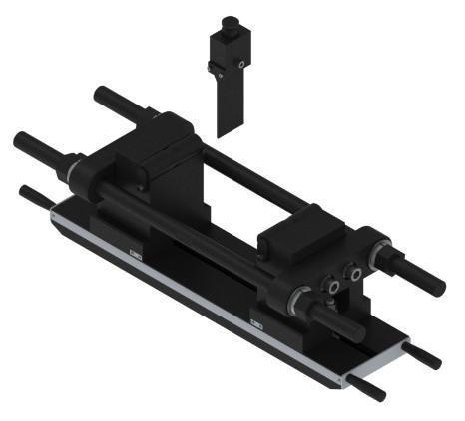
NextGen Bending fixture - NGA206A for hydraulic machines

NextGen’s line of heavy-duty bending fixtures is engineered for high-force testing applications involving metals, composites, and ceramics. Designed specifically for hydraulic universal testing machines, these fixtures support complex bending evaluations at forces up to 2000 kN, making them suited to structural testing in automotive, aerospace, construction, and research environments. Each fixture is developed in compliance with GB/T 232, GB1499.1, and GB1499.2, for accurate, repeatable testing in accordance with international standards.

These fixtures accommodate many mandrel diameters and support test spaces of up to 18.9″ (480 mm), with secure fixing blocks and positioning pin connections for enhanced stability. Whether conducting flexural analysis of reinforcing bars, composite layers, or advanced ceramics, this category offers reliable solutions for demanding bending evaluations.


One fixture covers the range, and what changes from test to test is the mandrel. The body is rated to 2000 kN and needs 18.9″ (480 mm) of test space; four mandrel diameters come with it, and the rest are listed in the second table.

Model NGA206A

Bending Fixture

The NGA206A Bending Fixture is built for performing high-force bending tests on metal, ceramic, and composite materials. Engineered for a capacity of up to 2000 kN, it complies with key standards such as GB/T 232, GB1499.1, and GB1499.2. The system uses a fixed block on the upper side and a positioning pin on the lower side, for a secure and stable setup during testing. The fixture includes a heavy-duty lower support platform with multiple mandrel size options, making it adaptable for various test configurations.

  • Application: Bending tests for metals, ceramics, and composites.
  • Maximum Capacity: ≤2000 kN load.
  • Weight:
    • Lower Grip: 190 lbs (86 kg)
  • Connection:
    • Upper Grip: Fixing block
    • Lower Grip: Positioning pin
  • Working Temperature: Ambient.
  • Standard Compliance: GB/T 232, GB1499.1, GB1499.2.
    NextGen Bending fixture - NGA206A - SizeNGA206A Bending Fixture
  • Grip Dimensions:
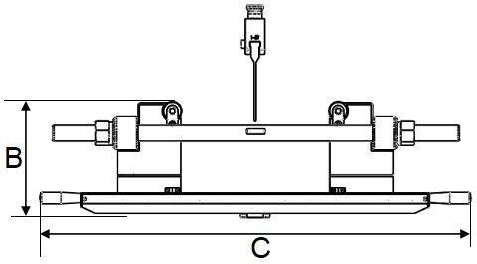
    • Lower Grip Height (B): 8.9″ (225 mm)
    • Lower Grip Width (C): 33.3″ (846 mm)
  • Minimum Test Space: 18.9″ (480 mm)
  • Included Mandrel Diameters: Φ32, Φ60, Φ88, Φ160
  • Optional Mandrels: Full list below
Table 1. NGA206A Bending Fixture
Parameter Specification
Application Bending test for metal, composite, ceramic, etc.
Maximum Force ≤2000 kN
Lower Grip Weight 190 lbs (86 kg)
Connection Upper: Fixing block
Lower: Positioning pin
Working Temperature Ambient
Standard GB/T 232, GB1499.1, GB1499.2
Lower Grip Height (B) 8.9″ (225 mm)
Lower Grip Width (C) 33.3″ (846 mm)
Minimum Test Space 18.9″ (480 mm)
Mandrel Diameter (included) Φ32, Φ60, Φ88, Φ160
Table 2. Optional Mandrels
Φ1 Φ2 Φ3 Φ4 Φ5 Φ6 Φ6.5 Φ8 Φ9 Φ10
Φ12 Φ13.5 Φ14 Φ15 Φ16 Φ16.5 Φ18 Φ19.5 Φ20 Φ21
Φ22 Φ22.5 Φ24 Φ25 Φ25.5 Φ27 Φ28 Φ28.5 Φ30 Φ31.5
Φ33 Φ34.5 Φ36 Φ38 Φ40 Φ42 Φ44 Φ46 Φ48 Φ50
Φ54 Φ56 Φ64 Φ66 Φ70 Φ72 Φ75 Φ80 Φ84 Φ90
Φ92 Φ95 Φ98 Φ100 Φ108 Φ110 Φ112 Φ120 Φ125 Φ130
Φ132 Φ135 Φ140 Φ144 Φ150 Φ154 Φ155 Φ160 Φ165 Φ170
Φ175 Φ180 Φ192 Φ196 Φ200 Φ210 Φ216 Φ224 Φ240 Φ242
Φ250 Φ252 Φ256 Φ280            

NextGen’s bending fixtures for hydraulic UTMs deliver precision, strength, and adaptability for high-load bending applications. Their compatibility with many mandrels and standardized specimen dimensions allows for flexible integration into existing test setups. Backed by certified engineering and rugged design, these fixtures are the trusted choice for labs and facilities that demand accuracy, repeatability, and long-term durability. Contact NextGen Material Testing Inc. today to explore the full selection.

For Laboratories

Need Additional Quality Control Equipment to Build Your Laboratory?

Flexural and bend testing is only one part of a complete quality control laboratory. NextGen can help you equip your entire lab with impact testers, notching and broaching systems, cooling chambers, tensile testers, hardness testers, specimen preparation equipment, and other supporting solutions, all coordinated as one complete project.

  • One partner to equip your complete laboratory
  • Installation, training, calibration
  • Support for the life of the equipment

FAQs

Plate, strip, bar and section coupons all go through the same bend test, because GB/T 232 covers metallic test pieces of round, square, rectangular or polygonal cross-section. The fixture is built to that method, so flat products run on the same setup as reinforcing bar.

For a flat coupon the product standard sets the bend angle and the mandrel diameter, usually as a multiple of the coupon thickness. Thin strip therefore calls for the small diameters at the start of the optional mandrel list, and heavy plate for the large ones near its end.

Coupon preparation matters as much as the fixture. Cut edges are rounded or smoothed before the test, since a burr or saw mark on the tension side can start a crack that says nothing about the steel. A transverse coupon from plate is cut across the rolling direction, usually the more demanding one in bending.

They go on the same fixture as steel, which is built for bending tests on metals, ceramics and composites at ambient temperature. What changes is the result the test records.

Steel wraps around the mandrel and is judged by the surface of the bend. Ceramics and most composite laminates deflect elastically and then break, so the result is the force at fracture, read by the load cell of the testing machine and worked into a flexural strength with the specimen dimensions.

On these materials the mandrel acts as the loading point. A larger diameter spreads the contact over a wider band, which helps keep a laminate from crushing locally under the load before it fails in bending.

Where a standard places a bar or beam on roller supports in three- or four-point bending, our flexure fixtures for large and brittle specimens are the companion choice.

It bends reinforcing bar around a mandrel to GB/T 232, the bend test method for metallic materials, and to the rebar requirements of GB 1499.1 for hot-rolled plain bars and GB 1499.2 for hot-rolled ribbed bars.

In the test the bar is supported at two points and a mandrel of the specified diameter bends it between them to the angle the product standard sets. The force is applied slowly, so the steel can deform plastically around the mandrel.

The outside of the bend is then examined, and the bar passes if that surface shows no cracks. The test checks ductility rather than strength, because reinforcing bar is bent to shape in fabrication and has to take that bend without cracking.

The fixture also runs bend tests on other metals, ceramics and composites, all at ambient temperature. Tensile tests on the same bars run in our dual-action hydraulic wedge grips, which carry jaw faces made for deformed steel bar.

Four mandrels come with the fixture, Ø32, Ø60, Ø88 and Ø160 mm. The optional list runs to 84 diameters from Ø1 to Ø280 mm, in half-millimeter steps in places, so the set can follow the exact diameter a standard calls for.

In the rebar standards the mandrel diameter is a multiple of the nominal bar diameter, and that multiple rises for larger bars and higher grades, so a laboratory that tests several sizes needs a matching set. Only the mandrel changes from test to test, because the fixture body stays the same.

Tell us your bar diameters and grades when you ask for a quote, and our team will pick the mandrels that match them.

It needs a hydraulic universal testing machine, because the fixture is built for that class of frame and is rated to 2000 kN (449,618 lbf). The frame must cover the highest force your largest bar needs, with a load cell that still reads your smallest bars accurately.

At the top the fixture mounts with a fixing block and at the bottom with a positioning pin, which gives a secure and stable setup under high force.

Plan the installation around the lower support platform, which weighs 86 kg (190 lbs) and measures 846 mm wide by 225 mm high, so it goes in with a hoist or lifting table.

Related Products

NG-SHM Series A – Servo-Hydraulic Universal Testing Machine (300–3000 kN)

NG-SHM Series A – Servo-Hydraulic Universal Testing Machine (300–3000 kN)

NG-SHM Series A is a high-force servo-hydraulic universal testing machine for static mechanical testing of metals and structural components. Available from 300 kN to 3000 kN, it uses a high-stiffness multi-column frame and dual-zone layout for tensile and compression work. Hydraulic wedge grips, extensometer compatibility, and GenTest software support testing of rebar, fasteners, chains, welds, castings, and large metallic specimens.

Read more
NG-SHM Class DP – Servo-Hydraulic Universal Testing Machine

NG-SHM Class DP – Servo-Hydraulic Universal Testing Machine

NG-SHM Class DP is a high-force servo-hydraulic testing machine with an upper actuator, single-zone test space, and side-action hydraulic wedge grips. Available in 600 kN, 1000 kN, and 2000 kN capacities, it supports tension, compression, bending, and shearing tests on metals and structural specimens. Its automatic clamping adjustment, dual-direction grip alignment, precision transducer, and long-travel cylinder help deliver stable, repeatable results.

Read more
NG-SHM Class D – Servo-Hydraulic Universal Testing Machine

NG-SHM Class D – Servo-Hydraulic Universal Testing Machine

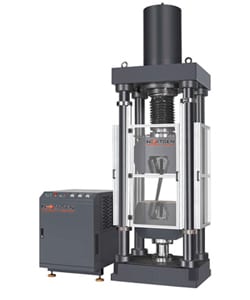
NG-SHM Class D is a servo-hydraulic universal testing machine for high-force mechanical testing of metals and structural components. Available in 600 kN, 1000 kN, and 2000 kN capacities, it uses an upper actuator and single-zone test space for tension, compression, bending, and shearing. Its long-travel cylinder, wedge hydraulic grips, and rigid guidance system make it suitable for extra-long, high-elongation specimens.

Read more
NG-SHM Class C – Servo-Hydraulic Universal Testing Machine

NG-SHM Class C – Servo-Hydraulic Universal Testing Machine

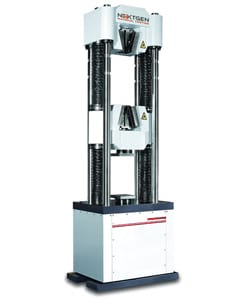
NG-SHM Class C is a servo-hydraulic universal testing machine for high-force metal testing, with capacity options of 600 kN and 1000 kN. Its longer jaw face is designed for tensile testing of stranded steel wire, while the 6-column frame, dual-zone test space, hydraulic wedge grips, quick-return valve, and precision load cell support accurate, repeatable testing of rebar, fasteners, chains, welds, and castings.

Read more
NG-SHM Class B – Servo-Hydraulic Universal Testing Machine

NG-SHM Class B – Servo-Hydraulic Universal Testing Machine

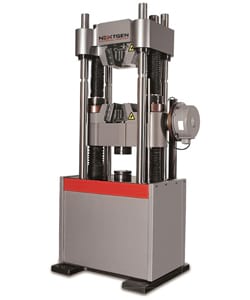
NG-SHM Class B is a high-force servo-hydraulic universal testing machine for tensile, compression, and flexural testing of metals and other high-strength materials. Available from 300 kN to 3000 kN, it uses a rigid multi-column frame, dual-zone test space, hydraulic wedge grips, and precise load-cell measurement to support reliable testing of fasteners, rebar, chains, welds, castings, and structural components.

Read more
GenMark 500 – Automatic Gauge Length Marking Machine

GenMark 500 – Automatic Gauge Length Marking Machine

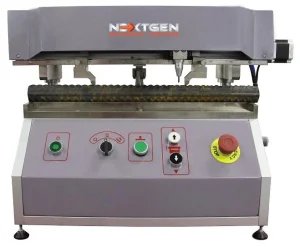
The GenMark 500 is a full-automatic gauge length marking machine for metal bar, rebar and wire rod, applying the reference marks used to determine elongation after fracture. A servo-driven lead screw sets 5 mm or 10 mm spacing and a pneumatic tungsten steel needle marks specimens up to 500 mm gauge length, supporting ISO 6892-1 and ASTM E8/E8M workflows. Adjustable marking force, quick needle changes, and fixtures for both round and flat samples keep specimen preparation consistent across operators and shifts.

Read more
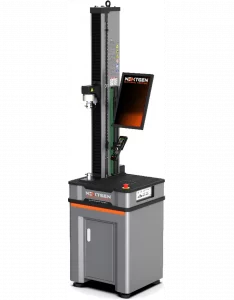
NG-EML Series A – Single-Column Universal Testing Machine (50 N – 5 kN)

NG-EML Series A – Single-Column Universal Testing Machine (50 N – 5 kN)

NG-EML Series A is a compact single-column benchtop universal testing machine for low-force tensile, compression, and flexural testing. Covering 50 N to 5 kN capacity options, it is suited for rubber, plastics, adhesives, films, foams, wires, metals, composites, and consumer products. Its electromechanical frame, high-speed servo actuation, GenTest software, and standards support make it practical for R&D and routine QC.

Read more
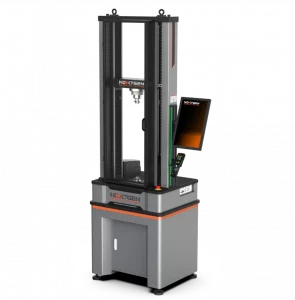
NG-EML Series B – Dual-Column Universal Testing Machine (100 N – 10 kN)

NG-EML Series B – Dual-Column Universal Testing Machine (100 N – 10 kN)

NG-EML Series B is a dual-column benchtop electromechanical universal testing machine for precision testing from 100 N to 10 kN. Built for research and industrial labs, it supports tension, compression, flexural, and component testing of composites, high-strength metals, polymers, films, foams, and rubber. Its compact rigid frame, advanced control accuracy, and GenTest software help deliver repeatable results in limited lab space.

Read more
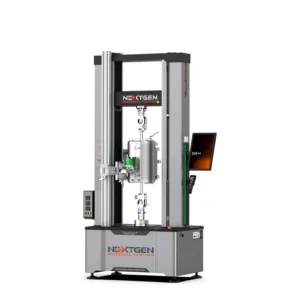
NG-EML Series C – Dual-Column Universal Testing Machine (5–50 kN)

NG-EML Series C – Dual-Column Universal Testing Machine (5–50 kN)

NG-EML Series C is a dual-column electromechanical universal testing machine available in bench-top and floor-standing formats from 5 kN to 50 kN. Built for tension, compression, flexural, shear, and peel testing, it combines Class 0.5 accuracy, a servo direct-drive system, high-rigidity frame, touchscreen control, and GenTest software to support precise testing of metals, composites, rubber, plastics, and polymers.

Read more
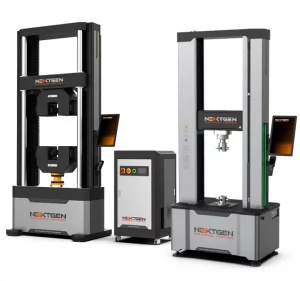
NG-EML Series D – Floor-Standing Universal Testing Machine (50–1000 kN)

NG-EML Series D – Floor-Standing Universal Testing Machine (50–1000 kN)

NG-EML Series D is a heavy-duty floor-standing electromechanical universal testing machine for high-capacity tensile, compression, and flexural testing. Available from 50 kN to 1000 kN, it is built for high-strength steels, advanced composites, alloys, and challenging research materials. Its rigid dual-column frame, servo direct-drive system, closed-loop control, safety protections, and GenTest software support stable, accurate testing.

Read more
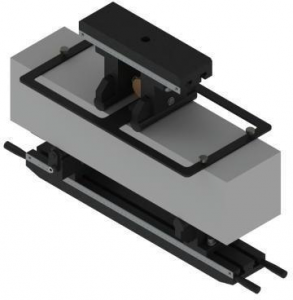
Flexure Fixtures for Large and Brittle Specimens

Flexure Fixtures for Large and Brittle Specimens

These flexure fixtures are designed for precise bending tests on large, brittle, or high-strength specimens, including metals, ceramics, composites, concrete, and construction materials. Compatible with hydraulic universal testing machines, they support single-point, three-point, and four-point bending configurations with adjustable spans and roller supports. Capacities up to 2000 kN help laboratories evaluate flexural strength, deformation behavior, and structural integrity.

Read more
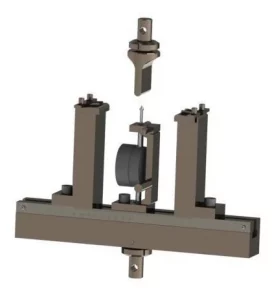
3-Point and 4-Point Bending Fixtures for Flexural Testing

3-Point and 4-Point Bending Fixtures for Flexural Testing

These 3-point and 4-point bending fixtures support flexural strength, deformation, and modulus testing of natural stone, ceramics, composites, concrete, metals, bricks, and other structural or brittle materials. Adjustable upper and lower spans, roller-supported loading, multiple capacity options, and optional deformation measurement help laboratories perform standardized bending tests with stable support conditions and repeatable force application.

Read more