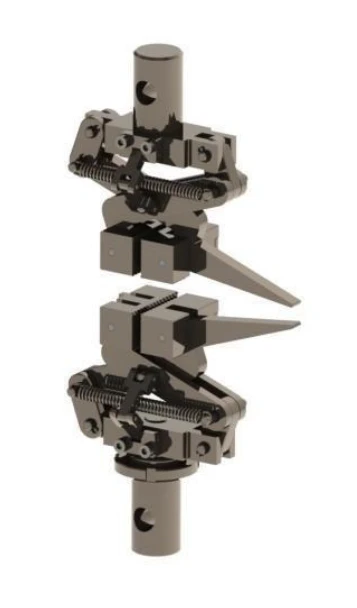
Self-Tightening Grips for Tensile Testing
NextGen’s self-tightening grips hold deformable and elastic materials: elastomers, foams, thin plastics, textiles and biomedical specimens. The clamping pressure rises by itself as tensile force is applied, so the grip follows the specimen as it thins instead of needing the operator to stop and retighten. That is what makes them the right choice for soft or low-friction materials, which either slip out of a fixed jaw or are crushed by one set tight enough to hold.
They come in the usual designs, scissor grips, cam-action grips and lever-actuated jaws, all built to mount on NextGen universal testing machines. Alignment and gripping force stay steady through the loading cycle, which is what makes a result repeatable across a batch rather than only accurate once.
Self-Tightening Grip Models
Two models cover the range. They differ in load capacity and in how much specimen they will take, so the choice comes down to the force you need and the size of what you are clamping. Each model below is followed by its own specification table.
Model NGA203A
Self-Tightening Tensile Grip, 2 kN
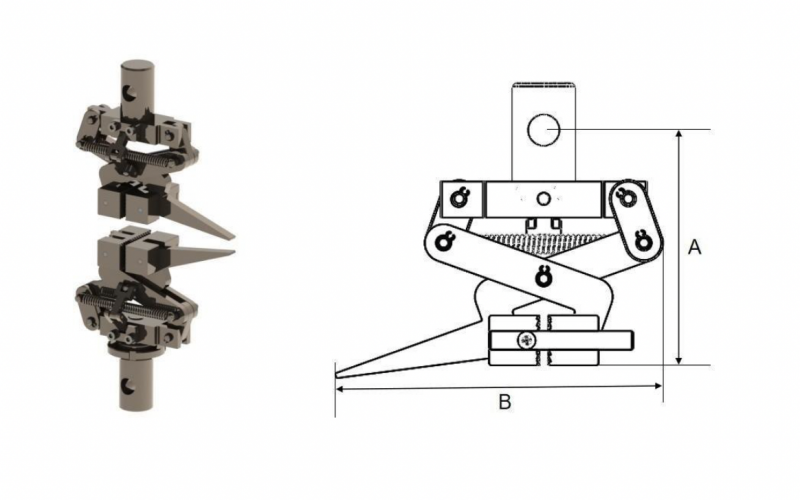
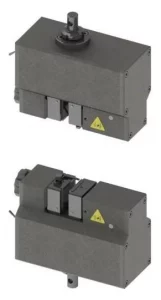
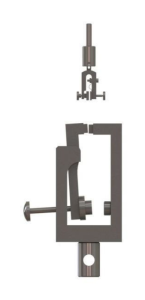
The NGA203A is the smaller of the two, for tensile testing of deformable and low-strength materials such as soft plastics and rubber. The self-tightening mechanism raises clamping force as the tensile load rises, which is what keeps hold of a specimen that thins or elongates during the test. It cuts slippage without the operator adjusting anything mid-test, and without the jaw pressure that damages a soft specimen. The body is compact, it mounts on standard universal testing machines through a Ø10 mm pin, and it is rated for ambient laboratory conditions.
Table 1. NGA203A self-tightening tensile grip, specifications
| Parameter |
Specification |
| Application |
Tension test for plastic and rubber |
| Maximum Force Capacity |
≤ 2 kN |
| Connection Type |
Upper Grip: Ø10 mm pin
Lower Grip: Ø10 mm pin |
| Overall Height (A) |
75 mm |
| Grip Body Width (B) |
4.1″ (104 mm) |
| Working Temperature |
Ambient |
| Grip Weight |
Upper Grip: 0.49 kg
Lower Grip: 0.49 kg |
| Compatible Specimen Thickness |
≤ 10 mm |
| Compatible Specimen Width |
≤ 30 mm |
When the specimen is wider or thicker than the NGA203A will take, or the break load runs past 2 kN, the larger model covers it.
Model NG5203A
Self-Tightening Tensile Grip, 5 kN
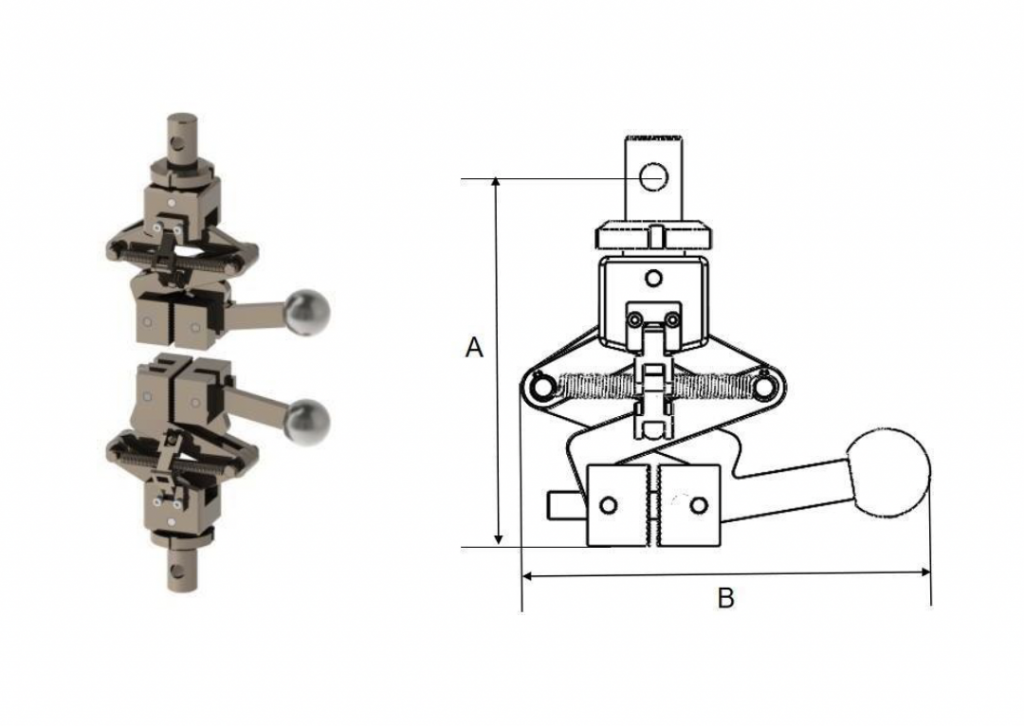
The NG5203A takes the same principle to a higher load and a larger specimen. It is built for flexible, low-friction materials such as plastics and rubber that stretch or deform under stress, where a heavier clamp and a wider jaw are needed. Clamping force again rises with the tensile load, so the hold tightens as the specimen thins rather than loosening. It uses the same Ø10 mm pin mount as the NGA203A and the same ambient working range, so the two are interchangeable on the same frame.
Table 2. NG5203A self-tightening tensile grip, specifications
| Parameter |
Specification |
| Application |
Tension test for plastic and rubber |
| Maximum Force Capacity |
≤ 5 kN |
| Connection Type |
Upper Grip: Ø10 mm pin
Lower Grip: Ø10 mm pin |
| Overall Height (A) |
5.4″ (137 mm) |
| Grip Body Width (B) |
5.9″ (150 mm) |
| Working Temperature |
Ambient |
| Grip Weight |
Upper Grip: 3.3 lbs (1.5 kg)
Lower Grip: 3.3 lbs (1.5 kg) |
| Compatible Specimen Thickness |
≤ 12 mm |
| Compatible Specimen Width |
≤ 45 mm |
Choosing Between the Two
Both grips solve the same problem: materials that deform, elongate or have too little surface friction to stay in a fixed jaw, such as plastics, rubbers, foams and textiles. Because clamping force follows the load, neither needs tightening during a run, and neither fails a test early through slippage. They suit quality control, where the same test has to give the same answer every time, and research, where the curve is the result.
Note: the limits that decide the choice are specimen size, not only force. The NGA203A takes up to 10 mm thick and 30 mm wide at 2 kN; the NG5203A up to 12 mm and 45 mm at 5 kN. Measure the widest specimen you clamp before choosing on capacity alone.
Tell us the material, the specimen width and thickness, and the force you expect at break, and we will confirm which of the two fits and whether the Ø10 mm pin mount matches your frame. Request a quotation and our technical sales team will come back with the pairing.
For Laboratories
Need Additional Quality Control Equipment to Build Your Laboratory?
Gripping and fixturing is only one part of a complete quality control laboratory. NextGen can help you equip your entire lab with impact testers, notching and broaching systems, cooling chambers, tensile testers, hardness testers, specimen preparation equipment, and other supporting solutions, all coordinated as one complete project.
- One partner to equip your complete laboratory
- Installation, training, calibration
- Support for the life of the equipment