GenVac MP3 Series – Vacuum Impregnation System for Epoxy Mounting

Metal Testing Equipment
Standards






Description
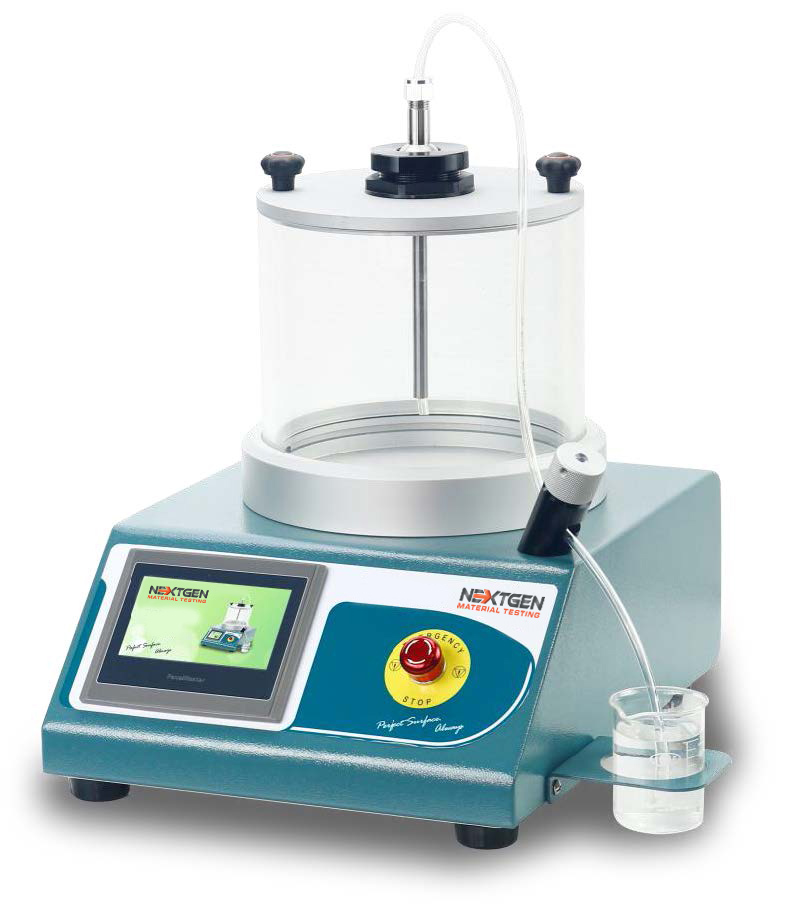
The GenVac MP3 is the upgraded intelligent vacuum impregnation system for metallography, and it holds up to ninety-nine degassing circles. The epoxy system fills pores and cavities in the sample, which is what improves edge retention on the finished mount.
A 4.3 inch colour touch panel with a graphic display carries the parameter setting. Eight memory methods, multiple languages, unit conversion and the ninety-nine degassing circles cover what a laboratory needs from a vacuum impregnation system. Read more in our Mega Blog.
GenVac MP3 vacuum impregnation system.
GenVac MP3 Vacuum Chamber and Degassing
The chamber is transparent, so the resin level in every cup is watched while it is filled. That saves resin and keeps the operator from breaking vacuum to check a cup. With manual degassing the cups can be filled at any position in the chamber, which matters when specimens of different heights go in together.
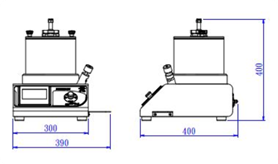
GenVac MP3 dimension drawing.
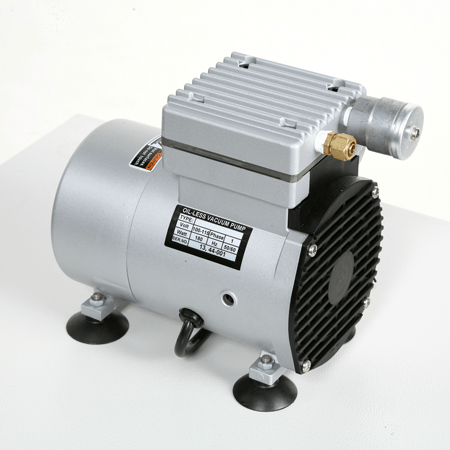
The supplied vacuum pump.
Vacuum Impregnation System Technical Specifications
Vacuum impregnation is used when a specimen is porous or fragile and cold mounting resin has to be drawn into the cavities before grinding starts. Check the chamber size, the vacuum level and the supply voltage against your samples before ordering. Imperial values come first, with the metric equivalent in brackets.
| Specification | GenVac MP3 |
|---|---|
| Vacuum Pressure | -600 mm/Hg (-0.799 bar / -79.993 kPa / -11.602 Psi) |
| Vacuum Pump Motor Power | 180 W |
| Pump Flow | 13.2 gal (50 L)/min |
| Vacuum Chamber Size (WxDxH) | 11.8″ × 11.8″ × 11.8″ / 30 × 30 × 11.8″ (30 cm) |
| Pressure Relief Method | Programmable pressure relief |
| Machine Dimension (WxDxH) | 21.25″ × 21.65″ × 22″ / 54 × 55 × 22″ (56 cm) |
| Weight | 99 lbs / 45 kg |
| Power Supply | AC110V/220V-1Ø |
| Standard Accessories | High flow epoxy resin, vacuum pump |
Vacuum Impregnation System Consumables
Resins, cups, rings and clips for the GenVac MP3 are listed below.
| Speedy Epoxy Resin - heat release during curing (curing at room temperature about 45 mins) | |
|---|---|
| Epoxy resin 950ml + Harden 20ml | |
| Epoxy resin 950ml + Harden 20ml + Mixer bag | |
| High Flow Epoxy Resin - no heat release during curing (curing at room temperature about 24 hrs) | |
| Epoxy resin 950ml + Hardener 350ml | |
| Epoxy resin 950ml + Hardener 350ml + Mixer bag | |
| Silicone Rubber Mounting Cup (General). Only bottom is bright | |
| Size | Package (pcs/bag) |
| Applied to diameter 25mm, Height 25mm (capacity is about 12ml) | 10 |
| Applied to diameter 31.75mm, Height 25mm (capacity is about 20ml) | 10 |
| Applied to diameter 40mm, Height 25mm (capacity is about 30ml) | 10 |
| Applied to diameter 50mm, Height 25mm (capacity is about 45ml) | 10 |
| Silicone Rubber Mounting Cup (High Transparency). Both bottom and surround are bright | |
| Size | Package (pcs/bag) |
| Applied to diameter 25mm, Height 25mm (capacity is about 12ml) | 10 |
| Applied to diameter 31.75mm, Height 25mm (capacity is about 20ml) | 10 |
| Applied to diameter 40mm, Height 25mm (capacity is about 30ml) | 10 |
| Applied to diameter 50mm, Height 25mm (capacity is about 45ml) | 10 |
| Transparent Acrylic Mounting Ring (Hollow) | |
| Size | Package (pcs/bag) |
| Diameter 25mm, Height 20mm (capacity is about 7ml) | 10 |
| Diameter 30mm, Height 20mm (capacity is about 10ml) | 10 |
| Diameter 40mm, Height 20mm (capacity is about 20ml) | 10 |
| Diameter 50mm, Height 20mm (capacity is about 33ml) | 10 |
| Transparent Acrylic Mounting Cup | |
| Size | Package (pcs/bag) |
| Diameter 25.4mm, Height 23mm (capacity is about 11ml) | 50 |
| Diameter 31.75mm, Height 23mm (capacity is about 18ml) | 50 |
| Specimen Clip | |
| Type | Package (pcs/bag) |
| Stainless circle clip for various metal specimens. Size Ø10 × 7 H (mm) | 100 |
| Plastic circle clip for various non-metal specimens. Size Ø7 × 6 H (mm) | 100 |
| Square mold for PCB specimens. Outer size 5.28 gal (20 L) × 20 W × 20 H (mm). Inner size 4.23 gal (16 L) × 2 or 3 W (mm) | 200 |
| Square in circle mold for PCB specimens. Outer size 7.93 gal (30 L) × 30 W × 20 H (mm). Inner size 4.23 gal (16 L) × 2 or 3 W (mm) | 200 |
| Rectangle mold for PCB specimens. Outer size 6.6 gal (25 L) × 10 W × 20 H (mm). Inner size 5.28 gal (20 L) × 2 W (mm) | 200 |
| Specimen Clip | |
| Type | Package (pcs/bag) |
| Stainless circle clip for various metal specimens. Size Ø10 × 7 H (mm) | 100 |
GenVac MP3 Spare Parts and Consumables
Parts and all consumables are in stock and can be acquired directly from NextGen Material Testing by request. We do not use proprietary parts, so additional parts can be sourced from local suppliers as needed many years down the road.
GenVac MP3 Installation
The MP series is a plug-n-play machine that needs no formal training or installation, and the supplied instructional videos cover the set up and the running of the machine.
Tell us the specimen you need to impregnate and the mount diameter, and we will confirm the resin, the cups and the clips to order with your GenVac MP3.
For Laboratories
Need Additional Quality Control Equipment to Build Your Laboratory?
Mounting is only one part of a complete quality control laboratory. NextGen can help you equip your entire lab with impact testers, notching and broaching systems, cooling chambers, tensile testers, hardness testers, specimen preparation equipment, and other supporting solutions, all coordinated as one complete project.
- One partner to equip your complete laboratory
- Installation, training, calibration
- Support for the life of the equipment
FAQs
It draws cold mounting resin into the pores and cavities of a specimen under vacuum, before grinding and polishing begin.
Filling those cavities is what improves edge retention on the finished mount. Without it, resin bridges over a pore and the edge breaks down during preparation.
It is used where specimens are porous or fragile: castings, sprayed coatings, sintered parts, corroded samples and thermal spray sections.
Air trapped in a pore stops resin entering it. Under atmospheric pressure the resin simply seals the opening and leaves the cavity empty.
Pulling a vacuum first removes that air, so when pressure is restored the resin is pushed into the cavity rather than sitting on top of it.
The difference shows at the grinding and polishing stage, where an unfilled pore collects abrasive and compound and then bleeds them back onto the surface.
Minus 600 mm Hg, which is minus 0.799 bar, minus 79.993 kPa or minus 11.602 psi.
The vacuum pump is supplied with the system: 180 W motor with a flow of 50 litres per minute.
Pressure relief is programmable rather than manual, which matters because the rate at which pressure is restored affects how the resin is drawn in. The pump is supplied with the system, so no separate vacuum source is needed at the bench.
The vacuum chamber measures 11.8 by 11.8 by 11.8 inches, or 30 by 30 by 30 cm.
That is enough for a batch of standard mounting cups rather than a single specimen, which is what makes the cycle time per sample reasonable.
The chamber is transparent, so the resin level in every cup is watched during filling without breaking vacuum to check. Cups run from 25 mm to 50 mm diameter, so how many go in a batch follows the mount size you work with rather than the chamber alone.
Up to ninety-nine degassing circles in a single programme.
Repeated cycles are used on materials where one evacuation is not enough to clear deep or tortuous porosity, such as coarse castings or open-cell structures.
The number needed is a property of the specimen rather than a setting to maximise, and it is usually established once for each material type and then stored. Resin choice works with it: the high flow epoxy releases no heat and cures over about 24 hours at room temperature, which suits a long multi-cycle programme.
Through a 4.3 inch colour touch panel with a graphic display, holding eight memory methods.
Eight stored methods covers a laboratory that handles a few recurring material types, so the operator recalls a method rather than re-entering parameters.
The interface supports multiple languages and unit conversion, which matters where a laboratory reports in both metric and imperial. Programmable pressure relief is stored with the method, so the rate at which pressure returns is part of the recipe rather than set by hand each time.
Yes, with manual degassing the cups can be filled wherever they sit in the chamber.
That flexibility matters when specimens of different heights go in together, because a fixed filling position would force every cup to the same arrangement.
Combined with the transparent chamber, it also saves resin: the level is seen and stopped rather than estimated. The transparent acrylic cups and the high-transparency silicone type both make that level easier to judge than the general silicone cup.
The system is supplied with high flow epoxy resin. Two families are listed for it: a speedy epoxy that cures at room temperature in about 45 minutes with heat release during curing, and a high flow epoxy with no heat release.
Heat release is the deciding factor on sensitive specimens, since an exotherm can affect the material you are about to examine.
Cups, rings and clips are supplied alongside the resins: silicone and transparent acrylic cups from 25 mm to 50 mm, hollow acrylic rings, stainless clips for metal specimens, plastic clips for non-metals and dedicated moulds for PCB sections.
The machine measures 21.25 by 21.65 by 22 inches, or 54 by 55 by 56 cm, and weighs 99 pounds or 45 kg.
It is a bench unit, so the requirement is a stable surface with room for the supplied vacuum pump alongside.
Power supply is AC 110 V or 220 V single phase, so it suits either laboratory standard. The MP series is plug and play with no formal installation, and the supplied instructional videos cover the setup and the running of the machine.
Between mounting and grinding. The specimen is placed in a cup, resin is drawn in under vacuum, and the mount is cured before it goes to the grinder.
Skipping impregnation on a porous specimen costs time later, because the pores contaminate the polishing stage and the edge fails inspection.
The rest of the line is under metallography sample preparation equipment.
No. A dense, sound metal specimen mounts perfectly well without it, and adding the step wastes resin and time.
The step earns its place when the specimen is porous, cracked, fragile or coated, or when edge retention at a surface layer is the point of the examination.
If you are unsure whether your samples need it, send a description of the material and the feature you are examining: contact us.
The routine items are the vacuum pump and the chamber seal. A pump that no longer reaches the rated vacuum will not fill deep porosity, and the symptom appears on the mount rather than on the display.
Chamber cleanliness matters as well, since cured resin on the seal face is the usual cause of a slow evacuation.
Consumables, resins and replacement parts can be quoted alongside the system: request a quote.
Related Products
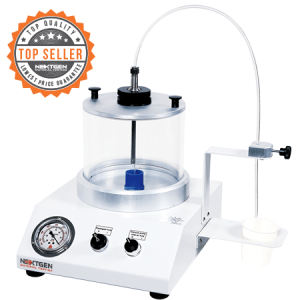
GenVac MP Series – Vacuum Impregnation System for Epoxy Mounting
GenVac MP Series is a vacuum impregnation system for epoxy cold mounting of porous metallographic specimens. Designed for rocks, minerals, ceramics, circuit boards, composites, and other sensitive materials, it uses a separate vacuum pump, transparent removable chamber lid, disposable cup holder, and controlled resin inlet tube to help achieve clean impregnation with clear visual monitoring and minimal material loss during sample preparation.
Read more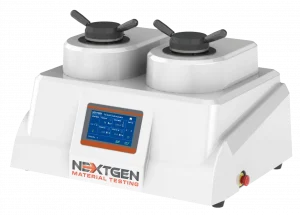
GenPress MFA Dual HYD – Fully Automatic Dual Hydraulic Mounting Press
GenPress MFA Dual HYD is a fully automatic dual hydraulic mounting press for higher-throughput metallographic sample mounting. It can produce up to four samples per cycle and supports 1–2 inch mold sizes, 7-inch touchscreen control, automatic or manual operation, closed-loop hydraulic pressure, integrated cooling, and over 100 saved programs, helping laboratories improve consistency, efficiency, and repeatable specimen preparation.
Read more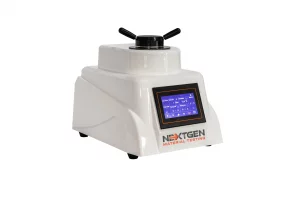
GenPress MFA MOT – Fully Automatic Motorized Mounting Press
GenPress MFA MOT is a fully automatic motorized mounting press for compression mounting of metallographic samples before grinding, polishing, and microscopic analysis. Controlled through a 7-inch touchscreen, it allows operators to set and save heating, cooling, timing, and pressure parameters for repeatable cycles. Motorized pressure loading, 1–2 inch mold compatibility, automatic or manual modes, and up to 100 stored programs improve lab efficiency.
Read more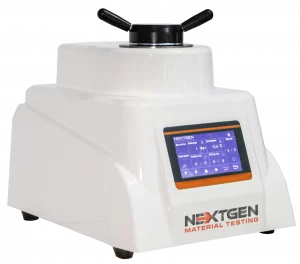
GenPress MFA HYD – Fully Automatic Hydraulic Mounting Press
GenPress MFA HYD is a fully automatic hydraulic mounting press for preparing metallographic samples before grinding, polishing, and microscopic inspection. It supports 1–2 inch mold assemblies, automatic or manual operation, 7-inch touchscreen control, closed-loop hydraulic cycles, integrated cooling, and storage for more than 100 mounting programs, helping labs produce consistent mounts while improving preparation speed and workflow control.
Read more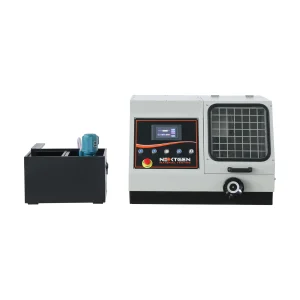
GenCut GL350 – Metallographic Cutting Machine
GenCut GL350 is a precision metallographic sample cutting machine for larger laboratory and industrial specimens. With automatic and manual work modes, a maximum circular cutting section of Φ100 mm, adjustable feed speed, robust cooling, and a closed structure with a large observation window, it helps produce clean, accurate cuts while reducing overheating, improving operator safety, and supporting efficient metallographic preparation workflows.
Read more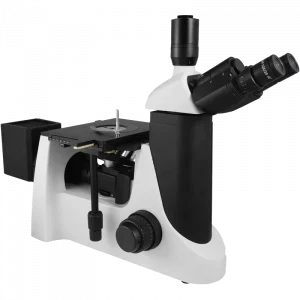
G-800E – Trinocular Metallurgical Microscope
G-800E is an inverted trinocular metallurgical microscope for industrial, research, and educational metallurgy applications. It supports reflected-light observation of polished metals, alloys, coatings, and mounted specimens, with a trinocular head ready for C-mount camera integration. Standard 10x, 20x, 50x, and 80x long-working-distance objectives, 10x eyepieces, and polarization capability make it useful for grain structure, inclusions, phases, and documentation.
Read more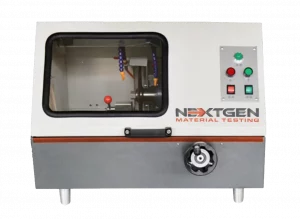
GenCut GL100M – Manual Metallographic Cutting Machine
GenCut GL100M is a precision manual metallographic sample cutting machine for clean, controlled preparation of metal specimens. It supports cutting sections up to Φ100 mm with a 350 mm wheel, 2800 rpm speed, and 3.0 kW motor. A closed safety structure, wide observation window, fast clamping system, cooling water tank, and stainless work surfaces help protect sample integrity and operator safety.
Read more
GenCut GL80A – Precision Metallographic Cutting Machine
GenCut GL80A is a precision metallographic sample cutting machine for preparing metal specimens with a cutting capacity up to Φ80 mm. Designed for simple, user-friendly operation, it supports clean sectioning before grinding, polishing, and microscopic inspection. Its enclosed cutting area, cooling support, observation access, and secure clamping approach help laboratories maintain sample integrity, operator safety, and consistent preparation results.
Read more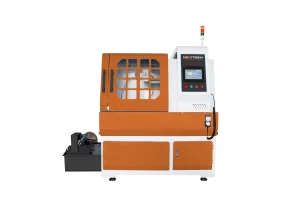
GenCut GL170XY – Multi-Function Abrasive Cut-Off Saw
GenCut GL 170XY is a large-capacity abrasive cut-off saw for automated metallographic sample cutting up to Φ170 mm. Its XY-axis movement, variable feed speed, large coolant system, 150 L water tank, illuminated cutting chamber, ventilation fan, and touchscreen control help operators cut demanding metal specimens safely, accurately, and consistently while preserving sample integrity for later analysis.
Read more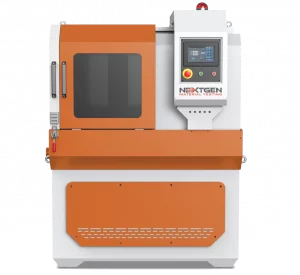
GenCut GL120XY – Multi-Function Abrasive Cut-Off Saw
GenCut GL 120XY is a multifunction abrasive cut-off saw for automated metallographic sectioning of metal specimens up to Φ120 mm. It features a fully automated XY table, 350 mm cutting wheel, 500–3000 rpm variable speed, 7-inch touchscreen with PLC control, dual coolant lines, and programmable feed movement to help deliver accurate cuts while minimizing overheating and specimen damage.
Read more
GenCut GL200E – High-Speed Precision Metallographic Cutter
GenCut GL200E is a high-speed automatic precision metallographic cutter for accurate sectioning of metals, ceramics, biological specimens, and other materials up to Φ60 mm. It offers automatic Y-axis feed, manual and pulse feed modes, 500–5000 rpm spindle speed, 0–600 mm/min feed control, micrometer adjustment, a 200 mm cutting wheel, protective cover, safety switch, and closed-loop overload protection.
Read more
GenCut GL100E – Low-Speed Precision Metallographic Cutter
GenCut GL100E is a low-speed automatic precision cutter for metallographic preparation of small and delicate specimens. Designed for metals, composites, ceramics, plastics, electronics, rocks, and thin-film samples, it uses a diamond cutting wheel, 7-inch touchscreen, micrometer control, coolant circulation, manual or gravity cutting modes, and automatic shut-off to deliver clean sectioning while helping minimize heat and sample damage.
Read more