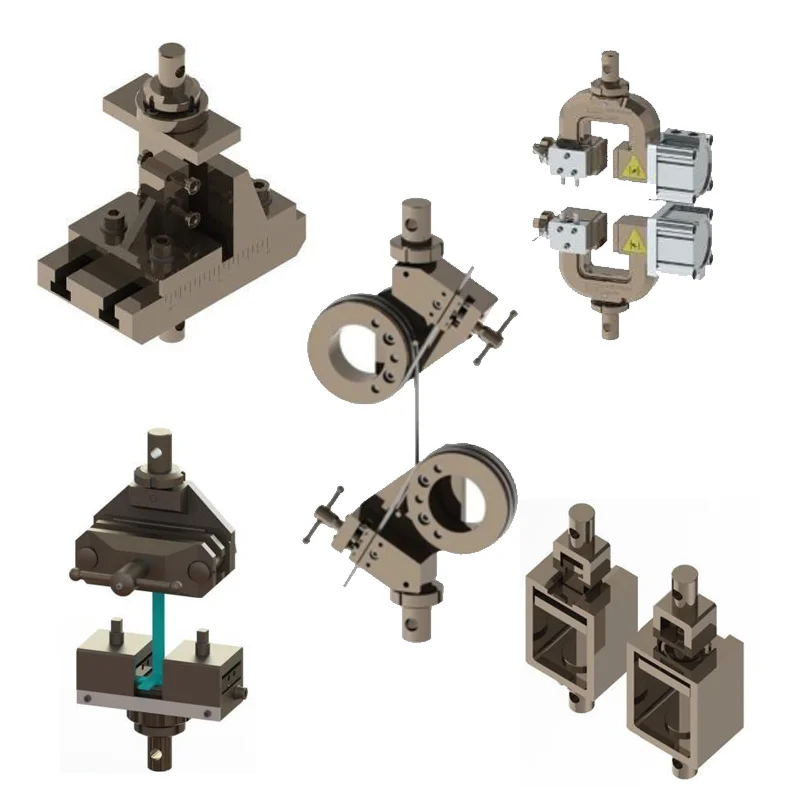
Metal Testing Equipment
Grips and fixtures are critical components for universal testing machines (UTMs), enabling precise application of tensile, compression, flexural, shear, peel, and puncture forces. Designed to securely hold specimens during testing, these accessories guarantee accurate load transmission and compliance with ASTM, ISO, and other international standards.
NextGen Material Testing offers a comprehensive selection of grips and fixtures compatible with electromechanical and servo-hydraulic UTMs. Each unit is engineered to suit specific material types and testing modes, ranging from rubber and plastic films to hardened metals and composite laminates. Available solutions include wedge grips for high-strength metals, pneumatic grips for efficient clamping, and flexural fixtures for 3-point and 4-point bending tests.
Our grips and fixtures support an extensive range of specimen geometries and dimensions, helping laboratories and manufacturers achieve optimal alignment, repeatability, and safety. Many models feature self-tightening mechanisms, interchangeable jaw faces (smooth, serrated, rubber-coated), and high-strength alloys to prevent specimen damage or slippage during high-load applications.
With the right combination of grips and fixtures, your UTM becomes a flexible testing platform suitable for R&D, quality control, and standard-compliant material testing. Whether conducting ASTM E8 tensile tests, ASTM D695 compression tests, or ISO 178 flexural testing, NextGen’s accessories are built to deliver consistent, traceable, and accurate results within all applications.
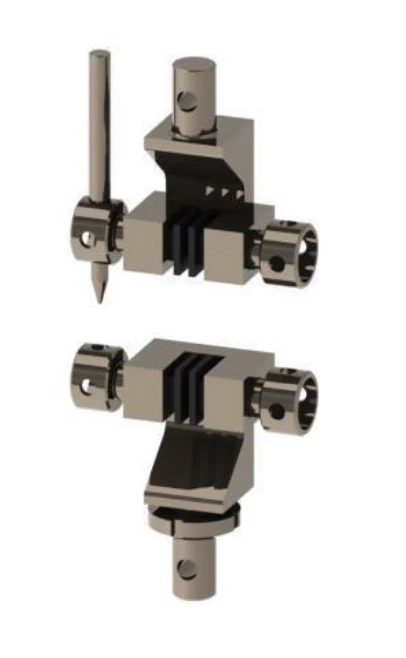 Side Action Tensile Grips for Versatile Clamping Applications
Side action grips are versatile mechanical clamps designed for tensile testing of plastics, metals, textiles, rubber, and composite specimens. These manually operated grips apply lateral pressure through dual jaws, tightened using screws or levers, to hold the specimen securely without causing surface damage.
Ideal for medium-load tensile applications, side action grips are commonly used in quality control and research environments. They are especially valued for their adaptability—interchangeable jaw faces (smooth, serrated, rubber-coated) allow precise matching to different material types and surface conditions, helping reduce slippage during testing.
This type of grip is a cost-effective and reliable choice for laboratories performing standardized tensile tests across a wide range of specimen geometries, where firm, controlled clamping is required without the complexity of powered gripping systems.
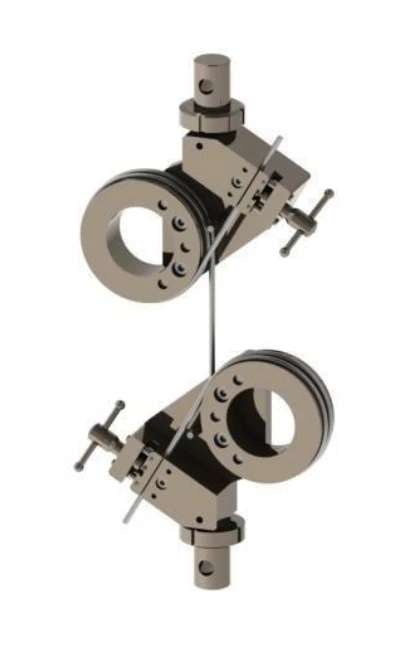 Snubbing Grips for Wire and Cable Tensile Testing
Wire and cable snubbing grips—also referred to as capstan or bollard grips—are specialized fixtures for tensile testing of wires, ropes, fiber bundles, and electrical cables with high slip risk. These grips use a curved mandrel or capstan around which the specimen is wrapped multiple times to generate friction and distribute the load evenly across its length.
This design prevents localized failure at the jaw and allows accurate measurement of the specimen’s full tensile strength, especially for high-strength steel cables, braided wires, and reinforced conductors. The free end is typically secured using a clamp or wedge, ensuring stable loading throughout the test.
These grips are essential for test laboratories, cable manufacturers, and infrastructure or construction quality control teams requiring compliance with ASTM, ISO, or other international standards for cable and wire testing. They offer a non-damaging, high-holding solution for tensile testing of flexible yet high-capacity specimens.
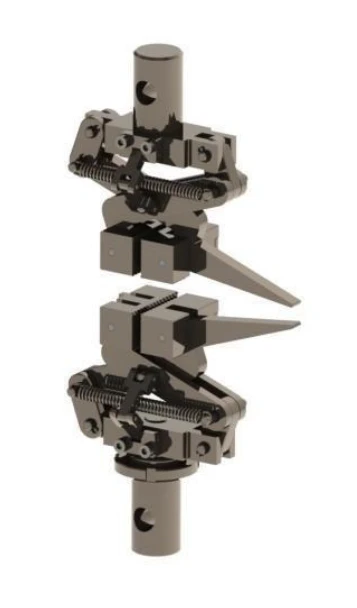 Self-Tightening Grips for Deformable and Elastic Materials
Self-tightening grips are designed to automatically increase clamping pressure as tensile force is applied, making them ideal for materials that elongate, thin, or deform during testing. Commonly used for elastomers, thin plastics, foams, fabrics, and biomedical specimens, these grips adapt to changing specimen dimensions without manual adjustment.
Popular designs include scissor grips, eccentric cam grips, and lever-action jaws, all of which tighten progressively under load. This mechanism minimizes slippage, eliminates the need for excessive pre-tightening, and prevents damage to delicate specimens at the start of the test.
These grips are well-suited for quality control laboratories, textile and rubber manufacturers, and research environments conducting standardized tensile tests on soft, elastic, or low-friction materials. They improve test repeatability and maintain reliable alignment and gripping force throughout the loading cycle.
Eccentric Roller Grips for Thin and Flexible Specimens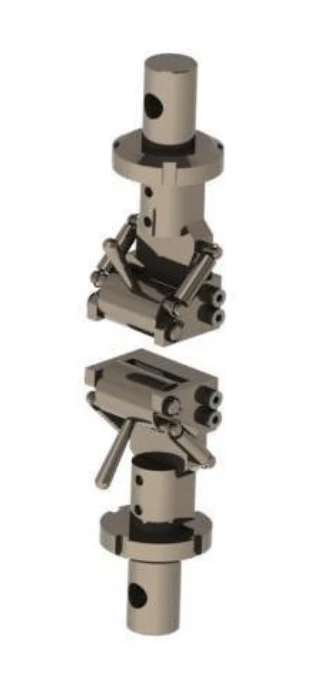
Eccentric roller grips are self-tightening fixtures specifically designed for tensile testing of thin films, rubber sheets, flexible plastics, and other delicate or low-strength materials. They feature an off-center cam roller that clamps the specimen against a fixed anvil. As the tensile load increases, the roller rotates further, automatically increasing the grip force.
This self-energizing mechanism ensures that even as the specimen elongates or necks, it remains securely held without slippage or tearing. To protect sensitive materials, the gripping surfaces are often coated with rubber or non-cutting materials.
These grips are ideal for R&D labs, quality control environments, and manufacturers working with soft or flexible specimens. Their tool-free, lever-actuated design allows for quick specimen loading while maintaining stable clamping pressure throughout the test. Eccentric roller grips comply with relevant ASTM and ISO standards for elastomer and film testing, ensuring accurate and repeatable results.
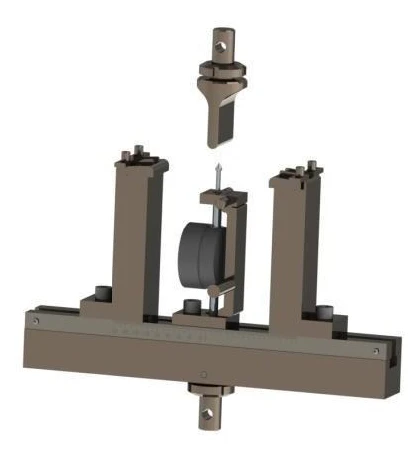
Bending Fixtures for Standard 3-Point Flexural Testing
Bending fixtures—also known as flexural test fixtures—are used with universal testing machines to perform 3-point and 4-point bend tests. These tests evaluate flexural strength, modulus of elasticity, and modulus of rupture in materials such as plastics, metals, wood, and composites.
The fixtures consist of lower support anvils and upper loading noses (or rollers), with adjustable spans to accommodate different specimen sizes and geometries. They are engineered to meet test requirements defined by standards such as ASTM D790 for plastics and ASTM C393 for sandwich structures. The design ensures precise alignment and minimal friction or torsion during loading.
Manufacturers, research facilities, and testing labs use bending fixtures to simulate real-world flexural stress scenarios under controlled conditions. Constructed from high-strength steel or rigid aluminum, these fixtures maintain structural integrity even under high loads, ensuring that force is applied directly to the specimen without deflection or misalignment.
Compression Fixtures for Axial Load Testing of Rigid Samples
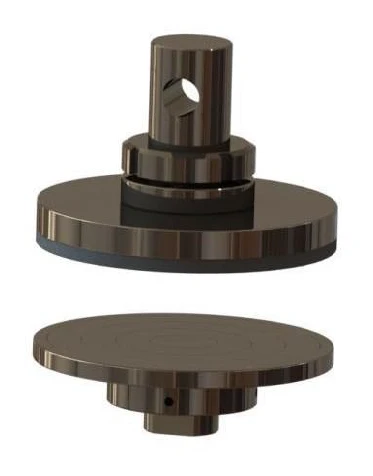
Compression fixtures are essential accessories for universal testing machines used to apply axial compressive loads in a stable and aligned manner. The standard configuration includes flat compression platens—precision-machined steel plates that ensure even force distribution across the specimen surface.
For high-precision or high-force testing, one platen may feature a spherically seated base to self-align with the specimen, reducing the risk of eccentric loading and improving result accuracy. Additional configurations include compression cages or four-post assemblies for testing large samples like foam blocks, packaging materials, or structural components, ensuring specimens do not buckle or shift during loading.
NextGen's compression fixtures are available in a range of sizes and capacities, suitable for testing plastics (ASTM D695), concrete cubes, metals, composites, and paperboard products. These fixtures are ideal for materials testing laboratories, construction quality control, and packaging validation, providing a rigid, compliant platform for reliable compressive strength measurements.
Shoulder Fixtures for Pull-Off and Component Testing
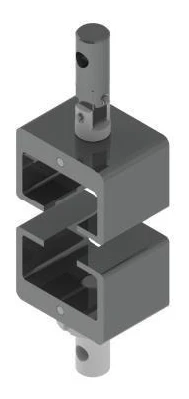
Shoulder fixtures—also known as shoulder grips or ledge grips—are specialized testing accessories designed to hold specimens with an enlarged end, flange, or head that cannot be gripped using standard jaws. These fixtures are essential for performing pull-off, push-out, and component integrity tests where force must be applied through the specimen’s shoulder to simulate real-world use conditions.
Common applications include testing bolt heads, cable terminations, syringe plungers, anchors, buttons, bottle caps, and fastener pull-outs. The specimen typically rests on a recessed ledge or collar, while the opposing end is subjected to axial force by the UTM.
Shoulder fixtures are widely used in medical device testing, automotive component validation, packaging durability, and construction anchoring systems, where it’s critical to assess how parts behave under tensile or compressive loads applied through their structural features. Built in various sizes and configurations, these grips ensure even load distribution across the shoulder area, preventing bending and enabling accurate, repeatable test results in accordance with ASTM and ISO standards.
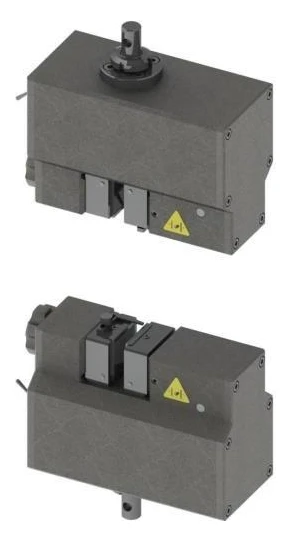 Pneumatic Grips for Fast and Repeatable Clamping
Pneumatic grips use air pressure to apply quick, uniform, and adjustable clamping force to test specimens. Activated by a button or foot pedal, these grips feature built-in air cylinders that close the jaws with precisely controlled pressure—ideal for testing materials that require consistent gripping without surface damage.
They are widely used for rubber, plastics, textiles, and other soft or flexible specimens where accurate pressure control is essential. Users can fine-tune the clamping force to prevent slippage or crushing, especially during standardized tensile tests.
Thanks to their fast operation, pneumatic grips are preferred in high-throughput testing laboratories, quality control departments, and manufacturing facilities. Variants like pneumatic side-action grips are commonly used for mid-range force applications up to 20 kN, offering repeatable and self-centering clamping across different test setups.
These grips support a wide range of material tests and can be adapted to meet requirements from ASTM, ISO, and other international standards, ensuring consistent, safe, and efficient performance in demanding test environments.
Wedge Tensile Grips for High-Load Metal and Composite Testing
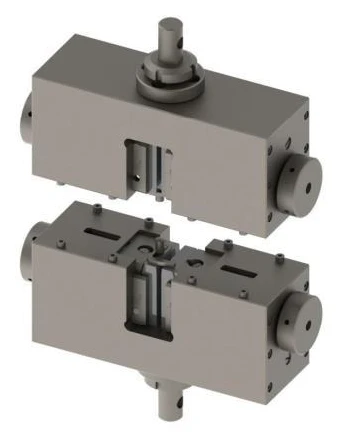
Wedge tensile grips use a self-tightening wedge-action mechanism that increases clamping force as tensile load rises. Each grip includes an internal wedge-shaped slider with serrated or knurled jaws that grip the specimen more firmly as tension is applied.
These grips are ideal for high-strength materials such as metals and composites, particularly in high-load testing applications. Their design ensures secure holding without slippage or jaw damage, even under peak loads. Available in both manual and hydraulic configurations, wedge grips accommodate a wide force range—from a few kilonewtons to over 500 kN.
They are commonly used in material testing laboratories, aerospace and automotive industries, and research institutions performing ASTM E8, ISO 6892, or other metal tensile tests. The grips maintain axial alignment during testing, making them essential for precise tensile strength measurements of hard, structural specimens.
3-Point and 4-Point Bending Fixtures for Uniform Moment Flexural Testing
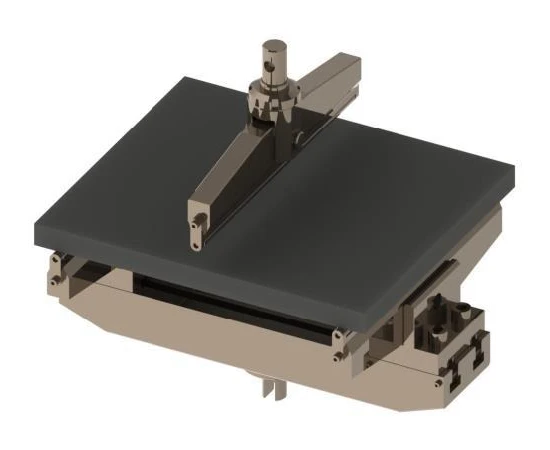
3-point and 4-point bending fixtures are specialized tools used in flexural testing to apply two evenly spaced loads across a specimen, creating a constant moment region between the load points. This configuration eliminates shear forces in the central section, enabling accurate measurement of flexural modulus and modulus of elasticity.
These fixtures are particularly suited for testing brittle materials, plastics, composites, and concrete beams, where minimizing stress concentration is essential. Typical applications include tests based on ASTM D6272 for plastics and ASTM C78 for third-point loading of concrete specimens.
The fixture consists of two upper loading rollers and two lower supports with adjustable span distances to accommodate different specimen sizes and meet specific standard requirements. It is widely used by construction material labs, composite manufacturers, and research institutions aiming to observe failure modes or deflection behavior under pure bending conditions.
Grips and Fixtures for Tensile, Shear, and Flexural Testing of Wood
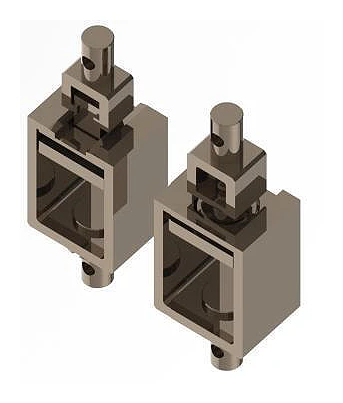
Wood testing grips and fixtures are specially designed to accommodate the anisotropic, variable nature of wood and timber specimens. These solutions support a full range of mechanical tests defined by standards such as ASTM D143 and ASTM D4761, covering tensile, shear, compression, nail/screw withdrawal, and flexural testing.
For tensile tests parallel to grain, grips with flat or serrated jaws or shouldered clamps are used to hold dogbone-shaped specimens without crushing. For perpendicular-to-grain tests, fixtures with bonded metal brackets are applied. Block shear fixtures allow testing of shear strength along the grain under tension or compression. Nail and screw withdrawal fixtures are designed to pull fasteners axially from wood blocks to assess withdrawal resistance.
Compression testing is performed using oversized or self-aligning compression platens, while 3-point and 4-point bending fixtures are used for measuring modulus of rupture and modulus of elasticity in lumber and beams.
These fixtures are widely used by wood product manufacturers, construction material testing labs, and furniture and fastener industries, ensuring accurate, repeatable testing while compensating for wood’s natural variability. All fixtures are built to prevent grip-induced failure and ensure compliance with wood testing standards.
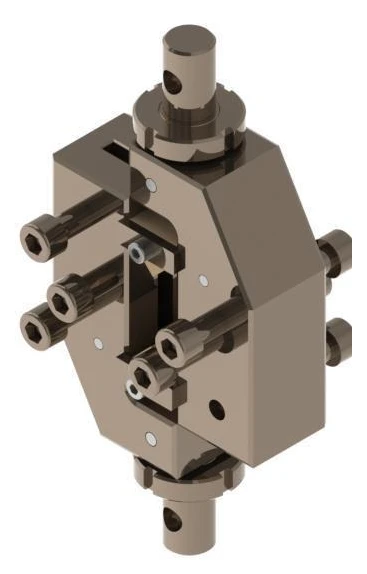 Composite Grips and Fixtures for Tensile, Shear, and Delamination Tests
Composite grips and fixtures are engineered for the complex mechanical testing of composite materials, including carbon fiber reinforced polymers, fiberglass, and laminates. These materials require specialized handling to avoid premature failure, misalignment, or stress concentrations during testing.
For tensile testing, hydraulic wedge grips with treated jaw surfaces are used to prevent slippage or crushing of composite laminates. In compression testing, fixtures such as the Combined Loading Compression (CLC) and IITRI types hold specimens with side supports or end tabs to ensure proper failure modes.
Shear testing of interlaminar strength is typically performed using short-beam shear fixtures (per ASTM D2344), Iosipescu shear fixtures (ASTM D5379), and rail shear devices (ASTM D7078) for in-plane shear. Fracture toughness evaluation includes double cantilever beam fixtures (ASTM D5528) for Mode I and end notch flexure or mixed-mode bending fixtures for Mode II delamination.
Additional solutions include picture frame fixtures and bias extensometer setups for fabric in-plane shear, as well as floating roller peel (ASTM D3167) and climbing drum peel fixtures (ASTM D1781) for testing bonded laminate assemblies.
Specialized Grips and Fixtures for Tear, Peel, and Puncture Testing
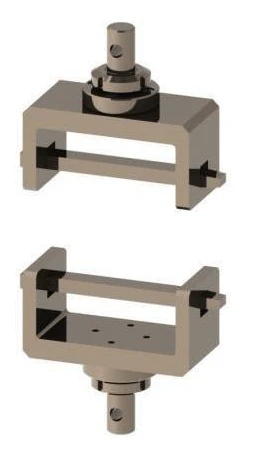
Special-purpose grips and fixtures cover a wide range of non-standard mechanical tests including peel, tear, puncture, pull-through, buckle, and custom shear testing. These solutions are designed for materials and configurations that cannot be tested using conventional grips, allowing flexible adaptation to specialized requirements.
Examples include 90-degree peel fixtures and climbing drum peel fixtures for adhesive bond strength testing of tapes, laminates, and bonded assemblies. Tear test grips hold plastic films or fabrics for propagation tear evaluation. Puncture fixtures include systems for geomembranes under ASTM D4833 and ball burst tests for textiles in accordance with ASTM D3787. Other options include tear propagation fixtures, eyelet pull-through grips, and buckle test fixtures.
Custom shear fixtures are available for adhesive lap joint testing, such as those conforming to ASTM D4501. These solutions are commonly used by packaging developers, textile manufacturers, material testing labs, and industrial product engineers requiring accurate test configurations beyond standard tensile or compression applications.
TestStar® Series Grips and Fixtures for Hydraulic UTM Integration
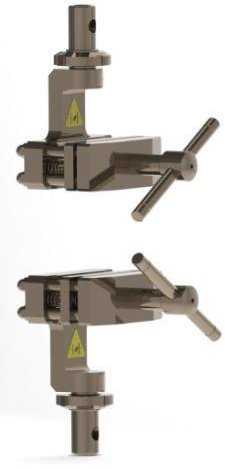 TestStar® series grips and fixtures are designed specifically for use with NextGen’s TestStar universal testing machines, which are high-performance systems equipped with hydraulic actuation. These accessories offer the same core functionality as standard grips but are fully compatible with TestStar mounting, force capacity, and control systems.
The range includes manual and pneumatic snubbing grips for testing wires and cables using the capstan method, side action grips for general-purpose tensile testing, wedge-action grips for high-strength metals, and dedicated compression and bending fixtures. Fixtures such as 3-point flexural setups are available for testing plastics, metals, and composites, utilizing the full capabilities of the TestStar frame.
These grips are ideal for test laboratories, heavy industrial applications, and materials R&D, particularly when working with large specimens or high-force testing requirements. Hydraulic variants are available for high-capacity setups.
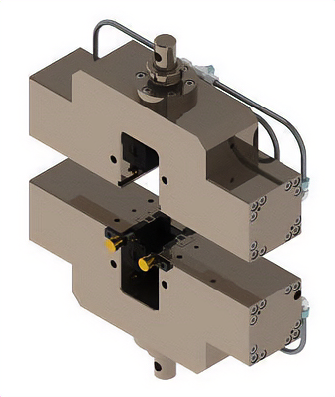 Dual-Action Hydraulic Grips with Wedge Clamping for High-Capacity Tests
Dual side action/wedge hydraulic grips are designed for high-capacity tensile testing, combining parallel hydraulic clamping with wedge-action self-tightening. In side-action mode, the jaws close symmetrically from both sides using hydraulic pressure, ensuring even, balanced force on flat or wide specimens without introducing bending stress.
The wedge-action mode uses angled jaw slides that increase clamping force as tensile load rises. This mechanism provides additional holding strength for large metal specimens, steel rods, and fasteners, making these grips ideal for testing applications involving forces in the hundreds of kilonewtons. The hydraulic actuation allows pre-set pressure control for safe and consistent specimen engagement.
These grips are commonly used on servo-hydraulic universal testing machines in construction materials labs, metal testing facilities, and industrial manufacturing environments, where conventional manual or pneumatic grips are insufficient. Their robust construction supports maximum machine loads, making them essential for rebar, bolt, and structural metal testing.
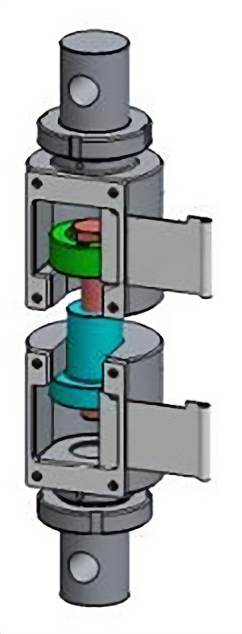 Threaded Grips for Bolt and Nut Tensile Testing
Bolt and nut tensile grips (also known as threaded grips) are specialized fixtures for axial tension testing of bolts, screws, studs, and nuts. These grips use threaded adapters or holders rather than clamping jaws, allowing direct engagement with the specimen's threads. The setup replicates real-world loading conditions by applying tensile force through the bolt head and nut.
These grips are essential for measuring the tensile strength, yield behavior, and proof load capacity of fasteners, in accordance with standards such as ASTM F606. In a typical proof load test, a nut is mounted on a hardened test mandrel and loaded to a specified tension to verify thread integrity and load-bearing capacity without failure. NextGen’s grips include interchangeable threaded inserts to accommodate various thread sizes.
Widely used in automotive, aerospace, construction, and mechanical engineering laboratories, these grips are built from high-strength steel to handle forces exceeding 100 kN. They enable reliable, repeatable testing of threaded fasteners and provide critical data for quality control and product certification in structural and mechanical applications.
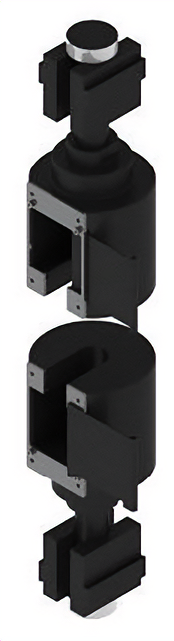 Grips and Fixtures for Hydraulic Universal Testing Machines
Within the hydraulic machine accessories category, the tensile grips and fixtures segment covers all devices for applying tension using a high-force system. This includes large hydraulic grips—both side-acting and wedge types—for straight-pulling of metal coupons or bars. It also encompasses special tensile fixtures like the tensile shear fixture, which may be used to test shear strength in tension (for example, pulling on a single-lap joint to induce shear failure), and proof load fixtures for nuts, as commonly needed in fastener testing.
A nut proof load fixture usually involves a loading mandrel (a hardened threaded rod) that the nut is fastened onto, paired with a support so the nut can be pulled without movement. The nut is stressed in tension via the mandrel up to a specified force to ensure it can hold that load without stripping. In the hydraulic context, these fixtures are built to withstand very high forces, since large nuts and fasteners can require hundreds of kilonewtons in proof tests. Tensile grips for hydraulic machines also often feature quick-change jaw inserts and heavy-duty construction, such as bolt grips with larger thread sizes or split collar grips for large diameter specimens.
Everything in this category is about handling large tensile forces safely and accurately. The fixtures are designed to maintain perfect alignment in the vertical direction, as off-axis loads at high force can be catastrophic. With NextGen’s tensile grips and fixtures for hydraulic frames, users can perform standard tension tests (like ASTM E8 for metals, ASTM A370 for rebar, etc.) and specialized tension-based tests (fastener proof tests, shear in tension, etc.) with confidence that the equipment can handle the load. Each fixture meets the relevant standard (such as wedge grips fulfilling the grip requirements of ASTM E8, or nut testers meeting ASTM F606) and interfaces properly with the high-capacity load cells and actuators of the hydraulic machine.
Products
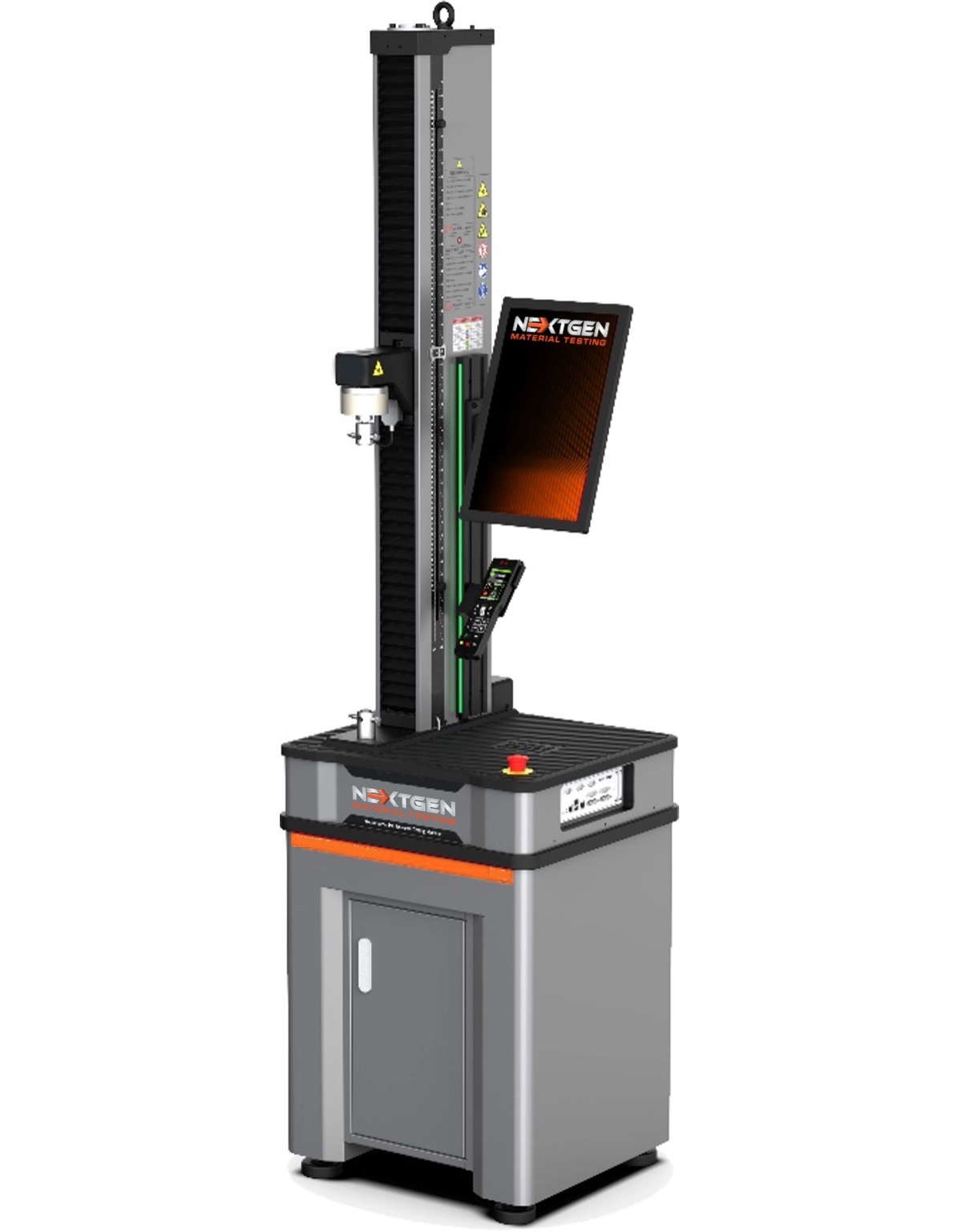
NG-EML Series A – Single Column Bench Top Universal Testing Machine (50 N – 5 kN)
The NG-EML Series A – Single Column Bench Top UTM (50 N–5 kN) is a precision electromechanical system designed for tension, compression, and flexural testing of low-force specimens. Featuring GenTest™ software, a high-speed servo drive, Class 0.5 accuracy, and USB/Ethernet control, this compact tabletop unit supports ASTM, ISO, and EN standards. Ideal for testing plastics, rubber, foams, films, composites, and thin metals.
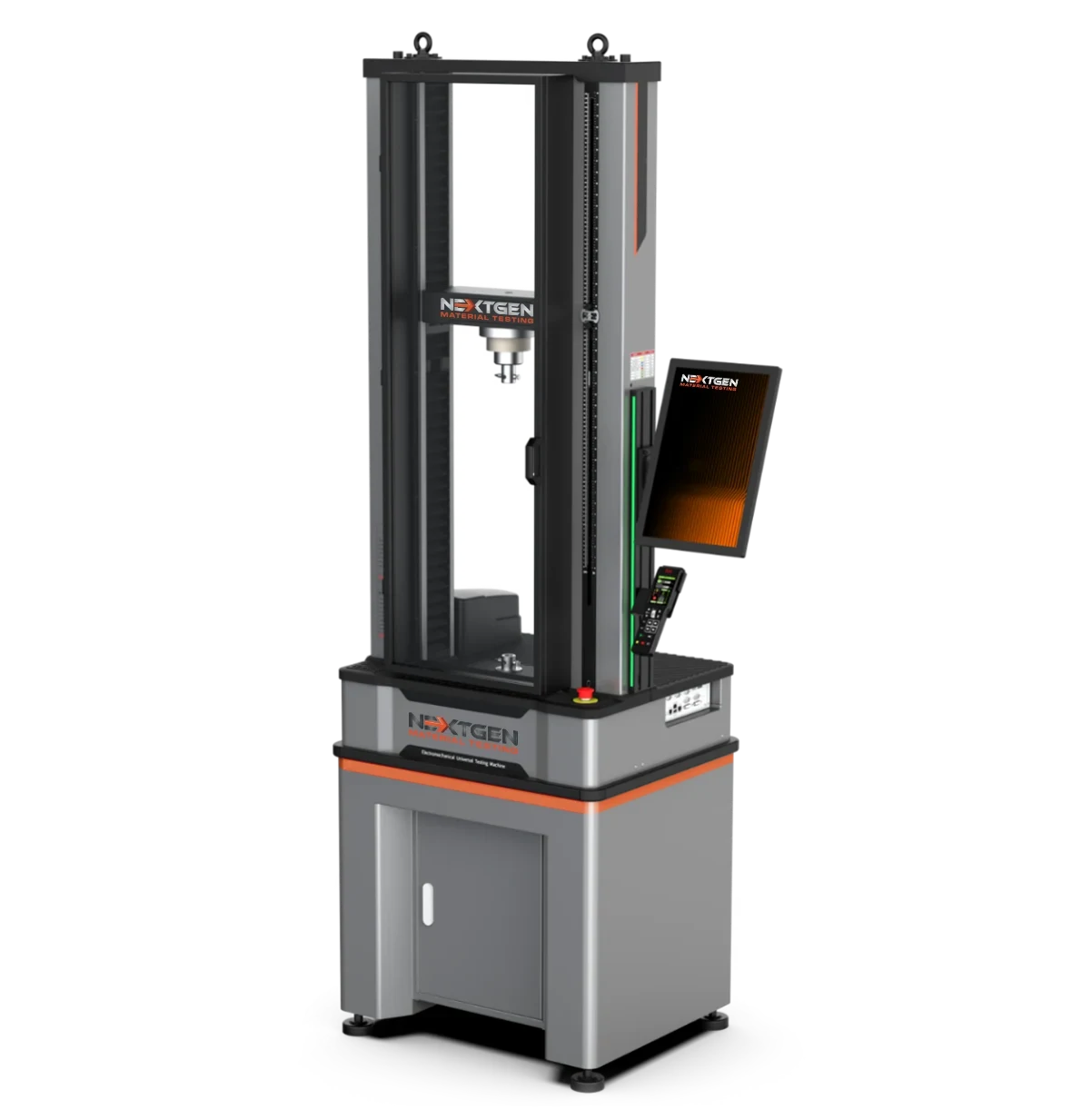
NG-EML Series B – Dual Column Bench Top Universal Testing Machine (100 N – 10 kN)
The NG-EML Series B is a high-precision dual-column benchtop universal testing machine engineered for tensile, compression, and flexural testing in the 0.1 kN to 10 kN range. It features Class 0.5 accuracy, a rigid FEM-optimized frame, and a direct-drive servo system with advanced closed-loop control, making it ideal for testing rubber, plastics, metals, composites, and high-performance polymers in both R&D and quality assurance settings.
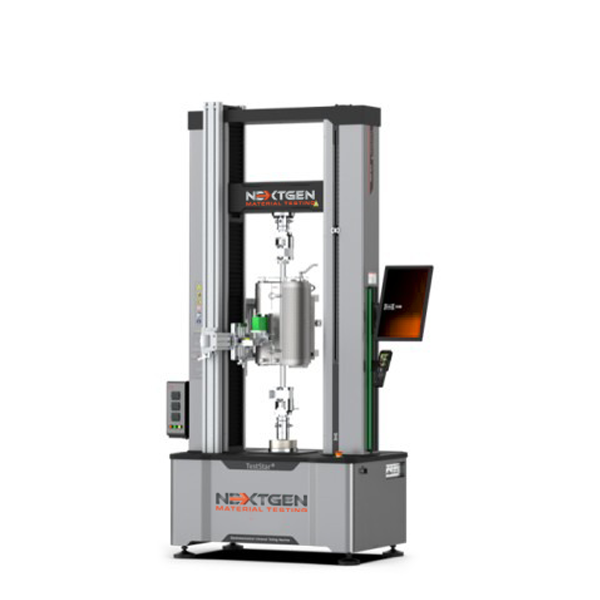
NG-EML Series C – Dual Column Bench Top and Floor Standing Universal Testing Machine (5 kN – 50 kN)
The NG-EML Series C is a precision-engineered dual-column universal testing machine for tension, compression, and flexural testing of metals, composites, rubbers, and polymers. Available in both bench-top and floor-standing formats, with force capacities from 5 kN to 50 kN and Class 0.5 accuracy.
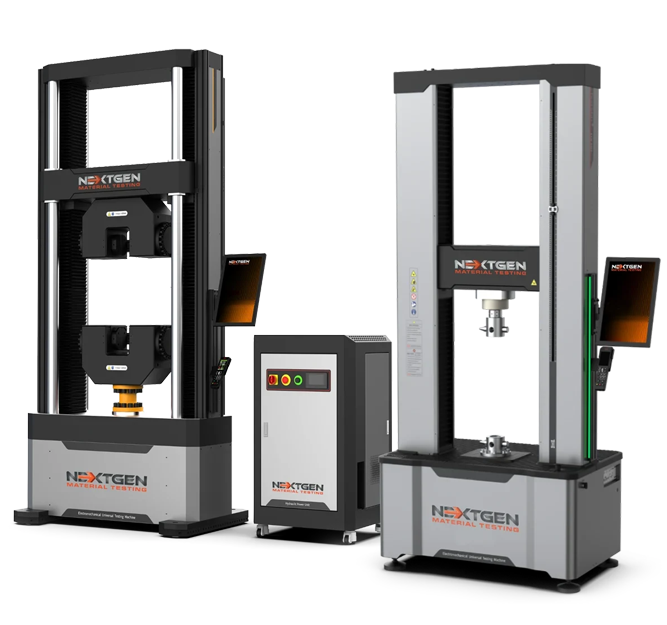
NG-EML Series D – Floor Standing Universal Testing Machine (50 kN – 1000 kN)
The NG-EML Series D – Floor Standing Universal Testing Machine (50 kN–1000 kN) is a dual-column system for tensile, compression, flexural, shear, and cyclic testing of high-strength metals, composites, polymers, and advanced materials. Available in single-space and dual-space configurations, it meets ASTM E8, ISO 6892-1, ISO 527, and GB/T 228 standards. With closed-loop control, 1200 Hz sampling, ultra-low speeds (0.00005 mm/min), and waveform generation, it is ideal for aerospace, automotive, construction, and research labs.
FAQs
Grips and fixtures are the critical connection between a universal testing machine and the specimen. Their job is to hold the sample securely, keep it properly aligned with the load axis, and transfer force into the specimen in a controlled way so your results reflect material behavior, not slippage, bending, or grip-induced damage.
In tensile testing, the right grips maintain consistent clamping as load increases and help prevent specimen pullout or jaw marks that can trigger premature breaks. In compression, bending, shear, peel, and other methods, dedicated fixtures establish the correct contact surfaces, support conditions, and loading geometry so the machine applies force the way the test method intends.
Grip and fixture selection typically depends on:
- Specimen form, such as flat coupons, round bars, wire and cable, or threaded fasteners
- Material response, such as hard metals versus soft plastics, rubber, films, or composites
- Test type and setup, such as tension, compression platens, 3-point or 4-point flexure, or peel and puncture fixtures
If you want to confirm the right configuration for your specimens and method, learn more or request a quote.
These grips and fixtures are intended for use on NextGen universal testing machines, including both electromechanical UTMs and servo-hydraulic UTMs. For hydraulic frames, the TestStar series grips and fixtures are built specifically to match NextGen TestStar hydraulic UTM integration.
Within the electromechanical UTM lineup, the correct grip or fixture is selected based on the frame class and how the accessory mounts to the machine, rather than being a one-size-fits-all part. In practice, many labs configure grips and fixtures across NextGen’s NG-EML frames, then match jaw style and load range to the material and test type.
To confirm the right UTM match for your tensile testing setup, compatibility typically comes down to:
- Frame type, electromechanical vs servo-hydraulic
- Force capacity and load cell range
- Mounting interface, adapters, and alignment needs
- Actuation needs, such as pneumatic or hydraulic clamping
If you want to confirm the exact UTM model and mounting needed for your grips and fixtures, review the options on learn more and share your specimen details via request a quote.
Properly selected fixtures improve test accuracy by keeping the specimen centered and stable so the applied force is transmitted the way the method intends. They also increase throughput by shortening setup time and reducing retests caused by slippage, misalignment, or premature grip-area failures.
For accuracy, the goal is repeatable load introduction with minimal unintended bending or crushing. A grip style matched to your material and geometry helps prevent slip and grip damage, and well-aligned compression platens help keep axial compression truly axial. For flexural work, dedicated 3-point or 4-point fixtures with the right span and roller geometry help produce consistent bending conditions from test to test.
For throughput, fixture choice often comes down to changeover speed and operator-to-operator consistency:
- Faster, more repeatable clamping for routine QC runs
- Less jaw swapping and fewer setup tweaks between specimens
- Fewer invalid results to investigate, repeat, or scrap
If you want to confirm the best grip and fixture configuration for your specimen geometry and test method, review the options under learn more or request a quote.
Choose specialized grips when a general-purpose setup cannot hold the specimen securely and concentrically throughout the test, or when the test method requires a specific loading condition beyond straightforward tensile clamping. The goal is to prevent slippage, reduce specimen damage at the jaws, and improve repeatability.
Specialized grips are typically the better choice when you are dealing with any of the following:
- Thin, flexible, or high-elongation specimens where grip force needs to increase with load, such as films and rubber, using eccentric roller grips.
- Wire, rope, or cable where conventional jaws tend to slip, using snubbing or capstan-style grips.
- Bolts, studs, screws, or nuts where threaded engagement is needed instead of jaw clamping, using threaded grips.
- High sample volume where fast, consistent clamping improves throughput, using pneumatic grips.
- Non-standard loading like bending, compression, peel, tear, or puncture, using dedicated fixtures.
If you want to confirm the right grip and fixture combination for your material, specimen geometry, and test method, learn more or request a quote.
Select grips and fixtures based on the maximum force you expect to apply in the test, while staying within the UTM frame’s rated capacity. In practice, the safe working limit is set by the lowest-rated component in the load train, including the grip or fixture, adapters, and the load cell, so the accessory should be chosen to comfortably handle your peak load for that method.
A simple way to size the hardware is to confirm these items up front:
- Your highest expected test force for the material, geometry, and method
- Whether the setup is for tensile, compression, flexural, shear, peel, or puncture loading
- Whether your UTM is electromechanical or servo-hydraulic, and which accessory family fits that style
Capacity is only part of the match. For consistent results, prioritize fixtures that maintain alignment and control slip or specimen damage, for example self-tightening designs and interchangeable jaw faces such as smooth, serrated, or rubber-coated options.
If you want to confirm the right grip or fixture rating for your peak load and specimen geometry, review the options and then learn more or request a quote.
These grips and fixtures are intended to cover a broad mix of materials, including metals, plastics, elastomers, composites, and wood, as long as you match the fixture style to your specimen geometry, surface condition, and the test you are running (tension, compression, bending, peel, puncture, and more).
In practice, selection is typically driven by what you need to hold and how it behaves under load:
- Metals: wedge or side-action grips for secure tensile clamping, plus threaded options for bolts and fasteners
- Plastics and elastomers: pneumatic, self-tightening, or roller-style grips to reduce slip and minimize clamp damage on softer specimens
- Composites: composite-focused grips and fixtures to manage alignment and reduce grip-induced failures
- Wood: dedicated wood grips and fixtures, along with bending and compression setups for timber and lumber-type samples
To dial in the right configuration, focus on specimen thickness and width, surface texture, expected force level, jaw face style, and whether you need a dedicated bending, compression, shear, or specialty test fixture.
If you want to confirm the best fixture set for your specific materials and specimen geometry, review the options to learn more or request a quote with your specimen details and target test type.
Grip capacity ratings are driven by the forces you plan to apply and the clamping method, not simply by whether the test frame is hydraulic or electromechanical. In practice, you can often use the same capacity-rated grips across frame types as long as the grips are rated for the required load and are compatible with the machine’s mounting and alignment scheme.
Hydraulic frames are frequently selected for higher-force work, and they are also commonly paired with hydraulic-actuated gripping (such as wedge or side-action styles) to deliver consistent clamping and safer handling at elevated loads. That is why hydraulic systems often end up specified with higher-capacity grip packages, even when the underlying “capacity rating” concept is the same.
When selecting grip capacity, focus on the full setup, including:
- Maximum test force for your method and specimen
- Specimen size, shape, and surface condition (risk of slip or crushing)
- Grip style and jaw faces needed for repeatable clamping
- Machine interface and adapters (mounting geometry and alignment)
If you want to confirm the right grip capacity and interface for your hydraulic or electromechanical frame, review the options on learn more and send your application details to request a quote.
The best jaw face is the one that holds your specimen securely through the entire test without introducing slip, crushing, or unwanted surface damage. In practice, you are balancing grip traction against how sensitive the specimen surface is.
Key inputs that typically drive jaw face selection include:
- Material hardness and ductility, including how easily it will indent or neck in the grip area
- Surface condition, such as smooth, coated, oxidized, or textured
- Specimen geometry, including thickness, width, and whether it is flat, round, or irregular
- Required load level and how much clamp force is needed to prevent slip
- Risk tolerance for jaw marks versus the need for high holding power
As a starting point, smooth faces are often used when you want to minimize marking, serrated or knurled faces are common for higher-traction gripping on tougher materials, and rubber-coated faces can help with softer or lower-friction specimens. The grip style and test method can also influence what works best for repeatability.
If you want to confirm the right jaw face and grip configuration for your material and specimen geometry, review the options under learn more or request a quote.
These grips and fixtures can be configured to hold many common tensile and fixture-based specimen geometries, including flat coupons and strip specimens, round rods and wire-like products, and non-standard shapes when a dedicated specialty fixture is the better fit.
For flat or wide specimens, side-action and wedge-style grips are commonly selected, with interchangeable jaw faces used to match the material surface and reduce slip or jaw marking. Round geometries are typically handled with grip and insert selections that maintain axial alignment and consistent contact.
For challenging or irregular setups, labs often move away from “jaw clamping” and into purpose-built fixtures designed around the test intent, for example:
- Thin films and flexible sheets, using self-tightening or roller-style grips
- Wire, rope, and cable, using snubbing or capstan-style grips
- Bolts, studs, and nuts, using threaded grips and adapters
- Peel, tear, and puncture samples, using dedicated specialty fixtures
If you want to confirm the right grip style, jaw faces, and mounting for your exact specimen geometry and method, use learn more or request a quote.
These gripping solutions are designed to control slippage on difficult specimens by matching the clamping mechanism to the material and geometry. For low-friction or delicate samples, several options use self-energizing grip action so holding force increases as tensile load rises, helping maintain a stable hold without over-crushing the specimen.
For thin films and thin laminate strips, eccentric roller grips and self-tightening grips are commonly used because they progressively increase grip force as the specimen is loaded, which helps prevent pullout as the sample elongates or necks.
For wires, strands, and cables, snubbing (capstan-style) grips reduce slip risk by wrapping the specimen around a curved surface to build friction and spread the load more evenly. Final selection typically depends on:
- Specimen form (flat strip vs round wire, single strand vs bundled)
- Surface condition (smooth, coated, braided)
- Force level and whether the material is easily damaged at the jaws
If you want to confirm the best grip style and jaw interface for your specific film, wire, cable, or laminate, use the product page to learn more and share your specimen details to request a quote.
Interchangeable jaw faces are available, and many grip models can be configured with smooth, serrated, or rubber-coated contact surfaces to better match your specimen material and surface finish.
Jaw-face selection typically depends on whether you are prioritizing maximum holding power or minimizing surface marking. Smooth faces are often chosen for more delicate or finished specimens, serrated faces are commonly used when slip resistance is critical, and rubber-coated faces can help increase friction on softer materials while reducing bite-in.
Availability and the best option can vary with the specific grip style, specimen geometry, and the load level you plan to run. Sharing your specimen thickness, material type, and target force range helps ensure the correct jaw insert size and surface type are paired to the right grip body.
If you want to confirm the right jaw-face options for your grips and your test method, learn more or request a quote.
Off-axis loading usually comes from the specimen being held slightly crooked, clamped unevenly, or allowed to shift as load increases. The most effective alignment features are those that automatically center the specimen and apply load symmetrically, so the force stays on the machine’s vertical axis and bending is minimized.
For tensile testing, look for grips that keep the load path centered, such as designs with self-centering clamping and jaws that close evenly from both sides. Wedge-style grips also help by tightening under load while maintaining axial alignment, which is especially important for harder, structural specimens.
For compression and flexural setups, alignment comes from the fixture geometry. Common features include spherically seated, self-aligning compression platens to reduce eccentric loading, plus compression cages or guided assemblies that keep larger specimens from buckling or sliding. In bending fixtures, accurate roller positioning and adjustable spans help keep the specimen square and reduce unwanted torsion.
If you want to confirm the right grip or fixture style for your specimen geometry and test method, review the options to learn more or request a quote.
Fixtures and grips for this UTM platform can be configured to cover tensile, compression, flexural (bending), shear, peel, and puncture test modes, using dedicated tooling matched to the specimen and method.
For example, tensile setups can use side-action, wedge-style, snubbing (capstan) grips for wire and cable, or threaded grips for bolts and fasteners. Flexural testing is supported with 3-point and 4-point bending fixtures, and compression testing is typically done with compression platens and related compression fixtures. For shear and bonded-joint work, composite-focused fixtures support common shear approaches, plus peel fixtures such as floating roller and climbing drum styles. Puncture options include fixtures used for geomembrane puncture and ball burst style testing.
Fixture selection typically depends on a few practical details:
- Material type and specimen geometry (flat, round, wire, laminate, fabric)
- Target load level and alignment requirements
- Jaw face style, inserts, and anti-slip needs
- Method-specific loading configuration (peel angle, shear fixture style, puncture tip and support)
If you want to confirm the right fixture set for your test modes and specimen details, start with learn more and then request a quote with your material, dimensions, and method.
3-point and 4-point bending fixtures are offered for flexural testing applications on this UTM grips and fixtures lineup, including dedicated setups for uniform-moment 4-point loading as well as standard 3-point flexural testing.
Fixture selection typically depends on your specimen material and geometry, the span range you need, and whether your method calls for a single central loading nose (3-point) or two loading points (4-point) to create a constant-moment region in the gauge area.
In practice, you will also want to match the roller or nose style to your specimen surface sensitivity and ensure the fixture interfaces cleanly with your test frame and load capacity for stable alignment and repeatable results.
If you want to confirm the right bending fixture configuration for your specimens and flexural method, use learn more or request a quote.
Capstan, also called snubbing or bollard grips, are typically the preferred approach for wire and cable tensile testing when slippage or grip-induced damage is a concern. Instead of biting into the specimen like jaw-style grips, the sample is wrapped around a curved mandrel to build holding force through friction while spreading the load along the length.
This wrap method helps you avoid premature breaks at the grip line and supports more representative tensile results, especially on high-strength cables, braided constructions, reinforced conductors, and other flexible specimens that tend to pull through standard grips.
In practice, the wrapped section carries the load and the tail end is secured separately, commonly with a secondary clamp or wedge, to keep the specimen stable through the pull.
If you want to confirm the right snubbing grip style and setup for your wire or cable type, review the grip options and learn more, then request a quote with your specimen construction and test method details.
Dedicated UTM fixtures are available for composite laminate delamination and fracture toughness work, including setups intended for interlaminar fracture testing in Mode I (DCB-style) and mixed-mode I and II configurations.
Fixture selection typically depends on the fracture mode you need to measure, your laminate construction and specimen geometry, and how the specimen will be loaded and aligned (for example, loading blocks versus other attachment approaches). Matching the fixture to the method helps reduce bending, twisting, and grip-induced damage that can distort crack growth behavior.
For laminate and sandwich structures, labs often pair delamination and fracture fixtures with composite-appropriate tensile grips or related composite test fixtures when the program also includes shear, peel, or flexural checks as part of a broader damage tolerance workflow.
If you want to confirm the right fixture style for your laminate type and test method, review the available options and request a configured recommendation from NextGen: learn more or request a quote.
Self-tightening and wedge-action grips improve repeatability by making the clamping force rise automatically as the tensile load increases. That “self-energizing” behavior keeps the specimen from creeping in the jaws, stabilizes the effective gauge length, and reduces operator-to-operator variation from under-tightening or over-tightening.
In wedge tensile grips, the pulling force drives an internal wedge geometry that continuously draws the jaws tighter. This is especially helpful for higher-strength metals and composites where small amounts of jaw movement can create slip, misalignment, or inconsistent break locations.
For deformable materials that elongate or neck down, self-tightening styles (such as cam, scissor, or roller concepts) adapt to changing specimen thickness during the test. That helps maintain grip pressure without crushing the specimen at the start, which supports more consistent results run to run.
If you want to confirm the best self-tightening or wedge grip style for your material, specimen geometry, and load range, learn more or request a quote.
For uniform-moment loading in flexural testing, a 4-point bending fixture is the preferred design. By applying load through two upper loading points onto two lower supports, it creates a constant bending moment region between the load points, which helps produce more consistent flexural modulus and strength results across specimens.
Compared with 3-point bending, 4-point setups reduce the influence of a single peak-stress location at midspan and are often chosen when you want cleaner, more repeatable bending behavior, especially for brittle materials, plastics, composites, and beam-like construction samples.
For best repeatability, look for a fixture layout that uses smooth loading rollers and support rollers, maintains good alignment on the UTM, and allows span adjustment so you can match your method requirements and specimen geometry.
If you want to confirm the right 4-point fixture configuration for your specimen size and bending method, start with learn more and then request a quote with your span, width, and material details.
Consistent alignment and clean force transfer start with using the right grip or fixture for the specimen geometry and loading mode, then clamping the specimen the same way every time. When the specimen is centered, fully seated, and held without slip or crush, you minimize bending, jaw-induced stress concentrations, and test-to-test scatter.
A practical setup routine that improves repeatability includes:
- Match the grip style to the material behavior, then use a consistent clamp sequence and engagement length
- Keep jaw faces and contact surfaces clean and in good condition to prevent slip
- Square and center the specimen before tightening, then apply a light preload and confirm stable seating
- Use fixtures intended for the load direction, for example axial compression fixtures and dedicated 3-point or 4-point bending fixtures
For clamping consistency, select jaw faces that suit the surface and strength of the sample, and consider self-tightening or pneumatic clamping approaches when your method benefits from more repeatable gripping behavior and reduced operator influence.
If you want to confirm the best grip and jaw-face configuration for your specimen type and method, use learn more or request a quote.
These grips and fixtures can help you satisfy common ASTM method requirements for tensile, compression, and flexural testing by providing the appropriate clamping, platen support, and loading geometry for the standard you are running.
Depending on the fixture style and specimen type, they are commonly applied to standards such as:
- Tensile: ASTM E8 (metals), ASTM A370 (steel products and rebar), ASTM F606 (fasteners and proof testing)
- Compression: ASTM D695 (rigid plastics and similar materials)
- Flexure: ASTM D790 (plastics), ASTM D6272 (4-point flexure), ASTM C78 (concrete flexure), ASTM C393 (sandwich constructions), plus wood methods such as ASTM D143 and ASTM D4761 where applicable
Final standard conformance depends on the complete method setup, including specimen geometry, alignment, span settings, load cell and strain measurement, and your test control and reporting workflow.
If you want to confirm the right grips or flexure/compression fixture for your specific ASTM method and specimen dimensions, learn more or request a quote.
These UTM grips and composite fixtures can be configured to run widely used composite shear and delamination methods, including short-beam shear, Iosipescu shear, rail shear, and Mode I double cantilever beam (DCB), when the correct fixture geometry and method setup are selected.
Common composite standards supported with the appropriate fixtures include:
- ASTM D2344, short-beam shear (interlaminar shear strength)
- ASTM D5379, Iosipescu shear
- ASTM D7078, rail shear
- ASTM D5528, Mode I DCB delamination
- ASTM D3167, floating roller peel
- ASTM D1781, climbing drum peel
Final method fit depends on your laminate type and thickness, specimen geometry, required spans and loading noses, alignment requirements, and what strain or displacement measurement approach you plan to use during the test.
If you want to confirm the right fixture configuration for your specific composite standard and specimen geometry, learn more or request a quote.
ISO 178 flexural testing is typically run using a 3-point bending setup, and dedicated bending fixtures are available for use with this UTM grip and fixture lineup.
For ISO 178 work, the common approach is a 3-point flexural fixture with a loading nose and two supports, with span adjustment to match the method and your specimen geometry. If you also run other flexural methods, 3-point and 4-point bending fixtures are available as well, depending on whether you need a standard bend setup or a more specialized uniform-moment configuration.
Final ISO 178 fit depends on your specific method details, especially specimen thickness and width, required support span, and the contact geometry at the loading nose and supports, plus how you plan to capture deflection or strain for modulus reporting.
If you want to confirm the right fixture configuration for your ISO 178 specimens and reporting needs, review the options under learn more and send your specimen details to request a quote.
For wood, textile, and geomembrane testing on a universal testing machine, these grips and fixtures are commonly selected to support ASTM methods used for each material family, including ASTM D143 and ASTM D4761 for wood mechanical tests, ASTM D3787 for textile ball burst, and ASTM D4833 for geomembrane puncture.
The exact standard you should run depends on the test type you need (tension, shear, flexure, puncture, or burst) and matching the fixture style to the specimen geometry so the load is introduced cleanly and repeatably:
- Wood: ASTM D143, ASTM D4761
- Textiles: ASTM D3787 (ball burst)
- Geomembranes: ASTM D4833 (puncture)
If you want to confirm the right fixture configuration and method setup for your specimens and reporting requirements, review the options under learn more and send your standard, specimen details, and target loads to request a quote.
These grips and fixtures typically mount to a NextGen universal testing machine using a clevis-and-pin style connection or a frame-specific adapter, so the required clevis size is the one that matches both the grip’s connection interface and your frame’s upper and lower attachment points.
The exact adapter set depends on your configuration, especially:
- Your frame series and capacity class (benchtop electromechanical vs higher-force floor models, or hydraulic frames)
- The connection style on the frame (pin-style clevis, threaded stud, or other mounting hardware)
- Whether you are changing only the upper, only the lower, or both connections
- The specific grip family and size you are installing (for example wedge, side-action, pneumatic, bending, compression)
For the fastest fit check, confirm what is currently on your machine, including the upper and lower clevis geometry and any existing adapter blocks, then match the grip connection to that same interface so you maintain alignment and avoid off-axis loading.
If you want to confirm the right clevis adapters for your frame and the grips you are considering, use learn more and request a quote.
Can NextGen provide crosshead thread adapters or custom couplings if we need them for our UTM setup?
Crosshead thread adapters and custom couplings can typically be supplied when needed to properly mount grips and fixtures to your universal testing machine and keep the load train aligned.
The right adapter depends on how your frame is configured, including the machine-side mounting interface (thread type and size or pin style), the load rating of the grip or fixture you are installing, and the test mode you are running (tension, compression, flexure, or specialty setups).
For threaded fastener testing, NextGen also offers threaded grip solutions that use interchangeable threaded inserts, which is useful when you need to cover multiple thread sizes without changing the entire fixture.
If you want to confirm the correct adapter or coupling for your frame and test method, review the options under learn more and send your mounting details to request a quote.
Pneumatic grips operate using compressed air, while hydraulic grips operate using hydraulic pressure, so the required utilities depend on the grip type and the way you want to generate and control clamping force on your UTM.
For pneumatic grips, plan for a stable source of clean, dry compressed air delivered to the grip’s valve or control hardware. Most labs also include basic air conditioning and control components to keep clamping consistent from operator to operator and shift to shift:
- Compressed air drop at the tester, with appropriate hose and fittings
- Regulator (and typically filtration) to set and maintain clamp pressure
- A simple actuation method such as a hand valve or foot control, depending on your workflow
For hydraulic grips, you will need a hydraulic pressure supply. This can be provided by a servo-hydraulic test frame’s existing hydraulics or by a dedicated hydraulic power unit, which typically also requires electrical power, hydraulic hoses, and safe line routing around the test area.
If you want to confirm the right utilities and control approach for your specimens and throughput goals, review the options on learn more and share your UTM model and grip style when you request a quote.
For high-load fixtures, the priority is using a test frame and mounting interface that are matched to the fixture capacity and keeping the load path axial and well aligned. In most cases, that approach avoids any need for frame modifications, while still protecting the crosshead, columns, and load cell from unintended side loading.
Anchoring becomes a practical consideration when the setup can introduce higher moments or vibration, for example heavy wedge grips, large compression platens or assemblies, bending fixtures with wide spans, or any off-center specimen geometry. A rigid bench or floor foundation, proper leveling, and verified grip alignment help maintain repeatability and reduce the risk of jaw slip or fixture rotation under load.
When planning high-load testing, the recommendation typically depends on:
- Frame style (bench vs. floor standing) and the target force range
- Fixture mass and how far the load line sits from the frame centerline
- Whether the method can create bending or torsion in the grips
- How frequently the fixture will be installed and removed
If you want to confirm the right frame and mounting approach for your high-load fixture and specimen geometry, learn more and request a quote.
Side action, wedge, and pneumatic grips mainly differ in how they generate clamping force and how consistent that force is as the test runs. The best choice depends on your material behavior, specimen geometry, expected load level, required alignment, and whether your priority is maximum holding power or fast, repeatable throughput.
Side action grips are a practical, general-purpose option when you want straightforward manual clamping and easy adaptation to different specimen surfaces. They are commonly selected for day-to-day QC and R&D work, especially when swapping jaw faces helps balance hold strength with avoiding surface damage.
Wedge grips are typically used when slip risk is high and tensile loads are higher, such as with metals and many composites. Their wedge mechanism naturally increases grip as the tensile load increases, which helps maintain secure holding and stable axial loading during a pull.
Pneumatic grips are a strong fit for faster cycling and improved repeatability across operators. Air actuation provides consistent, adjustable clamping pressure, which is especially helpful for softer or more crush-sensitive specimens and for high-throughput lab or production testing.
If you want to confirm the right grip style, jaw face, and mounting approach for your specimens and method, review the options on learn more and share your material and specimen details to request a quote.
Choose eccentric roller grips when you need to tensile test thin, flexible, or low-strength specimens that tend to slip, neck, or tear in standard serrated or wedge-style jaws. The eccentric roller design increases clamping force as the applied tensile load rises, helping the specimen stay captured without aggressive jaw pressure that can mark or initiate premature failure.
They are typically a strong fit for:
- Plastic films and packaging-style sheet materials where surface damage can skew results
- Rubber sheets and other soft, deformable specimens that can be crushed by conventional gripping
- Textiles and soft composites where consistent, low-force gripping is critical to repeatability
Grip selection still depends on your specimen geometry and expected force level, plus the mounting style on your UTM. Matching the correct roller-grip size to your specimen width and test load helps reduce slippage and edge tearing while keeping alignment stable.
If you want to confirm the right eccentric roller grip configuration for your specimen and test method, review the options under learn more or request a quote.
Threaded-grip fixtures are available for bolt, nut, and other threaded fastener testing, including proof testing setups where the goal is to verify thread integrity and load-holding capability without stripping or fracture. These fixtures engage the specimen by its threads using dedicated adapters or holders, so the load is applied axially and consistently through the fastener geometry.
For typical proof-load testing, the nut is assembled onto a hardened threaded mandrel and loaded in tension to the required proof level, then evaluated for thread damage or permanent deformation. Threaded-grip systems can also be configured for tensile-to-failure testing of bolts, studs, and screws when that is part of your test plan.
Selection usually depends on a few practical details:
- Fastener type (bolt, nut, stud) and whether you are testing proof load or ultimate tensile strength
- Thread form and size range, plus any fine-pitch requirements
- Your UTM frame type and the connection style used at the crosshead and base
- Alignment needs and any required inserts, mandrels, or adapters
If you want to confirm the right threaded-grip and proof-test configuration for your fasteners and UTM, use learn more or request a quote.
For a uniform-moment flexure setup, use a 4-point bending fixture so the region between the two loading noses is under a constant bending moment. For a general flexure test, a standard 3-point bending fixture is typically the better fit because it applies a single load at mid-span and is commonly used for routine flexural strength and comparison testing.
In practice, 4-point bending is often preferred when you want a larger “pure bending” zone (helpful for modulus work and for brittle materials where you want to minimize localized stress effects). A 3-point fixture is simpler to set up and is a common choice when a single maximum-stress location at the center is acceptable.
Fixture selection usually comes down to:
- Your method requirements (3-point vs 4-point loading)
- Specimen geometry and required support span
- Material behavior (brittle vs ductile) and the failure mode you want to observe
- Roller and support details needed for repeatable loading
If you want to confirm the right bending fixture configuration for your specimens and flexure method, learn more or request a quote.
TestStar Series grips are a recommended option when you are integrating fixtures with a hydraulic NextGen universal testing machine, especially when the goal is a clean, purpose-matched fit for hydraulic actuation and higher-force test setups.
The TestStar line is positioned specifically for hydraulic UTM integration and covers common mechanical test modes such as tensile, compression, bending, shear, and puncture. It is typically selected when you want robust clamping, consistent alignment, and fast changeover between fixtures for production and lab workflows.
To select the right TestStar configuration for your hydraulic UTM, match the accessory to your setup requirements:
- Frame and interface details, including the required pin connection style and size, which can vary by grip model.
- Force range and specimen geometry, which drive grip style, jaw faces, and fixture stiffness.
- Actuation preference, for example manual versus pneumatic clamping, based on throughput and repeatability needs.
If you want to confirm the best TestStar grip and connection style for your specific hydraulic UTM and specimens, start with learn more and then request a quote.
Most grips and fixtures are a mechanical add-on to the load train, so installing them typically does not require a controller setting change or a software update. After mounting the fixture, the usual step is to run your normal test method and confirm the setup is safe, aligned, and operating within your planned force and travel limits.
You may adjust method settings when the fixture changes how the test is executed, for example:
- Actuation type, manual versus pneumatic or hydraulic, which can add utility and grip-open or grip-close control steps.
- Test type and geometry, such as switching between tension, compression, or 3-point and 4-point bending, which affects span, preload, and end-of-test criteria.
- Instrumentation, if you add or change extensometers or other sensors and need the method to reference the correct channel and zeroing routine.
If you want to confirm the right configuration for your specimens, fixture style, and UTM model, review the options under learn more and send your application details to request a quote.
Digital reporting is typically driven by the test method, load cell, and any extensometer or displacement inputs, not by the specific grip or fixture style. That said, the selected grip or fixture can affect parts of method setup because it changes how the specimen is held and loaded.
Method setup items that often vary with the gripping or fixturing approach include:
- Initial grip separation or support span, such as in 3-point or 4-point flexural testing
- Jaw face style and contact geometry, plus any clamping approach needed to prevent slip or grip-induced breaks
- Specimen alignment and seating details, especially for high-load metal testing with wedge grips or specialized composite fixtures
- Any defined preload or seating step used to remove slack before the actual test segment begins
Reporting usually stays consistent, but many labs add traceability fields so results can be compared across setups:
- Grip or fixture type and size
- Jaw inserts or contact faces used
- Span settings for bending fixtures or contact tooling used in compression setups
If you want to confirm the right grip or fixture configuration for your specimens and method, review the options under learn more and share your specimen geometry and standard when you request a quote.
Preventing specimen pullout at elevated loads starts with using a grip that is designed to maintain holding force as load increases, then verifying the specimen is fully seated and aligned before you approach peak force.
Match the grip mechanism to the specimen and load risk. Wedge-action and other self-tightening designs increase clamping as tensile load rises. For soft or low-friction materials, self-tightening or controlled-pressure pneumatic grips help maintain consistent engagement. For wire and cable, snubbing or capstan-style grips spread load through wrap friction to reduce slip and jaw-side breaks.
Use jaw faces that fit the surface and geometry, then keep them in good condition. Interchangeable jaw options such as smooth, serrated, knurled, or rubber-coated faces help you balance holding power versus specimen damage. Replace worn inserts and keep jaw faces clean so the contact condition is repeatable.
Run a quick pre-load check to confirm the specimen is centered, the load train stays axial, and the grips remain stable. As a simple safety practice, keep hands out of the grip zone during loading and maintain a clear line of fire in case the specimen releases suddenly.
If you want to confirm the right grip style and jaw configuration for your specimen material and target loads, review the options on learn more and request a quote.
Protective shields or a safety enclosure are a smart choice whenever a UTM test could produce flying fragments, sudden grip slip, or rapid energy release from the specimen or tooling. The need is driven more by the failure mode and the grip or fixture setup than by the UTM frame itself.
They are most often used for tests where the specimen can shatter, whip, or eject hardware, such as:
- High-load tensile testing of metals and composites, especially when fracture is abrupt
- Wire and cable tensile testing where stored energy and recoil are possible
- Flexural and shear fixtures where brittle materials can break into pieces
- Puncture, tear, and peel style setups where a release can be sudden
Good grip and fixture selection also reduces the risk that drives shielding. Using grips suited to the specimen type, along with appropriate jaw-face choices and self-tightening styles when needed, helps minimize slippage and unexpected specimen release during tensile loading.
If you want to confirm the right shielding approach for your material, specimen geometry, and the grips or fixtures you are using, review the options and application fit here: learn more or request a quote.
Many of these grips are designed to minimize slippage and help reduce the chance of a sudden specimen release by maintaining strong, stable clamping as load is applied.
Several grip styles rely on self-tightening behavior where the grip force increases with tensile load, which is especially helpful when specimens tend to slip as they neck or elongate. Depending on the grip type, this can be achieved through wedge-action clamping or other self-energizing jaw designs used for films, elastomers, metals, and composites.
Release risk also depends heavily on configuration and setup, including specimen geometry and surface condition, jaw-face selection (smooth vs. serrated vs. protective faces), alignment, and how the grip is actuated and preloaded. For fast, repeatable loading, pneumatic or hydraulic gripping can help by applying controlled, consistent jaw pressure.
If you want to confirm the safest grip style and jaw-face setup for your material and specimen shape, review the options to learn more or request a quote with your specimen details and target test method.
Inspect jaw faces routinely, ideally before each test series and anytime you change specimen material, thickness, or surface condition. Replacement is not calendar-based, it should be driven by visible wear and by whether the grips can hold the specimen without slip at your normal clamping setup.
In practice, jaw faces should be cleaned and visually checked for damage, then replaced when you see any of the following:
- Rounded, polished, or uneven serrations or knurling
- Embedded debris, galling, or corrosion that marks specimens or reduces contact
- Recurring specimen slip, especially at lower-than-expected loads
- Mismatched jaw sets that no longer clamp evenly across the specimen width
How quickly jaw faces wear depends on what you test and how you clamp, including material hardness, surface coatings, load level, alignment, and whether you use smooth, serrated, or rubber-coated jaw options. Keeping faces clean, using the correct face style, and replacing jaws in matched pairs typically helps maintain repeatability.
If you want to confirm the best jaw face style and a practical inspection routine for your specific specimens and grip type, learn more or request a quote.
Any time you change grips or fixtures, treat it as a setup change to the load train. Before running production tests, re-establish a clean mechanical setup and confirm the machine is reading force and displacement the way your method expects, with the fixture installed and fully seated.
Common verification steps include:
- Inspect and re-seat the fixture, adapters, pins, and jaw faces, then torque and lock as required for the connection style.
- Re-zero force and position with the new fixture installed, and confirm any preload or slack compensation behavior is appropriate.
- Check axial alignment and specimen centering to minimize bending, especially when switching between tensile grips and bending or compression fixtures.
- Verify method settings that depend on the fixture, such as span, contact geometry, grip separation, and any extensometer mounting and travel limits.
- Run a short shakedown test on a sacrificial specimen to confirm clamping stability and repeatability.
If you are moving between very different fixtures or load ranges, many labs also schedule a periodic force verification per their internal quality system and test method requirements.
If you want to confirm the right fixture setup and verification approach for your specimens and test method, review the fixture options under learn more and share your application details to request a quote.
Spare jaw faces and other high-wear components are available for this grips and fixtures lineup, and many grip styles are built around interchangeable jaw faces so you can refresh the contact surfaces without replacing the full grip assembly.
How quickly replacements ship typically depends on the exact grip family and jaw configuration you are using, plus the jaw face style you need, such as smooth, serrated, or rubber-coated, and whether you are gripping flat versus round specimens.
For production and high-throughput lab work, it is common to keep an extra jaw-face set on hand to minimize downtime. To match the correct spare parts quickly, share the following with your request:
- Your grip or fixture model and how it mounts to the UTM
- Jaw type and surface style needed for your material
- Specimen geometry, flat or round, and the working contact area you are using
- Quantity and any preferences for keeping a spare set in your crib
If you want to confirm the right jaw faces and wear parts for your specific grips and specimens, review the configuration details under learn more and send your grip model and jaw style to request a quote.
NextGen can support fixture selection for your UTM application, then provide on-site installation and operator training so your team can clamp specimens correctly and run tests safely and consistently.
Fixture selection is typically driven by your material and specimen details, plus the test method you need to run. The most common inputs we review are:
- Test type, tension, compression, flexure, shear, peel, or puncture
- Specimen geometry and surface condition
- Force level and alignment requirements
- UTM platform, electromechanical or servo-hydraulic, and any powered gripping needs
For installation, NextGen can set up the system at your facility, complete required physical and electrical connections, mount and verify supplied fixtures and transducers, and confirm proper operation.
Training can include a practical onboarding for up to three operators, covering safety, installing fixtures and accessories, a walk-through of major system elements, basic software use, and powering the system on and off.
If you want to confirm the right grip and fixture configuration for your specimens and test methods, review the options under learn more and send your application details to request a quote.
Technical support is available to help optimize your universal testing machine grip and fixture setup. For quick setup questions and troubleshooting, you can reach the team by phone or through a technical support inquiry, and for hands-on optimization, on-site service can be arranged.
Remote support is typically the fastest path for dialing in issues like specimen slippage, jaw face selection, grip sizing, alignment concerns, or how to mount a bending, compression, or specialty fixture for your method.
When you need in-person help, NextGen offers on-site installation and training services performed by qualified technicians and quality engineers. On-site work commonly includes installing the system, making physical and electrical connections, verifying operation, and mounting and checking peripheral fixtures and transducers supplied with your order.
If you want to confirm the best support approach for your specific specimens and test method, review this lineup to identify your grip or fixture type, then contact us to schedule setup optimization. You can also learn more about the available grip and fixture options.
Grips and fixtures are covered under NextGen’s standard warranty for manufacturing defects in materials or workmanship, with a minimum 12-month warranty period starting on the delivery date. Coverage applies to the accessory as supplied, when used and maintained correctly for its intended testing application.
Warranty coverage does not extend to normal wear items or consumables, or to damage caused by misuse, abuse, improper maintenance, or customer modification. In practice, jaw faces and jaw inserts are commonly treated as wear components because they can dull, chip, deform, or glaze from repeated clamping and specimen interaction. Replacements due to routine gripping wear are typically handled as service parts rather than a warranty claim.
For shipping damage or delivery-related issues, labs should complete and document a full incoming inspection promptly so any concerns can be addressed within the required inspection window.
If you want to confirm warranty treatment for your specific grip style and jaw-face material, review the accessory details and then learn more or request a quote with your specimen type, load range, and jaw-face style.
How fast can replacement parts and consumables ship if they are available from North American stock?
For UTM grips and fixtures, replacement parts and consumables that are in North American stock can typically be released for shipment quickly once the part numbers, compatibility, quantity, and ship-to details are confirmed. This helps minimize downtime for production and lab testing when you need jaw faces, inserts, fasteners, or wear items on short notice.
Ship speed mainly depends on a few practical factors:
- Whether the item is a standard stocked component or a made-to-order grip, insert, or adapter
- Quantity and whether you need matched sets (for repeatable clamping)
- Carrier selection and delivery method (ground vs. air)
- Destination and any special packaging requirements
For many consumables, typical lead times are often in the 1 to 3 week range depending on order quantity, and stocked items can move faster when available.
If you want to confirm stock status and the fastest ship option for your exact grip or fixture configuration, use learn more and send a request a quote.
Long-term service support can be arranged for your UTM grip and fixture setup, including scheduled checkups and ongoing technical assistance to keep clamping performance consistent and reduce unplanned downtime.
A practical preventive maintenance visit for grips and fixtures is typically focused on wear items and setup integrity, for example:
- Inspecting jaw faces, wedges, pins, and threaded interfaces for wear or damage
- Verifying smooth, repeatable clamping and proper specimen alignment
- Checking pneumatic or hydraulic connections (when applicable) for leaks and proper function
- Reviewing safe operating practices and quick operator refreshers as needed
The right service interval depends on your usage rate, load levels, specimen materials, and whether you are running pneumatic or hydraulic gripping. Many labs also coordinate annual calibration support through accredited ISO laboratories for instruments that have calibration requirements.
If you want to set up a preventive maintenance cadence matched to your grips, fixtures, and test methods, start with learn more and then contact us with your UTM model, grip types, and typical materials.