TensileMill CNC MICRO – Flat Tensile Specimen Preparation Machine

Metal Testing Equipment

Standards





Description
The TensileMill CNC MICRO is a compact 2-axis specimen preparation machine for flat tensile and impact samples, offered by NextGen Material Testing in partnership with TensileMill CNC. It gives a laboratory a way to bring specimen preparation in-house and hold dimensional consistency from batch to batch, in a footprint that fits where a full industrial CNC would not.
Specimen geometry is part of the test result: ASTM E8/E8M and ASTM E23 fix the shape and the tolerances of tensile and notched-bar impact specimens, and a gauge section that varies from one sample to the next moves the numbers that come off the testing machine. A dedicated preparation machine is how that variation is kept out of the data.
The MICRO handles metals, plastics and composites, and it is built to be run by people who are not machinists: specimen details go in on the touchscreen, and the software generates the path.
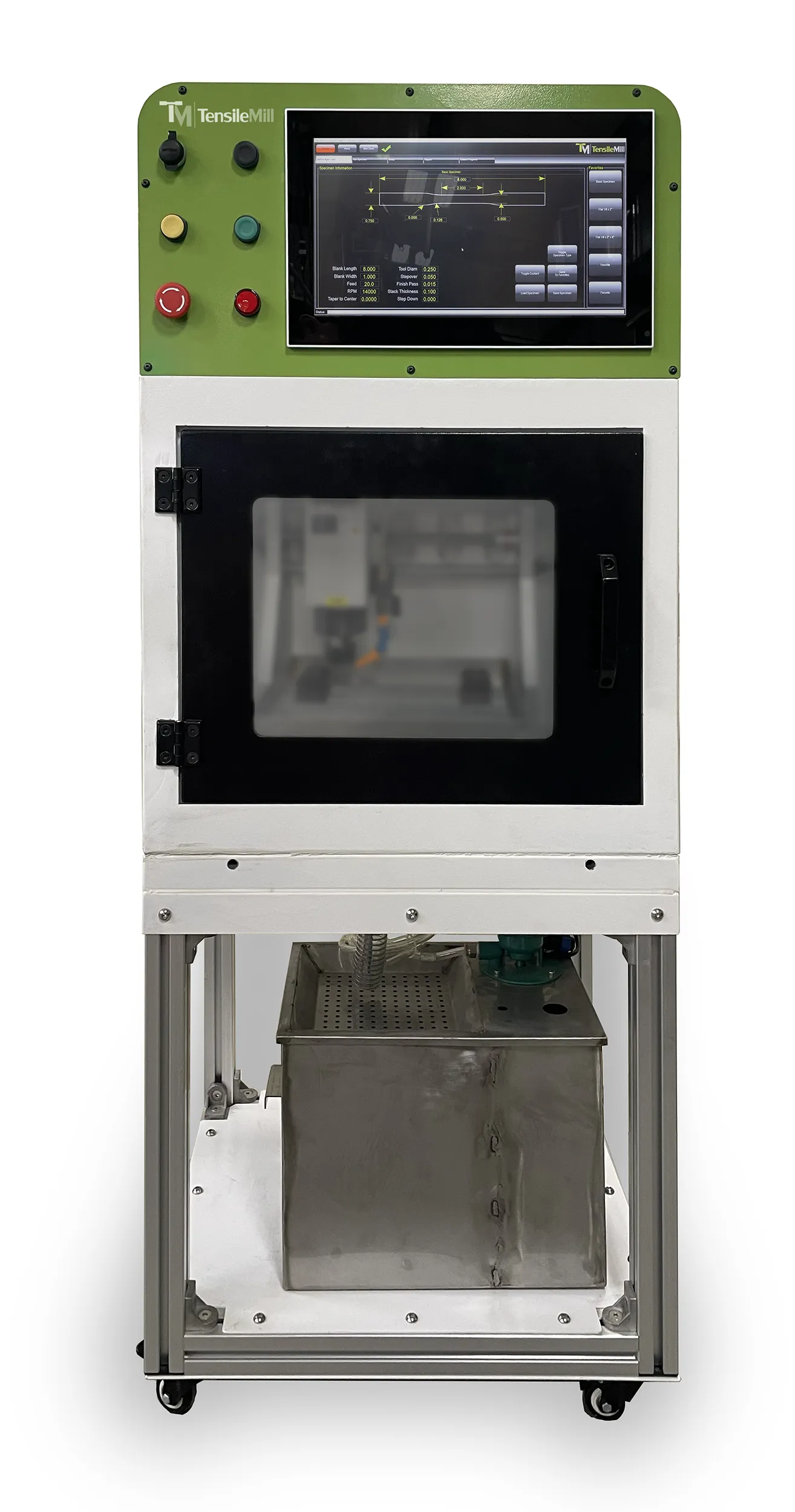
TensileMill CNC MICRO on its mobile stand.
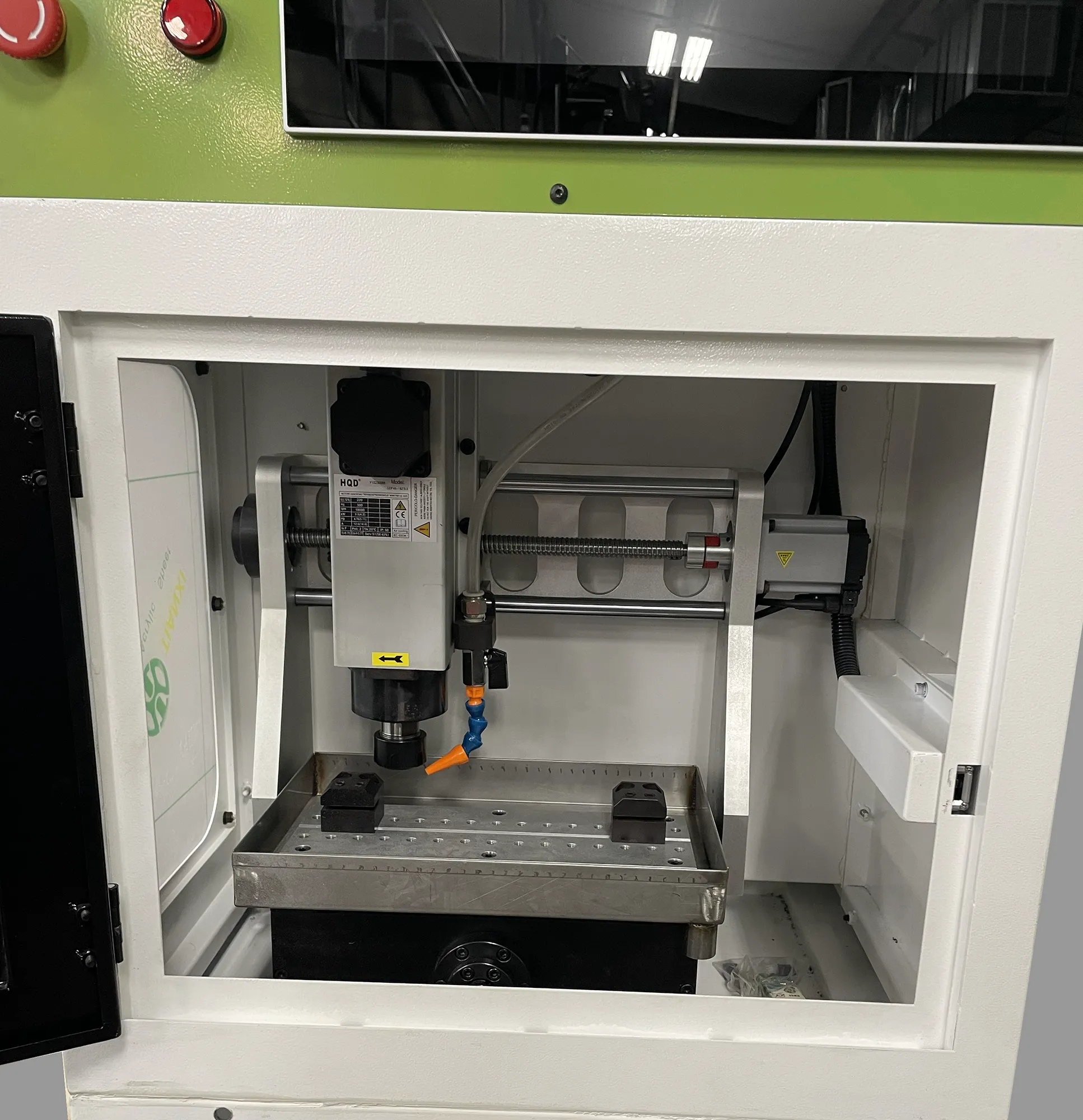
The working area, spindle over the fixture.
TensileMill CNC MICRO Features
Everything below is what separates a dedicated preparation machine from a general-purpose mill pressed into laboratory service.
2-axis dedicated build
A compact 2-axis configuration built for one job: flat tensile and impact specimens, rather than a general-purpose CNC adapted to laboratory work.
15.6-inch touchscreen
An integrated 15.6-inch touchscreen running the TensileSoft interface, so an operator prepares specimens without conventional CNC programming.
Standard and custom geometry
Standard specimen formats and custom dimensions, both entered on the screen.
Enclosed cabinet
A full enclosure keeps chips and coolant inside and keeps the bench around the machine clean.
Recirculating flood coolant
Flood coolant recirculates from a tank built into the machine base.
Air-cooled spindle
The spindle is air-cooled, so no external water line and no chiller are needed.
Single-phase power
220 V single phase through a standard 20 A receptacle: no three-phase supply to arrange.
Carbon interface upgrade
An optional Carbon interface opens the machine to wider CNC work without replacing the base machine.
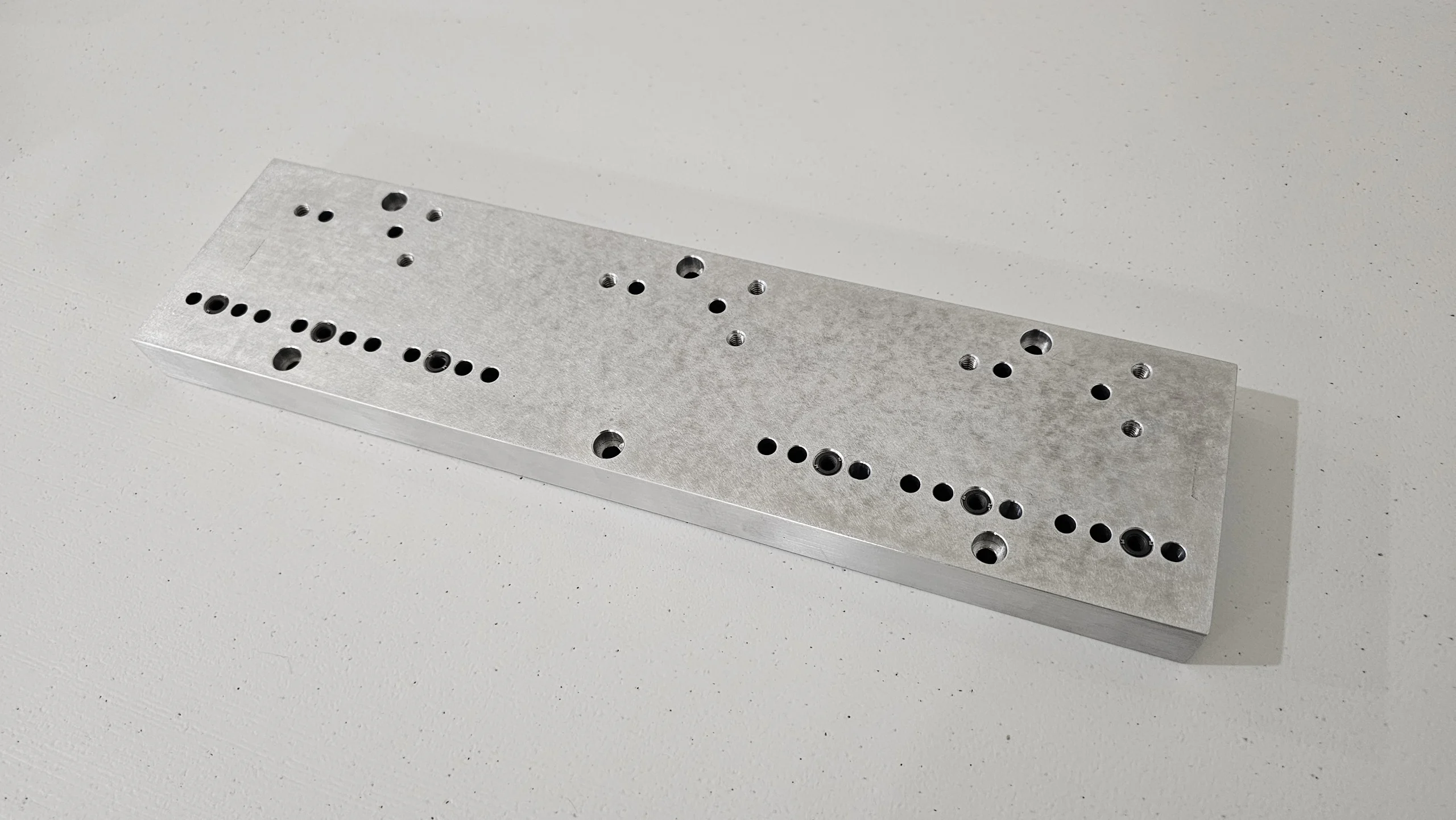
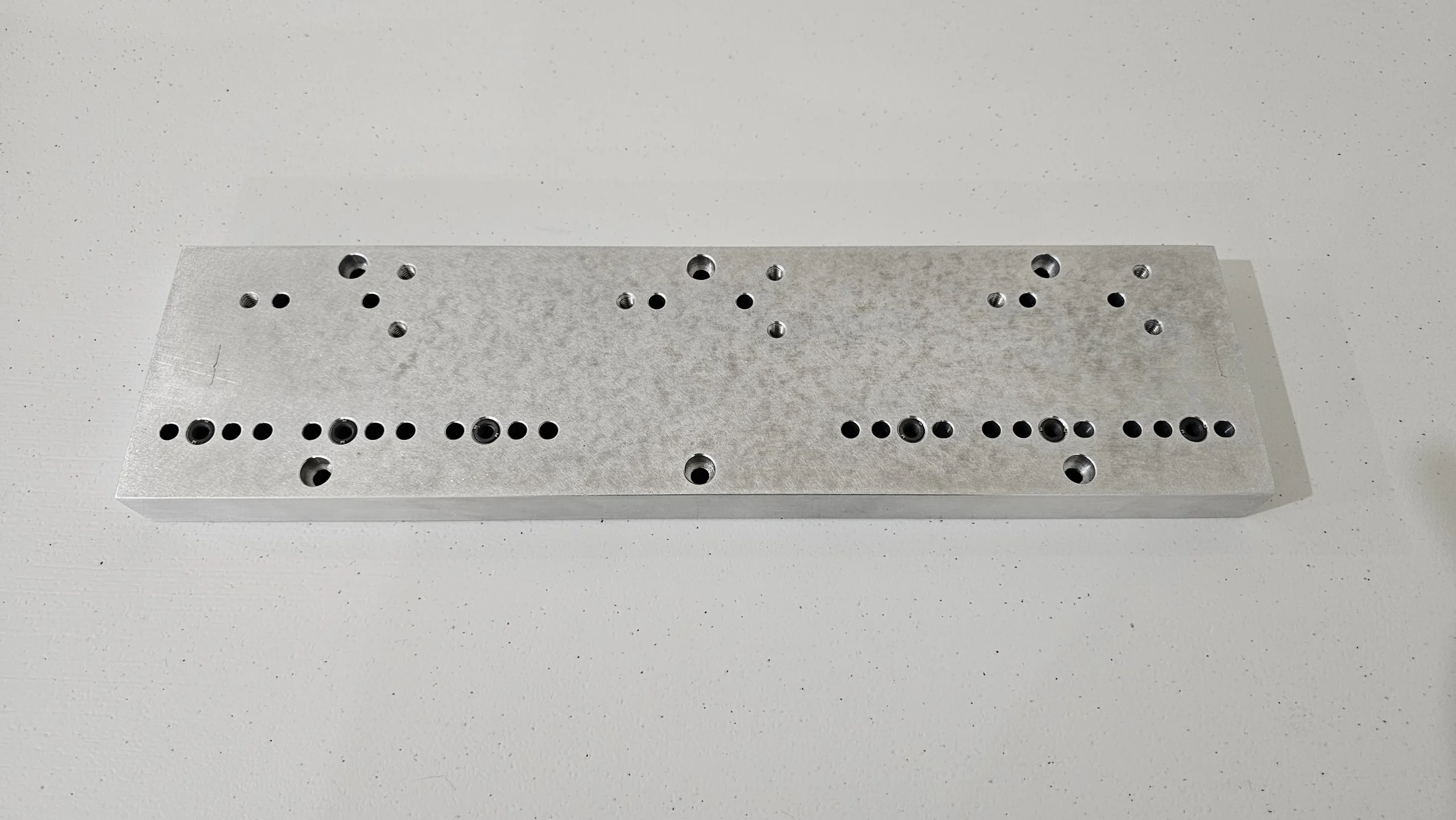
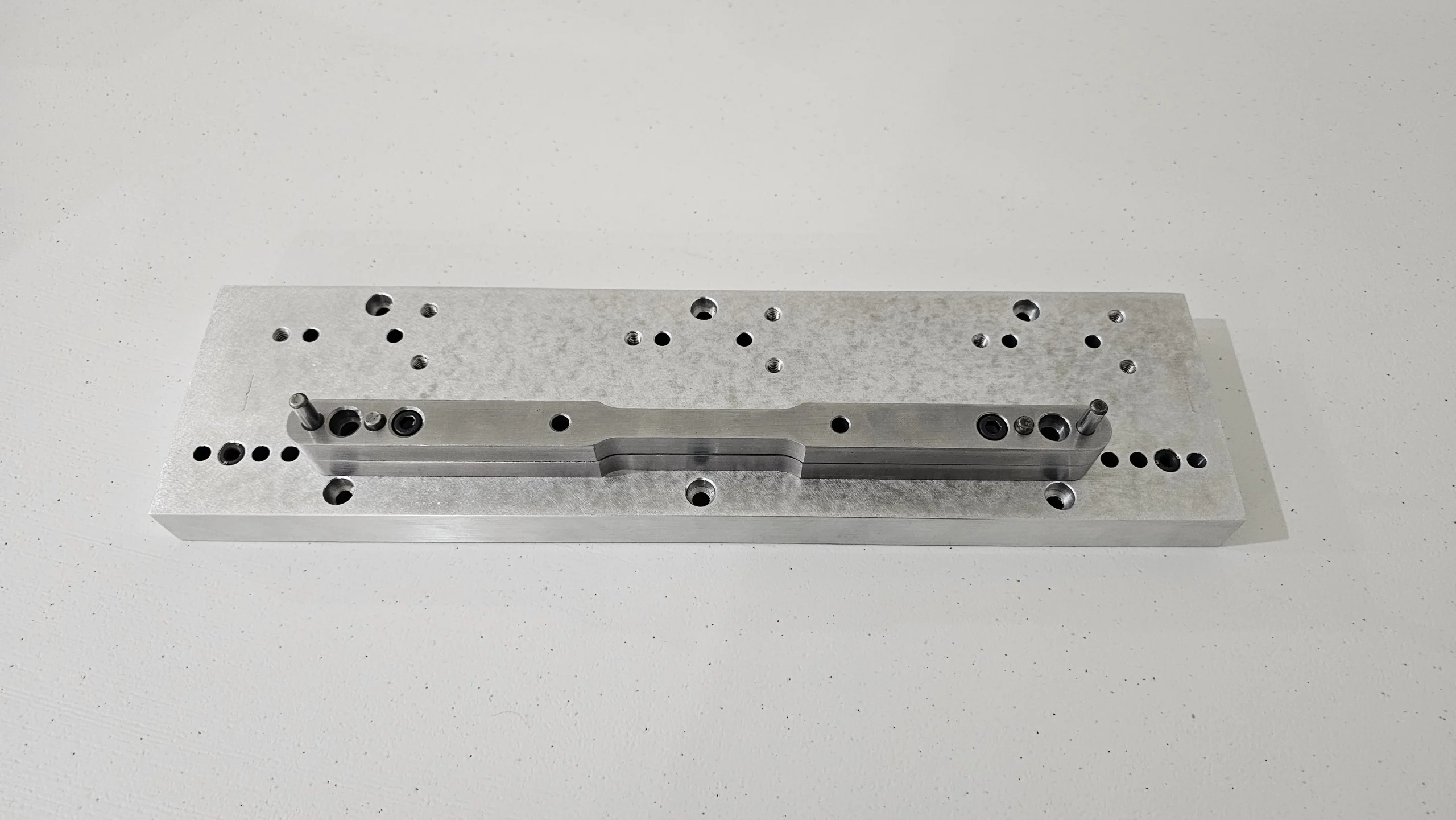
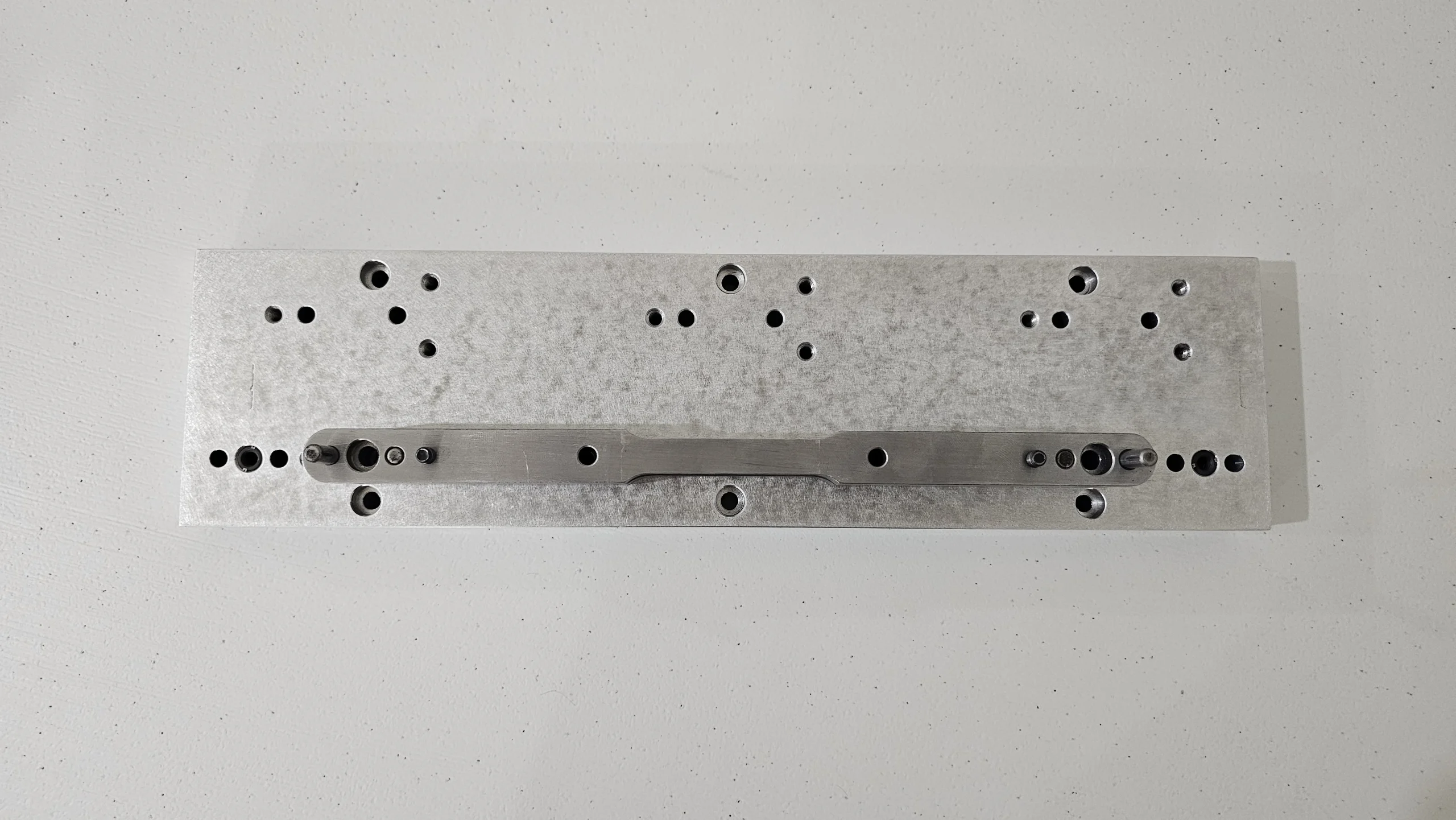
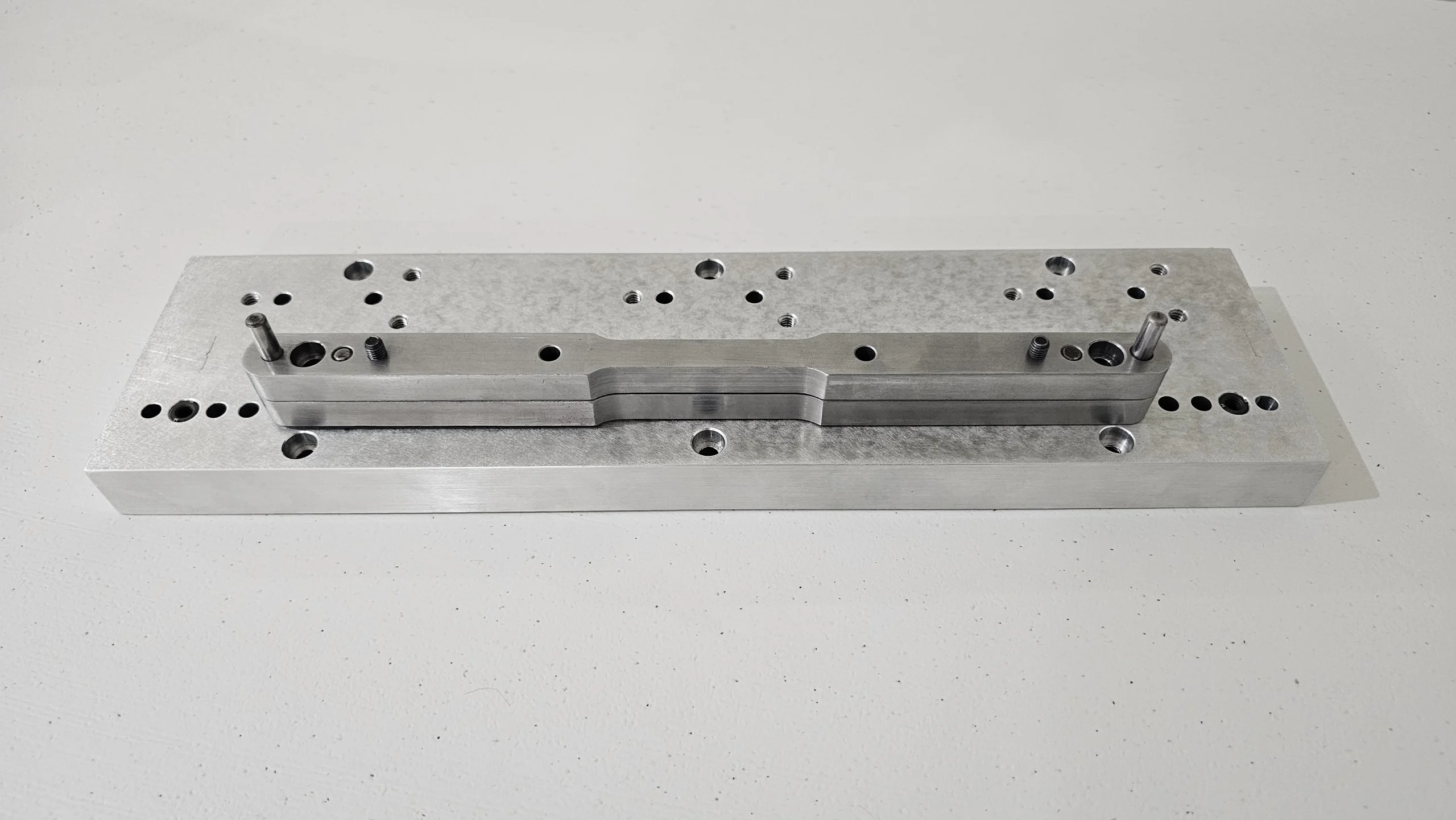
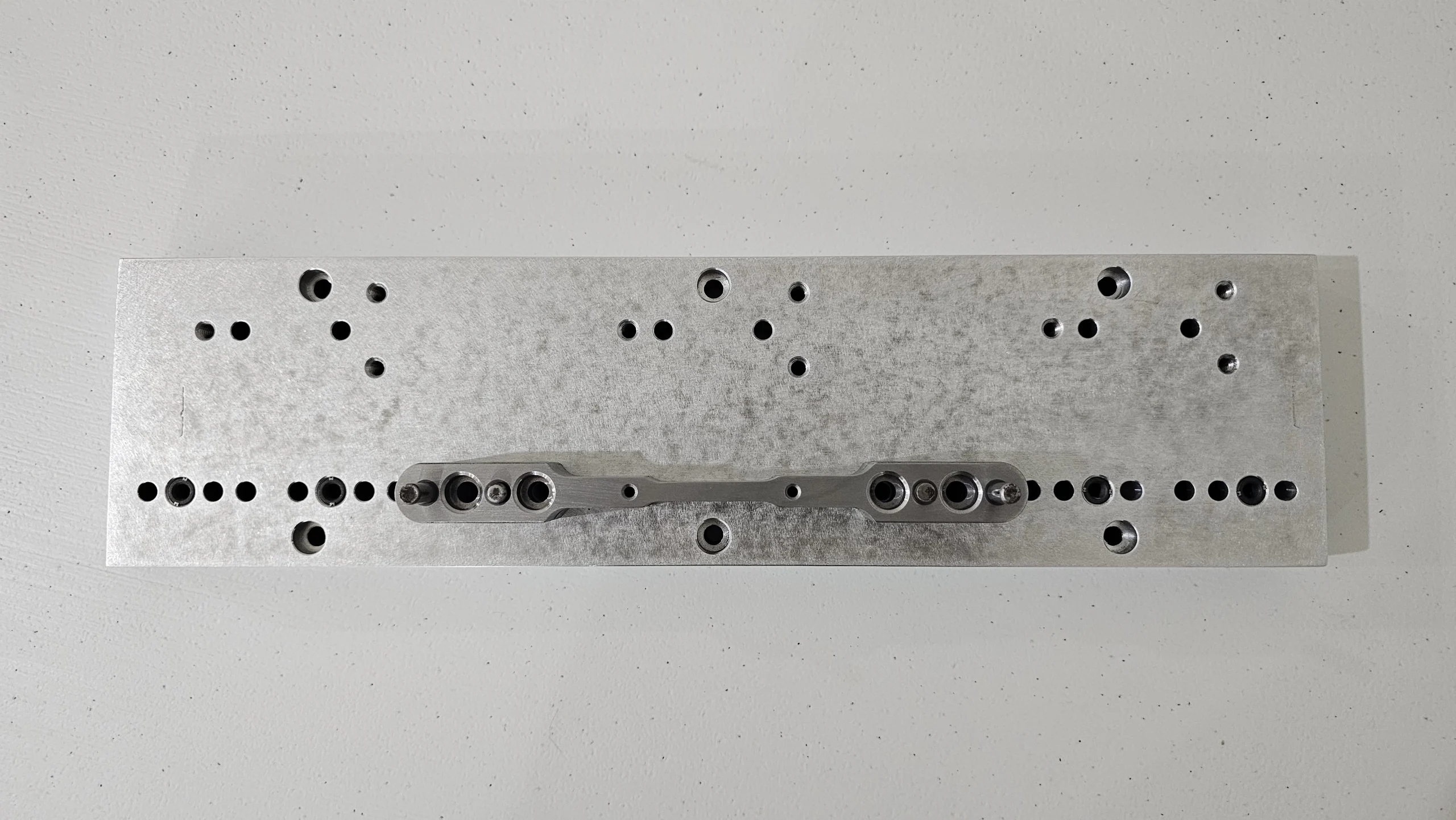
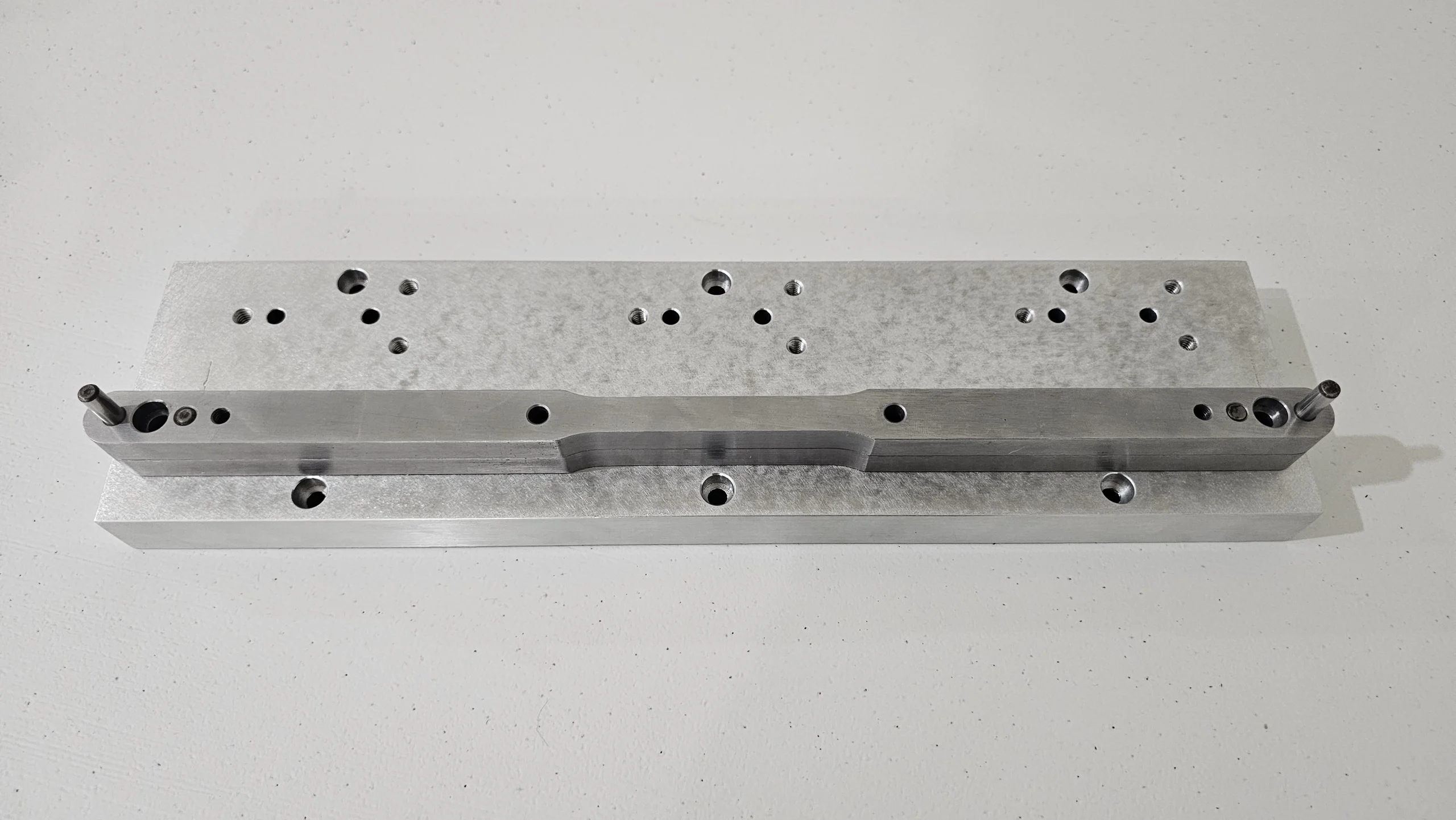
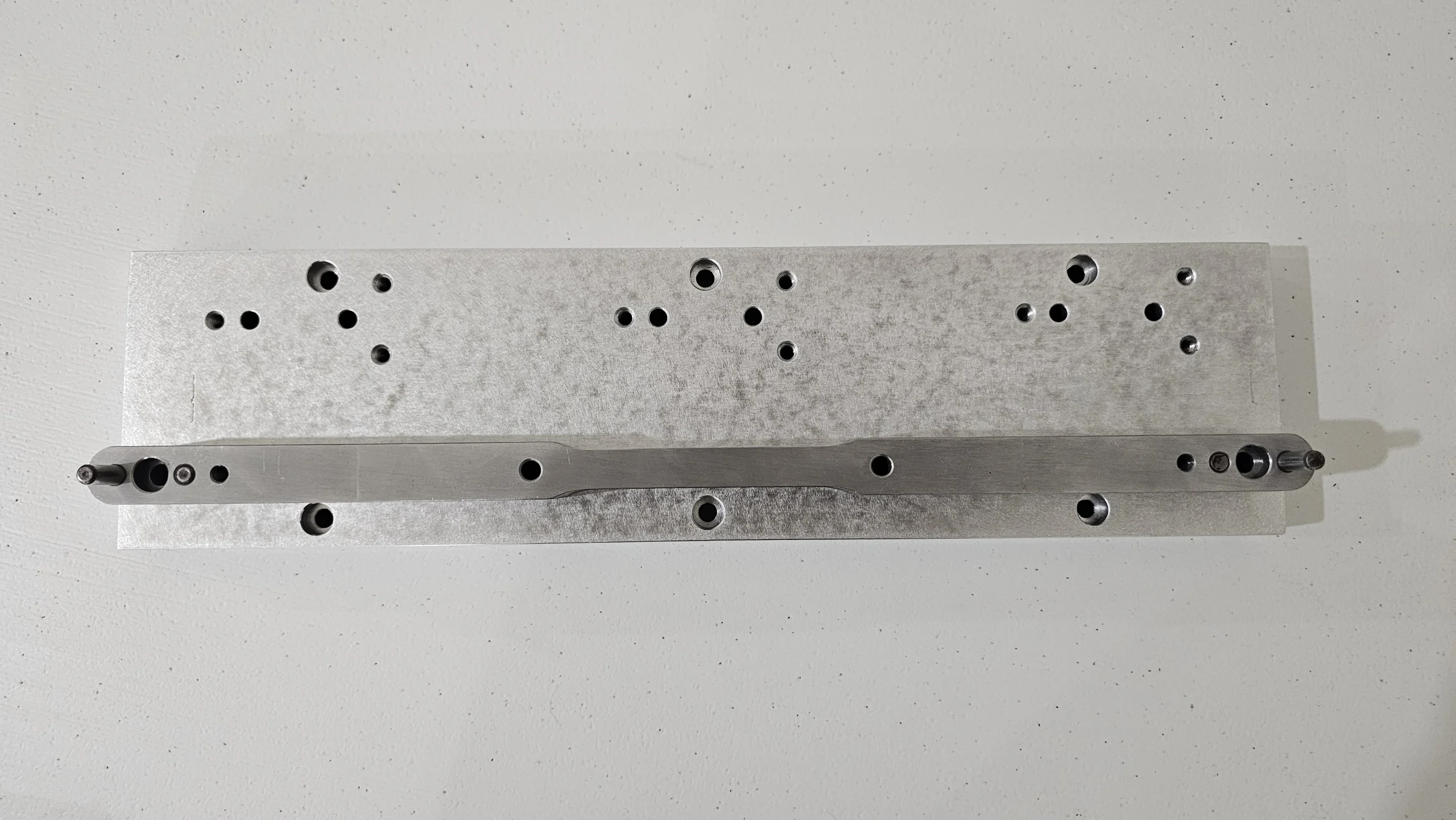
The model below shows the base plate for 8″ specimens.
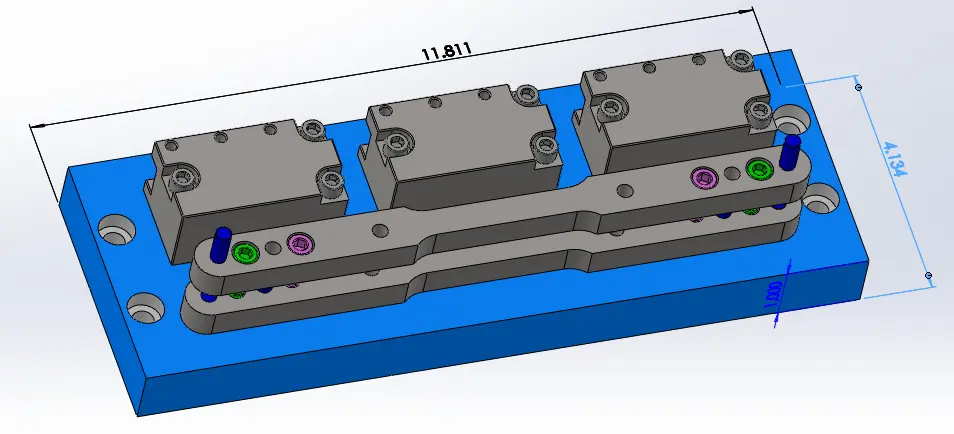
Base plate for 8″ specimens, 11.81″ × 4.13″ (300 × 105 mm).
TensileMill CNC MICRO Applications
The MICRO prepares flat specimens for tensile and impact testing programs, in laboratories where comparable results matter more than volume: QA and QC departments, R&D laboratories, universities and training facilities, and manufacturers verifying material during production. Because it accepts both standard formats and custom dimensions, it covers internal test methods as well as the published geometries.
Typical work:
- Flat tensile specimens in metals, plastics and composites
- Impact specimens for laboratory and production testing
- Batch-to-batch material verification in QA and QC workflows
- Specimen preparation for research, development and qualification programs
- Educational and technical training work that needs repeatable geometry
- In-house replacement of outsourced specimen preparation, for turnaround and control
TensileSoft Control Interface
The machine is run from the TensileSoft interface on the integrated 15.6-inch touchscreen. The operator enters the specimen details, selects the material, and the software generates the machining path: there is no G-code to write. Standard geometries are selected from the list, custom dimensions are typed in, and profiles that get used often are saved and recalled, which is what keeps a repeat batch identical to the last one.
A laboratory that later needs broader machining capability can move to the Carbon interface and keep the same machine.
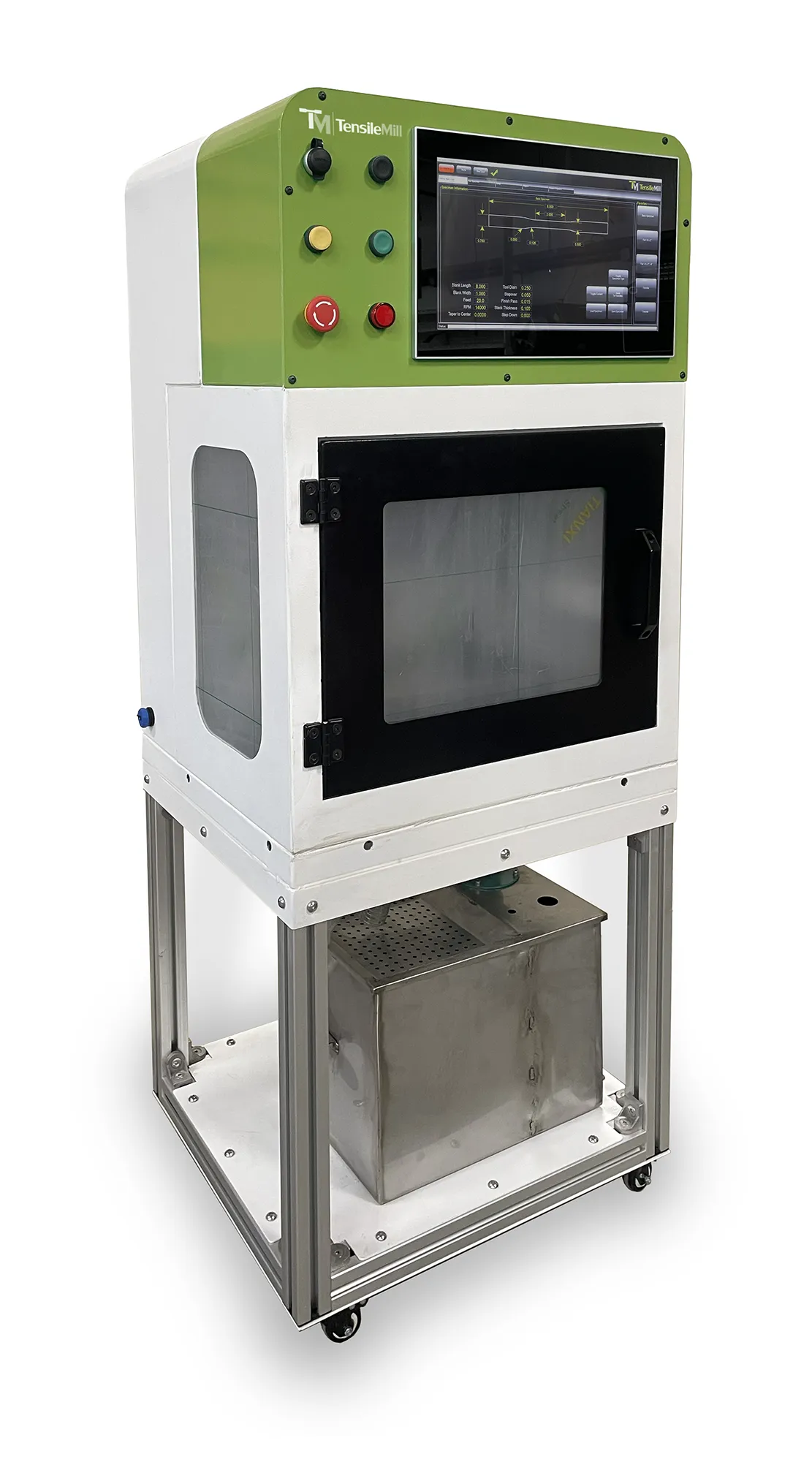
The 15.6-inch touchscreen sits above the enclosure.
TensileMill CNC MICRO Technical Specifications
Check the working area against the largest specimen you prepare and the supply against your shop power: the MICRO runs on single-phase 220 V and needs no external water. Imperial values come first, with the metric equivalent in brackets.
| Specification | TensileMill CNC MICRO |
|---|---|
| Machine | |
| Machine Dimensions | 27.6″ × 29.3″ × 60.2″ (700 × 745 × 1,530 mm) |
| Working / Traveling Area | 8.27″ × 4.72″ × 0.79″ (210 × 120 × 20 mm) |
| Weight | 1500 lb (680 kg) |
| Suggested Floor Dimensions | 82.7″ × 78.5″ (2100 × 2000 mm) |
| Enclosure | Full safety enclosure |
| Base | Mobile stand with integrated coolant tank |
| Spindle and motion | |
| Rotating Speed of Spindle | 18,000 rpm |
| Spindle Motor Power | 3.3 kW (4.4 hp) |
| Spindle Cooling | Forced-air cooling |
| Tool Holder | ER25 |
| Traverse Speed (X / Y / Z) | Up to 315″ (8,000 mm)/min |
| Feed Rate | 1-1,000 mm/min |
| Positioning Accuracy | Within 0.01 mm* |
| Repeatability | Within ±0.02 mm* |
| Control | |
| Controller | MachMotion |
| Control Interface | TensileSoft |
| Display | Integrated 15.6-inch touchscreen |
| Upgrade Option | Carbon interface available |
| Services and connections | |
| Input Voltage | 220 V, 1 ph |
| Operating Voltage Range | 200-240 V |
| Total Power | 3.3 kW (15 Amps) |
| Recommended Receptacle | Standard 3-prong 20 A receptacle |
| Coolant System | Recirculating flood coolant |
| Coolant Tank | Self-contained, integrated in base |
| External Water Connection | Not required |
| Chiller Connection | Not required |
| Pneumatic Connection | Optional |
| Consumables and support | |
| Routine Consumables | End-mills, coolant |
| Recommended Lubricant | ISO 68 equivalent way lube oil |
| Typical Coolant Replacement Interval | Every 6-12 months depending on usage |
| Common Coolant Brands | Cim Cool, Hocut, Blaser |
| Common Lubricant Brands | Mobil, Shell, Irving |
| Tooling Recommendation | Based on customer material type |
| Spare Parts Support | Available |
* Accuracy and Repeatability Disclaimer: Published accuracy and repeatability values are based on proper machine setup, recommended tooling, operational procedures, maintenance practices, material conditions, and validated proof-of-concept parameters. Actual performance may vary depending on material type, hardness, specimen geometry, tooling selection, fixturing, machine workload, operator practices, production conditions, and adherence to recommended operational protocols. Operation outside of recommended procedures or intended application parameters may affect achievable accuracy, repeatability, equipment longevity, and overall system performance.
Send us the specimen standard you work to and the material you cut most often, and we will confirm whether the MICRO covers it or whether a larger TensileMill fits your throughput better. Contact our team or request a quote online.
For Laboratories
Need Additional Quality Control Equipment to Build Your Laboratory?
Flat specimen preparation is only one part of a complete quality control laboratory. NextGen can help you equip your entire lab with impact testers, notching and broaching systems, cooling chambers, tensile testers, hardness testers, specimen preparation equipment, and other supporting solutions, all coordinated as one complete project.
- One partner to equip your complete laboratory
- Installation, training, calibration
- Support for the life of the equipment
FAQs
They complement a MICRO installation by extending your specimen prep from flat tensile and impact coupons to round tensile programs. The MICRO is built for precise flat specimen work, while a TensileTurn system adds a dedicated path for round bars and other round geometries, so one lab can keep more of the prep workflow in-house and maintain a consistent internal process.
That pairing is especially useful in mixed-material labs and production QA groups. The round-specimen side is covered by TensileTurn CNC – Industrial Upgrade – Round Tensile Specimen Preparation, which is aimed at standard round, sub-size, threaded-end, button-head, and fatigue-style specimens.
If you want to confirm the right flat-and-round setup for your lab, learn more or request a quote.
Yes. This system’s TensileSoft interface lets operators enter specimen details, choose the material, and save previously used profiles for future recall, which is useful for repeat batches where the same specimen format is prepared again and again.
The touchscreen workflow is built for specimen preparation, so teams can standardize routine flat tensile and impact sample work without relying on traditional CNC programming. That helps keep batch-to-batch preparation more consistent in QC, R&D, and training environments.
If you want to confirm the best setup for your specimen sizes and repeat-work flow, learn more or request a quote.
This system is built for metals, plastics, and composite materials, and it is set up for both flat tensile and impact specimen preparation.
For flat tensile work, that means it is aimed at test-ready specimens where repeatable geometry matters for QA/QC, R&D, qualification, and training. The same platform is also positioned for impact specimen preparation in laboratory and production workflows.
If you want to confirm the right setup for your material and specimen geometry, learn more or request a quote.
This system is intended for flat tensile and impact specimen preparation, so standard dog-bone tensile samples and Charpy/Izod flat impact geometries are within its application range. It is positioned for labs that need repeatable specimen geometry for testing programs tied to ASTM D638, ASTM E8, ASTM A370, ISO 527, and ASTM E23 workflows.
In practice, the exact setup depends on the specimen dimensions, the method requirements, and the fixtures or software profile you want to run. The page also notes support for standard specimen formats and custom dimensions, which makes it a practical fit for both routine QC and development work.
If you want to confirm the best setup for your dog-bone or Charpy/Izod flat geometry, learn more or request a quote. If you are comparing a closely related flat specimen option, the TensileMill CNC Classic Upgrade is another good point of reference.
It can handle custom specimen dimensions, and it is built for metals, plastics, and composite materials. The TensileSoft workflow also supports standard specimen formats and custom geometries, so the machine is meant for more than one fixed sample shape.
For laminated or layered specimens, the practical fit depends on the layup, thickness, and how securely the sample can be clamped and machined to the target geometry. The saved-profile workflow also helps keep repeat custom cuts consistent from one batch to the next.
If you want to confirm the right setup for your material and specimen dimensions, learn more or request a quote. Share the thickness, layup, and target test method, and we can help point you to the best configuration.
It makes sense when your lab or plant needs a compact way to prepare flat tensile and impact specimens in-house, instead of waiting on an outside shop. This is especially practical for QA/QC teams, R&D groups, and training labs that need consistent specimen geometry, faster turnaround, and tighter control over day-to-day sample prep.
Typical fit cases include:
- batch-to-batch verification in production workflows
- flat specimen work for metals, plastics, or composites
- impact specimen prep for laboratory and production testing
- replacing outsourced prep to reduce delays and keep the work in one workflow
This setup is also a strong option when space is limited, since it is built as a compact 2-axis machine with an enclosed layout, touchscreen control, and onboard coolant handling.
If you want to confirm the best setup for your specimen type and workflow, learn more or request a quote.
For this machine, the usual cutting tools are end-mills selected for the specimen material, since the tooling recommendation is based on customer material type and end-mills are listed as a routine consumable. The coolant setup is a recirculating flood system with a self-contained tank in the base, which keeps flat tensile and impact specimen preparation compact and self-contained.
In practice, the coolant choice is usually driven by the material being machined and the surface finish you want on the specimen. The page names Cim Cool, Hocut, and Blaser as common coolant brands, and it also notes that the spindle is air-cooled, so no external water or chiller connection is required.
If you want to confirm the best tooling and coolant for your alloy, polymer, or composite, learn more or request a quote. For replacement cutting tools and coolant, the coolants, lubricants, tooling page is a useful next stop.
Consider the TensileMill CNC MINI when your work is centered on standardized flat tensile specimens and you want the larger working envelope, water-cooled spindle, and a more traditional CNC setup for routine QC or training. Consider the MICRO when you need flat tensile and impact specimen preparation in a smaller, more self-contained machine with guided touchscreen operation, air cooling, and no external water or chiller connection. In short, MINI leans toward flat tensile throughput, while MICRO is the better fit when space, cleanup, and a simpler daily workflow matter more.
If your lab handles metals, plastics, and composites, the MICRO is the stronger all-around choice for mixed specimen prep because it is built for both flat tensile and impact samples and supports standard or custom geometries. The MINI is a strong fit when your process is focused on flat tensile coupons and you want the broader travel area and water-cooled spindle for regular production or lab use.
If you want to confirm the right setup for your specimen geometry, standards, and shop utilities, learn more or request a quote for a configuration review.
This system ships from the factory with a MachMotion controller and the TensileSoft control interface on an integrated 15.6-inch touchscreen. That setup gives operators a guided, specimen-prep workflow instead of relying on conventional CNC programming at the machine.
For flat tensile and impact specimen preparation, that combination is the main operator environment. The controller handles the machine side, while TensileSoft provides the screen-based setup and execution flow. In a lab setting, this makes day-to-day use more straightforward for repeatable specimen work.
If you want to confirm the right factory configuration for your specimens and workflow, learn more or request a quote.
Yes, this system includes an optional Carbon interface upgrade for expanded CNC capability. It is a practical way to move toward a more advanced control setup while keeping the machine focused on flat tensile and impact specimen preparation.
For selection purposes, the main points are your specimen geometry, operator workflow, and how much CNC flexibility you want in day-to-day use. If you are standardizing in-house prep for metals, plastics, or composites, it is worth matching the interface choice to the level of automation your lab actually needs.
If you want to confirm the right configuration for your workflow, learn more or request a quote.
In quality control and R&D workflows, this system is typically run by QA/QC staff, R&D lab personnel, materials engineers, and trained test operators who prepare flat tensile and impact specimens. The touchscreen-guided TensileSoft workflow is designed to be approachable for non-machinists, so routine setup does not depend on traditional CNC programming.
The exact owner of the machine depends on how your lab is organized, but the most common pattern is a shared setup where engineers define the method and trained operators handle daily specimen prep for batch verification, development work, and qualification programs. The page positions it for QA/QC departments, R&D laboratories, universities, training facilities, and production support environments.
If you want to confirm the best operator workflow for your specimen type and internal method, learn more or request a quote.
The larger TensileMill CNC XL is usually the better choice when your lab has a steady stream of flat tensile specimen prep, needs faster turnaround, or wants a more industrial setup for daily use. It is a strong fit for high-volume QC, production sampling, and labs that want to machine more specimens in-house instead of relying on a compact bench-top workflow.
If your work centers on repeat flat coupons for metals, polymers, or composites, the TensileMill CNC XL makes sense when you want heavier-duty hardware, faster material processing, and less operator touch time. Labs that need production-style throughput, more automation, or a setup aligned with standard flat specimen programs will usually see more value from the larger frame.
If you are deciding between the compact MICRO and the XL, the key factors are specimen volume, available floor space, and how automated you want the workflow to be. For a quick fit check on your method and throughput goals, learn more or request a quote.
Yes, this system is specified with a full safety enclosure, and its coolant setup is self-contained with an integrated tank in the base. It uses recirculating flood coolant, so the machine is designed for contained specimen preparation rather than an open splash setup.
For flat tensile and impact specimen preparation, that combination helps support cleaner day-to-day operation and simplifies installation. The page also notes that an external water connection and chiller connection are not required, which is useful for labs that want a more self-contained footprint.
If you want to confirm the enclosure and coolant setup for your lab layout or specimen workflow, learn more or request a quote.
The enclosed design centers on a full safety enclosure, so the spindle, tooling, and coolant area stay contained during flat tensile and impact specimen preparation. That helps keep day-to-day operation cleaner and safer for lab and production use.
The machine is also built as a self-contained setup, with a recirculating flood coolant system and a coolant tank integrated into the base. In practical terms, that keeps the work area compact and reduces open exposure around the machine. The guided touchscreen workflow also makes operation more controlled and easier for technicians who do not want conventional CNC complexity.
If you want to confirm the right setup for your specimens and workflow, learn more or request a quote. Share your material, specimen geometry, and throughput needs, and we can help narrow the best configuration.
Compressed air is not required for standard operation on this system. The published configuration lists the pneumatic connection as optional, so air would only come into play if you choose a pneumatic option or accessory that uses that connection. The base machine is set up with an air-cooled spindle, so it does not need an external water or chiller hookup for normal use.
From a utility standpoint, this makes the machine easier to place in a lab or production area, since the standard setup centers on power, coolant, and the built-in enclosure rather than plant air. If your specimen prep workflow includes an air-driven add-on, that is the point where compressed air would matter.
If you want to confirm the right configuration for your specimen type and utility setup, learn more or request a quote.
Yes, the MICRO is positioned for ongoing spare-parts support. The product page calls out stocked consumables and spares, spare parts support available, and a lifetime product support advantage, which points to a long-term support path for the machine.
For wear items, tooling, and routine supplies, NextGen also maintains a dedicated Consumables And Spare Parts page. In practice, the exact replacement plan still depends on the part type, your specimen mix, and how often the machine is used.
If you want to confirm the spare-part plan for your MICRO build, learn more or request a quote.
Yes. The MICRO uses a touchscreen-driven TensileSoft control environment that guides operators through setup, lets them enter specimen details and material selection, and generates the machining path automatically, so day-to-day operation does not depend on traditional CNC programming.
That guided approach is aimed at labs and production teams that want a cleaner, more in-house specimen prep workflow without needing a highly specialized machinist for every setup. It is positioned as a practical fit for both experienced machinists and users without CNC backgrounds.
If you want to confirm the best setup for your specimen geometry and workflow, learn more or request a quote.
The Carbon interface upgrade is meant to add broader CNC capability, so it does not change the MICRO’s core job or its guided TensileSoft workflow for routine specimen preparation. On the base system, operators enter specimen details, choose the material, and let the software generate the machining path, which keeps day-to-day use straightforward.
Where the upgrade matters is flexibility. If your lab needs more custom CNC control for specialized flat tensile or impact sample work, Carbon can change how much program editing and setup you do compared with the simpler touchscreen-driven workflow. For standard repeat work, the base interface is the simpler path, while the upgrade is the configuration to review for advanced custom jobs.
If you want to confirm the right setup for your specimen geometry and workflow, learn more or request a quote.
Yes, the machine is supported with stocked consumables and spare parts, which is the right setup for keeping routine maintenance items moving without unnecessary delays. For a tensile specimen preparation system like this, that typically covers the wear items and replacements most labs need most often.
The exact turnaround still depends on the item, the machine configuration, and whether you are ordering a routine wear part, a tooling item, or a less common replacement. The page also highlights after-sales technical support, so the practical approach is to confirm the part number and the use case before placing the order.
If you want to confirm the right wear parts for your setup, learn more or request a quote. For ongoing maintenance items, you can also review consumables and spare parts.
This system is built specifically for compact 2-axis flat specimen preparation, so it fits flat tensile and impact specimen machining directly. It is intended for labs and production teams that want a dedicated setup for repeatable sample prep, rather than a general-purpose CNC machine.
It is aimed at flat specimens in metals, plastics, and composites, and the workflow is shaped around consistent geometry, cleaner operation, and easier day-to-day use. The page also notes support for standard specimen formats and custom geometries, which makes it practical for quality control, R&D, and material qualification work.
If you want to confirm the right setup for your specimen type and method, learn more or request a quote.
This system’s primary role in a test lab is to prepare precise flat tensile and impact specimens in-house, so the lab can support consistent geometry, repeatable results, and faster turnaround than outsourced sample prep. It is aimed at metals, plastics, and composite materials used in routine QA, R&D, qualification, and production testing.
In practical terms, it gives technicians a dedicated way to machine test-ready specimens without relying on a full industrial CNC setup or heavy conventional programming. That makes it a strong fit for labs that need controlled specimen prep for batch verification, development work, or training environments where repeatability matters.
If you want to confirm whether this setup fits your specimen geometry and method needs, learn more or request a quote.
Out of the box, this system is built for flat tensile specimens and impact specimens. It is aimed at routine sample prep for metals, plastics, and composites where consistent geometry matters.
The native workflow also supports standard specimen formats and custom geometries, so it is designed around flat specimen preparation rather than a general-purpose CNC setup. That makes it a practical fit for QA/QC, R&D, qualification work, and in-house specimen prep where repeatability and turnaround are important.
If you want to confirm the best setup for your specimen shape and test method, learn more or request a quote for a quick configuration check.
This system is configured for a 220 V, single-phase installation. The listed total power draw is 3.3 kW at 15 amps, and NextGen specifies a standard 3-prong 20 A receptacle for setup.
For site planning, the operating range is 200 to 240 V, so the electrical supply should be matched to that range and circuit capacity. The machine also uses a self-contained coolant tank, with no external water connection or chiller required, which keeps installation straightforward.
If you want to confirm the right electrical setup for your lab or review the full installation fit, learn more or request a quote.
This system does. The MICRO’s TensileSoft touchscreen workflow supports standard specimen formats and also lets operators enter custom dimensions for nonstandard flat tensile or impact geometries when needed.
That makes it a practical fit for labs that need routine standard profiles most of the time, but still have occasional special specimen requirements. The setup is handled through the control interface, so the job can stay consistent from run to run without relying on conventional CNC programming.
If you want to confirm the right setup for your nonstandard specimen geometry, learn more or request a quote. Share the material, specimen type, and target dimensions, and we can point you to the most suitable configuration.
The MICRO is built for metals, plastics, and composite materials, and it is a strong fit for routine specimen prep when you need flat tensile or impact samples for QC, R&D, or production testing.
It is designed to bring specimen preparation in-house with a compact, enclosed workflow that focuses on consistency, repeatability, and controlled geometry from one batch to the next. That makes it practical for labs and manufacturing teams that prepare the same sample types regularly and want a simpler day-to-day process.
If you want to confirm the best setup for your material type and specimen geometry, learn more or request a quote. Share your standard and sample shape, and we can help narrow the right configuration.
No, an external water supply or chiller is not needed for the spindle cooling system. This machine uses an air-cooled spindle, and the coolant setup is self-contained in the base, which keeps the tensile specimen preparation workflow compact and easier to install.
For lab planning, that means the cooling package is built around internal recirculating flood coolant rather than site water service. It is a practical fit for flat tensile and impact specimen prep where you want cleaner setup, less utility dependence, and straightforward day-to-day operation.
If you want to confirm the utility requirements for your lab or compare this configuration with other specimen prep options, learn more or request a quote.
Under typical use, the flood coolant is generally replaced every 6 to 12 months. The right interval depends on how heavily this specimen preparation machine runs, what materials you cut, and how quickly the coolant picks up fines and contamination.
For labs doing frequent flat tensile or impact specimen prep, it is smart to inspect coolant condition regularly and shorten the changeout cycle if the system sees heavy production use. Coolant is listed as a routine consumable, and the consumables and spare parts section is the best place to plan ongoing supply for day-to-day operation.
If you want to confirm the right coolant plan for your materials and run rate, learn more or request a quote.
For routine flat tensile sample machining, a longitudinal polisher is usually not the next required step. This system is built to prepare precise flat tensile and impact specimens in-house with repeatable geometry, so the MICRO itself is already aimed at producing test-ready samples.
That said, a separate polisher like NG-AutoPol makes sense when your method calls for a low-stress longitudinal surface finish after turning or milling, especially for tighter tensile or fatigue-focused workflows. In other words, it depends on the specimen type, the surface finish your method requires, and whether you need polishing beyond the machining step.
If you want to confirm whether your flat tensile workflow should stay with the MICRO alone or add polishing, learn more or request a quote. A quick note on your material, specimen geometry, and test method will point you to the right setup.
The MICRO improves consistency by giving you a dedicated 2-axis workflow for flat tensile and impact specimen preparation, instead of relying on a general-purpose machine or outsourced work. Its guided touchscreen control helps operators follow the same preparation path each time, so specimen geometry stays more uniform from batch to batch.
That repeatability is reinforced by the stated positioning accuracy within 0.01 mm and repeatability within ±0.02 mm, along with support for standard specimen formats and custom geometries. The enclosed layout, integrated recirculating flood coolant, and self-contained base-mounted tank also help keep the process controlled and cleaner for routine lab use.
If you want to confirm the best setup for your flat tensile or impact specimens, learn more or request a quote.
Technical support inquiries are typically answered within 24 hours. If the issue is urgent, NextGen also recommends calling the toll-free line for faster service. That makes the 24-hour window a practical benchmark for routine technical support questions.
For a smoother handoff, send the request through the technical support inquiry form or route it to After Sales/Tech Support, which is listed as extension 3. After-hours support is also available by email.
If you want help with this system, learn more and then contact us so the support team can review your setup and next steps.
This system supports ASTM A370, ASTM D3039, ASTM D638, ASTM E23, and ASTM E8 for flat tensile and impact specimen preparation. Those standards cover the main geometry families used for metals, plastics, and composites, so the exact choice depends on your material and the test method you follow.
In practical terms, labs use this kind of setup to prepare consistent coupons for metals, plastic tensile work, composite tensile work, and impact specimens. That makes it a good fit when you need repeatable geometry for QC, R&D, or in-house specimen prep.
If you want to confirm the best setup for your specimen type and reporting needs, learn more or request a quote.
Use an ISO 68 equivalent way lube oil for the ways and moving components on this machine. That is the recommended lubrication grade listed for the MICRO, and it is the right starting point for keeping the slideways and moving parts running smoothly.
For routine maintenance, keep to a compatible machine way lubricant and apply it consistently as part of your normal service routine. The product page also points to common lubricant brands such as Mobil, Shell, and Irving, which can help when you are matching shop supplies to the machine.
If you want to confirm the best lubricant choice for your setup or check the related maintenance items, learn more or request a quote.
TensileSoft guides operators through specimen setup with a touchscreen workflow that keeps the process straightforward. Users can choose a standard specimen geometry, enter custom dimensions when needed, and let the software build the machining path automatically.
That makes it practical for both repeat production work and one-off lab jobs. The software also lets operators enter specimen details, select the material, and save commonly used profiles for later recall, which helps keep flat tensile and impact specimen preparation consistent from run to run.
If you want to confirm the right TensileSoft setup for your specimen type and test method, learn more or request a quote.
Plan on 2100 × 2000 mm, or 82.7 × 78.5 in, of floor space for this system. The machine itself measures 27.6 × 29.3 × 60.2 in (700 × 745 × 1,530 mm), so the recommended layout is based on the full working footprint, not just the cabinet size.
For access, give operators enough room to reach the enclosed work area, the touchscreen, and the specimen-loading side comfortably. The self-contained base, integrated coolant tank, and air-cooled spindle help keep the installation compact, and the unit does not need external water or chiller connections.
If you want to confirm the best layout for your lab, learn more or request a quote. If you share your specimen size and service access needs, we can help you match the install plan to your workflow.
The working travel envelope is 210 x 120 x 20 mm, or 8.27 x 4.72 x 0.79 in. That is the usable X, Y, and Z machining area for flat tensile and impact specimen preparation on this system.
For specimen prep work, that envelope is best viewed alongside the part geometry, fixture setup, and tool path you plan to run. In practice, the usable space will be driven by the specimen size, clamping method, and the exact profile you need to machine.
If you want to confirm fit for your specimen geometry or compare setup options, learn more or request a quote.
The MICRO is specified at positioning accuracy within 0.01 mm and repeatability within ±0.02 mm during machining. For flat tensile and impact specimen preparation, that level of control supports consistent geometry from part to part.
In practice, the final outcome still depends on the full setup, including workholding, tooling, material type, and how the specimen program is configured. For routine QC and lab workflows, it is a strong fit when tight dimensional consistency matters.
If you want to confirm the right setup for your specimen type and method, learn more or request a quote. If you share the material and specimen geometry, we can help point you to the best configuration.
The warranty covers the machine itself, but consumables are excluded. For this system, the routine consumables called out on the product page are end-mills and coolant, and the warranty support page says the instrument is covered for at least 12 months.
In practical use, anything that wears during normal specimen machining is handled as a consumable, while the frame, controls, and other major machine components are covered as equipment. The product page specifically notes end-mills and coolant as routine consumables, with coolant replacement depending on usage.
If you want to confirm the right replacement and coverage path for your setup, learn more, review the Consumables And Spare Parts – Coolants, Lubricants, Tooling page, or contact us for a quick check on your specimen material and tooling needs.
For routine flat tensile and impact specimen preparation, the machine travels at up to 8,000 mm/min, with a feed range of 1 to 1,000 mm/min. That gives you a fast move rate for positioning and a much finer cutting feed for the actual specimen prep pass.
In day-to-day tensile sample preparation, the right setting depends on the specimen geometry, material, and the finish you want on the edge and gauge section. Many labs use the higher traverse speed for non-cutting moves, then select a controlled feed for the machining step so repeatability stays consistent from sample to sample.
If you want to confirm the best setup for your material and specimen type, learn more or request a quote. If you have a target standard, material, and sample thickness, that is the fastest way to match the configuration to your workflow.
For the 220 V connection, this system is set up for a standard 3-prong 20 A receptacle. The machine is listed for 220 V, single-phase power, with a 200 to 240 V operating range and a 15 A total load.
That makes the receptacle choice a practical fit for a dedicated lab or shop circuit, especially where you want stable power for repeat specimen preparation. If you are planning the installation, it is also worth confirming the final outlet, breaker, and local electrical requirements with your electrician so the connection matches the site setup.
If you want to confirm the right power setup for your lab, learn more or request a quote.
For ISO flat tensile specimen work, this system is listed for ISO 527. It is positioned for precise flat tensile and impact sample preparation, so it fits the kind of test-piece machining labs use for plastics, composites, and related materials.
If you are matching a specific ISO 527 setup, the final fit depends on the specimen geometry, material, and how your lab defines the preparation method. That is usually the point where fixture choice, cutting path, and documentation details matter most.
If you want to confirm the right setup for your ISO 527 workflow, learn more or request a quote with your specimen type and method details.
Routine maintenance for this compact specimen-preparation machine centers on coolant, lubrication, and tooling. In practice, that means checking coolant level and condition, changing coolant on a usage-based schedule, and using the recommended ISO 68 equivalent way lube oil on the ways and guide surfaces.
It also helps to inspect end-mills for wear, clear chips and debris from the enclosure and work area, and confirm clamping and tooling before each run. Many labs keep consumables and spare parts on hand so coolant, lubricant, and replacement tooling are ready when needed.
If you want to match maintenance items to your specimen type and workload, learn more about the system or request a quote for the right setup.
NextGen’s standard warranty covers the full machine, and the normal warranty term is 12 months from delivery. It is meant to protect the equipment itself during the first year of ownership.
Wear items and consumables are excluded, and warranty claims can be declined if the issue is tied to misuse, abuse, improper maintenance, or customer modification. For ordering and receipt dates, the delivery terms on your quote or invoice are the best reference point.
If you want to confirm the warranty terms for your exact setup, you can learn more on the product page or request a personalized quote with your application details.
For this system, basic training is usually organized around the operators who will actually run the machine day to day. In practice, that means the session is sized to your workflow, not a fixed headcount.
The right setup typically depends on a few things, such as how many people will share the machine, whether you want one person trained for setup and programming, and how your specimens and fixtures are handled on site. For a QC lab, that may be a small operator group. For a production environment, it often makes sense to include the primary users plus whoever backs them up on other shifts.
If you want to match the training plan to your team and specimen preparation workflow, learn more or request a quote.
This system weighs 1,500 lb (680 kg). It is a substantial machine, so plan on controlled delivery, enough floor space, and a stable final placement path when you bring it into the lab.
For handling, the practical advantage is that the MICRO is self-contained. It uses a mobile base with an integrated coolant tank, runs on 220 V single-phase power, and does not require an external water or chiller connection. That makes installation simpler, but it still calls for careful positioning because of its size and weight.
If you want to confirm the best setup for your lab space and receiving plan, learn more or request a quote for a configuration review.
NextGen does offer training and installation services for this system, and those services are described as being delivered to your facility. The company also says the goal is to leave your team with enough knowledge to run the equipment comfortably and confidently.
That fits the MICRO well, since its touchscreen-guided workflow is meant to simplify specimen prep and reduce the learning curve for operators who are new to CNC-style sample preparation.
If you want to confirm the best setup for your lab, learn more or contact us and ask about installation timing, operator onboarding, and your site requirements.
This system uses an ER25 tool holder, so the matching compatible collets are ER25 collets. That gives you the correct setup for selecting tooling around the cutter shank size used in flat tensile specimen preparation.
For MICRO workflows, the practical fit is straightforward, tool selection is tied to the ER25 holder, while the exact cutting tool and collet choice should follow the specimen geometry, material type, and finishing requirements of your tensile or impact samples.
If you want to confirm the right tooling setup for your material and specimen geometry, learn more or request a quote.
Related Products
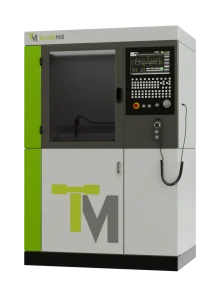
TensileMill CNC Classic Upgrade – Flat Tensile Specimen Preparation Machine
TensileMill CNC Classic Upgrade is a hybrid CNC specimen preparation system for machining flat tensile and Charpy/Izod impact specimens in-house. It combines TensileSoft™ guided software with a FANUC controller, standardized geometry templates, rigid cast-iron construction, and a servo-driven spindle. Support for ASTM E8, ASTM E23, ISO 6892-1, DIN 50125, and JIS Z2201 helps labs produce repeatable test-ready specimens.
Read more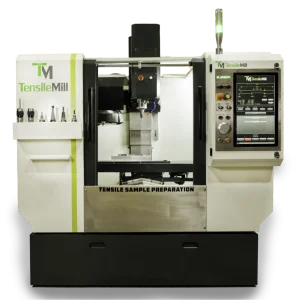
TensileMill CNC XL – Flat Tensile Specimen Preparation Machine
TensileMill CNC XL is a high-capacity flat tensile specimen preparation machine for laboratories and production floors handling larger or tougher materials. It combines extended table travel, increased spindle power, precision servo motors, Mach4-based control, and the TensileSoft interface to machine ASTM E8, ASTM A370, ISO 6892-1, and DIN 50125 specimens with repeatable dimensional accuracy, faster turnaround, and reduced outsourcing.
Read more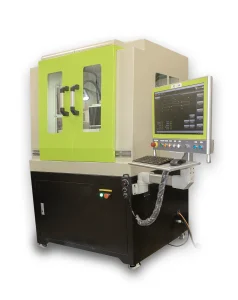
TensileMill CNC MINI – Compact Flat Tensile Specimen Preparation Machine
TensileMill CNC MINI is a compact flat tensile specimen preparation system for laboratories that need in-house CNC machining without a large industrial footprint. Built around a heavy cast-iron frame, smooth linear rails, high-powered servos, a 24,000 rpm ISO20 spindle, and guided TensileSoft/Carbon software, it prepares ASTM, ISO, DIN, and JIS-style specimens with repeatable geometry for metals, composites, and polymers.
Read more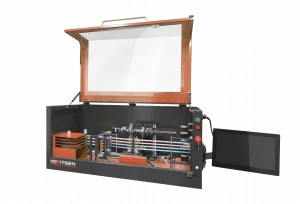
NG-AutoPol – Automatic Longitudinal Polisher for Tensile Specimens
NG-AutoPol is an automatic longitudinal polishing system for metallic tensile and fatigue specimens. It removes machining marks, grinding stress, and residual surface stress after turning or milling, producing a uniform low-stress finish along the specimen axis. Touchscreen control, interchangeable fixtures, adjustable 5–50 N force, 10–100 mm/s speed, multi-grit automation, and ASTM E8, ASTM E466, ASTM E606, EN 6072, and NADCAP-ready workflows support repeatable preparation.
Read more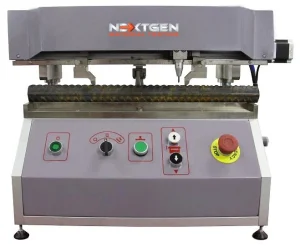
GenMark 500 – Automatic Gauge Length Marking Machine
The GenMark 500 is a full-automatic gauge length marking machine for metal bar, rebar and wire rod, applying the reference marks used to determine elongation after fracture. A servo-driven lead screw sets 5 mm or 10 mm spacing and a pneumatic tungsten steel needle marks specimens up to 500 mm gauge length, supporting ISO 6892-1 and ASTM E8/E8M workflows. Adjustable marking force, quick needle changes, and fixtures for both round and flat samples keep specimen preparation consistent across operators and shifts.
Read more