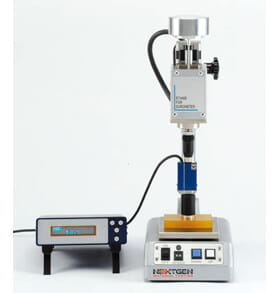
The automatic NX-01 shore durometer measuring system is the most precise for Shore A and Shore D hardness testing. Itis designed to measure the material’s resistance to permanent indentation and is primarily used in the plastic and rubber industries. NextGen offers a complete line of durometers including the more basic analog handheld instruments leading up to our most advanced automatic durometers.
Our NX-01 equipment tests the most common Shore A and D scales andis in accordance with ASTM D2240, ISO 7619, ISO 868, DIN 53 505, JIS K 6253 and JIS K 7215. The Shore A scales are utilized for softer types of plastics and rubbers. The Shore D scale, which uses a heavier load, is used for harder types of plastics.
The NX-01 features a separate digital control box which allows you toenter your testing parameters and allow the Automated Shore Measuring system to take over. The NX-01 series consists of an automatic measurement stand (NX-610), a durometer sensor (NX-719 or NX-720) and counter (NX-C01). The durometer sensor can be easily exchanged for Shore A and Shore D testing. The NX-01 includes the 1kgf weight for standard Shore A testing. The 4kgf optional weight can be purchased additionally for Shore D testing.
All of NextGen durometers are covered by a 1-year manufacturing warranty and are additionally covered with NextGen’s Life-Time Consultation benefit.
For further information on our NextGen durometers, please Contact Us now. You can read more about our Plastic and Rubber Durometers at: Shore Hardness Measuring Systems
Plastic Testing18 Oct 2026Shore Durometer Hardness to ASTM D2240: Choosing the Scale, Reading the Number and Why Two Durometers DisagreeShore hardness is the number most rubber and plastic specifications quote first, and it is also the number most likely to start an argument between a supplier and a customer. Two instruments, both calibrated, both from reputable makers, read the same part three or four points apart, and each side is sure the other one is wrong. Most of the time neither instrument is broken. The two readings were taken under conditions the standard leaves open, and the difference was written into the number before anyone looked at the display. This guide works through ASTM D2240 and its ISO counterparts in the order a laboratory meets them: what a durometer measures, which of the twelve types fits a material, why one scale does not translate into another, how the...Read the articlePlastic Testing6 Aug 2025Most Popular DIN Standards in Material TestingStandards keep material tests readable across labs and borders. Among the major families you’ll run into in day-to-day work, DIN standards from the German Institute for Standardization (Deutsches Institut für Normung) are especially visible. Many have been harmonized with European and international practices, so data produced according to DIN often translates cleanly across markets. In this article, we break down 13 commonly used DIN standards in material testing. For each one, we explain what the method measures, typical specimens and conditions, the kind of equipment it’s run on, and where it’s most often applied. Where applicable, we’ll point to close ISO or ASTM counterparts and highlight practical differences that can impact results, such as...Read the articlePlastic Testing24 Sep 20248 Most Used ISO Standards in Material TestingWhat are ISO Standards? The International Organization for Standardization (ISO) is an independent, non-governmental entity that develops and publishes standards to guarantee that products, services, and systems are safe, reliable, and of high quality. Established in 1947, ISO has grown to encompass over 25,000 standards that span a wide range of industries, including technology, manufacturing, material testing and environmental management. ISO standards facilitate international trade by creating a unified set of guidelines businesses can follow to meet global expectations. ISO's Purpose and Reach ISO standards serve as a vital tool for maintaining consistency, safety, and efficiency in a variety of fields. ISO standards provide a framework for...Read the articlePlastic Testing27 Aug 2024Why NextGen is Your Best Choice for Material Testing EquipmentIn the field of material testing, finding a reliable partner that provides advanced equipment, consumables, and comprehensive services such as calibration, maintenance, and technical support is extremely important. With a large number of companies specializing in material testing equipment, the challenge lies in determining which one truly offers the best solutions. Often, the answer to this question becomes clear only after experiencing their products and services firsthand. NextGen Material Testing, stands out as a leading company in this competitive industry. We supply our clients with cutting-edge equipment designed for a broad range of testing applications. We make sure that our customers have all the necessary consumables and support to keep...Read the articlePlastic Testing14 Nov 2023Pendulum Rebound Resilience Tester from NextGen – Review"How can we quantify the invisible robustness embedded within the materials that shape our products?" This question captures the essence of resilience testing, one of the most fundamental methods of determining the durability of materials under stress. In order to determine the level of resilience in a material, this process facilitates the measurement of its capacity to absorb energy and its ability to revert to its original state after being deformed. As part of this article, we will discuss resilience testing with a special focus on NextGen's Pendulum Rebound Resilience Tester. As an example of innovation, this tester serves as a benchmark for evaluating the elastic properties and tenacity of materials for a variety of industrial applications. In...Read the articlePlastic Testing31 Aug 2023Review of NG-DM-A Series Digital Densimeter SystemsA digital densimeter is a laboratory instrument that measures the density of materials using advanced electronic technology. It is used in industries such as pharmaceuticals, petrochemicals, and materials science to ensure that products meet specific standards and function as intended. This article provides a comprehensive overview of the digital densimeters of the NG-DM-A Series from NextGen Material Testing Inc., emphasizing their significance and application in modern industries. The Important Role of Digital Densimeters in Modern Industries Densimeter efficiency is best demonstrated in its compatibility with a wide range of materials. From rubber to plastics, its significance is undeniable. In the tire industry, for instance, rubber consistency...Read the articlePlastic Testing2 Nov 2026Izod Impact Testing of Plastics to ASTM D256 and ISO 180: Methods, Notches and Reading the ResultAn Izod value is often the first impact number on a plastics datasheet, and it is easy to read more into it than it holds. A notched bar is clamped upright, a pendulum swings once, and the energy it lost breaking the bar becomes a single figure in J/m or kJ/m². Behind that figure sit a choice of standard, a notch cut a particular way, a hammer of a particular size and a break that may not have been complete. Change any of them and the number moves, sometimes far enough to reverse the ranking of two materials, which ASTM D256 itself warns can happen. This guide follows the test the way a plastics laboratory meets it: how the bar is loaded, what the current ASTM D256 contains, the specimens and notches of D256 and ISO 180, where the pendulum's energy...Read the articlePlastic Testing1 Nov 2026Melt Flow Rate to ASTM D1238 and ISO 1133: Procedure A vs B, MFR vs MVR and Why Results DriftMelt flow rate is the first property on most thermoplastic datasheets and the figure a molder checks when a new resin lot arrives. It is also easy to argue about: two laboratories test pellets from the same bag on two calibrated instruments and report numbers further apart than the specification allows. The test is simple, but sensitive to details the result does not show, such as the melt temperature just above the die, moisture in the pellets and how the charge was packed. This guide follows ASTM D1238 and ISO 1133 in the order a laboratory meets them: the number, the conditions, Procedures A and B, MFR against MVR, the differences between the standards, and why results drift. Short answerWhat is melt flow rate?Melt flow rate (MFR), also called...Read the articleRubber Testing15 Oct 2026Rubber Tensile Testing to ASTM D412 and ISO 37: Where the Scatter Comes FromRubber tensile results scatter more than most laboratory numbers, and the instinct is to blame the material. Sometimes that is fair: a compound that was mixed or cured unevenly will show it. More often the spread was built in before the crosshead moved, by the way the specimen was cut, measured and conditioned, and the test itself only reported it. ASTM D412 and ISO 37 both measure the same family of properties: tensile strength, elongation at break and the stress at a given elongation. Both are explicit about what has to be held constant for those numbers to mean anything, and most of the scatter that reaches a report traces back to one of those conditions slipping. Short answerWhy do rubber tensile test results scatter?More often because of how...Read the article
Related equipment
Machines Behind This Article
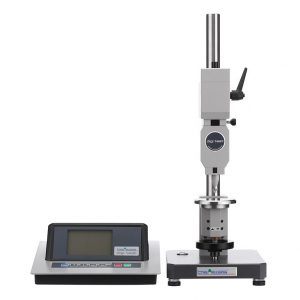 Plastic TestingAutomatic Shore, IRHD and VLRH Hardness Testing SystemDigi Test II is an automatic Shore, IRHD, and VLRH hardness testing system for rubber, plastics, foams, elastomers, O-rings, tubes, hoses, and shaped parts. It...View product
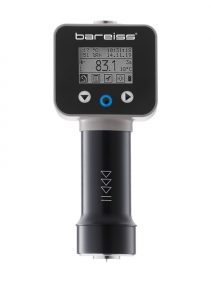 Plastic TestingPortable Shore Durometer System with Test StandHPE III is an advanced portable Shore durometer system for hardness testing of rubber, plastics, and related materials. It measures hardness while also displaying...View product
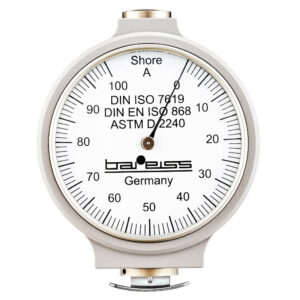 Plastic TestingAnalogue Shore Durometer with Test StandThe Classic Analogue Shore Durometer is a German-manufactured hardness tester for rubber and plastic materials, available with manual or automatic test stand...View product
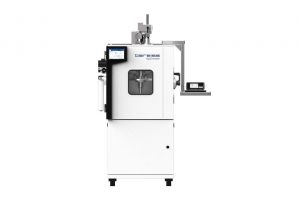 Rubber TestingdigiChamber – Temperature-Controlled Hardness TesterdigiChamber is a temperature-controlled rubber hardness testing system designed by Bareiss for Shore A and IRHD N testing under extreme environmental conditions. It...View product
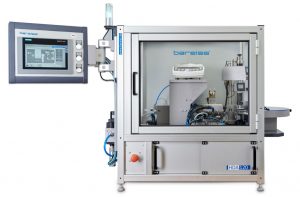 Plastic TestingHDA 120 – Hardness and Density Automation SystemHDA 120 is a semi-automatic hardness and density automation system for rubber and plastic sample characterization. It can handle up to 20 samples, perform three...View product
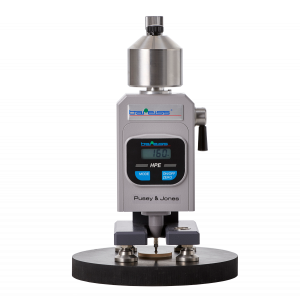 Plastic TestingPusey and Jones TesterPusey & Jones Tester is a portable plastometer system for measuring hardness and indentation behavior of rubber and rubber-like materials, especially rubber rollers...View product