There are many types of abrasion testing in material science: Martindale abrasion test, Wyzenbeek abrasion test, DIN abrasion test, and pin-on-disk wear testing. Among the most commonly used methods is the abrasion test, which involves rotating a specimen against an abrasive wheel under a specific load to measure the material’s wear resistance. This test is commonly used on coatings, plastics, and textiles to assess their durability and longevity. As part of these tests, abrasion testers are used.
In this blog, let us introduce you to our notable product in the field of material testing – the Linear Abrasion Tester, a machine designed to meet the high standards and requirements of abrasion testing.
General Information About Linear Abrasion Tester
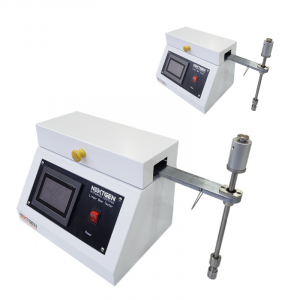 The Linear Abrasion Tester is an advanced device developed to evaluate the abrasion resistance, scratch resistance, and color transmission of different products. Our highly adaptable tester can perform both dry and wet abrasion tests, thus being able to be used in a number of different kinds of conditions.
This tool can test samples of any size or shape, making it extremely useful for products with contoured and polished surfaces, such as computer mice and other IT products that require plastic finish wear resistance testing. It is extensively used in industries like plastics, automotive accessories, rubber, leather, textiles, electroplating, removable components, paints, printing patterns, and more.
By subjecting materials to abrasion and scratch tests, NextGen’s Abrasion Tester helps manufacturers determine how well their products will hold up under wear and tear. For example, a computer mouse might undergo multiple abrasion cycles to guarantee that the finish remains intact despite constant use. Similarly, automotive accessories and rubber components can be tested to verify that they withstand everyday usage.
The tester’s capability to conduct color transmission tests is particularly beneficial for products where appearance is critical. This feature makes certain that materials maintain their color quality over time, resisting decolorization and rubbing fastness.
Compliance with Standards by Linear Abrasion Tester
Our abrasion tester complies with several key industry standards. These standards include ASTM D6279, ASTM F1319, and ISO 105-X12. Lets breakdown each standard for more information.
-
ASTM D6279: This standard outlines the test method for evaluating plastic abrasion resistance using a rotary platform, double-head tester. This is important in terms of assessing the durability of plastic materials in different applications. It confirms that they can withstand wear and tear in real-world conditions and will not break down.
-
ASTM F1319: This standard specifies the procedures for conducting accelerated wear tests on materials, focusing on coatings and finishes. It helps determine how well a material can resist abrasion and maintain its appearance over time. This is a factor that is extremely important for consumer satisfaction and for the longevity of a product.
-
ISO 105-X12: This international standard specifies a method for determining the color fastness of textiles to rubbing. It is vital to evaluate how well a fabric retains its color when subjected to mechanical stress, therefore making sure the quality and durability of textile products are not compromised.
Technical Specifications of NextGen’s Abrasion Tester
Now, we would like to go over the main technical specifications in order to get a better understanding of its capabilities. The following is a list of detailed technical specifications for the this tester.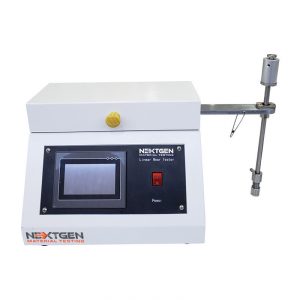
-
Movement Speed: 2-60 RPM
-
Dimensions: 10.25″ x 11″ x 12.65″ / 26 x 28 x 32 cm
-
Power Supply: 120V 60Hz 1PH
-
Function: Linear Abrasion Laboratory Testing
-
Features: User-Friendly Touch Panel
-
Display: Touchscreen
-
Weight: 77lbs / 35 kg
Who Can Benefit from this Abrasion Tester
We have already mentioned a few examples of how the Linear Abrasion Tester can be used in many different industries. Considering that this versatile tester is ideal for evaluating abrasion resistance, scratch resistance, and color transmission, allow us to list some common industries and sectors that can make significant use of it.
Plastics Industry
Manufacturers of plastic components can use this tester to determine whether their products can withstand wear and tear, maintaining their appearance and functionality over time. For example, engineering plastics like PEEK, UHMW, and Acetal are frequently used in applications requiring high abrasion resistance, such as bearings, gears, and wear strips. This machine helps assess these materials’ durability under continuous friction and abrasion.
Automotive Industry
The tester is crucial for assessing the durability of automotive accessories, such as interior trim and exterior components, as well as verifying their compliance with stringent quality standards. For instance, automotive parts made from abrasion-resistant plastics can be tested for their ability to withstand harsh conditions and repeated use. This helps maintain the quality and longevity of parts like dashboard panels, door trims, and seat components.
Textile Industry
Textile manufacturers can evaluate fabrics’ abrasion resistance and color fastness, assuring that their products remain durable and visually appealing despite frequent use. The tool can test fabrics used in upholstery, clothing, and industrial applications, demonstrating how well these fabrics withstand repeated wear and tear.
Rubber and Leather Industries
Producers of rubber and leather goods can test their materials to guarantee they are robust enough for demanding applications, such as footwear, upholstery, and industrial uses. Our tester helps to determine the wear resistance of these materials. Thus, products like shoes, belts, and automotive leather interiors can withstand daily use without significant degradation.
Coatings and Paints
Companies involved in coatings and paint production can use this tester to assess wear resistance, providing long-lasting protection and aesthetic appeal. For example, protective coatings on metal and plastic surfaces can be tested for their ability to resist abrasion. This can help manufacturers verify that their coatings provide adequate protection against wear and environmental factors.
Packaging Industry
Abrasion testing is also extremely important for the packaging industry, where materials like printed labels, folding cartons, and corrugated boxes need to maintain their appearance and structural integrity during handling and transit. By evaluating the abrasion resistance of these materials, manufacturers can make certain their products remain visually appealing and durable throughout their lifecycle.
Maximizing Material Durability with the NextGen’s Linear abrasion tester
To summarize, the Linear Abrasion Tester is a flexible and robust instrument designed to evaluate abrasion resistance, scratch resistance, and color transmission across different types of materials and industries. Complying with key standards like ASTM D6279, ASTM F1319, and ISO 105-X12, this tester provides precise and reliable results! Its ability to perform both dry and wet abrasion tests makes it suitable for diverse testing conditions, allowing it to perform a comprehensive assessment of the material under test.
Our tester’s applications span an array of multiple industries, including plastics, automotive, textiles, rubber, leather, coatings, paints, and packaging. By evaluating how well materials withstand wear and tear, the machine helps manufacturers improve product durability and longevity. For instance, it aids in verifying the robustness of automotive interior trims, the abrasion resistance of engineering plastics, and the color fastness of textiles, among others.
Whether you are looking for reliable material testing equipment, particularly abrasion testers, or would like to know more about our rubber testing equipment on offer, you can request a quote online or contact us directly to know what we can do with your inquiry. You can count on us to help you in any way we can.
Machines Behind This Article
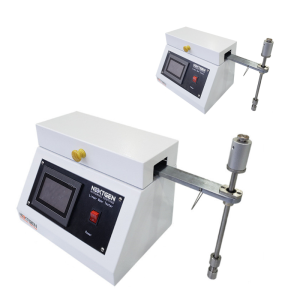 Rubber TestingLinear Abrasion TesterThe Linear Abrasion Tester evaluates abrasion resistance, scratch resistance, and color transfer performance under dry or wet test conditions. Designed for samples...View product
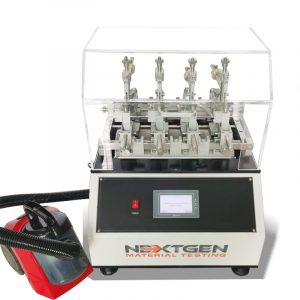 Rubber TestingGenWyze – Wyzenbeek Abrasion TesterGenWyze is a certified Wyzenbeek abrasion tester for measuring abrasion resistance of fabrics, upholstery materials, and selected coated or metallic surfaces. The...View product
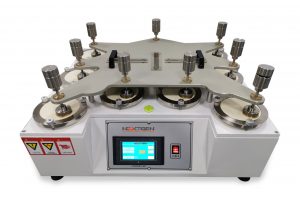 Rubber Testing9-Station Martindale Abrasion TesterGenDale 9-Station Martindale Abrasion Tester measures abrasion resistance and appearance change in shoe fabrics, linings, coated fabrics, textiles, and related...View product
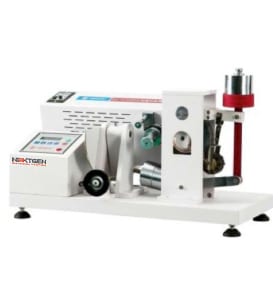 Rubber TestingAkron Abrasion TesterGenKron Akron Abrasion Tester measures abrasion resistance by tracking volumetric loss from a rotating specimen exposed to a standard grinding wheel. Designed for...View product
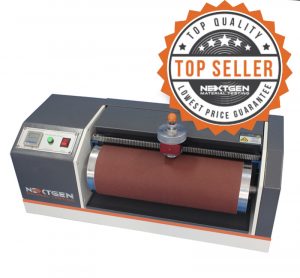 Rubber TestingDIN Abrasion TesterGenDin is a DIN abrasion tester for measuring abrasion resistance of vulcanized rubber, thermoplastic elastomers, footwear materials, tires, seals, and other rubber...View product
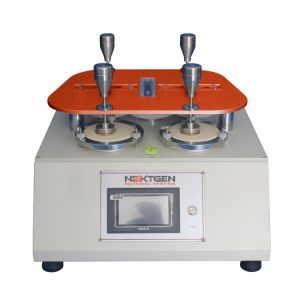 Rubber TestingGenDale – Martindale Abrasion TesterGenDale is a Martindale abrasion tester for evaluating abrasion resistance and visible wear in shoe fabrics, linings, textiles, and related materials. It tests up...View product
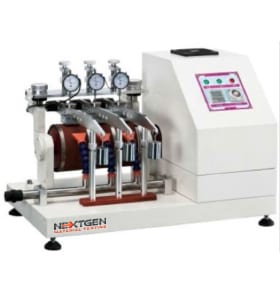 Rubber TestingGenNBS – NBS Rubber Abrasion TesterGenNBS is an NBS rubber abrasion tester for evaluating abrasion resistance of vulcanized rubber and related compounds, especially shoe soles and heels. It measures...View product
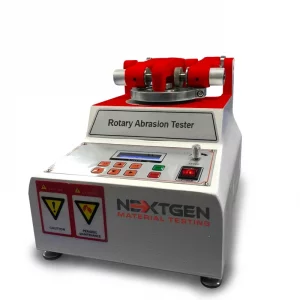 Rubber TestingRotary Abrasion Tester (Single and Dual Wheel)NextGen’s Rotary Abrasion Tester is available in single- and dual-wheel configurations for evaluating surface wear resistance on rubber, plastics, fabrics, paper,...View product
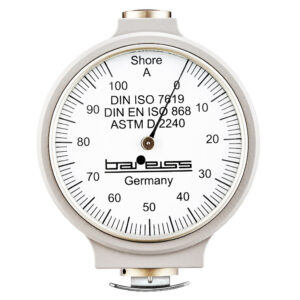 Rubber TestingAnalogue Shore Durometer with Test StandThe Classic Analogue Shore Durometer is a German-manufactured hardness tester for rubber and plastic materials, available with manual or automatic test stand...View product
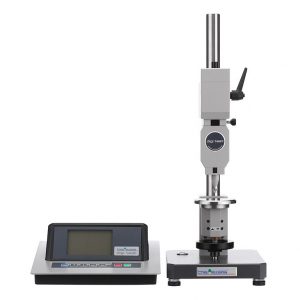 Rubber TestingAutomatic Shore, IRHD and VLRH Hardness Testing SystemDigi Test II is an automatic Shore, IRHD, and VLRH hardness testing system for rubber, plastics, foams, elastomers, O-rings, tubes, hoses, and shaped parts. It...View product
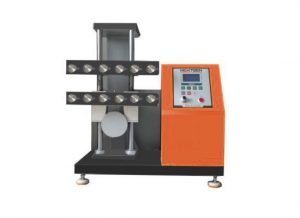 Rubber TestingDemattia Flex Cracking TesterGenFlex Demattia Flex Cracking Tester evaluates the ability of rubber products to withstand repeated flexing without developing cracks. It simulates standard...View product
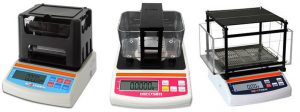 Rubber TestingDigital Densimeter SystemNextGen Digital Densimeter Systems measure density, specific gravity, volume, and related material properties for rubber, plastics, tires, shoe materials,...View product