Standards
Ultimate User-Friendliness
Leading Dependability and Reliability
Strict Compliance with Industry Standards
Stocked Consumables and Spares
Trusted After Sales Technical Support
Lifetime Product Support Advantage
Sheet Metal Bend Testing for Ductility and Formability Evaluation
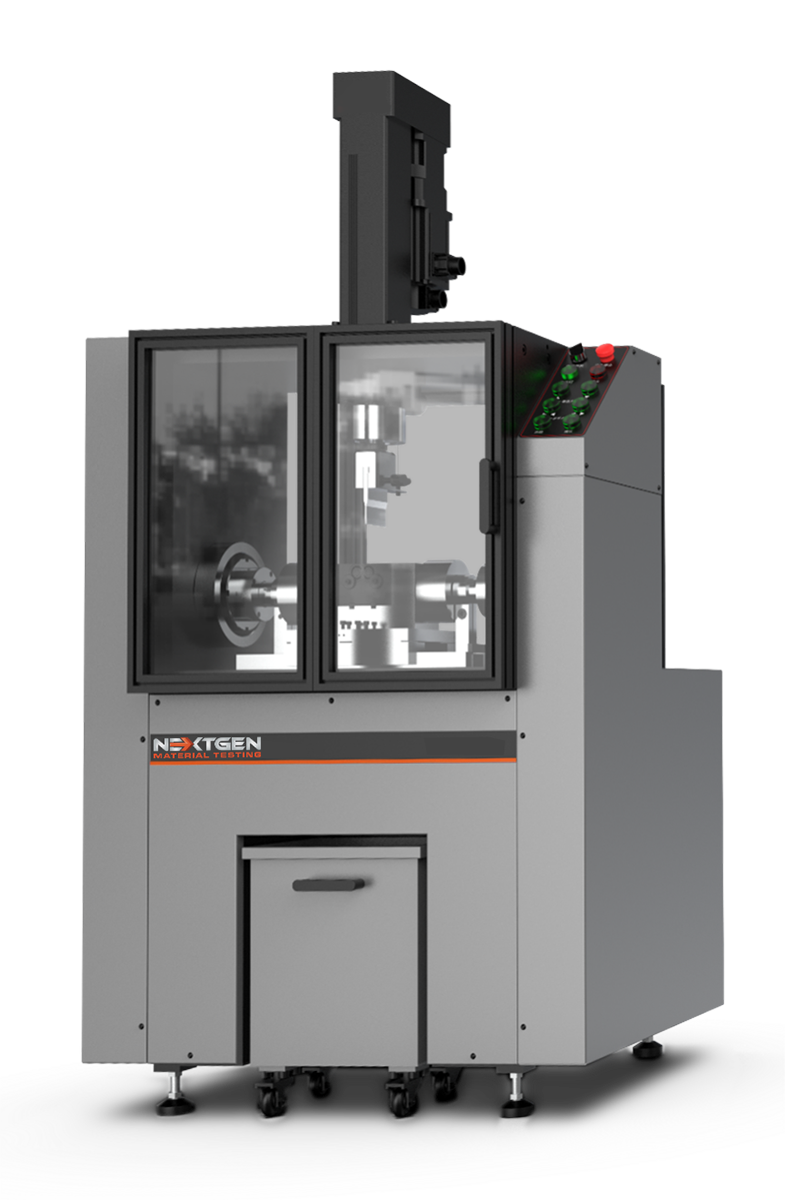
The NG-FLX Series A is an electromechanical bend testing system designed for controlled sheet metal bending, three-point bend testing, flattening tests, and formability evaluation. It is used to measure how metallic sheet materials respond to bending force, bending angle, and controlled deformation.
Unlike a general-purpose universal testing machine, the NG-FLX Series A is built specifically for sheet metal bend testing workflows. The system combines vertical loading, horizontal support movement, interchangeable mandrels, support rollers, and U-bend tooling to match the required test method and specimen geometry.
The system is suitable for laboratories and production facilities testing steel sheet, aluminum sheet, automotive sheet materials, formed metal samples, and other flat metallic specimens. Typical test goals include ductility evaluation, bendability assessment, cracking observation, flattening behavior, and comparison of material performance under repeatable bending conditions.
Configuration Type: Electromechanical sheet metal bend testing system
Force Capacity: 20 kN, 50 kN, and 100 kN reference configurations
Typical Specimens: Sheet metal, steel sheet, aluminum sheet, formed metal samples, automotive sheet materials, and flat metallic specimens
Testing Applications: Three-point bending, flattening, ductility testing, sheet metal formability evaluation, bending angle measurement, and bend force analysis
Customization: Mandrels, support rollers, U-bend molds, fixture package, force capacity, travel, roller spacing, protective enclosure, GenTest software, and reporting workflow
Three Reference Configurations for Sheet Metal Bend Testing
The NG-FLX Series A is available in three reference configurations based on required vertical and horizontal force capacity. Each model is designed for controlled sheet metal bending, three-point bend testing, flattening tests, and real-time force and bending angle data collection.
20 kN Reference Configuration
NG-FLX Series A-204
20 kN Sheet Metal Bend Testing System
A lower-force configuration for controlled bend testing of thin sheet metal specimens, formed samples, and smaller laboratory test pieces. This model is suitable for applications where compact frame size and repeatable bend angle measurement are required.
Capacity
20 kN vertical / 20 kN horizontal
Best For
Thin sheet metal, smaller samples, routine bendability checks
Typical Use
Three-point bending, flattening tests, ductility evaluation
50 kN Reference Configuration
NG-FLX Series A-504
50 kN Sheet Metal Bend Testing System
A mid-range configuration for sheet metal bend testing where higher force capacity is required for thicker or stronger metallic specimens. This model is suitable for quality control and R&D workflows involving steel sheet, aluminum sheet, and automotive sheet materials.
Capacity
50 kN vertical / 50 kN horizontal
Best For
Steel sheet, aluminum sheet, automotive materials
Typical Use
Bendability testing, formability evaluation, bending angle measurement
100 kN Reference Configuration
NG-FLX Series A-105
100 kN Sheet Metal Bend Testing System
A higher-capacity configuration for demanding bend and flattening test applications. This model is intended for stronger sheet metal specimens, higher-force forming evaluations, and laboratories that need additional force range for material development or production verification.
Capacity
100 kN vertical / 100 kN horizontal
Best For
High-strength sheet metal, stronger formed materials, R&D testing
Typical Use
High-force bending, ductility assessment, cracking observation
Note: These models are reference configurations. Final tooling, mandrels, support rollers, U-bend molds, travel, roller spacing, protective enclosure, GenTest software, and reporting workflow can be configured according to the required test method and specimen geometry.
Technical Specifications — NG-FLX Series A
The specifications below summarize the NG-FLX Series A reference configurations for sheet metal bend testing, three-point bending, flattening tests, and formability evaluation. Final tooling, mandrels, support rollers, U-bend molds, protective enclosure, software, and reporting workflow can be configured according to the required test method and specimen geometry.
Reference Capacities
20 kN, 50 kN, 100 kN
Machine Type
Electromechanical bend testing system
Test Methods
Bend, flattening, formability
| Specification |
A-204 |
A-504 |
A-105 |
| Vertical Maximum Force |
20 kN |
50 kN |
100 kN |
| Horizontal Maximum Force |
20 kN |
50 kN |
100 kN |
| Force Range |
1% to 100% FS |
| Force Accuracy |
±0.5% of reading |
| Force Resolution |
1/500,000 FS |
| Position Resolution |
0.3 μm |
| Vertical Loading Speed |
0.01–200 mm/min |
| Maximum Vertical Travel |
5.91 in
5.9″ (150 mm) |
7.87 in
7.9″ (200 mm) |
| Horizontal Supports Moving Speed |
0.01–50 mm/min |
0.01–100 mm/min |
| Distance Between Support Rollers |
0.04–1.97 in
1–50 mm |
0.04–3.94 in
1–100 mm |
| Support Roller |
Ø0.79 × 2.76 in, Ø1.18 × 2.76 in
Ø20 × 70 mm, Ø30 × 70 mm |
| Mandrel Diameter |
R0.8, R1.0, R1.1, R1.2, R1.3, R1.4, R1.5, R1.6, R1.8, R2.0, R2.5, R2.8, R3.0, R3.2, R3.6, R4.0, R4.4, R4.8
Optional tooling, selected according to test method |
| Mold Thickness for U Bend |
2.0, 2.2, 2.4, 2.6, 2.8, 3.0, 3.2, 3.6, 4.0, 5.0, 5.6, 6.0, 6.4, 7.2, 8.0, 8.8, 9.6 mm
Mold thickness equals mandrel diameter; optional tooling selected according to order |
| Specimen Size |
0.02–0.16 in
0.5–4 mm |
| Dimensions |
37.40 × 26.77 × 67.72 in
37.4 × 26.8 × 67.7″ (950 × 680 × 1,720 mm) |
50.00 × 27.56 × 85.59 in
50 × 27.6 × 85.6″ (1,270 × 700 × 2,174 mm) |
| Power Supply |
1-phase, AC 220 V, 50 Hz, 2 kW |
| Weight |
Approx. 1,653 lb
1,653 lbs (750 kg) |
Approx. 2,976 lb
2,976 lbs (1,350 kg) |
Standards and Method Support
The NG-FLX Series A can be configured to support bend, flattening, ductility, and sheet metal formability testing in accordance with selected ASTM, ISO, VDA, GB/T, and other recognized standards. Applicable methods depend on specimen geometry, material type, mandrel size, support roller spacing, tooling selection, bending angle measurement, and reporting requirements.
Commonly supported standards include:
- ASTM E290 — Standard Test Methods for Bend Testing of Material for Ductility
Used for bend testing of materials to evaluate ductility and resistance to cracking or surface irregularities during bending.
- ISO 7438 — Metallic materials — Bend test
Specifies a method for determining the ability of metallic materials to undergo plastic deformation in bending.
- VDA 238-100 — Plate bending test for metallic materials
Used to determine bending angle and evaluate deformation behavior and sensitivity to failure of metallic materials during forming processes or crash-load-related bending.
- GB/T 15825.5 — Sheet metal formability and test methods — Part 5: Bending test
Used for sheet metal bending formability testing, including evaluation based on bending behavior and minimum relative bending radius.
- GB/T 232 — Metallic materials — Bend testing method
Used to determine the ability of metallic materials to withstand plastic deformation during bend testing.
Bend Testing Applications for Sheet Metal and Formed Materials
The NG-FLX Series A is used for controlled bend testing workflows where force, displacement, bending angle, tooling geometry, and material response need to be measured under repeatable conditions. It is suitable for sheet metal laboratories, automotive material testing, production QC, and R&D work involving steel, aluminum, and formed metallic specimens.
Sheet Metal Bend Testing
Used to evaluate how sheet metal responds to controlled bending force and tooling contact. This helps determine whether a material can be bent to the required angle or radius without visible cracking, fracture, or unacceptable surface defects.
Three-Point Bending
Supports three-point bend testing using selected support rollers and mandrels. This setup is used to apply a controlled bending load at the center of the specimen while the sample is supported at two points.
Flattening Tests
Used to evaluate flattening behavior after bending or forming. This is useful when checking how a specimen responds to compression, closing, or deformation after an initial bend operation.
Ductility Evaluation
Used to assess the ability of a metallic specimen to undergo plastic deformation during bending. Ductility testing helps identify cracking tendency, surface failure, and bendability limits.
Bending Angle Measurement
The system can collect bending angle data during the test, allowing operators to evaluate material behavior at specific bend angles and compare results across different specimens or material grades.
Automotive Sheet Metal Formability
Suitable for automotive sheet metal testing where bendability, deformation behavior, and failure sensitivity are important. This is especially relevant for steel and aluminum sheet materials used in formed parts.
Steel and Aluminum Sheet QC
Used in quality control workflows for steel sheet, aluminum sheet, and formed metal samples. Typical checks include bend performance, repeatability, crack observation, and comparison between production batches.
Why Bend Testing Matters for Sheet Metal
Bend testing helps determine whether sheet metal can withstand plastic deformation without cracking, fracture, or unacceptable surface irregularities. This is important for materials that will be formed, bent, pressed, folded, or shaped during manufacturing.
For production and quality control, bend testing provides a direct way to compare material behavior between batches, suppliers, thicknesses, grades, or heat treatments. A specimen that meets tensile requirements may still show poor bendability, cracking, or surface failure during forming.
For R&D and automotive material development, bend testing helps evaluate how steel, aluminum, and high-strength sheet materials behave under controlled deformation. Measurements such as bending force, bending angle, displacement, and visible failure behavior can support material selection, forming process validation, and product qualification.
Mandrels, Support Rollers and U-Bend Tooling
The NG-FLX Series A is configured with bend tooling selected according to the required test method, specimen thickness, bend radius, and support spacing. Tooling selection is important because mandrel radius, roller diameter, and support distance directly affect how the sheet metal specimen bends during the test.
The system can be supplied with interchangeable mandrels for different bend radii, including small-radius tooling for tighter bend evaluations. Support rollers are used to hold the specimen during three-point bending, while the horizontal support movement allows the roller spacing to be adjusted for the selected test setup.
For U-bend applications, mold thickness is selected according to the required mandrel diameter and specimen geometry. This allows the same machine platform to support different bend and flattening workflows without treating every test as a fixed setup.
Typical tooling options include:
- Interchangeable mandrels for selected bend radius requirements
- Support rollers for three-point bending workflows
- Adjustable support roller spacing
- U-bend molds selected according to mandrel diameter
- Custom tooling for specimen geometry, thickness, and test method requirements
Test Control, Bending Angle Measurement and Reporting
The NG-FLX Series A uses controlled vertical loading and horizontal support movement to perform repeatable sheet metal bend testing. The system measures test force and bending angle in real time, allowing operators to evaluate material response during bending, flattening, and formability tests.
The machine can be configured with load measurement for both vertical and horizontal loading directions. This supports controlled force application, bend force analysis, bending angle evaluation, and comparison of results between materials, thicknesses, or production batches.
GenTest software is used for test operation, data display, and reporting workflow. The software package can be configured around the required test method, specimen type, result fields, and documentation requirements.
Core functions include:
- Real-time test force measurement
- Bending angle data collection
- Controlled vertical loading
- Horizontal support movement
- Force and position data acquisition
- Test method setup according to specimen and tooling requirements
- Report generation through GenTest
- Protective enclosure and safety-focused operation for bend testing workflows
Configured for Test Method, Specimen Thickness and Fixture Requirements
The NG-FLX Series A can be configured around the required bend test method, specimen thickness, tooling geometry, force range, travel requirements, safety cover, and reporting workflow. Tooling and fixture selection should be matched to the specimen material, bend radius, support spacing, and target standard.
Mandrel Selection
Mandrels can be selected according to the required bend radius, specimen thickness, and applicable test method.
Support Roller Selection
Support rollers are selected for three-point bending workflows based on specimen size, contact requirements, and test setup.
U-Bend Mold Selection
U-bend molds can be selected according to mandrel diameter, specimen geometry, and the required bending or flattening procedure.
Roller Spacing
The distance between support rollers can be configured to match the selected test method, specimen length, and bend setup.
Force Capacity
The system is available in 20 kN, 50 kN, and 100 kN reference configurations for different sheet metal thicknesses and material strengths.
Vertical Travel
Vertical travel can be matched to the required bend stroke, tooling height, specimen setup, and deformation range.
Horizontal Support Travel
Horizontal support movement allows the bend setup to be adjusted for different roller spacing and specimen configurations.
Protective Enclosure
A full protection cover can be included for safer operation during bend, flattening, and repeat testing workflows.
GenTest Reporting
GenTest reporting can be configured for force data, bending angle data, result fields, test records, and laboratory documentation.
Customer-Specific Fixtures
Custom fixtures can be designed for non-standard specimens, special bend setups, formed parts, or application-specific test requirements.
Configuration Note: Final setup should be selected based on specimen material, thickness, target bend radius, required standard, mandrel size, support roller spacing, force capacity, and reporting requirements.
How to Specify Your Bend Testing System
To configure the correct NG-FLX Series A system, the test setup should be defined around the material, specimen geometry, bend method, tooling requirements, and reporting workflow. This helps select the correct force capacity, mandrel, support roller spacing, travel range, fixture package, and GenTest reporting setup.
Material Type
Steel sheet, aluminum sheet, formed metal sample, or other flat metallic specimen.
Specimen Thickness
Required thickness range for bend, flattening, or formability testing.
Specimen Width and Length
Sample dimensions needed to confirm support spacing, tooling clearance, and fixture setup.
Required Standard
ASTM, ISO, VDA, GB/T, or internal test procedure to be supported.
Bend Method
Three-point bending, flattening, U-bend testing, or other defined bend workflow.
Mandrel Radius
Required mandrel radius or bend radius for the selected test method.
Support Roller Distance
Required distance between support rollers for the bend test setup.
Maximum Force
Expected maximum bend force required for the material and specimen thickness.
Reporting Requirements
Required result fields, bending angle data, force data, export format, and documentation workflow.
To select the correct NG-FLX Series A configuration, provide the specimen details, target standard, bend method, tooling requirements, expected force range, and reporting needs.
For configuration support, contact NextGen Material Testing with your application details.
For Laboratories
Need Additional Quality Control Equipment to Build Your Laboratory?
Flexural and bend testing is only one part of a complete quality control laboratory. NextGen can help you equip your entire lab with impact testers, notching and broaching systems, cooling chambers, tensile testers, hardness testers, specimen preparation equipment, and other supporting solutions, all coordinated as one complete project.
- One partner to equip your complete laboratory
- Installation, training, calibration
- Support for the life of the equipment