Rock Mechanics Testing Equipment
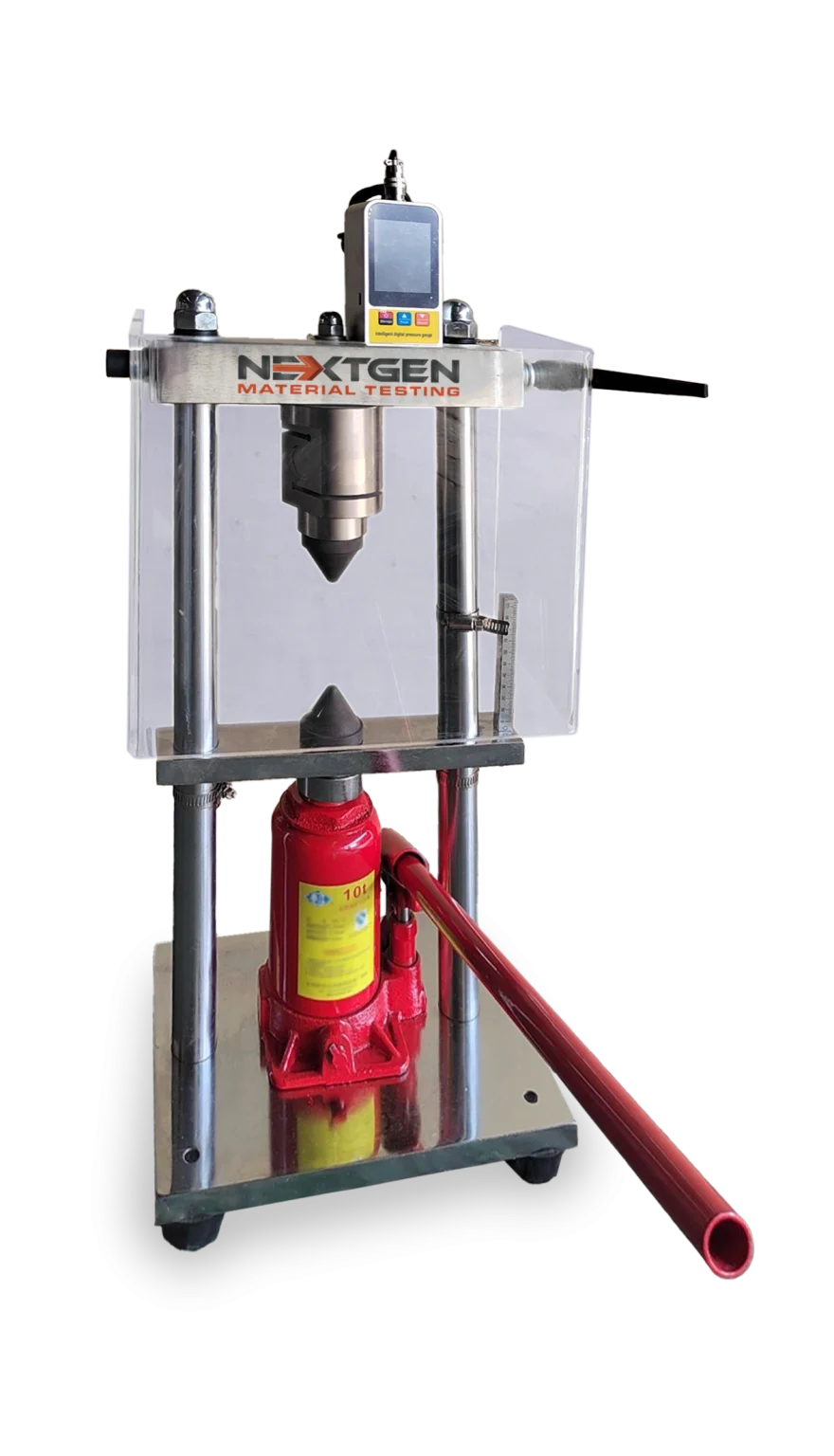
Rock strength is checked in two main ways before heavier compression work is considered. A point load test squeezes a core, block or irregular lump between two hardened platens and reports a point load strength index under ASTM D5731, which is widely used for classification and screening because it needs little or no specimen preparation. A direct shear test slides one half of a specimen over the other under a constant normal force and measures the strength of intact rock or of a joint, as described in ASTM D5607. One result is an index, and the other is the strength of a defined shear plane.
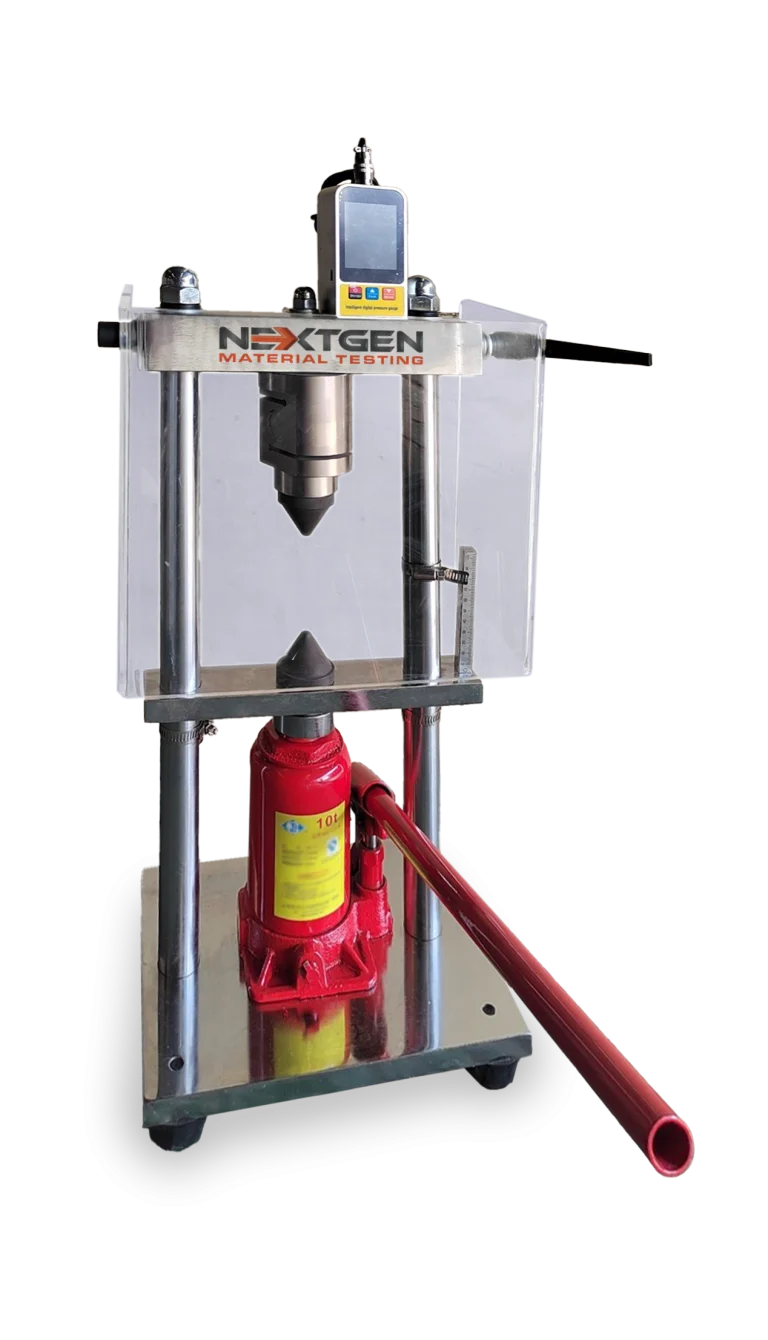
The point load tester is built to be carried to site, with a digital reading, a carbide loading head and battery power, so an exploration core can be tested as it comes. The shear box is a compact two-part frame with a low friction pressure maintainer that holds the normal stress while the specimen changes volume, and it is used in the field and on the bench. Fixtures for hydraulic universal testing machines extend the range to rock and concrete specimens in a large frame. NextGen engineers install and calibrate the equipment, operators are trained, and support continues for the life of the instruments.
For Laboratories
One partner to equip your complete rock mechanics laboratory
Rock testing rarely stops at one machine. NextGen equips the whole laboratory, from coring, cutting and core grinding to point load, shear box and abrasivity testing, and stays responsible for it after delivery.
- Equipment, fixtures and software
- Installation, training, calibration
- Lifetime technical support
Most requested
 100 kN
Portable Point Load Tester
The Point Load Tester is a portable rock strength testing system for fast field and laboratory assessment of core…
View product
Get quote
Most requested
 Rock Shear Box Apparatus
The Rock Shear Box Apparatus provides a practical field and laboratory method for determining rock shear strength and…
View product
Get quote
100 kN
Portable Point Load Tester
The Point Load Tester is a portable rock strength testing system for fast field and laboratory assessment of core…
View product
Get quote
Most requested
Rock Shear Box Apparatus
The Rock Shear Box Apparatus provides a practical field and laboratory method for determining rock shear strength and…
View product
Get quote
 Portable Point Load Tester100 kN
The Point Load Tester is a portable rock strength testing system for fast field and laboratory assessment of core…
Point load testing
Rock Shear Box Apparatus
The Rock Shear Box Apparatus provides a practical field and laboratory method for determining rock shear strength and…
Rock shear testing
Nothing matches that filter. Show all products
FAQs
Choose by the question. The point load tester gives a strength index quickly, in the field or the laboratory, and suits classification and screening. The shear box gives shear strength along a defined plane such as a joint, and suits slope, foundation and underground design where sliding governs. Where the strength of intact rock is wanted and not that of a joint, start with the index. Tell us the core diameter and where the test is done.
Yes. The splitting fixtures for rock and concrete are designed for shear and splitting tests on rock, concrete and composite specimens in hydraulic universal testing machines. The model is rated to 2000 kN, hangs from a flange at the top with a positioning pin at the bottom, needs 450 mm of test space and takes cylindrical samples of 50 by 50 mm or cubes of 50 mm. Send us your machine model and we will check the fit.
The rock shear box is the equipment behind the direct shear test on rock discontinuities in ASTM D5607. It was developed at Imperial College, London, by Professor E. Hoek. The NextGen standard page notes that ASTM has marked D5607 withdrawn, so many laboratories meet it as a legacy requirement. Confirm the reference in your project specification and tell us the sample size, up to 115 by 125 mm or cores to 102 mm.
Both run the same test on the same frame of the rock shear box. The /A comes with five digital gauges of 25 mm range, four vertical and one horizontal, and Bourdon gauges on the pumps. The /D comes with five potentiometric transducers and two pressure transducers that feed an external data logger, supplied as an accessory. Choose the /D when the test must produce a recorded curve and not readings written down by the operator.
The NG-RockStrength runs on a 9 V battery, so no generator has to go to site, and it weighs 93 lb (42 kg) with the jack built into the outer shell. It reads to 100 kN at 0.001 kN resolution with an error under 1% of full scale, on an LCD. The maximum distance between loading points is 90 mm, which covers usual exploration core sizes. The carbide loading cone is the wear part, so hold spares.
From the point load tester index you can estimate the uniaxial compressive strength of the rock, measure anisotropy by comparing the maximum and minimum strength in different directions, classify the rock, work out weathering zones and predict drilling efficiency. ASTM D5731 treats it as a classification and screening tool and not a substitute for design-strength testing, so use it to select specimens for more time-intensive tests.