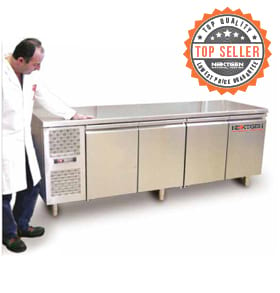
Curemate 550 – Climatic Curing Cabinet

Cement & Concrete Testing Equipment
Standards
Description
The NG-CureMate 550 is a climatic curing chamber with a capacity of 145.3 gal (550 litres), built to hold cement and mortar specimens at a controlled temperature and humidity from casting until testing.
Curing conditions are not a background detail in cement testing: strength at 28 days is only comparable between laboratories because the specimens spent those days in the same climate. The chamber exists to make that climate repeatable and to show, at any moment, that it was held.
A digital control unit with 0.1 resolution displays temperature and relative humidity at all times, together with the phase the chamber is in: cooling, heating, ventilation or humidification. It supports the curing conditions required by ASTM C109, ASTM C511 and EN 196-1.
Capacity145.3 gal (550 litres)
Temperature+10 to +40 °C ±1 °C
Humidity80% to 100% RH
Weight452 lbs (205 kg)
NG-CureMate 550 Features
The cabinet is stainless steel inside and out, and the working details are aimed at a laboratory where the door opens many times a day.
Digital control
Control unit with 0.1 resolution. Temperature, for example 20.0 °C, and relative humidity, for example 95.0% RH, are displayed at all times along with every phase of operation.
Temperature range
From +10 °C to +40 °C, held to ±1 °C.
Humidity range
From 80% to 100%, up to saturation.
Humidifier
Humidity is generated automatically by vaporization.
Structure
Inner and outer structure entirely in AISI 304 stainless steel, with grid shelves. The cabinet top can be used as a work bench.
Insulation
60 mm thick self-extinguishing polyurethane foam, CFC-free.
Doors and shelves
Doors on special hinges for automatic closure. Four doors and eight plasticized steel shelves are supplied as standard, and up to six extra shelves can be added.
Refrigeration
Airtight system with air condensation and R404a ecological, CFC-free gas.
Heating
Thermostatically controlled heating element with low thermal inertia.
NG-CureMate 550 Technical Specifications
The cabinet is wide rather than tall, which is worth checking against the wall it will stand along.
| Item | NG-CureMate 550 |
|---|---|
| Capacity | 145.3 gal (550 litres) |
| Temperature range | +10 °C to +40 °C, ±1 °C |
| Humidity range | 80% to 100% RH, up to saturation |
| Control resolution | 0.1 |
| Structure | AISI 304 stainless steel inside and out |
| Shelves | 8 supplied as standard, up to 6 extra |
| Insulation | 60 mm self-extinguishing polyurethane foam, CFC-free |
| Refrigerant | R404a, CFC-free |
| Power supply | 220 V, 50 Hz, single phase, 1,600 W |
| Dimensions (W × D × H) | 89 × 27.6 × 33.5″ (2,260 × 700 × 850 mm) |
| Weight | 452 lbs (205 kg) |
Where floor space is short and height is available, the NG-CureMate 750 holds a similar volume in an upright cabinet.
Have Questions or Need to Confirm a Detail?
Tell us how many moulds a week you cure and the temperature your standard specifies, and we will confirm which of the two cabinets fits the room. A quick request online with those numbers comes back with the shelf configuration.
For Laboratories
Need Additional Quality Control Equipment to Build Your Laboratory?
Controlled curing is only one part of a complete quality control laboratory. NextGen can help you equip your entire lab with mortar mixers, climatic curing cabinets, Blaine fineness apparatus, Vicat setting-time apparatus, autoclaves, and other supporting solutions, all coordinated as one complete project.
- One partner to equip your complete laboratory
- Installation, training, calibration
- Support for the life of the equipment
FAQs
The Curemate 550 supports the curing conditions required by ASTM C109, ASTM C511 and EN 196-1, the methods most cement laboratories report strength against in North America and Europe.
ASTM C511 is the specification for the moist cabinets, moist rooms and storage tanks used when testing hydraulic cement and concrete, and it sets the climate such a cabinet has to hold. ASTM C109 mortar cubes spend their first period after casting in moist air, still in their moulds, before they are stripped and stored in lime-saturated water until the test age.
That first period is where a curing cabinet earns its place. Its temperature and humidity are held by the controller and shown on the display at any moment, so a laboratory can show an auditor that the specimens behind a 28 day strength result cured in the climate the method sets.
The Curemate 550 has a capacity of 550 litres (145.3 gal). It is supplied with eight plasticized steel shelves, and up to six extra shelves can be added, so a fully fitted cabinet carries fourteen shelves for moulds.
The shelves are open grids, which lets the moist air reach the moulds from below as well as from above. With four doors along the front, the shelves can be grouped by test series, by casting date or by the age at which the specimens will be broken.
How many shelves to fit depends on how many moulds are in cure at the same time, which follows from the number of batches you cast each week and how long each one stays in moist air.
Give us your weekly mould count and the curing temperature of your standard on our quote form, and the reply will come back with the shelf configuration for your laboratory.
The Curemate 550 holds any temperature from +10 °C to +40 °C to within ±1 °C. The usual cement curing set points sit well inside that span, and the room on either side of them is what makes the cabinet useful beyond routine work.
A laboratory studying how a concrete mix gains strength in cold weather can cure specimens at the low end, near +10 °C, and one checking a mix for hot climates can run toward +40 °C. Both can be done in the same cabinet that handles the standard program the rest of the week.
Every set point in the range is held to ±1 °C, and switching between set points is done on the controller, with no change to the cabinet itself or to the shelves loaded inside it.
Humidity is generated automatically by vaporization, and the chamber holds relative humidity anywhere from 80% up to saturation at 100%. The controller switches to its humidification phase whenever the air becomes drier than the set point.
Moist curing is about keeping the water in the mix available to the cement. A specimen that dries at the surface in its first hours stops hydrating there, and the cube or prism ends up weaker than the material it is meant to represent.
Running close to saturation keeps the surfaces of the specimens damp without anyone spraying or covering them by hand. After a door has been opened, the humidifier makes up the moisture that escaped, so the climate recovers without the technician having to intervene.
By looking at the front panel. Temperature and relative humidity are on screen continuously, read to 0.1 (20.0 °C and 95.0% RH, say), and next to them the current operating phase: cooling, heating, ventilation or humidification.
The phase tells the technician what the cabinet is doing about the reading. A short dip in humidity while the humidification phase is running, or a small rise in temperature while it is cooling, is easy to tell apart from a fault.
A reading at 0.1 resolution against a ±1 °C tolerance leaves a clear margin for judging whether the climate is in limits. Laboratories copy the displayed values into the curing log at each inspection, and that log becomes part of the record behind every strength result.
The Curemate 550 is built for a laboratory where the cabinet is opened many times a day, and four doors let the technician open only the section that holds the moulds being loaded or removed. The rest of the chamber stays closed, so less moist air escapes on each visit.
Each door hangs on special hinges that close it automatically. A door left ajar during a busy morning of casting would let the humidity drop across the whole cabinet, and self-closing hinges take that risk out of the routine.
Smaller doors also help with planning. One section can hold a long test series that should not be disturbed, while another takes the day's new casts, and specimens due for demoulding can be grouped behind their own door so they come out together.
Yes. The cabinet is low and wide, at 850 mm high, and its stainless steel top can be used as a work bench. In a laboratory short of bench surface, the curing area provides some of it.
The top is a convenient place to set down moulds before they go in, to strip specimens that have finished their time in moist air, and to label and record them before they move to water storage. Having that surface on the cabinet keeps the walk between curing and handling short.
It also suits setting time work. The North American setting time method keeps the Vicat specimen in moist air between penetrations, so a Manual Vicat Apparatus placed on the top lets the operator move the mould from the cabinet to the needle and back without crossing the room.
The Curemate 550 measures 2,260 × 700 × 850 mm (89 × 27.6 × 33.5″), width by depth by height, and weighs 205 kg (452 lbs). It is wide rather than tall, so the length of free wall is the dimension to check first, with room in front for the four doors to swing open.
The electrical supply is 220 V, 50 Hz single phase, with a draw of 1,600 W that covers the refrigeration, heating, humidifier and controller from one supply. A curing cabinet runs around the clock, so a dedicated circuit is the safer choice: a fault on other equipment then cannot switch the climate off halfway through a curing period.
Where the free wall is short but the ceiling is high, the Curemate 750 holds a similar volume in an upright cabinet that takes much less floor length.
The inner and outer structure is AISI 304 stainless steel throughout. A curing chamber works at high humidity every day of its life, and stainless steel stands up to that moisture and to the alkaline residue from fresh cement and mortar where plain steel would corrode.
Its walls hold a 60 mm layer of CFC-free, self-extinguishing polyurethane foam. The layer keeps the room's temperature swings away from the specimens, which means less work for the refrigeration and heating, and the self-extinguishing grade adds a measure of fire safety inside the walls.
The shelves are plasticized steel grids, strong enough for loaded moulds and coated against the wet air. Together with the smooth stainless walls, they make the inside easy to wipe clean of spilled mortar between test series.
The cabinet has both a refrigeration system and a heating element, so it can hold a set point below or above the temperature of the room. The cold side is an airtight refrigeration circuit with air condensation; the warm side is a thermostatically controlled element with low thermal inertia.
Air condensation means the refrigeration unit gives off its heat to the room air, with no cooling water connection to install. The sealed circuit runs on R404a, a CFC-free refrigerant gas.
Because of its low thermal inertia, the element warms up fast when the controller calls for heat and stops adding heat soon after, so the chamber does not swing past the set point. Paired with the refrigeration, it lets the cabinet hold a set point near +10 °C in a warm laboratory as well as one near +40 °C in a cool one.
The Curemate 550 handles the stage between casting and water storage. Under EN 196-1, mortar is mixed to a fixed recipe, compacted into prism moulds, and the filled moulds go straight into moist air to begin curing.
The mixing step is done in a standard mortar mixer, and our mortar mixers cover that part of the line, so every batch is mixed the same way before it reaches the moulds. The moulds then sit on the cabinet shelves until the specimens are hard enough to strip.
After demoulding, the prisms move to water storage and stay there until they are broken in flexure and compression at their test ages. Because the moist air stage comes first, any drift in the cabinet affects every result that follows, which is why a laboratory keeps an eye on the display throughout that first period.
Related Products
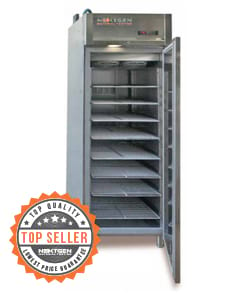
Curemate 750 – Climatic Curing Cabinet
NextGen Curemate 750 is a 750 L climatic curing cabinet for cement and concrete specimens requiring stable temperature and humidity conditions. Built with AISI 304 stainless steel inner and outer structure, it supports up to six extractable shelves and 24 molds. Digital 0.1-resolution control, +15°C to +30°C temperature range, 80–100% humidity, automatic vaporization humidification, and insulated construction support reliable curing workflows.
Read more