TensileTurn CNC Classic Upgrade – Round Tensile Specimen Preparation Machine

Metal Testing Equipment
Standards






Description
The TensileTurn CNC Classic Upgrade is a compact CNC lathe built for one job: accurate, repeatable round tensile specimens. It takes specimen diameters up to 1.5″ (45 mm) and cuts material up to 55 HRC, and with the triple clamping fixture several samples go through in a single setup.
The machine is run from the TensileSoft™ 2.0 interface on a 15″ touchscreen. Specimen dimensions come from a library of common testing standards, ASTM, ISO, DIN and others, or are typed in as custom geometry. A technician with no machining background prepares specimens consistently from that screen, while a machinist still has the full FANUC CNC controls for general turning.
The sequence is short: load the stock, secure it, select or enter the specimen parameters, start. It takes minutes and fits into the testing routine instead of queueing at an outside machine shop, and the stable frame and controlled cutting keep gauge dimensions repeatable from batch to batch.
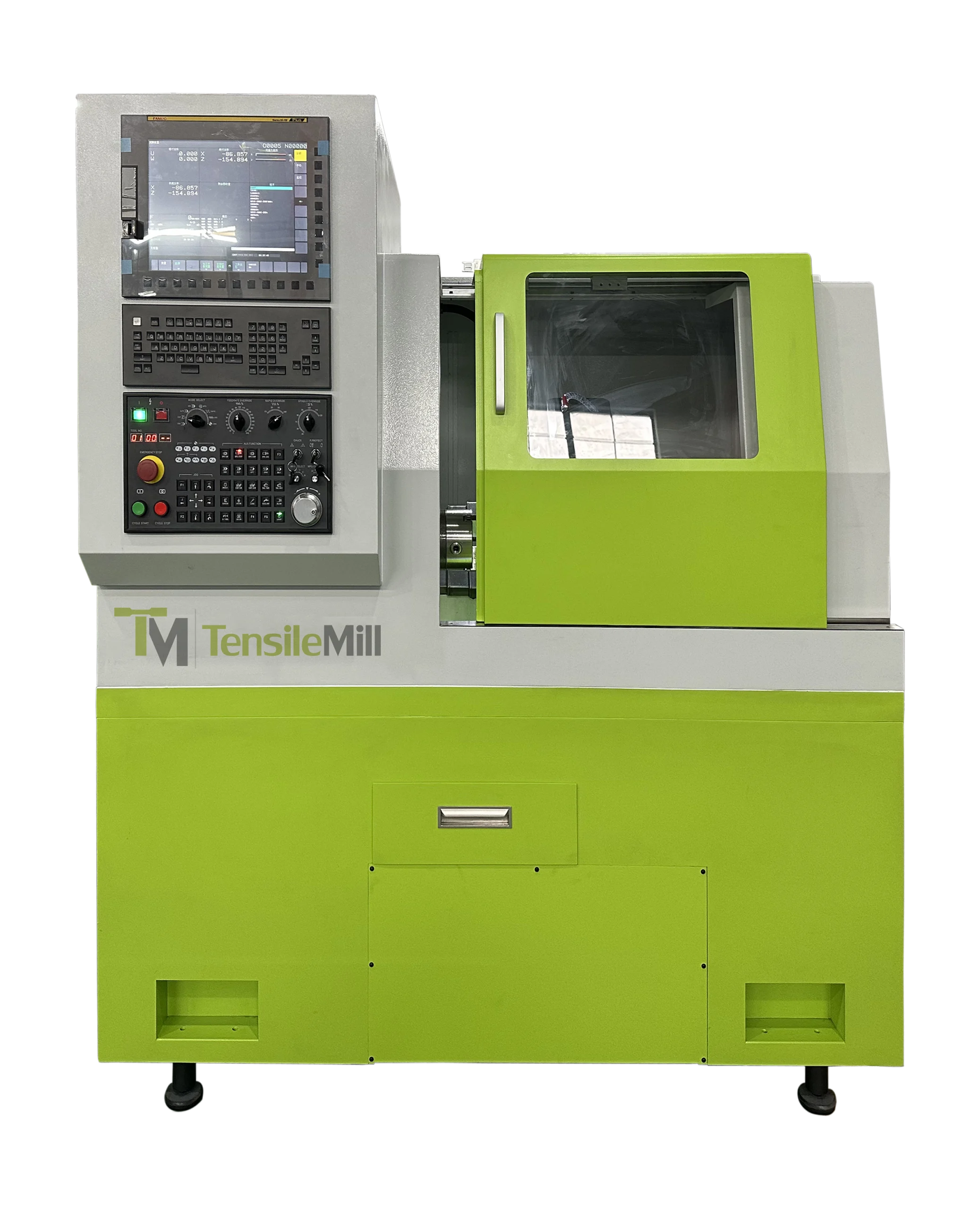
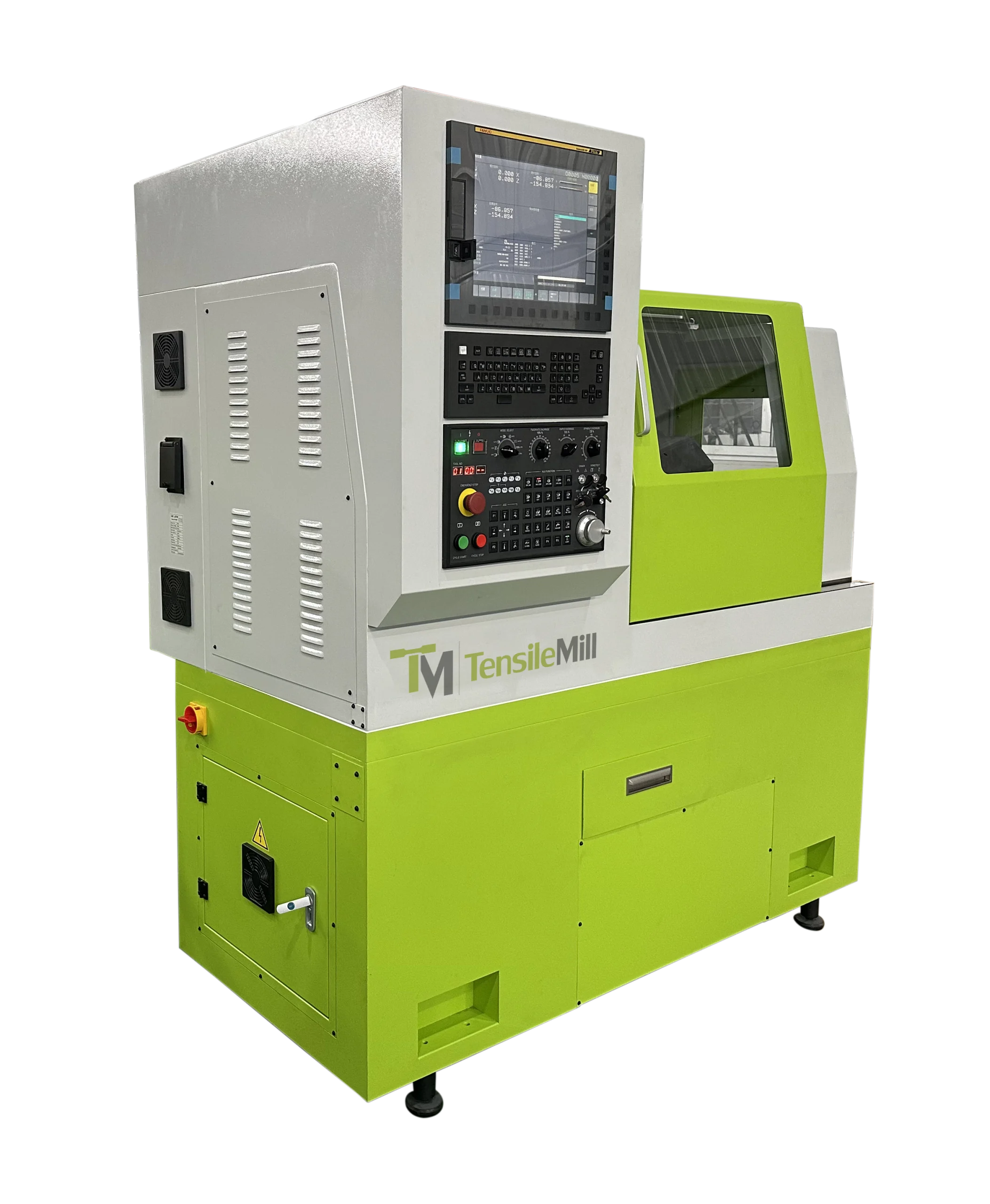
TensileTurn CNC Classic Upgrade.
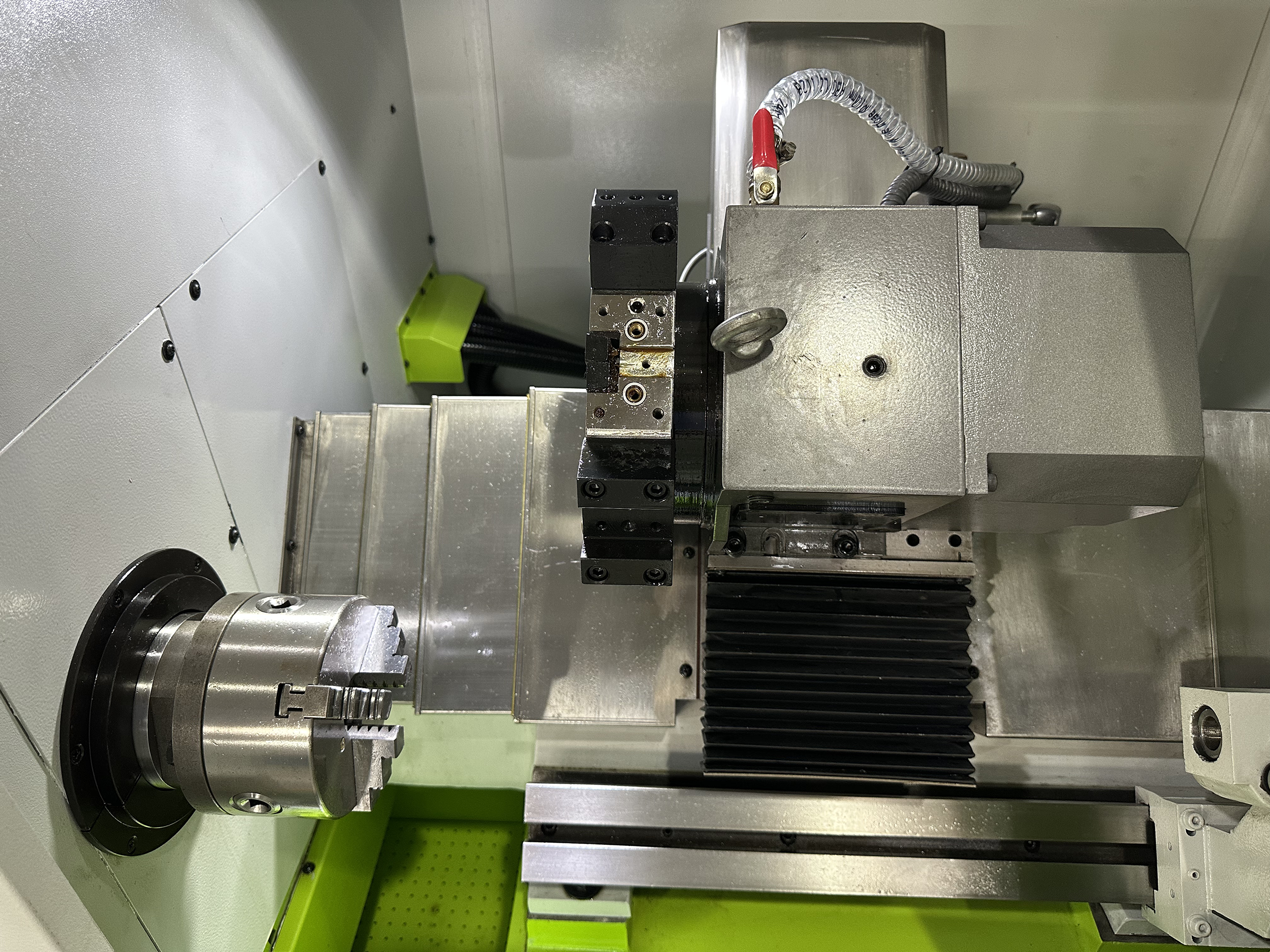
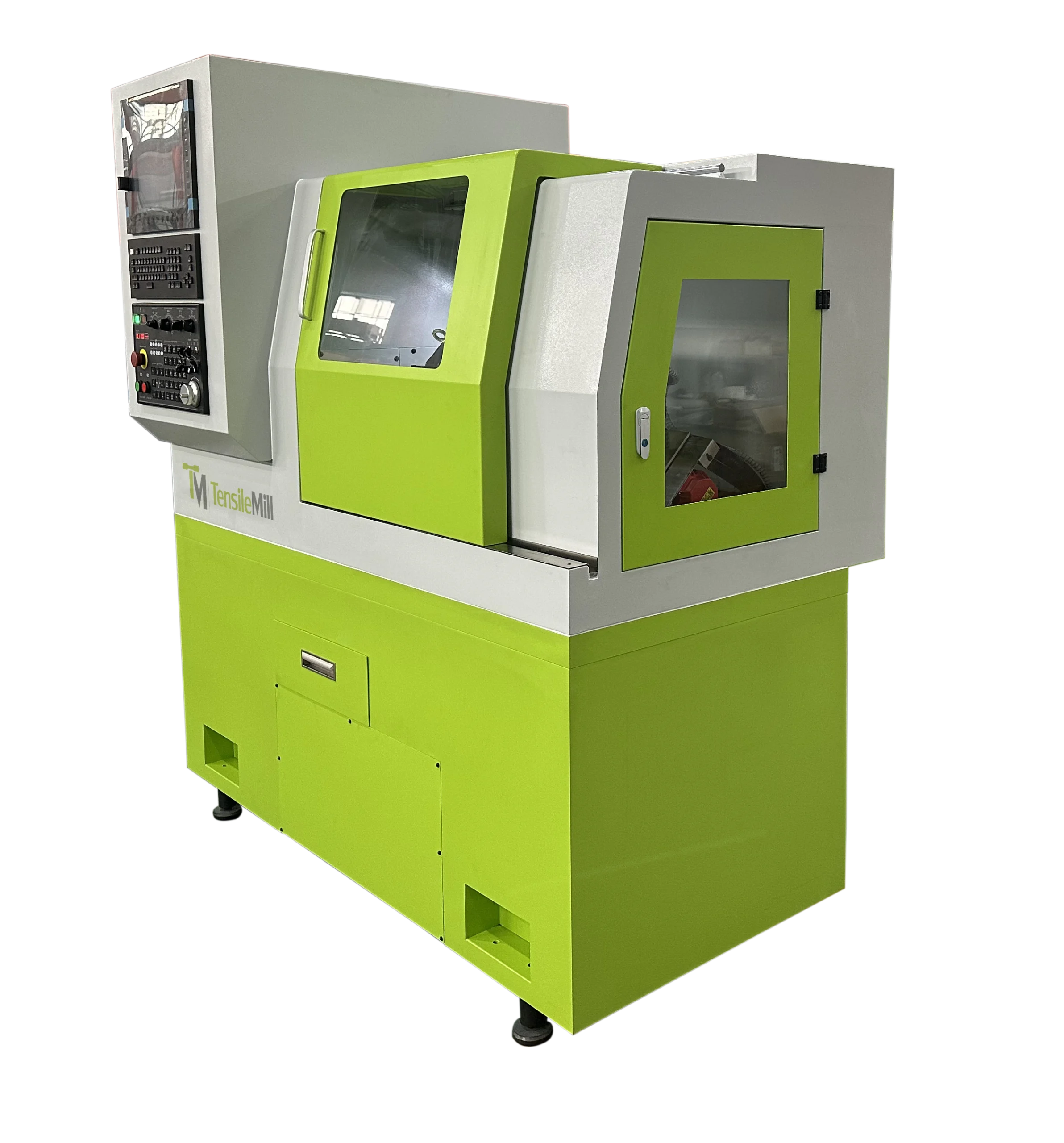
Chuck, turret and tailstock inside the enclosure.
Specimens the Classic Upgrade Prepares
Round specimen geometry is defined by the method, and the shoulder transitions are where a general-purpose lathe usually drifts. The Classic Upgrade covers:
- Standard round tensile specimens
- Sub-size specimens
- Threaded-end tensile bars
- Button-head and fatigue specimens
- Samples made from round, square or irregular stock
It is used in quality control laboratories preparing routine specimens, in research and development where the geometry changes often, and on production sites where mechanical testing is part of the daily schedule.
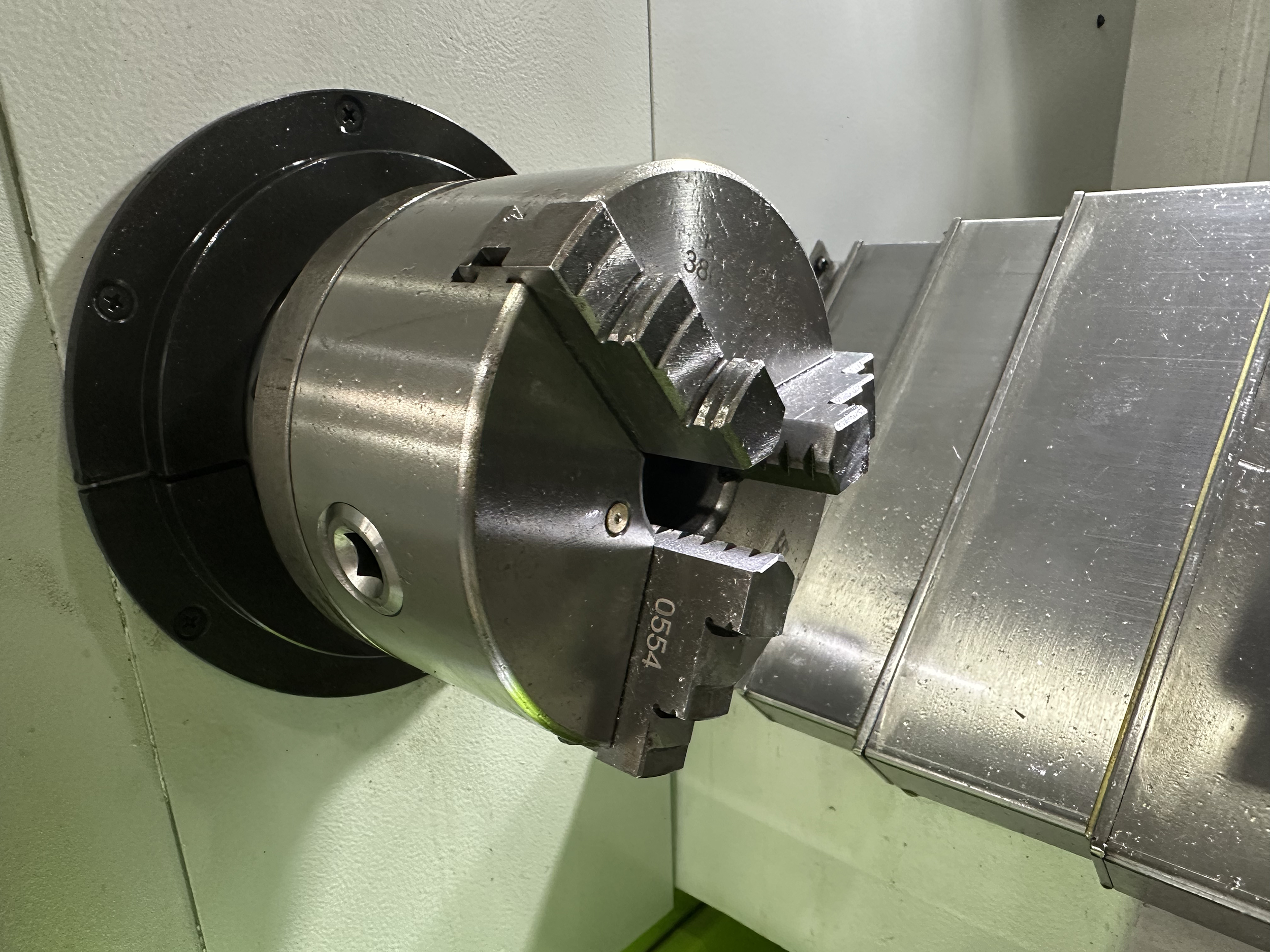
The three-jaw chuck centres the stock.
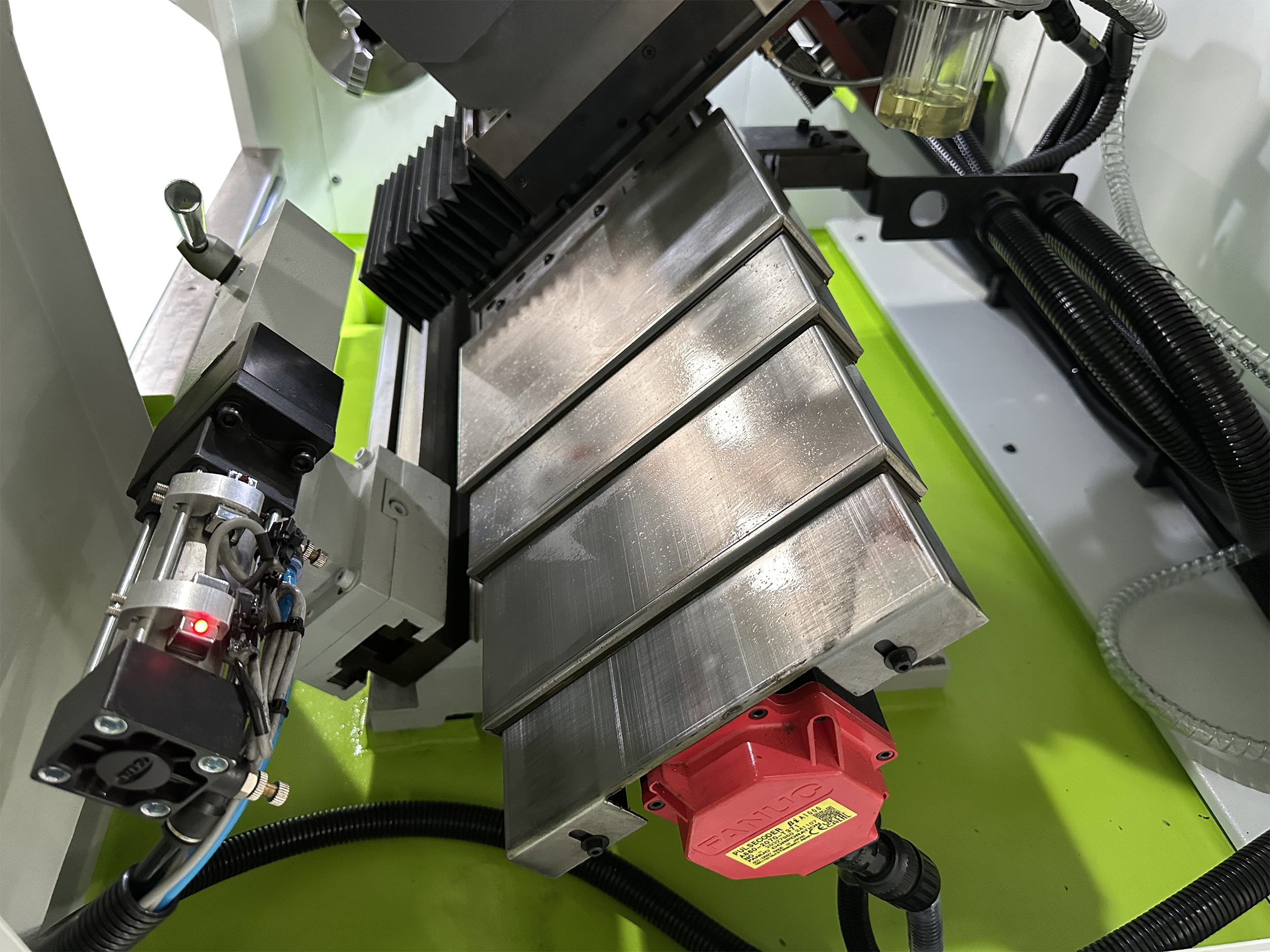
Slideways and turret.
Working Characteristics
Dimensional consistency across batches is what lets tensile data be compared over time, even when the material, the heat treatment or the supplier changes. In daily use the machine also puts specimen preparation on the same clock as testing: specimens are made when they are needed, not when an outside shop has capacity.
Stable geometry
The same geometry across multiple batches, so tensile results stay comparable.
Controlled cutting
Cutting conditions are controlled, which keeps variation out of the gauge section and the shoulder transitions.
No machining queue
No waiting for machine shop access or for an outsourced batch to come back.
Material changes
Switching between materials does not mean reconfiguring the setup or moving to another machine.
Secure workholding
Clamping keeps the stock centered and secure through the cycle.
Coolant circulation
Circulating coolant keeps heat build-up from distorting the dimensions being cut.
Stable tooling
Tool positioning holds across repeated cycles.
Control System
The machine ships with a 15″ touchscreen controller running a full FANUC CNC environment, so the simplified TensileSoft™ specimen interface and the general turning controls sit side by side. Storage and connectivity are on board, so files and parameters are handled without extra hardware:
- 64 GB storage and 4 GB RAM for program handling and data retention
- Wi-Fi, Ethernet and USB ports for transferring files and saving settings
- Macro B programming, tool offset management and work coordinate systems
- Helical interpolation, drilling cycles, scaling, mirroring and motion planning
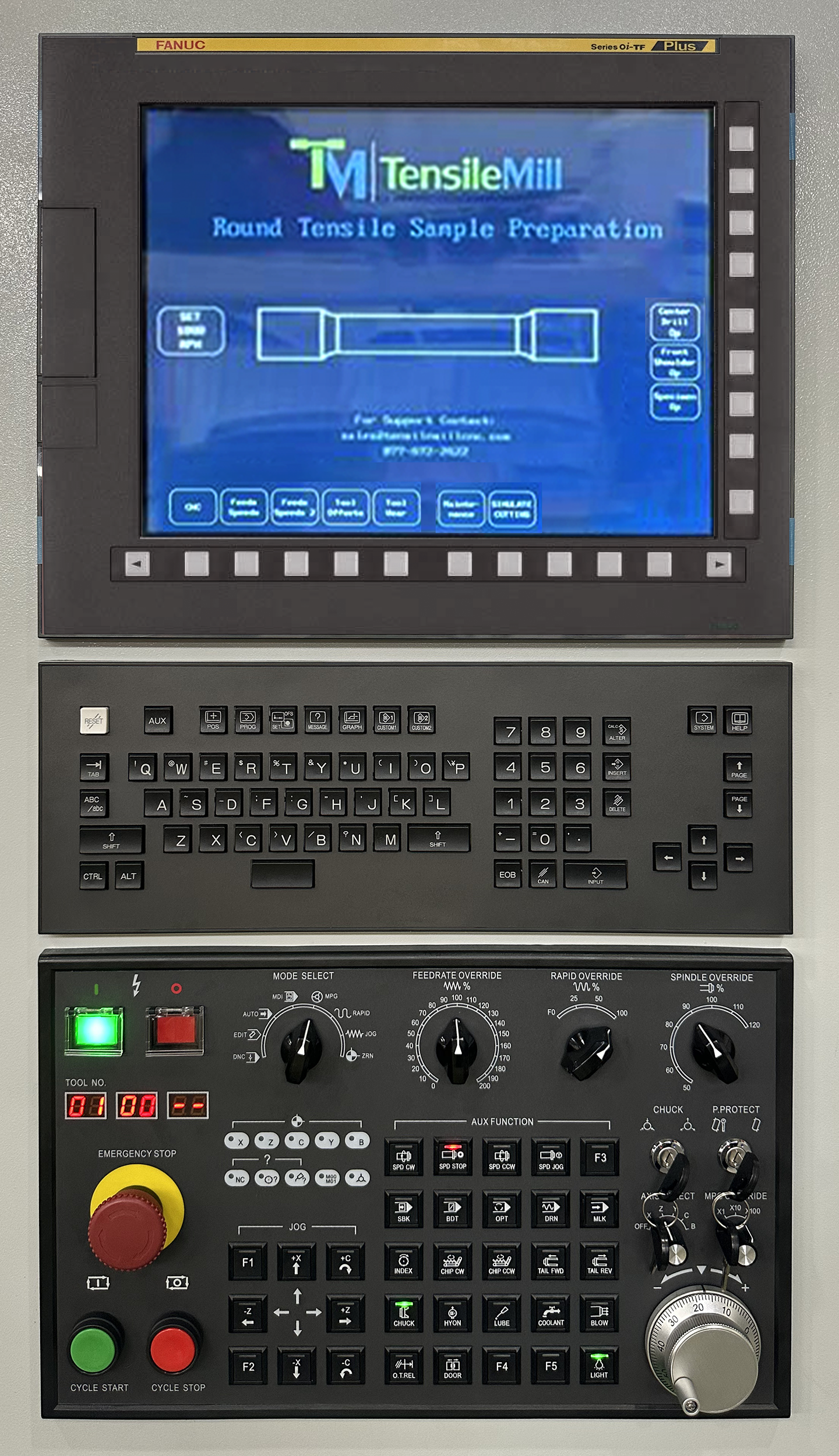
FANUC panel with the TensileSoft screen above it.
Service Plan
The service plan keeps the machine on a schedule instead of on a repair list. Preventive maintenance is planned around your testing calendar, and training and re-training cover new technicians as well as experienced staff refining a workflow. It is normally set up around onboarding new operators, keeping specimen preparation consistent across shifts, absorbing a change in material type or testing volume, and extending equipment life through regular checks. Contact your representative to review the plan options.
TensileTurn CNC Classic Upgrade Technical Specifications
Check the swing over bed and the center width against your starting stock: the machine runs on single-phase 220 V and needs a pneumatic connection. Imperial values come first, with the metric equivalent in brackets.
| Specification | TensileTurn CNC Classic Upgrade |
|---|---|
| Capacity | |
| Swing Over Bed | Ø11.8″ (Ø300 mm) |
| Swing Over Cross Slide | Ø7.8″ (Ø200 mm) |
| Center Width | 23.6″ (600 mm) |
| Center Height | 5.5″ (140 mm) |
| Lathe Chuck Diameter | Ø4.92″ (Ø125 mm) |
| Spindle | |
| Spindle RPM | 300 |
| Spindle Speed Range | 30-4000 rpm |
| Spindle Nose | 1:04 |
| Spindle Taper | MT4 |
| Spindle Bore | Ø1.02″ (Ø26 mm) |
| Motion and tooling | |
| Tool Changer Type | Electric |
| Tool Positions | 4 |
| Max Tool Section Size | 0.47″ × 0.47″ (12 × 12 mm) |
| X-Axis Travel | 7.1″ (180 mm) |
| Z-Axis Travel | 18.3″ (465 mm) |
| X-Axis Rapid Feed | 236 in/min (6000 mm/min) |
| Z-Axis Rapid Feed | 315 in/min (8000 mm/min) |
| Position Accuracy (X / Z) | ±0.002″ / ±0.001″ (±0.05 mm / ±0.03 mm)* |
| Repeatability (X / Z) | ±0.0001″ / ±0.0001″ (±0.02 mm / ±0.02 mm)* |
| Tailstock | |
| Tailstock Taper | MT2 |
| Tailstock Sleeve Diameter | Ø1.18″ (Ø30 mm) |
| Tailstock Sleeve Travel | 3.15″ (80 mm) |
| Machine and services | |
| Machine Dimensions (L × W × H) | 62.5″ × 27.75″ × 59.65″ (1590 × 705 × 1515 mm) |
| Shipping Dimensions (L × W × H) | 72″ × 37.2″ × 72.65″ (1829 × 945 × 1845 mm) |
| Net Weight / Gross Weight | 1873 lb / 850 kg |
| Coolant Tank Capacity | 6.6 gal (25 L) |
| Coolant Pump Power | 40 W |
| Main Motor Power | 2.2 kW |
| Total Electrical Connection | 3.5 kW |
| Input Voltage | 220 V (single phase) |
| Pneumatic Connection Required | Yes |
* Accuracy and Repeatability Disclaimer: Published accuracy and repeatability values are based on proper machine setup, recommended tooling, operational procedures, maintenance practices, material conditions, and validated proof-of-concept parameters. Actual performance may vary depending on material type, hardness, specimen geometry, tooling selection, fixturing, machine workload, operator practices, production conditions, and adherence to recommended operational protocols. Operation outside of recommended procedures or intended application parameters may affect achievable accuracy, repeatability, equipment longevity, and overall system performance.
Send us the specimen standard, the largest diameter you turn and the stock you start from, and we will confirm the fixture and the tooling to order with your Classic Upgrade. Contact our team for pricing and service plan options.
For Laboratories
Need Additional Quality Control Equipment to Build Your Laboratory?
Round specimen preparation is only one part of a complete quality control laboratory. NextGen can help you equip your entire lab with impact testers, notching and broaching systems, cooling chambers, tensile testers, hardness testers, specimen preparation equipment, and other supporting solutions, all coordinated as one complete project.
- One partner to equip your complete laboratory
- Installation, training, calibration
- Support for the life of the equipment
FAQs
This system can be configured for higher-throughput round tensile specimen preparation by using a triple clamping fixture that lets you prepare multiple samples in a single setup.
In practice, multi-sample clamping reduces handling and changeover time because operators can load several blanks, then run the same program sequence across the set while maintaining consistent locating and alignment.
The best throughput gain depends on your specific parts and workflow, including:
- Starting stock form and how much material must be removed
- Specimen geometry, such as threaded ends, button-head features, or sub-size gage sections
- Required surface finish and dimensional control for your method
- How you batch jobs in TensileSoft versus one-off custom geometries
If you want to confirm the right clamping approach for your bar sizes and specimen styles, review the machine details under learn more and request a quote for the exact fixture and tooling package.
This system is designed around a contained machining area for round tensile specimen preparation, with a guarded work zone intended to help protect the operator from rotating components, chips, and coolant during cutting.
The Classic Upgrade is shown with an enclosed work area and internal guarding around the cutting and workholding region. In day-to-day lab use, that enclosure is the primary protection layer that supports safer loading, machining, and cleanout practices when preparing round bars for tensile testing.
Door interlocks and E-stop implementation are typically defined by the control and safety configuration used for your site and how the machine will be operated. The most common drivers are: operator access needs during setup, whether the machine is placed in a shared lab versus a production cell, and any internal EHS requirements for interlocked access and emergency stop locations.
If you want to confirm the exact safety package for your facility, please learn more and request a quote with a note on your preferred guarding and interlock expectations.
This system’s primary role in a testing lab is to machine raw stock into consistent, test-ready round tensile specimens, so tensile results reflect the material and heat treatment rather than variability from manual or outsourced specimen prep.
In a typical workflow, the lab loads round, square, or irregular stock, clamps it, selects a standard specimen geometry from the controller’s library or enters a custom profile, then runs the CNC machining cycle to produce repeatable gauge dimensions and transitions.
By bringing round specimen preparation in-house, the Classic Upgrade helps labs keep specimen turnaround aligned with UTM scheduling and reduces delays that can come from waiting on external machine shops. It also supports a wider range of specimen styles, including standard round, sub-size, threaded-end, and button-head or fatigue-type geometries.
If you want to confirm the right configuration for your specimen types and standards, you can learn more or request a quote.
This system is designed to machine tensile specimens from round, square, or irregular stock, and it is typically set up with a 3-jaw chuck plus a multi-part clamping approach for repeatable centering and secure holding during machining.
For irregular stock, collets, soft jaws, or pipe-holding style solutions are usually evaluated as part of the workholding configuration, since the best choice depends on your starting shape, wall thickness or hollowness, surface condition, and how much stock you need to remove to clean up and true the bar.
In practice, labs often use custom-profiled soft jaws for non-round shapes, collets for fast, concentric gripping on consistent blanks, and dedicated supports or fixtures when thin-wall tube or short cutoff pieces need extra stability.
If you want to confirm the right workholding configuration for your irregular stock and specimen geometry, please learn more and request a quote.
The built-in libraries in the TensileSoft 2.0 touchscreen interface include commonly used round tensile specimen geometries tied to major tensile standards, so you can select a standard-based starting point instead of programming dimensions from scratch.
On this model, the standard sets called out for the built-in library include:
- ASTM E8
- ASTM A370
- ASTM B557
- ISO 6892-1
- DIN 50125
- JIS Z 2241
For method variants such as sub-size, threaded-end, or button-head specimens, many labs still confirm the exact revision, required tolerances, and any customer or NADCAP flowdowns, then either pick the closest template or enter the geometry manually to match the test plan.
If you want to confirm the best library setup for your specific specimen type and standard revision, learn more or request a quote.
Programs and key setup data can be saved and transferred using the controller’s built-in USB ports and network connectivity. This system includes a 15 inch touchscreen controller running a full FANUC CNC environment, with Wi-Fi and Ethernet available for moving files and saving settings.
For round tensile specimen preparation, most labs back up the items that directly affect repeatability between shifts and between machines, such as:
- CNC part programs and any macro-driven routines
- Tool offset data and work coordinate systems
- Method-specific settings used for your specimen geometries
Best practice is to validate the transfer with a short prove-out on the destination machine, since some parameters can be machine-specific and your IT method (USB vs Ethernet or Wi-Fi) can vary by facility policy.
If you want to confirm the best backup and transfer approach for your workflow and controller setup, review the system details under learn more and we can walk you through options when you request a quote.
What floor space, access clearance, and anchoring do I need for the TensileTurn CNC Classic Upgrade?
Plan your floor space around the machine’s installed dimensions of 62.5 x 27.75 x 59.65 in (1590 x 705 x 1515 mm), then add practical working clearance on the operator and service sides for safe loading, door access, and routine maintenance. Anchoring is typically site-dependent and is usually driven by your facility’s safety practices, floor condition, and vibration control needs.
In most labs and production QA areas, the clearance requirement is set by how you will handle stock and service the unit, including:
- Bar stock infeed and outfeed, plus room to work at the chuck and tailstock
- Front access for tool changes, setup, and cleaning
- Side or rear access for electrical and pneumatic connections, and for coolant-related service tasks
For anchoring, many customers place the system on a stable, level concrete floor and use leveling to keep machining repeatable. Whether you bolt it down or use an isolation approach depends on your floor, local code or seismic requirements, and how strict you want vibration control to be for your specimen prep workflow.
If you want to confirm the right layout and anchoring approach for your shop floor and specimen handling method, review the system details under learn more and send your space constraints through request a quote.
A compressed air, pneumatic connection is required for this system as part of the standard installation utilities.
The recommended operating pressure should be set to match the machine’s pneumatic components and any auxiliary air functions used in your workflow, such as workholding-related air circuits or housekeeping air. In practice, most labs plan for clean, dry, regulated shop air with a dedicated shutoff and filtration at the drop, then fine-tune the regulator during installation to maintain stable, repeatable operation.
If you want to confirm the correct air pressure range and inlet details for your exact configuration and facility utilities, use the product page to learn more and then request a quote.
Full FANUC CNC control is available for advanced users beyond the simplified TensileSoft specimen-prep workflow. The 15-inch touchscreen controller runs a full FANUC CNC environment, so you can work in the standard guided interface for tensile specimen geometry, then switch into full CNC functions when you need to handle general turning tasks.
In day-to-day lab use, most teams stay in TensileSoft for consistent round tensile specimen preparation from standards libraries or custom inputs. When you have experienced machinists on staff, full CNC access supports process tuning, special transitions, and non-standard research geometries while keeping everything on the same machine and control platform.
For advanced programming and setup, the controller supports items such as:
- Macro B programming, tool offsets, and work coordinate systems
- Common motion functions like drilling cycles, scaling, and mirroring
- Wi-Fi, Ethernet, and USB for file transfer and saving settings
If you want to confirm the best control approach for your specimen types and how your team plans to use full CNC mode, review the details on learn more and send your requirements to request a quote.
Spindle speed is set electronically through the onboard 15 in touchscreen controller. You can run the simplified TensileSoft specimen-prep interface for routine tensile bar machining, or switch into the full FANUC CNC environment when you want direct control of turning parameters.
The available spindle speed range on this system is 30 to 4000 rpm, which gives you flexibility to match common metals and engineered materials by adjusting the program to suit your cut.
For different materials, the “right” rpm within that range typically depends on the alloy or hardness, the starting bar diameter, the cutting tool grade and geometry, and the surface finish requirements for the reduced section. Coolant use and chip control can also influence the best setpoint for repeatable results.
If you want to confirm recommended speed and program settings for your exact material and specimen geometry, learn more or request a quote.
This round-specimen CNC preparation system is suitable for machining threaded-end tensile bars, button-head specimens, and sub-size round tensile specimens as part of an in-lab specimen preparation workflow.
For day-to-day QC and R&D use, operators can pull common specimen geometries from the onboard standards library or enter custom dimensions directly at the touchscreen, which helps keep specimen geometry consistent from one batch to the next.
Final details still depend on your exact specimen and test setup, especially the required thread form, button-head profile, shoulder transitions, and how the specimen will be gripped in the UTM. Starting stock condition and shape also matter, since labs may be machining from round, square, or irregular material.
If you want to confirm the best configuration for your threaded ends, button-head requirements, and sub-size geometry, use learn more or request a quote.
This system is intended to machine round tensile specimens in a wide range of metals, and it is rated to work reliably with materials up to 55 HRC.
When you are machining near that upper hardness level, results are most dependent on the cutting tool grade and geometry, the programmed speeds and feeds, and how much stock you are removing to reach the final reduced section. These factors directly affect surface finish, tool life, and repeatability from specimen to specimen.
For best consistency in ASTM E8 and ISO 6892-1 style specimen preparation, it also helps to match your process to the starting bar condition, such as heat treated versus annealed, and to control clamping and concentricity so the reduced section is turned cleanly without chatter.
If you want to confirm the right tooling and setup for your specific alloy and hardness, learn more and request a quote with your material grade, hardness, and specimen geometry.
This system is intended for round specimen machining in metallic materials and alloys typically used for standardized tensile testing, provided the stock is within the machine’s supported hardness range up to 55 HRC.
In practical terms, it is a metal-focused specimen preparation lathe for ferrous and non-ferrous materials that can be turned into consistent gauge sections and transitions without tearing, chatter, or excessive work hardening.
Material suitability is driven by your machining method and finish requirements, including:
- Material hardness and heat-treat condition
- Cutting tool type and edge geometry
- Coolant use and heat control during finishing passes
- Starting stock condition such as scale, oxide, or surface defects
If you want to confirm the best setup for your specific alloy and specimen geometry, review the details under learn more and share your material and bar size when you request a quote.
The minimum stock size that can be safely held depends on the workholding setup and how the part is supported during machining. This system uses a 3-jaw chuck and tailstock support, so the practical lower limit is driven less by the machine itself and more by how much secure jaw engagement you can maintain without distorting or slipping the stock.
In real lab use, the smallest “safe to hold” diameter is mainly influenced by:
- how much jaw contact length you have (and whether you can grip on a larger sacrificial section)
- stick-out length from the chuck and whether the tailstock is used for support
- material strength and cutting forces for the geometry you are machining
- surface condition, scale, or coatings that reduce grip
For very small diameters, a common approach is to keep the unsupported length short, support the free end with the tailstock, and machine the reduced gauge section away from the clamping area so the chuck is always gripping a stiffer section of stock.
If you want to confirm the right workholding approach for your smallest diameter and specimen style, please learn more and request a quote with your starting stock diameter, length, and specimen standard.
This system is designed to machine round tensile specimens up to 1.5 in (45 mm) in diameter.
In practice, that diameter limit is most relevant to the finished specimen geometry you plan to run for tensile testing, including standard round bars as well as sub-size, threaded-end, and button-head styles.
To confirm the best setup for your material and specimen style, it helps to review a few basics:
- Starting stock shape and size (round, square, or irregular)
- End configuration (plain, threaded, button-head) and any shoulder requirements
- How many parts you want to fixture per setup (single vs multi-part clamping)
If you want to confirm the right configuration for your maximum diameter and specimen type, use learn more and request a quote with your target standard and specimen drawing.
Extended service coverage is available for this system through a Service Plan that combines scheduled preventive maintenance with training and re-training for your team. It is designed to help reduce unplanned downtime and keep specimen preparation consistent over time.
The plan can be tailored to how you run the TensileTurn CNC in your lab or production support area, including:
- Onboarding new technicians and refreshers for existing operators
- Maintaining consistent round tensile specimen preparation across shifts
- Adjusting support as your material mix or testing volume changes
- Regular maintenance checks aimed at extending equipment life
If you want to confirm the best Service Plan scope for your specimen types, throughput, and staffing, review the system details and request a tailored proposal here: learn more or request a quote.
This system is designed to machine a wide range of round tensile specimen geometries used in day-to-day lab and production testing, from standard bars to specialty end styles used for higher-load gripping and research work.
Typical specimen types it is suited to prepare include:
- Standard round tensile specimens
- Sub-size round specimens
- Threaded-end tensile bars
- Button-head specimens
- Fatigue-style specimens
It can also be used when your starting material is not perfectly round, since it is intended to prepare specimens from round, square, or irregular stock, and operators can choose standard-based geometries from an onboard library or enter custom dimensions for R&D specimens.
If you want to confirm the best setup for your specific specimen geometry and starting stock, use learn more or request a quote.
For multi-batch round tensile specimen preparation, this system is specified for axis positioning accuracy of ±0.002 in on X and ±0.001 in on Z, with axis repeatability of ±0.0001 in on both X and Z. These figures describe CNC axis motion performance, which is the foundation for consistent specimen geometry from batch to batch.
In production-style batching, the part-to-part results you see on finished diameters, radii, shoulders, and gage sections also depend on how the specimen is held and how the process is managed over time, especially as tools wear and material conditions change.
To keep consistency tight across multiple batches, most labs standardize a few controls:
- Use a consistent chucking and datum strategy, and avoid changing stick-out between lots
- Maintain tool condition and offsets, and re-verify after tool changes
- Control coolant and chip evacuation to reduce built-up edge and thermal drift
- Confirm with a first-article check and periodic in-process checks using the same gaging method
If you want to confirm expected batch-to-batch results for your specific specimen geometry and workflow, review the configuration details under learn more and use request a quote so we can match the setup to your material, tolerance targets, and batch size.
This system is rated with a 23.6 in (600 mm) center width, which defines the maximum specimen length that can be supported between centers for round tensile specimen preparation.
In day-to-day use, the practical usable length depends on how much stock you need to keep engaged in the chuck or clamping fixture for rigidity, and how much tailstock support and tool clearance your specific specimen geometry requires.
If you are preparing threaded-end or button-head tensile bars, plan extra allowance beyond the finished specimen length for facing, center work, and secure workholding so the gauge section is machined without chatter or slippage.
If you want to confirm the right between-centers setup for your starting stock and specimen standard, please learn more or request a quote.
Ongoing service for this system is centered on scheduled preventive maintenance and operator training to keep round tensile specimen preparation stable and to help minimize unplanned downtime. Calibration or alignment verification can be included when your quality program requires it, but it is typically scoped to your site’s acceptance criteria and documentation needs.
For a CNC specimen-prep lathe, the exact verification steps depend on what you are trying to control in production and how tightly you need to correlate machined geometry to tensile results.
Common items customers ask to verify include:
- Spindle, chuck, and tailstock alignment checks that impact concentricity
- Axis positioning and repeatability checks related to gauge diameter control
- Tool offset and setup checks that affect shoulder transitions and threaded features
- Documentation format needed for internal audits or customer requirements
If you need documented calibration or alignment verification as part of ongoing service, contact us to review your requirements, or request a quote for a tailored plan. You can also learn more about the system and service plan options.
This system is supported with stocked consumables and spare parts intended to keep your round tensile specimen preparation workflow running with minimal interruption. For quick shipment in North America, timing depends on the specific item and whether it is a standard wear component or a model and option specific assembly.
In practice, the fastest-moving items are usually the ones tied to routine uptime, such as common consumables and standard replacement parts used across day-to-day specimen machining. Tooling and fixtures can vary more because they are often selected around your specimen geometry and clamping approach.
To speed up ordering and avoid mismatches, it helps to confirm a few basics up front:
- Your machine configuration and any installed options
- The exact part number or tooling description
- Your specimen size range and material types
- Whether you want a recommended on-site spare kit for production continuity
If you want to confirm what is on the shelf for your configuration and get the quickest ship path, use learn more and then request a quote with your parts list or specimen details.
Ongoing service support and training are available for this system, including installation support and operator training delivered by qualified technicians and quality engineers. Whether help is best handled remotely or on-site depends on what you need and how the machine is being used in your lab or production workflow.
Refresher training is typically focused on practical, day-to-day round tensile specimen preparation, for example standard selection from the built-in dimensions library versus entering custom geometry, consistent setup practices, and tips to keep results repeatable across operators and shifts.
For process optimization, the most common focus areas are reducing setup time, improving batch-to-batch consistency, and aligning specimen prep with your UTM schedule. The right plan usually depends on your specimen family, stock condition, and how you fixture and sequence jobs.
If you want to align the right support approach to your specimens and workflow, review the system details under learn more and reach out through contact us.
The Classic Upgrade and the Industrial Upgrade both support guided round tensile specimen preparation using a touchscreen-driven workflow, but they target different priorities. The Classic Upgrade is oriented toward larger specimen capacity and longer work envelope, while the Industrial Upgrade emphasizes an industrial-style mechanical package with more tool stations and automated center drilling for standardized setups.
Key comparison points that typically drive the decision:
- Specimen capacity: Classic Upgrade supports specimen diameters up to 1.5 in (45 mm) and materials up to 55 HRC.
- Work envelope: Classic Upgrade provides a larger swing and longer center width than the Industrial Upgrade.
- Tooling: Classic Upgrade is configured with a 4-position electric tool changer, Industrial Upgrade lists an 8-position electric turret plus dedicated boring tool stations.
- Build and guarding: Industrial Upgrade lists a granite base with ballscrew motion and a stainless-steel enclosure, and includes an automated center-drilling function.
If you are primarily machining larger round bars or want more room for longer starting stock and setups, the Classic Upgrade is usually the better fit. If your priority is faster changeovers with more tools kept on the machine, plus center-drilling automation in a more production-oriented enclosure, the Industrial Upgrade tends to align better.
If you want to confirm the right configuration for your specimens, geometry, and throughput goals, you can learn more, learn more, or request a quote.
For round tensile specimen preparation, preventive maintenance is mainly about keeping chips and coolant under control, protecting the spindle and slides, and catching toolholding or alignment issues before they affect specimen geometry. Exact intervals depend on your workload, materials, coolant use, and shop cleanliness, but most labs follow a simple time-based routine and adjust based on results.
A practical starting schedule is:
- Each shift or daily: remove chips, wipe down exposed surfaces, verify coolant level and flow, drain water from the air supply line, quick check of chuck and tailstock clamping.
- Weekly: clean around guards and sensors, inspect tools and holders for wear or damage, check hoses and fittings for leaks.
- Monthly or quarterly: clean the coolant tank and screens, check fasteners and covers, review backlash or unusual noise, confirm repeat setups are still holding your typical tolerances.
- Annually: a deeper mechanical and electrical inspection, plus a full service visit if you run high volume.
If you use standard libraries for ASTM, ISO, or DIN specimens, also include a periodic “dimensional sanity check” using your preferred measurement method so deviations are caught early.
If you want to confirm the right PM cadence and service plan options for your specimen mix and throughput, use learn more and request a quote.
This system manages coolant as a recirculating loop to control cutting heat and help maintain consistent round tensile specimen geometry. Coolant is held in an integrated 25 L tank and circulated by a dedicated coolant pump, so the same fluid can be reused through normal day-to-day machining.
For routine specimen preparation, most labs run a water-miscible machining coolant (synthetic or semi-synthetic) mixed per the coolant supplier’s recommendations. The best choice depends on your material mix (carbon steel vs stainless vs aluminum), corrosion protection expectations, and any downstream cleaning requirements before tensile testing.
Filtration is typically kept simple and focused on keeping chips and fines out of the pump and nozzle path. Common approaches include:
- A chip screen or basket at the tank return
- Magnetic collection for ferrous swarf
- An optional external bag or cartridge filter if you generate a lot of fine material
If you want to confirm the right coolant and filtration approach for your alloys, finish targets, and throughput, review the system details under learn more or request a quote with your material list and preferred coolant chemistry.
Chips and coolant are kept under control by machining inside an enclosed work area with internal guarding, so cutting splash and chip scatter stay in the cutting zone instead of ending up on nearby benches, floors, or instruments. Coolant is circulated during machining to manage heat, and it is collected back into the machine’s coolant tank for reuse.
In day-to-day use, operators typically keep the enclosure closed while turning, then remove chips during routine cleanouts of the work area. Because coolant is recirculated and stored on-board, you are not relying on open buckets or external drains that can create mess in a lab setting.
Cleanliness depends on your material, cut parameters, and how often you run batches. Good practices include:
- Keeping coolant at the proper level and using the right concentration for your shop standard
- Scheduling quick chip cleanouts between batches to prevent buildup
- Wiping down the enclosure and collection areas as part of your normal specimen prep routine
If you want to confirm the best setup for your chip load, coolant practice, and specimen workflow, learn more or request a quote.
Beyond the standard 3-jaw chuck, this system can be configured to support alternate workholding approaches that better match your specimen blank, especially when you are trying to hold multiple parts or stabilize longer stock for consistent round tensile specimen preparation.
For higher throughput, a triple clamping fixture can be used to prepare multiple samples in a single setup, which helps reduce changeovers when you are running repeated geometries.
For longer or more flexible blanks, tailstock-assisted support is also a common approach. The machine includes an MT2 tailstock taper, and the spindle has an MT4 taper and a through-bore, which can influence how you choose to support and locate your starting stock.
If you want to confirm the best workholding configuration for your specimen style and starting stock, use learn more and request a quote.
On-site installation and operator training can be added to your TensileTurn CNC Classic Upgrade order, and many labs choose to bundle it so the machine is set up and operators are productive right away.
A typical on-site installation visit focuses on getting the system placed, connected, and running correctly, including making physical and electrical hookups and confirming the supplied peripherals, fixtures, and sensors are mounted and functioning as intended.
Basic operator training is commonly delivered for a small group of users and covers safe operation, a walk-through of the major system elements, and an introduction to the included control software and normal power-up and shutdown workflow. If you need on-site calibration, that is usually scoped separately from a standard installation visit.
If you want to confirm what is included for your site and timeline, review learn more and request a quote with your location and preferred training scope.
Custom specimen geometries can be entered for round tensile specimen preparation, and the control platform is set up to retain and reuse your preferred setups for repeat work.
The machine runs a TensileSoft™ 2.0 interface on a 15-inch touchscreen, where you can choose common standard specimen dimensions from the built-in library or manually input your own custom geometry when you are running non-standard gauge lengths, shoulders, or threaded and button-head variants.
For repeatability across batches, the full FANUC CNC environment supports program handling and data retention, with onboard storage plus Wi-Fi, Ethernet, and USB connectivity for moving files and backing up settings. Many labs store recurring geometries as named programs or parameter sets, then control revisions by material grade, heat treat condition, and test method.
If you want to confirm the best way to set up and manage saved geometries for your specific specimen family, learn more or request a quote with your target geometry and standard.
Operator account and permission control is typically handled based on how you want to separate day-to-day specimen preparation from deeper CNC setup functions. This system uses the TensileSoft 2.0 specimen-prep interface on a 15 inch touchscreen controller, with access to a full FANUC CNC environment when needed.
In multi-shift QC and lab environments, the most common approach is to keep routine operators in a guided, run-focused workflow, while limiting higher-impact changes to trained personnel. The exact setup is usually driven by your internal controls and traceability requirements.
When defining operator levels, most teams focus on protecting a few key items:
- Editing standard or custom specimen geometries and saved programs
- Tool offsets, coordinate settings, and machine setup parameters
- Access to file transfer and backup functions used for program management
If you want to confirm the best way to structure operator access for your shop or lab, use the product page to align on the control approach and then request a quote with your workflow and shift details, or learn more.
This system is backed by a minimum 12-month warranty that covers the machine top to bottom, starting on the day it is delivered. Coverage applies from the time the instrument leaves NextGen’s facility, so you are protected through shipment and into commissioning.
In addition to the warranty term, NextGen provides ongoing after-sales support and a lifetime service commitment to supply spare parts and accessories for the instrument. How an issue is handled can vary by the situation, for example technical guidance, parts support, or coordinating service based on the fault and your site requirements.
Consumables are excluded from the lifetime spare parts and accessories service. Warranty claims may also be declined when a failure is tied to buyer modification, improper maintenance, misuse, or abuse.
If you want to confirm warranty handling for your site, configuration, and service preferences, please learn more or request a quote.
Bringing round tensile specimen preparation in-house typically cuts turnaround time by removing outside shop queues, shipping, and scheduling handoffs. With this system, you can machine specimens on demand to match your UTM schedule, so testing is less likely to sit idle while you wait for prepared bars to return.
In day-to-day lab and production QC use, faster flow comes from a few practical advantages:
- Standard-dimension selection through the TensileSoft 2.0 touchscreen interface, plus the ability to enter custom geometry for R&D work.
- Repeatable, controlled cutting conditions that help keep gauge sections consistent, reducing rework and retests.
- A triple clamping fixture that supports preparing multiple samples in a single setup for higher throughput.
If you want to confirm the best setup for your specimen types, materials, and throughput goals, start with learn more and then request a quote.
Preloaded geometry libraries are provided for common standard tensile specimen dimensions. Using the TensileSoft™ 2.0 touchscreen interface, you can select specimen dimensions from a built-in library aligned to widely used standards, or you can manually enter custom geometry when your method or drawing calls for something different.
For routine QA and production sampling, this lets technicians choose a recognized standard specimen format and run consistent machining without having to hand-program every gauge section and transition.
When you need non-standard variants, such as sub-size, threaded-end, button-head, or research geometries, the workflow supports direct parameter entry. Experienced users can also switch into the full FANUC CNC environment for more general turning tasks when required.
If you want to confirm which standard libraries match your specimen style and how you would set up your specific geometry, use learn more or request a quote.
TensileSoft 2.0 is designed to make specimen setup straightforward on the 15 inch touchscreen. Instead of starting from a blank CNC program, the operator typically begins by selecting a specimen geometry from a built-in library of common testing standards, or by entering a custom geometry. From there, the interface keeps setup focused on the specimen dimensions needed to run a consistent machining cycle, then the operator starts the cut after the stock is loaded and clamped.
In practical day-to-day use, specimen setup usually follows a simple on-screen flow:
- Select a standard-based specimen template or choose a custom geometry entry
- Confirm the key specimen dimensions for the required tensile bar style
- Load the stock, secure it, then start machining from the touchscreen
- When needed, experienced users can switch over to full FANUC CNC controls for broader turning tasks
If you want to confirm the best setup approach for your specimen types and whether you should rely on standard templates or custom entries, review the system details and options on the product page and then request a configured recommendation. learn more or request a quote.
UL or CSA electrical compliance for this round tensile specimen preparation system is typically configuration-dependent, based on the exact electrical build, labeling, and documentation required for your facility and local inspector.
The TensileTurn CNC Classic Upgrade is specified for 220 V single-phase power with a total electrical connection of 3.5 kW, and it also requires shop air. Whether the delivered machine is UL-marked, CSA-marked, or provided as an inspector-friendly electrical package depends on what level of North American compliance your site mandates.
To quote and supply the right compliance package, we will usually confirm a few practical items with you:
- Your plant or lab requirement, UL, CSA, or other local jurisdiction needs
- Preferred disconnect and plug-in versus hardwired installation approach
- Any site-specific safety or documentation requirements for the electrical cabinet and interlocks
If you want to confirm the right electrical compliance approach for your installation, review the system details under learn more and send your facility requirements using request a quote.
This system is designed for a 220 V, single-phase electrical supply, with a total electrical connection of 3.5 kW. Your facility should provide a properly grounded 220 V feed and an appropriately sized branch circuit and overcurrent protection to support that connected load.
For planning purposes, the installed load includes the main motor and auxiliary loads such as the coolant pump. The exact circuit sizing and protection selection should follow your local electrical code and your plant standards, and it can be influenced by items like startup behavior, line conditions, and your preferred disconnect and receptacle approach.
For a smooth installation, most labs plan a dedicated circuit and a clearly accessible means of disconnect near the machine. This model also requires a pneumatic connection, so it helps to coordinate electrical and utilities at the same time.
If you want to confirm the right electrical hookup details for your site and the exact configuration being quoted, use learn more and request a quote.
Related Products
TensileTurn CNC Industrial Upgrade – Round Tensile Specimen Preparation Machine
TensileTurn CNC Industrial Upgrade is a compact CNC lathe for preparing standardized round tensile specimens in laboratory and production environments. Guided TensileSoft software lets operators select ASTM E8, ASTM B557, ISO, or DIN specimen profiles or enter custom dimensions. It machines round, square, or irregular stock into round bars, threaded tensile specimens, fatigue bars, and button-head samples while improving repeatability and turnaround.
Read more
NG-AutoPol – Automatic Longitudinal Polisher for Tensile Specimens
NG-AutoPol is an automatic longitudinal polishing system for metallic tensile and fatigue specimens. It removes machining marks, grinding stress, and residual surface stress after turning or milling, producing a uniform low-stress finish along the specimen axis. Touchscreen control, interchangeable fixtures, adjustable 5–50 N force, 10–100 mm/s speed, multi-grit automation, and ASTM E8, ASTM E466, ASTM E606, EN 6072, and NADCAP-ready workflows support repeatable preparation.
Read more
GenMark 500 – Automatic Gauge Length Marking Machine
The GenMark 500 is a full-automatic gauge length marking machine for metal bar, rebar and wire rod, applying the reference marks used to determine elongation after fracture. A servo-driven lead screw sets 5 mm or 10 mm spacing and a pneumatic tungsten steel needle marks specimens up to 500 mm gauge length, supporting ISO 6892-1 and ASTM E8/E8M workflows. Adjustable marking force, quick needle changes, and fixtures for both round and flat samples keep specimen preparation consistent across operators and shifts.
Read more