ASTM D7625-22 is the current ASTM test method for the laboratory determination of the abrasiveness of rock using the CERCHAR Abrasiveness Index (CAI). It replaced the 2010 edition, which ASTM lists as withdrawn in 2019, and it is used to estimate cutter wear, replacement rates and excavation cost where rock abrasivity drives tool consumption.
If you need help matching the cited edition to your project requirement or aligning stylus hardness, surface preparation and reporting to your QA plan, you can talk with our team.
ASTM D7625-22: Laboratory Determination of Abrasiveness of Rock Using the CERCHAR Abrasiveness Index Method
The standard describes a laboratory procedure in which a hardened conical steel stylus is drawn 10 mm across a rock surface under a fixed load, and the flat worn on the stylus tip is measured to give the CERCHAR Abrasiveness Index. ASTM describes abrasiveness as a behaviour of rock rather than a basic physical or mechanical property, and the method was developed for mechanical excavation, where it governs disc cutter performance, cutter replacement and tunnel cost.
Quick Definition
What it is: A short scratch test with a 90 degree steel cone. The diameter of the worn flat on the tip, in tenths of a millimetre, is the CAI for that scratch, and the reported value is the mean of several scratches, each made with a fresh or re-sharpened point.
What it is used for: Classifying rock abrasiveness for tunnelling, mining and mechanical excavation, and estimating disc cutter, pick and drill bit consumption.
What Changed From the 2010 Edition
The title now names the CERCHAR Abrasiveness Index Method. The scope states that CAI varies inversely with stylus hardness, so results obtained with styli of other hardness have to be normalised to the standard hardness, where the 2010 edition focused on a Rockwell C 55 stylus and only discussed other values.
The scope also explains the fixed 10 mm scratch: most of the stylus wear happens in the first 2 mm, and a variation of about half a millimetre in scratch length does not change the result significantly. Saw-cut surfaces remain the second choice after a freshly broken surface, with conglomerates, coarse-grained granite and schistose rock named as typical cases, and a saw-cut result is normalised by one of two equations instead of one.
Two Apparatus Designs
The method covers both the original CERCHAR apparatus, in which the stylus is drawn across a fixed specimen at about 10 mm per second, and the West apparatus, in which the specimen moves beneath a stationary stylus at about 1 mm per second. ASTM estimates that both give the same CAI.
Common Test Workflow
The laboratory prepares a freshly broken rock surface where possible, or a saw-cut surface where breaking does not give a usable face, clamps the specimen, and makes a series of 10 mm scratches under a 70 N load, each with a new or re-sharpened stylus. The wear flat on each tip is measured under magnification and the CAI is reported as the mean, together with the stylus hardness, the surface condition and any normalisation applied.
Decisions that affect results: stylus hardness and resharpening, surface condition, scratch direction in foliated rock, moisture condition of the specimen, and whether the wear flat is read from the side or from above.
Equipment Commonly Used for This Standard
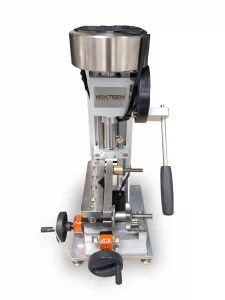
The test runs on a dedicated CERCHAR-type abrasivity tester rather than a universal testing machine. The West Cerchar Abrasivity Index Tester follows the West design: a stationary stylus under a 70 N deadweight, a rigid vice, a two-axis cross table and a scratch distance control of 0.01 mm, with optional stylus pins, a sharpening tool and a digital microscope for reading the wear flat.
How to Read This Designation
Designation: D7625 is the ASTM standard number.
Revision year: the -22 suffix indicates the 2022 edition. Some project specifications still cite ASTM D7625-10; when a contract names that edition explicitly, follow the cited edition unless substitution is allowed.
Talk With Us About ASTM D7625-22 Testing Equipment
If you need a CERCHAR abrasivity testing setup for rock, along with stylus supply, sharpening and an inspection package, please request pricing and include the rock types, expected specimen dimensions and the edition cited in your procedure.