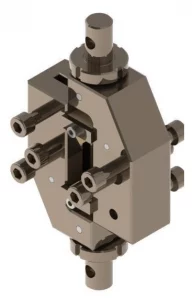
ASTM D5379/D5379M is a standard test method for determining shear properties of fiber-reinforced composite materials using a V-notched beam specimen and dedicated shear fixture.
This method is widely used to generate shear stress–strain response data that supports material qualification, R&D comparisons, and production or incoming QA checks for composite laminates. If you need help matching the right revision, specimen orientation, or strain measurement approach, contact our team.
ASTM D5379/D5379M — Standard Test Method for Shear Properties of Composite Materials by the V-Notched Beam Method
ASTM D5379/D5379M describes a laboratory test method used to measure shear properties of high-modulus fiber-reinforced composites. The test uses a V-notched beam specimen loaded in a fixture intended to create a controlled shear region between notches.
The standard is commonly selected when teams need repeatable shear property data for design allowables development, material screening, or qualification programs where shear modulus and shear strength are key inputs.
Quick definition
Document type: Test method.
What it measures: Shear stress–strain response and derived shear properties (such as shear strength and shear modulus/chord modulus) for composite materials, based on a V-notched beam configuration.
What makes it distinctive: Uses a V-notched beam specimen and a purpose-built fixture to drive a shear-dominant response in a defined section of the coupon.
What this standard covers
ASTM D5379/D5379M applies to composite materials reinforced by high-modulus fibers and includes common composite material forms such as continuous-fiber laminates (including unidirectional and woven forms) as well as certain short-fiber reinforced composites.
Depending on how the specimen is oriented relative to the material axes, the method can be used to evaluate shear behavior in different shear planes for anisotropic composite materials.
Why this standard matters in testing
Shear properties are frequently needed for structural analysis, failure modeling, laminate design, and quality control of composite parts and panels. A V-notched beam approach is often chosen to obtain a usable shear stress–strain curve and a shear modulus value using a relatively compact coupon and a controlled fixture-based loading configuration.
Because composite shear response can be sensitive to layup, specimen preparation, conditioning, and strain measurement, equipment configuration and test setup discipline can strongly influence comparability between labs and programs.
Common materials, product types, or applications covered
ASTM D5379/D5379M is commonly applied to polymer matrix composites where shear performance is a key requirement, including:
- Carbon fiber and glass fiber reinforced laminates
- Unidirectional tape laminates and woven fabric laminates
- Composite panels and coupons used for material qualification and design data generation
- Aerospace, defense, automotive, sporting goods, and industrial composite development programs
Common test or verification workflow
Most labs use ASTM D5379/D5379M within a controlled coupon-testing workflow that emphasizes repeatability and documentation.
Typical workflow: Define laminate and orientation → prepare and machine V-notched coupons → condition specimens as required by the program → install strain measurement (as required) → load the specimen in a V-notched beam shear fixture on a universal test system → record force and strain through the required range → calculate and report shear response and derived shear properties for the specified material plane.
Common decision points: Selecting the material coordinate plane/orientation, choosing strain measurement method, and ensuring fixture alignment and consistent specimen preparation.
Equipment commonly used for this standard
ASTM D5379/D5379M typically points to a mechanical test system with a dedicated V-notched beam shear fixture and appropriate instrumentation for force and strain measurement.
Common equipment: Universal testing machine (electromechanical or servohydraulic), calibrated load cell, V-notched beam shear fixture, specimen alignment aids, and data acquisition/control software.
Common strain measurement options: Strain gages applied to the coupon (frequently used for shear strain) and/or suitable extensometry when allowed by the test program and fixture geometry.
Quoting considerations: Fixture capacity and stiffness, load cell sizing, control mode and data rate needs, and whether your workflow requires strain gaging support, environmental conditioning, or elevated/low-temperature testing.
How to read this designation or revision
ASTM standards are commonly cited using the designation plus a year date. For this method, the designation is typically shown as ASTM D5379/D5379M followed by a year (for example, a “-19” style suffix).
Some catalogs and quality systems also show a reapproval year (for example, a “(2026)” or “R26” style notation) when the content has been reviewed and reapproved without a full technical revision. When you are building a compliance plan or comparing results across suppliers, always align on the exact cited edition and notation used in your purchase order or test plan.
Related standards, methods, or frameworks
Composite shear characterization is often supported by multiple test methods, depending on laminate type, thickness, and the specific shear property needed.
Often considered alongside ASTM D5379/D5379M: ASTM D7078/D7078M (V-notched rail shear) and ASTM D3518/D3518M (in-plane shear by ±45° tension), among other composite test methods used in qualification programs.
Get help selecting a D5379/D5379M test setup
If you are configuring a universal testing system and V-notched beam shear fixture for composite shear testing, you can request a detailed quote with the right capacity, fixture, and instrumentation options for your specimen geometry and reporting requirements.