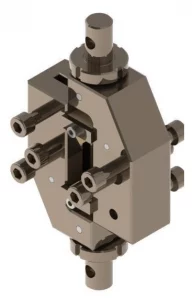
ASTM D2344/D2344M is a standard test method for measuring the short-beam strength of polymer matrix composite materials and their laminates using a three-point bending setup. It is widely used as a fast, practical check that is sensitive to resin-dominated and interlaminar behavior in composite laminates.
If you are not sure whether short-beam strength is the right screening metric for your laminate, thickness range, or failure mode goals, talk with our team about matching the standard to your test plan.
ASTM D2344/D2344M — Standard Test Method for Short-Beam Strength of Polymer Matrix Composite Materials and Their Laminates
This method is commonly referred to as a short-beam shear or short-beam strength test for polymer matrix composites. The specimen is a short beam machined from a flat or curved laminate and loaded in three-point bending to produce a short-beam strength value.
Because multiple failure modes can occur in this geometry, the reported short-beam strength is generally used for comparison, process control, and screening—not as a direct substitute for a single “pure” material property.
Quick Definition
ASTM D2344/D2344M: A three-point bending short-span test method used to determine the short-beam strength of fiber-reinforced polymer matrix composite laminates (often used as an interlaminar/shear-sensitive screening test).
What This Standard Covers
ASTM D2344/D2344M describes how to load a short composite beam in three-point bending and calculate a short-beam strength result under defined geometric constraints. It applies to high-modulus fiber-reinforced composite laminates, including continuous- or discontinuous-fiber-reinforced polymer matrix composites where laminate response is balanced and symmetric about the beam’s longitudinal axis.
The method is intended for relatively thin laminate beams (commonly up to about 6 mm thick) and uses a short support span relative to thickness to promote interlaminar/resin-dominated failure behavior.
Why This Standard Matters in Testing
Short-beam strength testing is frequently selected when teams need a repeatable, efficient way to compare laminate quality between batches, process settings, or material systems. It is also commonly used for shop-floor or lab-level screening where quick turnaround matters.
Because the stress state is complex in a short-beam specimen, consistent specimen geometry and consistent failure mode are important for meaningful comparisons across lots or builds.
Common Materials, Product Types, or Applications Covered
ASTM D2344/D2344M is most often applied to polymer matrix composite laminates such as:
- Carbon fiber/epoxy and glass fiber/epoxy laminates
- Unidirectional, woven, or multi-axial laminate constructions (when laminate symmetry/balance requirements are met)
- Flat panels and coupons machined from manufactured laminate parts (including curved laminates when appropriate)
It is commonly used in aerospace, motorsports, sporting goods, industrial composites, and general composite manufacturing where laminate-to-laminate comparisons are needed.
Common Test or Verification Workflow
A typical ASTM D2344/D2344M workflow centers on controlling coupon geometry and the three-point bending setup so results can be compared across batches or conditions.
Common workflow: Define laminate build and thickness range → machine short-beam coupons → condition specimens if required by your program → run three-point bend tests using the short-span configuration → calculate short-beam strength and document the observed failure mode for comparability.
Equipment Commonly Used for This Standard
ASTM D2344/D2344M is typically run on a universal testing machine (UTM) equipped for three-point bending with appropriate spans and supports for short-beam testing.
Common equipment: Universal testing machine (electromechanical or servo-hydraulic), suitable load cell, three-point bend fixture (supports and loading nose sized for composite coupons), and test software that can control crosshead rate and report peak load for strength calculations.
Common options (application-dependent): Environmental conditioning/testing capability when programs require controlled temperature and/or humidity; data acquisition for crosshead displacement and other channels when needed for internal reporting requirements.
How to Read This Designation or Revision
Designation format: ASTM D2344/D2344M.
Units: The standard is published in both SI and inch-pound units, and the two systems are intended to be used independently (not mixed). In many ASTM “/M” designations, the “M” indicates the metric/SI unit context is included alongside inch-pound.
Revision suffix: A year added after the designation (for example, “-22”) identifies the edition year being cited. Test setup details and reporting expectations can change between editions, so purchaser specifications should cite the exact revision.
Related Standards, Methods, or Frameworks
Short-beam strength is often used alongside other composite mechanical test methods when a program needs a broader property set or different stress states.
Often considered in the same test planning discussions: ASTM D7264/D7264M (flexural properties of polymer matrix composites) and dedicated composite shear methods such as ASTM D5379/D5379M (V-notched beam shear) or ASTM D7078/D7078M (V-notched rail shear), depending on the property needs and specimen availability.
Get help selecting a D2344 test setup
If you are configuring a UTM and bend fixture for your laminate thickness range and target throughput, you can request a detailed quote for an ASTM D2344/D2344M-ready setup.