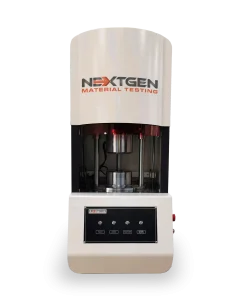
ASTM D1646 describes Mooney viscometer test methods used to measure Mooney viscosity (a torque-based processability indicator for rubber), plus stress relaxation behavior and early-stage pre-vulcanization (scorch) characteristics.
This standard is widely used in rubber manufacturing and compound development to compare incoming raw polymers, monitor batch-to-batch consistency, and flag mixing or formulation changes that can affect processing on mills, calenders, and extruders. If you need help matching a Mooney viscometer configuration to the exact D1646 outputs you must report, talk with our team.
ASTM D1646 — Standard Test Methods for Rubber—Viscosity, Stress Relaxation, and Pre-Vulcanization Characteristics (Mooney Viscometer)
ASTM D1646 is a set of test methods built around the Mooney viscometer. It defines how to determine Mooney viscosity from the shearing torque resisting rotation of a metal rotor embedded in rubber in a heated cavity.
It also includes procedures to measure how torque decays after stopping the rotor (stress relaxation), and procedures that use torque increase during heating to characterize very early vulcanization behavior (incipient cure / scorch behavior).
Quick definition
Document type: Test methods.
What it does: Uses a Mooney viscometer to measure (1) Mooney viscosity (torque-based processability), (2) stress relaxation after stopping rotor rotation, and (3) early-stage pre-vulcanization / incipient cure behavior as torque rises during heating.
What this standard covers
ASTM D1646 covers procedures for measuring Mooney viscosity and defines the viscometer setup, test temperatures, and procedures used for the determination.
It also describes a stress relaxation test on the Mooney viscometer (torque decay after an abrupt stop) and procedures for measuring the initial rate of vulcanization when compounded rubber is tested at a temperature where vulcanization may occur.
Why this standard matters in testing
Process control and comparability: Mooney viscosity is often used as a fast, practical indicator of how a rubber or compound is likely to handle during mixing and downstream processing. Consistent results depend on controlling temperature, timing, and instrument condition.
Complementary insight: The standard highlights that viscosity and stress relaxation do not track molecular structure and non-rubber constituents in the same way, so pairing Mooney viscosity with stress relaxation can improve discrimination between materials that may look similar by a single metric.
Early cure risk: Pre-vulcanization (scorch) behavior helps identify compounds that may begin curing too soon during processing, which can cause handling issues and scrap if not detected early.
Common materials, product types, or applications covered
ASTM D1646 applies to rubber and rubber compounds tested in a Mooney viscometer, including raw rubbers and unvulcanized compounds where processability and early cure tendency are important.
Typical use cases include incoming QC on polymers, compound development and optimization, and manufacturing checks to maintain consistent mixing and forming behavior.
Common test or verification workflow
ASTM D1646 is commonly run as a controlled-temperature Mooney viscometer sequence, where the sample is loaded into a heated die cavity and torque is monitored while the rotor runs.
Common workflows: (1) measure Mooney viscosity at a specified temperature and timing, (2) stop the rotor and capture torque decay for stress relaxation, and/or (3) run a heating/hold sequence to detect torque rise associated with incipient cure (scorch) behavior in compounded materials.
Equipment commonly used for this standard
ASTM D1646 is fundamentally an instrument-based standard and typically points to a Mooney viscometer system capable of stable temperature control and repeatable torque measurement under the conditions required by the method.
Common equipment: Mooney viscometer with heated dies, appropriate rotor(s), torque sensing and data acquisition, and tooling/consumables needed for consistent loading and cleanup.
Selection cautions: Because D1646 results are sensitive to temperature control, rotor/die condition, and timing control, equipment comparisons should focus on temperature stability, torque calibration practices, and software/reporting support for the exact outputs your spec or customer requires. If you are equipping a lab or upgrading an older unit, you can request a detailed quote for a Mooney viscometer setup aligned to your reporting needs.
How to read this designation or revision
ASTM standards are commonly cited as the designation letter/number (D1646) followed by a hyphen and a two-digit year indicating the year of last adoption or revision. A letter suffix (such as “a”) can appear when multiple revisions occur within the same year.
Some ASTM listings also include a parenthetical year indicating the most recent reapproval year. For purchasing, audits, and customer-specific requirements, always match the exact cited designation (including any suffixes and reapproval notation) to ensure the correct edition is being used.
Related standards, methods, or frameworks when useful
ASTM D1646 notes an ISO counterpart for Mooney viscosity and pre-vulcanization characteristics (ISO 289 Parts 1 and 2), and it cautions that technical differences (including sample preparation allowances) can lead to different Mooney values between the two approaches.
If you are converting requirements between ASTM and ISO references, align on the exact method version and sample preparation rules before using results interchangeably.
Get help selecting Mooney viscometer equipment for ASTM D1646
If you need to run ASTM D1646 for viscosity, stress relaxation, and scorch/incipient cure work, we can help you scope the right instrument configuration, temperature range, and reporting outputs for your rubber lab workflow. Contact our team with the material type, target temperatures, and the exact designation your customer or internal spec calls out.