Accurate metallographic analysis starts before the specimen reaches the microscope. Cutting, mounting, grinding, and polishing all influence whether the final surface reflects the material’s true structure or carries preparation-related damage. Excess heat, weak edge support, inconsistent pressure, poor abrasive progression, and unstable polishing conditions can all introduce artifacts that affect interpretation.
Well-matched metallography sample preparation equipment helps control these risks across the full workflow. By improving sectioning control, mounting stability, and grinding and polishing repeatability, labs can produce more consistent specimens and reduce the chance that preparation defects are mistaken for real material features.
Why Equipment Control Matters in Metallography Sample Preparation
A polished specimen may look clean, but surface appearance alone does not prove that the material’s structure has been preserved. Metallography depends on structural fidelity: the goal is to expose the microstructure without adding heat damage, deformation, edge loss, or polishing artifacts that can interfere with interpretation.
Equipment control matters because each preparation stage affects the next. A poor cut can require more aggressive grinding. Weak mounting support can cause edge rounding. Inconsistent grinding or polishing conditions can leave scratches, smearing, pull-out, or relief. When these variables are controlled, results become easier to reproduce across samples, operators, and workflows.
How Sectioning Equipment Affects Sample Integrity
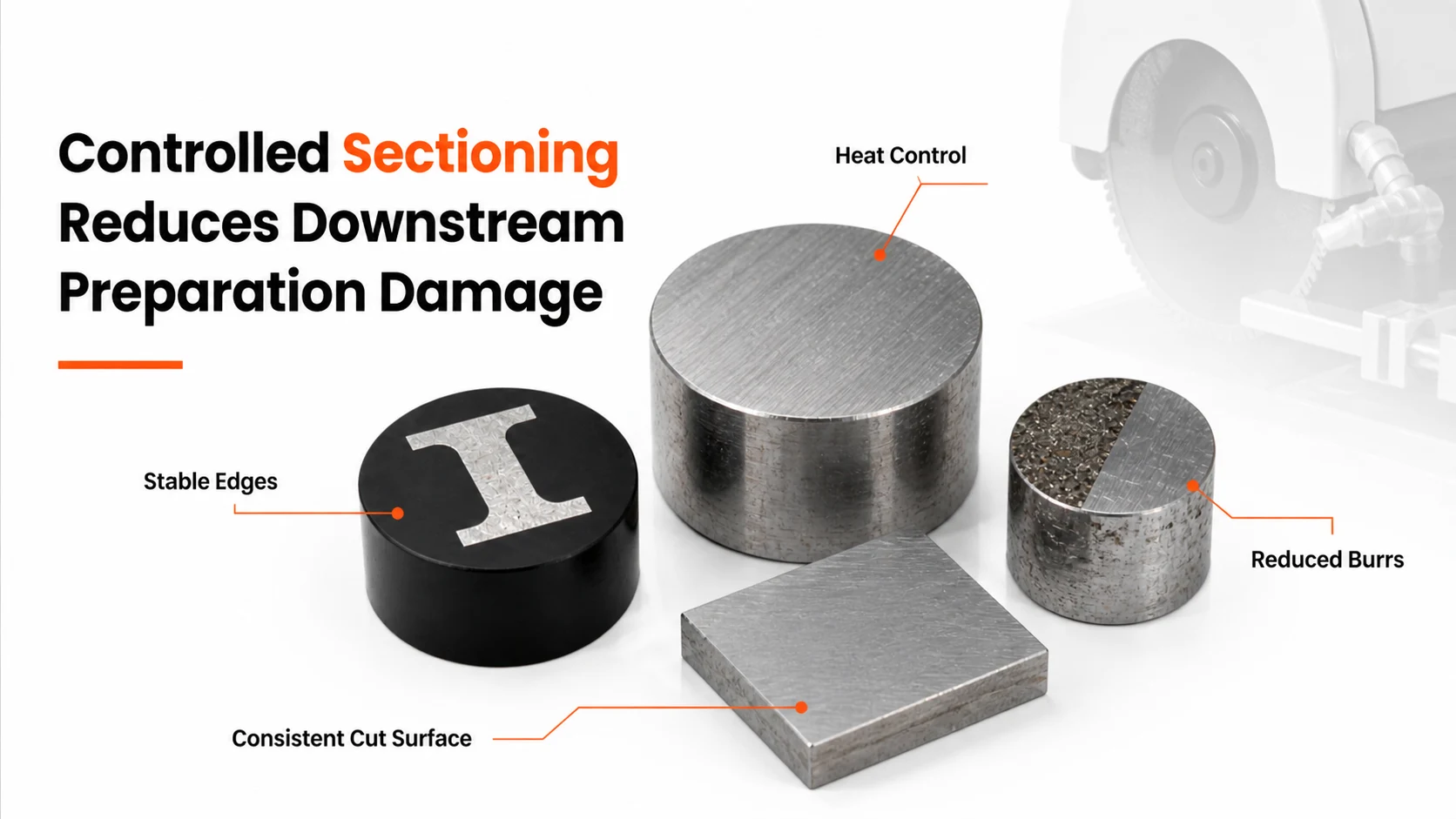
Sectioning is the first stage where preparation damage can enter the workflow. If the cut introduces excess heat, deformation, burrs, microcracks, or edge damage, the sample already begins the next step with compromised surface integrity. Later grinding and polishing then have to remove more damage before the structure can be evaluated with confidence.
Cutting method matters because different samples place different demands on the process. Abrasive cutting is well-suited to a wide range of specimen sizes and shapes, while low-speed precision cutting is better suited to delicate materials and applications where minimizing cut damage is critical. Material type, hardness, and geometry all influence which approach makes more sense.
Process control is especially important during sectioning. Abrasive metallographic cutters with effective coolant circulation can help reduce the risk of overheating, while stable feed control and proper wheel selection help limit deformation, burrs, and edge damage before grinding begins.
A good cut reduces the burden on every step that follows. Grinding should start with an abrasive fine enough to establish flatness and remove sectioning effects within a few minutes, while rougher cut surfaces usually require more aggressive initial removal. When sectioning is not well controlled, the warning signs often appear during the next preparation steps.
Signs that sectioning conditions may be creating downstream preparation problems:
- Visible burrs or edge damage after cutting
- Discoloration or signs of localized overheating near the cut area
- Greater time needed in grinding to remove sectioning effects
- Unstable edges that become harder to preserve during later preparation
- More aggressive, abrasive steps are required than the sample normally needs
- Inconsistent surface condition from one specimen to the next.
How Mounting Improves Edge Retention, Handling, And Consistency
Mounting helps stabilize samples that are small, thin, irregular, or difficult to hold through the next preparation steps. A proper mounting setup makes difficult specimen shapes and sizes easier to handle while helping protect sample edges and surface defects. A more stable specimen is easier to prepare consistently during grinding and polishing.
Edge retention is one of the main reasons mounting matters in metallography. If edges are not supported well, they are more likely to round off or lose definition during grinding and polishing. Gaps around a specimen can leave the edges unsupported, increasing the risk of edge rounding, cracking, and poor edge retention.
Good mounting also improves preparation consistency from sample to sample. It creates a more manageable form for handling, helps protect delicate features, and reduces the risk of rework caused by weak support or gap-related defects. Mounting presses with adjustable heating, cooling, pressure, and timing settings can improve repeatability by making mounting cycles easier to control and reproduce.
How Grinding and Polishing Prepare the Surface for Reliable Analysis
Grinding and polishing are the stages that turn a cut sample into a surface that can be interpreted with confidence. Grinding removes damage left by sectioning and establishes the flatness needed for consistent preparation. Polishing then reduces the finer deformation and scratch patterns that still remain. Each grinding step is meant to remove damage left by the previous stage, so preparation works as a controlled sequence rather than a finishing step done for appearance.
A smooth-looking surface is not always a trustworthy one. If grinding does not fully remove earlier damage, or if polishing leaves smearing, pull-out, relief, porosity-related distortion, edge rounding, or residual scratches, the final image can be harder to interpret correctly.
Process control plays a direct role in how repeatable those results become. Speed, pressure, cooling, and force distribution all influence how material is removed and how consistently samples are prepared from run to run. Grinding and polishing equipment should give operators control over speed, pressure, preparation time, cooling, and force distribution. These settings help each step remove damage from the previous stage without introducing new scratches, smearing, relief, or edge rounding.
Depending on the material and analysis goal, the prepared surface may also require cleaning and etching before microscopic examination, so the quality of earlier preparation steps remains important through the final analysis stage.
The Preparation Defects That Most Often Undermine Metallographic Accuracy
Preparation defects can enter the workflow during cutting, mounting, grinding, or polishing. Some are caused by heat or mechanical stress, while others come from weak edge support, poor abrasive progression, unstable polishing conditions, or incomplete removal of earlier damage. In metallography, these artifacts are usually workflow problems rather than isolated surface flaws.
| Preparation Defect | Where It Often Begins | Why It Matters In Analysis |
|---|---|---|
| Thermal damage | Cutting | Can alter the near-surface condition and make the structure less representative |
| Mechanical deformation | Cutting or aggressive grinding | Can distort the surface layer and complicate interpretation |
| Edge rounding | Mounting gaps or poor support during grinding/polishing | Can reduce definition at boundaries, coatings, and edge features |
| Pull-out | Grinding or polishing of brittle or multiphase materials | Can leave empty spaces that look like material defects |
| Relief | Uneven removal between phases | Can exaggerate structural contrast and mislead interpretation |
| Smearing | Polishing of softer materials | Can blur the true surface condition and hide detail |
| Residual scratches | Incomplete prior-step removal | Can mask boundaries and reduce surface clarity |
| Porosity-related distortion | Polishing or weak support | Can change how pores, voids, or porous regions appear under magnification |
These defects are especially problematic when they are mistaken for real material features. A distorted edge, damaged surface layer, or poorly supported mounted sample can change how boundaries, phases, pores, coatings, or local defects appear under magnification.
What To Look For In Metallography Sample Preparation Equipment
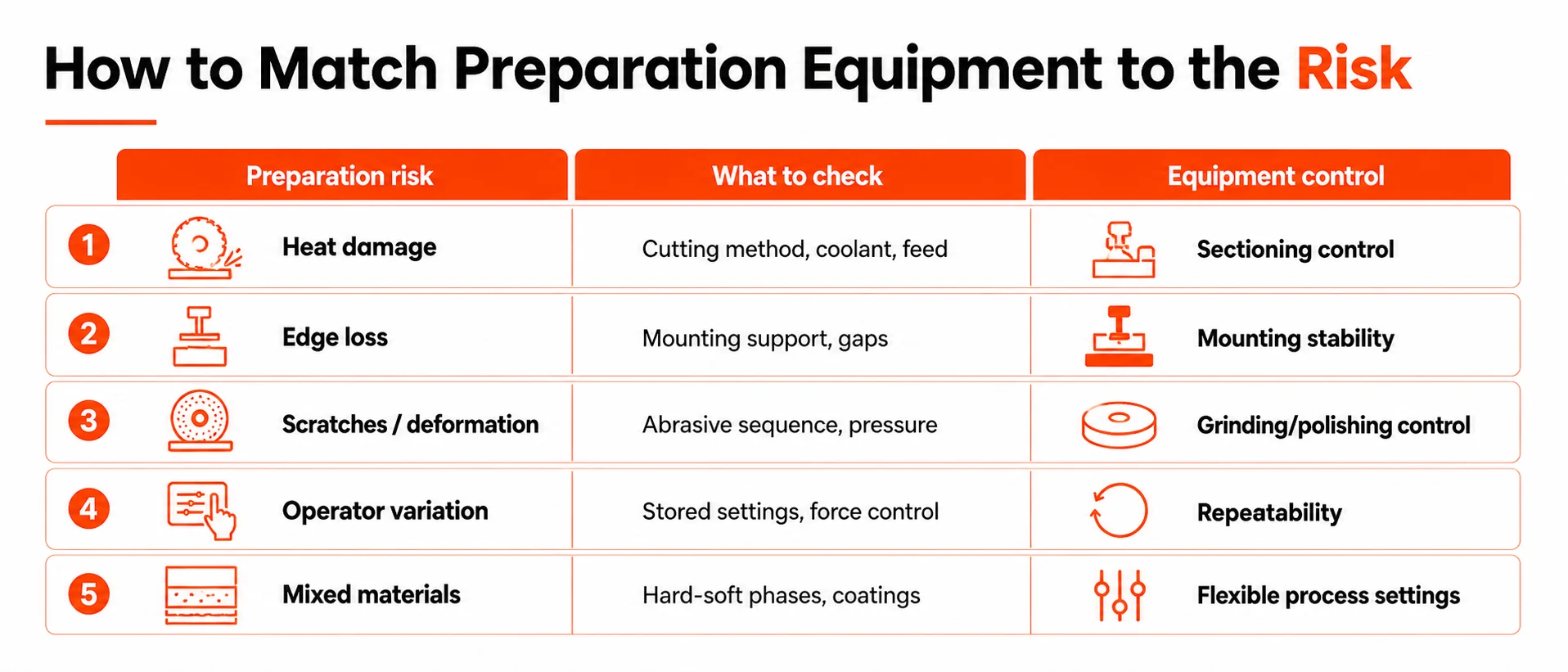
Equipment selection should start with the work itself. Before choosing a metallography sample preparation system, define the material being prepared, specimen geometry, section size, features that must be preserved, and routine lab workload. A setup that works well for routine production samples may not be the right fit for delicate edges, coatings, weld zones, multiphase materials, or irregular sections.
Control is often more important than broad machine claims. In sectioning, that includes the right cutting method and proper cooling to limit heat-related damage. In mounting, it means stable support and repeatable cycle settings. In grinding and polishing, it means controlled speed, pressure, force distribution, and step progression, so each stage can remove prior damage without creating new problems.
Repeatability is another major selection point. Features such as adjustable parameters, stored programs, cooling, and multi-sample handling can help reduce operator-to-operator variation and make results more consistent from run to run. Equipment that supports repeatable settings is often more valuable than equipment chosen mainly for generic size or power claims.
When evaluating metallography sample preparation equipment, focus on whether the system supports:
- The right cutting method for the material and specimen geometry
- Effective cooling and heat control during sectioning
- Stable mounting support for small, thin, or irregular samples
- Controlled speed and pressure during grinding and polishing
- Consistent force distribution across samples
- Programmable repeatability for routine preparation workflows
- Enough flexibility to handle both sample variety and lab volume
Why Matching Equipment To The Application Matters
The right preparation setup becomes easier to define when the application is clear from the start. Material type, specimen geometry, surface condition, section size, and the features being examined all influence how much control the lab needs during cutting, mounting, grinding, and polishing.
A system that looks versatile on paper can still create problems if it does not match the actual preparation demands of the work. Cutting that is too aggressive can add unnecessary damage. Weak mounting support can make fragile edges harder to preserve. Limited grinding and polishing controls can increase variation instead of improving efficiency.
A useful way to evaluate equipment is to consider the most difficult routine sample, not only the most common one. Thin coatings, fragile edges, hard-soft material combinations, and small mounted sections often reveal whether the preparation workflow has enough control and repeatability.
How NextGen Equipment Supports Controlled Metallography Preparation
For laboratories building or upgrading a metallography preparation workflow, NextGen offers equipment that supports controlled sectioning, repeatable grinding and polishing, and more consistent sample preparation. Two systems that fit key stages of this workflow are the GenCut GL 120XY for sectioning and the GenGrind FA-IC 250S for grinding and polishing.
GenCut GL 120XY Multi-Function Abrasive Cut-Off Saw
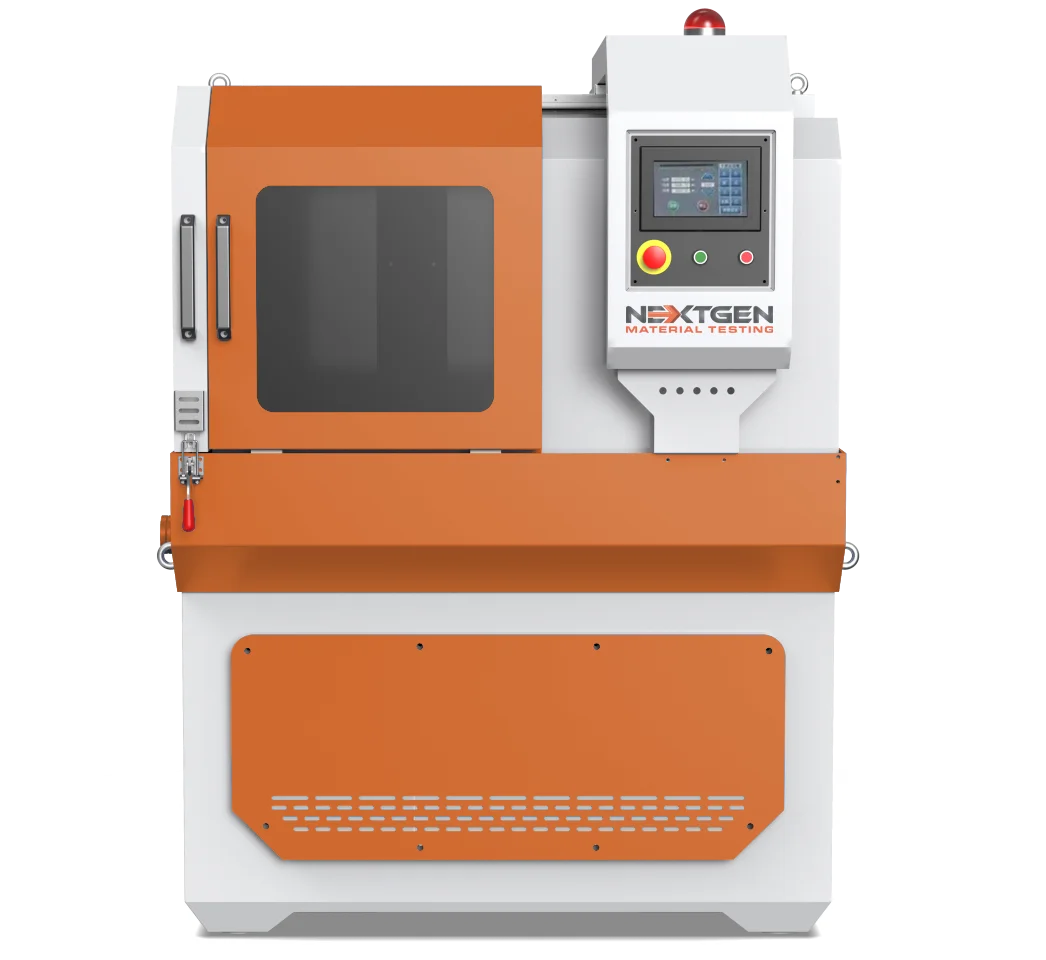 The GenCut GL 120XY is designed for metallographic sectioning where cutting capacity, process control, cooling, and operator safety all matter. It gives labs a controlled way to prepare specimens before mounting, grinding, polishing, and final analysis.
Core features include:
- 120 mm maximum cutting capacity
- Fully automated XY table
- Touch screen control
- Variable cutting speed
- Double-hood enclosed structure
- Cooling support during cutting
The GenCut GL 120XY fits labs that need a controlled first step in the preparation workflow. A more controlled sectioning process can help reduce heat-related damage, edge problems, and the amount of correction needed during later grinding and polishing.
GenGrind FA-IC 250S Fully Automatic Grinder and Polisher
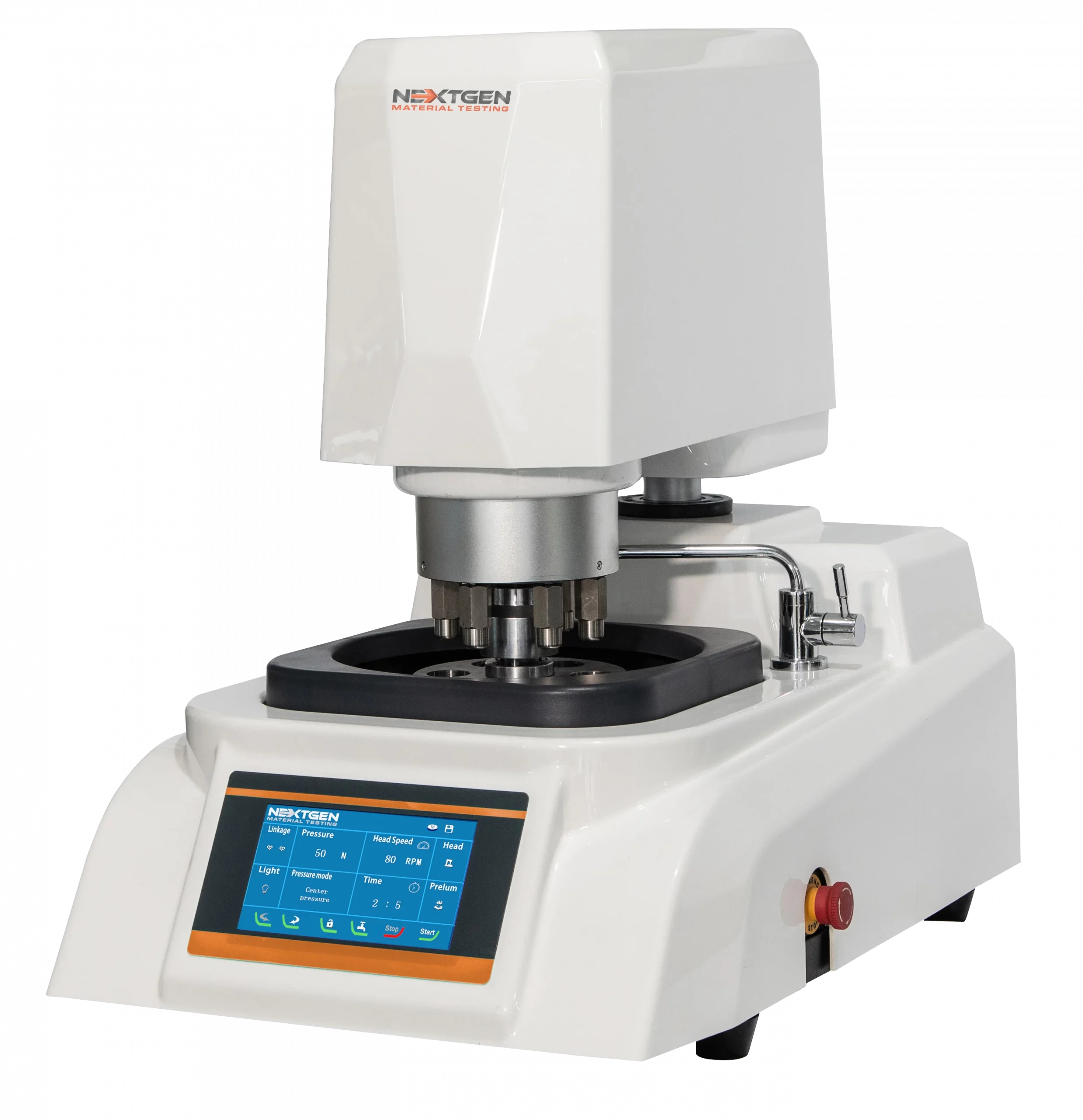 The GenGrind FA-IC 250S is a fully automatic single wheel grinder and polisher for metallographic sample preparation. It supports key surface preparation steps, including grinding and polishing, through automated control and repeatable settings.
Core features include:
- Fully automatic grinding and polishing
- 250 mm / 10” working disc
- Touch screen control
- Adjustable speed and preparation time
- Individual and central force control
- Cooling support during grinding
The GenGrind FA-IC 250S fits the stage where earlier preparation damage must be removed and the final surface is prepared for microscopic analysis. Its automated control and repeatable settings can help labs create more consistent preparation routines across samples, operators, and batches.
Where Each System Fits in the Workflow
The GenCut GL 120XY supports the sectioning stage, where the priority is controlled cutting, cooling, cutting capacity, and reduced preparation damage. The GenGrind FA-IC 250S supports the grinding and polishing stage, where repeatable speed, force, preparation time, and cooling help create a surface ready for microscopic analysis.
In a complete metallography preparation workflow, these systems are complementary rather than interchangeable: one controls the cut, while the other controls the surface prepared for final analysis.
Choose Equipment That Supports Reliable Metallographic Analysis
Reliable metallographic analysis depends on more than the final microscope image. It depends on how well the sample was sectioned, supported, ground, polished, and prepared before analysis. When each stage is controlled, labs can reduce avoidable artifacts, improve repeatability, and make final interpretation more consistent.
If your lab is reviewing its current preparation process or planning a new setup, NextGen can help match metallography sample preparation equipment to your materials, specimen geometry, workflow, and analysis requirements. Share your application details with NextGen to build a preparation workflow that supports more consistent results from the first cut to final analysis.
Keep Reading in Metallography Sample Preparation
See the Metallography Sample Preparation rangeMachines Behind This Article
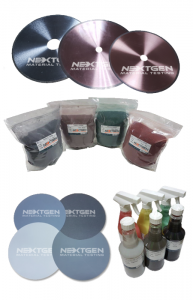 Metallography Sample PreparationMetallography ConsumablesMetallography consumables cover the materials needed for sectioning, mounting, grinding, polishing, etching, and cleaning specimens before microscopic examination....View product
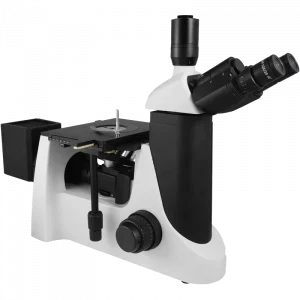 Metallography Sample PreparationG-800E – Trinocular Metallurgical MicroscopeG-800E is an inverted trinocular metallurgical microscope for industrial, research, and educational metallurgy applications. It supports reflected-light observation...View product
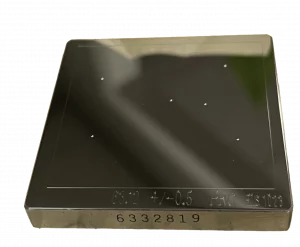 Metallography Sample PreparationHardness Test Blocks, Indenters and AccessoriesHardness test blocks, indenters, and accessories support daily verification and reliable operation of metal hardness testing systems. The range includes certified...View product