ASTM E92 describes standardized test methods for determining Vickers hardness and Knoop hardness of metallic materials using diamond indentation.
If you need help selecting the right hardness method (Vickers vs. Knoop) or aligning your procedure to the exact edition cited by a customer, you can talk with our team.
ASTM E92: Standard Test Methods for Vickers Hardness and Knoop Hardness of Metallic Materials
ASTM E92 is a hardness testing standard focused on Vickers and Knoop indentation methods, including both the test procedure and key requirements for hardness testing machines.
It is widely used in metals QA/QC, process control, and R&D when an optical indentation method is preferred for its versatility across a wide hardness range and for localized measurements.
Quick Definition
Standard type: Test methods.
What it measures: Vickers hardness (HV) and Knoop hardness (HK) of metallic materials from diamond indentations.
Force ranges covered: Vickers testing from 1 gf up to 120 kgf, and Knoop testing from 1 gf up to 2 kgf.
What This Standard Covers
ASTM E92 covers the determination of Vickers hardness and Knoop hardness of metallic materials using indentation hardness principles. In addition to the core test method steps, it addresses requirements for hardness testing machines and includes annexes related to verification and standardization activities (machines, indenters, and hardness test blocks).
Because Vickers and Knoop are optical indentation methods, the workflow centers on creating a controlled indentation and measuring the indentation geometry to calculate a hardness number.
Why This Standard Matters in Testing
Vickers and Knoop hardness testing is commonly used for materials evaluation, manufacturing quality control, and research and development. In many metal systems, hardness values are also used as a practical indicator that can be correlated to properties such as tensile strength, wear resistance, and ductility (with the usual material- and condition-specific limitations).
ASTM E92 is also used when localized hardness variations matter, such as when checking heat-treated cases, weld regions, coatings on metal substrates, or gradients across a section. In these situations, a single indentation may not represent bulk hardness, so test planning (number and location of indents) becomes important.
Common Materials, Product Types, or Applications Covered
Common materials: Metallic materials (including steels, stainless steels, aluminum alloys, copper alloys, nickel alloys, and other engineering metals).
Common applications: Heat treat verification, weld/HAZ checks, incoming inspection, process monitoring, failure analysis support, and R&D characterization where an optical indentation method is appropriate.
When Knoop is often considered: Situations where a shallower, more elongated indentation is useful (for example, when evaluating gradients or very localized regions and trying to place indents closer together).
Common Test or Verification Workflow
Most ASTM E92 workflows follow a straightforward sequence: select the method (Vickers or Knoop), select an appropriate test force and dwell per the procedure, prepare a test surface suitable for optical measurement, make indentations, measure indentation dimensions, calculate/report hardness values, and document test conditions.
Because the standard also addresses hardness machine requirements and includes verification-related annexes, many labs pair routine testing with scheduled verification activities using calibrated reference test blocks and documented checks of the test system’s performance.
Related microindentation guidance: For microindentation force-range guidance (forces at or below 1 kgf), ASTM E92 points users to ASTM E384 for additional procedures and guidance.
Equipment Commonly Used for This Standard
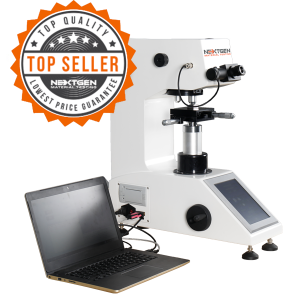
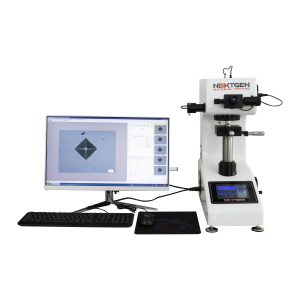
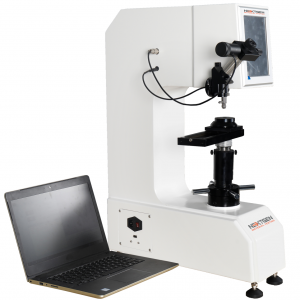
ASTM E92 typically points to an indentation hardness testing setup with controlled force application and optical measurement. Final configuration depends on your force range, part geometry, throughput, and documentation requirements.
- Vickers/Knoop hardness tester: A system capable of applying the selected force range and supporting Vickers and/or Knoop indenters.
- Diamond indenter(s): Vickers and/or Knoop indenters appropriate to the method being reported.
- Optical measurement system: Built-in microscope/camera and measurement software for reading indentation dimensions and calculating HV/HK.
- Workholding and positioning: Anvils, stages, and fixturing that stabilize the part and allow consistent placement of indents (especially important for small features and gradients).
- Verification accessories: Certified hardness test blocks and supporting accessories used for routine checks and periodic verification activities.
- Sample preparation tools (as needed): Metallographic mounting and polishing equipment when a smooth, readable indentation surface is required for reliable optical measurement.
If you are matching a tester to a particular force range, automation level, or reporting requirement, you can request a detailed quote for a configuration aligned with your lab workflow.
How to Read This Designation or Revision
Designation: “E92” is the fixed ASTM designation for this standard.
Year suffix: A hyphen followed by two digits (for example, “E92-23”) indicates the year of acceptance or the year of the most recent revision.
Other suffix conventions you may see: A year in parentheses can indicate the year of last reapproval, and an epsilon symbol may be used to mark an editorial change that did not alter the year designation.
Revision sensitivity: Hardness testing results are highly dependent on test force selection, indenter type, verification practices, and reporting conventions, so it is important to align your procedure and reporting with the exact edition cited in your drawing, purchase specification, or customer requirement.
Related Standards, Methods, or Frameworks
ASTM E384: Commonly used alongside ASTM E92 when working in the microindentation force range and for additional microindentation-focused guidance.
Other hardness methods you may encounter in the same QA programs: ASTM E18 (Rockwell hardness) and ASTM E10 (Brinell hardness) are often specified for broader or production-oriented hardness checks, while Vickers/Knoop methods may be selected for localized measurements or when an optical indentation approach is preferred.
Get help configuring a Vickers/Knoop hardness testing setup
If you are planning a Vickers or Knoop hardness tester purchase for ASTM E92 work, we can help you match force range, optics, verification accessories, and reporting needs to your application. To compare options, request pricing for a hardness testing system.