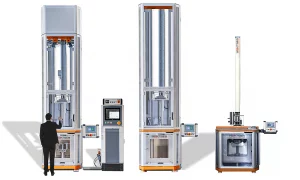
ASTM D7192 is a standard test method for measuring the high-speed puncture behavior of plastic films using instrumented load and displacement sensing. It is commonly used to characterize puncture resistance and the load–deformation response of thin, flexible films under impact-style, multi-axial deformation conditions.
If you need help matching the right test setup to your film type, thickness range, or reporting requirements, talk with our team about your application before specifying equipment.
ASTM D7192-20 Standard Test Method for High Speed Puncture Properties of Plastic Films Using Load and Displacement Sensors
This method focuses on instrumented puncture testing at higher test velocities than conventional slow-speed puncture tests. The output is typically a load-versus-deformation response, which can be used to compare films and assess how puncture performance changes with impact rate.
The method is generally applied to plastic films (ASTM film terminology commonly uses 0.25 mm as a thickness boundary), and it is intended for non-rigid materials. Rigid plastics are typically addressed using other instrumented puncture methods.
Quick definition
ASTM D7192 is an instrumented high-speed puncture test method that measures how a plastic film responds to puncture at controlled velocities, capturing load and displacement during the event.
Common outputs: Load–deformation response and puncture-related performance comparisons at different test speeds.
Primary value: Helps quantify rate sensitivity (how puncture behavior changes as impact speed increases).
What this standard covers
ASTM D7192 covers the determination of puncture properties of plastic films over a range of test velocities. The method is designed to generate instrumented data (load and displacement) during a puncture event under multi-axial deformation conditions.
The method notes that puncture response can depend on thickness but is not necessarily linear with thickness, so comparisons are commonly made between specimens of essentially the same thickness unless a validated thickness relationship is established for the specific film family.
Why this standard matters in testing
Film puncture performance is often tied to packaging durability, handling damage risk, and field reliability where impact-like events occur (drops, snagging, concentrated contact, or localized intrusion). ASTM D7192 is used when buyers and engineers need an instrumented, rate-dependent view of puncture behavior rather than a single low-speed puncture number.
This method is also frequently referenced alongside material or product specifications. When a product specification modifies the test method, those specification requirements take precedence for acceptance testing.
Common materials, product types, or applications covered
ASTM D7192 is commonly applied to plastic film materials and film-based products where puncture at higher deformation rates is a design or quality concern.
Typical examples: Flexible packaging films, protective films, liners, and other thin polymer film constructions where puncture/impact damage resistance is a performance driver.
Practical caution: Results can be strongly influenced by film fabrication method, resin type/grade, gauge uniformity, and defects (for example, die lines or contaminants), so sampling and specimen selection are critical for meaningful comparisons.
Common test or verification workflow
A typical ASTM D7192 workflow in a lab environment centers on preparing film specimens, clamping them in an appropriate fixture, and puncturing through an unsupported area at specified velocities while recording synchronized load and displacement signals.
Common workflow steps: Select representative film samples and thickness, condition specimens as required by internal or customer requirements, run puncture tests at one or more specified speeds, and report puncture response using the required acceptance or comparison criteria.
When edition and spec details matter: If you are testing to a procurement specification, confirm whether it calls out specific test speeds, fixture details, or reporting conventions that modify the base method.
Equipment commonly used for this standard
ASTM D7192 points to an instrumented, high-speed puncture testing setup capable of controlling puncture velocity and recording load and displacement during the event. Equipment selection usually depends on the required speed range, expected force range, and data acquisition needs.
- High-speed puncture or impact-style test frame capable of controlled puncture velocities
- Instrumented load measurement (force sensor/load cell) suitable for dynamic events
- Displacement measurement appropriate for the motion profile and required resolution
- Film clamping fixture designed to minimize slip and define the unsupported test area
- Puncture probe/tup geometry appropriate to the referenced edition and any controlling product specification
- High-speed data acquisition and analysis software for synchronized load–displacement output
If you are comparing systems, focus on: achievable and repeatable velocity control, sensor bandwidth and sampling rate, fixture changeover, and the ability to produce clean load–deformation curves at your targeted film gauges.
How to read this designation or revision
ASTM standards are commonly cited with a year suffix to identify the specific edition being used. For this method, ASTM lists an active edition as ASTM D7192-20.
Good practice: When quoting testing capability or writing a test plan, cite the full designation with the year (for example, ASTM D7192-20) and align all parties on any customer or product-specification modifications.
Related standards, methods, or frameworks when useful
Depending on the material category and stiffness, ASTM D7192 is often considered alongside other plastics and film standards. The standard itself references film terminology and notes an alternative method for rigid plastics.
Often referenced in the same decision path: ASTM D883 (plastics terminology and film definition context), ASTM D3763 (instrumented puncture testing of rigid plastics), and ASTM D4000 (plastics classification system listing materials standards).
Request a quote for a D7192-ready puncture test setup
If you are selecting an instrumented high-speed puncture system and need the right force range, speed capability, sensors, and clamping fixture for ASTM D7192, you can request a detailed quote for a configuration matched to your films and throughput.