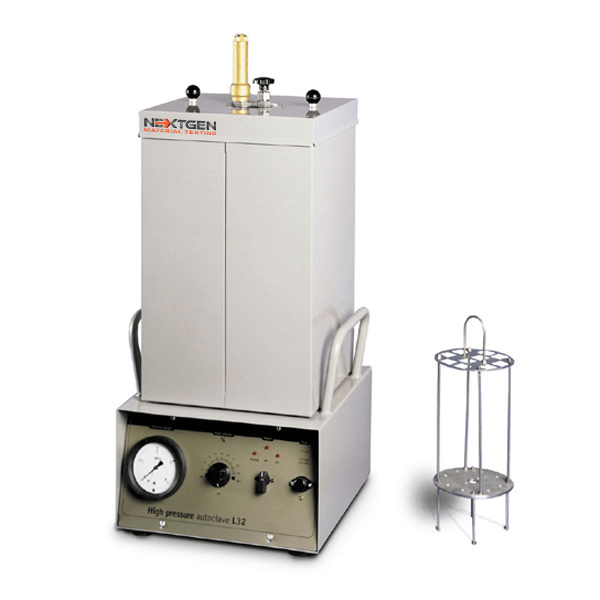
The high pressure autoclave carries out the autoclave expansion test on Portland cement, the check for potential delayed expansion known as soundness. Cement bars are held in saturated steam at high pressure, and the change in their length afterwards is what the test reports.
The vessel is a high-pressure steam chamber with internal dimensions of 6.1″ (154 mm) diameter by 16.9″ (430 mm) high, and it accepts a rack holding 10 specimens made in the bar moulds listed under accessories. It is supplied complete with pressure gauge, pressure regulator, temperature regulator, control switches, safety valve and specimen rack.
The test itself is defined by ASTM C151, with specimen preparation and length measurement following ASTM C490. There is a note on the instrument in our blog.
Everything that regulates and monitors the cycle is part of the instrument rather than an option, which matters on a vessel that runs at pressure.
Plan the bench around the footprint and the height: the vessel is over a metre tall with the lid clear.
| Item | Autoclave, high pressure |

|---|---|
| Internal chamber | Ø6.1″ (154 mm) × 16.9″ (430 mm) high |
| Specimen capacity | 10 specimens on the supplied rack |
| Heater | 2,600 W |
| Overall dimensions | 17.7 × 18.7 × 42.5″ (450 × 475 × 1,080 mm) |
| Weight | Approximately 121 lbs (55 kg) |
Specimen bars for the test are cured before autoclaving, which is the job of a climatic curing chamber.
Tell us whether you already hold the bar moulds and the length comparator, and we will quote the autoclave with whatever is missing rather than on its own. Send a quick request online with your standard.
Need Additional Quality Control Equipment to Build Your Laboratory?
Autoclave testing is only one part of a complete quality control laboratory. NextGen can help you equip your entire lab with mortar mixers, climatic curing cabinets, Blaine fineness apparatus, Vicat setting-time apparatus, autoclaves, and other supporting solutions, all coordinated as one complete project.