Accurate testing of cement and concrete materials is necessary for verifying their durability, safety, and compliance with industry standards. One of the most reliable methods for assessing hydraulic cement quality is through autoclave testing. This process evaluates critical properties such as material expansion and curing behavior, providing key insights into their long-term performance.
At NextGen, we understand the challenges faced by professionals in testing these materials. That’s why we are proud to offer our high-pressure autoclave, a cutting-edge solution built to meet ASTM C151 and ASTM C490 standards. With advanced features, robust construction, and exceptional reliability, our autoclave provides everything needed for precise and consistent testing in laboratories and industrial settings.
Throughout this blog, we’ll examine what an autoclave is, highlight the specialized features of our high-pressure autoclave, and explain why it stands out as a reliable testing tool for cement and concrete.
What Is an Autoclave?
An autoclave, also known as a steam sterilizer, steam autoclave, or pressure sterilizer, is a device that uses pressurized steam to achieve sterilization and processing of materials. These devices are of great importance in a number of industries, where they are used to verify the safety, sterility, and quality of products and equipment. Operating at high temperatures and pressures, autoclaves effectively neutralize harmful microorganisms, including bacteria, viruses, and fungi, while also being capable of curing, vulcanizing, or processing materials for industrial applications.
In healthcare, autoclaves are indispensable for sterilizing surgical instruments, medical equipment, and laboratory glassware, making sure that everything used in medical and dental procedures is free of contaminants. Laboratories rely heavily on autoclaves to decontaminate biological waste, sterilize media, and prepare equipment for experiments, making them the backbone of modern scientific research. Industries such as manufacturing and food production also benefit from autoclaves. They are used to cure composites, vulcanize rubber, and perform hydrothermal synthesis, while in the food industry, autoclaves sterilize canned goods to extend shelf life and guarantee their safety for consumption.
Autoclaves come in various types to meet specific needs. Gravity displacement autoclaves, common in laboratories, use steam to displace air in the chamber, achieving reliable sterilization. Vacuum autoclaves (Class B) are equipped with a vacuum system to remove air before steam introduction, making them ideal for sterilizing complex instruments in medical and dental settings. Horizontal and vertical autoclaves cater to different spatial and load requirements, with horizontal models accommodating larger loads and vertical models offering space-efficient solutions for smaller facilities.
Autoclaves are extremely important in material testing and quality control, particularly in industries like construction and cement manufacturing. By simulating extreme conditions, they help evaluate material expansion, curing behaviors, and overall performance. This guarantees that materials meet durability and safety requirements, enabling manufacturers to optimize formulations and maintain product consistency. The use of autoclaves is a necessity for the reliability and quality of industrial processes.
Overview of High-Pressure Autoclave
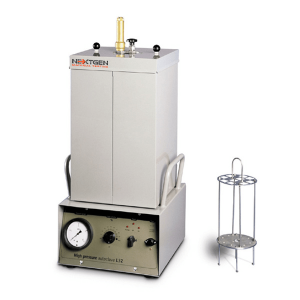 Our high-pressure autoclave is a state-of-the-art device for precise and reliable testing of hydraulic cement and concrete materials. It features a durable high-pressure steam vessel with internal dimensions of 6 inches in diameter and 17 inches in height (154 mm x 430 mm), capable of holding 10 specimens. These specimens are prepared using the 62-L0033/B molds, making the autoclave a trusted choice for laboratories and industries requiring consistent, accurate testing.
The autoclave is equipped with advanced features, including a pressure gauge, pressure regulator, temperature regulator, control switches, and a safety valve, guaranteeing both safety and operational efficiency. A specially designed specimen rack facilitates the convenient handling and organization of test samples during testing. Its powerful 2600W heater provides consistent steam generation, delivering optimal performance for even the most demanding testing requirements.
With overall dimensions of 17.7 x 18.7 x 42.5 inches (450 x 475 x 1080 mm) and a weight of approximately 121 lbs (55 kg), the autoclave is compact and easy to incorporate into most laboratory setups. It is available in models supporting both 110V and 230V power supplies, offering flexibility for international use. Certified to comply with ISPELS procedures, the autoclave guarantees safe and reliable performance for professionals in material testing and quality control.
Built to address the unique challenges of testing fast-setting and hardening materials, this high-pressure autoclave is an invaluable instrument for assessing cement and concrete durability and performance. Its robust design and advanced features make it the perfect choice for laboratories, research facilities, and industries dedicated to achieving the highest standards of material quality.
Who Can Benefit from a High-Pressure Autoclave?
The high-pressure autoclave has proven to be a valuable tool for a broad spectrum of professionals and industries, enabling accurate material testing and quality assurance in critical applications. Here’s how various sectors can benefit from its advanced capabilities:
1. Construction Industry
In construction, cement and concrete durability and performance are crucial factors. Engineers and quality control teams rely on high-pressure autoclaves to test materials for expansion and curing behavior under controlled conditions. As an example, when building large-scale infrastructure like bridges or tunnels, understanding how the concrete mix behaves under pressure ensures structural stability and longevity. The autoclave allows for precise evaluation of different cement formulations, minimizing potential cracking or failure in high-stress environments.
2. Cement Manufacturing
Cement producers use high-pressure autoclaves to test product consistency and quality before distribution. By evaluating material expansion during curing, manufacturers can refine their formulations to meet industry standards and customer demands. Specifically, testing hydraulic cement helps producers create mixes that resist water ingress, a crucial aspect for applications in dams or underwater structures.
3. Quality Control Laboratories
Independent laboratories specializing in material testing use autoclaves to verify that cement and concrete products meet regulatory and performance standards. This tool is critical for compliance testing, where results must be documented and certified for use in regulated industries. Laboratories can test samples from different suppliers to verify product consistency, providing reliable data for clients across the construction, infrastructure, and engineering sectors.
4. Research and Development Centers
Academic and industry facilities benefit greatly from high-pressure autoclaves when developing new cement and concrete technologies. Researchers use these devices to test innovative materials, such as eco-friendly or high-performance cement mixes, under extreme conditions. The autoclave can help analyze the performance of low-carbon cement mixes that are intended to reduce environmental impact, paving the way for sustainable construction solutions.
5. Government and Regulatory Bodies
Government agencies and regulatory authorities responsible for infrastructure and construction safety often use high-pressure autoclaves to conduct independent testing. By way of example, during inspections of public works projects, agencies may require detailed reports on the materials used to verify their compliance with safety and performance standards. Autoclaves provide the precision and reliability needed for critical assessments.
6. Engineering and Consulting Firms
Consulting engineers tasked with evaluating construction materials for large-scale projects benefit from autoclave testing’s detailed insights. When advising on materials for a high-rise building in a seismically active area, these firms can use autoclave data to recommend cement mixes that offer optimal performance under stress.
Your Trusted Partner in Cement and Concrete Testing
The high-pressure autoclave from NextGen Material Testing is a powerful, reliable tool built specifically to meet cement and concrete testing challenges. From its ability to evaluate material expansion and curing behavior to its robust construction and advanced safety features, this autoclave is built for precision and consistency. Its compact design, international compatibility, and strict quality standards make it a necessary asset for laboratories, construction sites, research facilities, and manufacturing plants worldwide.
The high-pressure autoclave makes certain that professionals have the insights they need to deliver durable, high-performance materials by catering to an array of industries and applications. Hence, whether you are testing cement formulations for large infrastructure projects or developing new concrete technologies for sustainable construction, this autoclave delivers accuracy and reliability you can trust.
At NextGen Material Testing, we are committed to helping you choose the right material testing equipment for your specific needs. If you require additional information or have questions about our products, please don’t hesitate to contact us directly or request an online quote. Our goal is to assist you in achieving excellence in material testing.
Machines Behind This Article
High Pressure AutoclaveHigh-Pressure AutoclaveThe high-pressure Autoclave is designed for cement and concrete laboratories that need controlled steam-pressure curing or soundness-related testing. Its internal...View product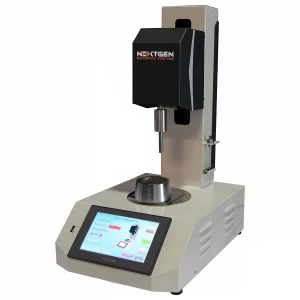 Cement & Concrete TestingAutomatic Vicat ApparatusThe Automatic Vicat Apparatus determines cement paste standard consistency and setting time with less operator intervention than a manual frame. It uses automated...View product
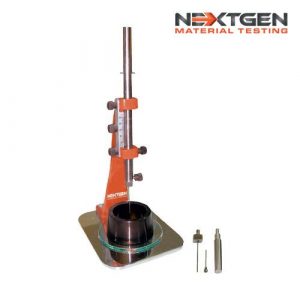 Cement & Concrete TestingManual Vicat ApparatusThe Manual Vicat Apparatus is used to determine cement and concrete setting time through controlled penetration of a needle or plunger into a prepared sample. Its...View product