ISO 18352:2009 defines a compression-after-impact (CAI) test method used to measure the residual compressive strength of polymer matrix composite laminate plates after an impact event at a specified energy level.
This standard is commonly referenced when qualifying or comparing carbon-fibre-reinforced composite laminates where impact damage tolerance matters. If you need help matching specimen size, fixture style, or machine capacity to the edition you must follow, talk with our team.
ISO 18352:2009 — Carbon-fibre-reinforced plastics — Determination of compression-after-impact properties at a specified impact-energy level
ISO 18352 describes a two-step method: first damaging a multidirectional composite laminate plate by impact at a defined energy level, then compressing the impacted plate in-plane to determine residual compressive strength.
It is primarily used for continuous-fibre-reinforced polymer matrix composite laminates made from unidirectional prepreg tapes/fabrics or woven fabrics, where CAI performance is a key damage-tolerance metric.
Quick Definition
Document type: Test method (compression-after-impact / CAI).
What it measures: Residual in-plane compressive strength after an impact event at a specified energy level.
Typical output: CAI (residual compression strength) used for material comparison, qualification, and composite allowables/databases.
What This Standard Covers
ISO 18352 focuses on determining how much compressive load-carrying capability remains after a laminate plate has been damaged by impact. The intent is to create a repeatable, standards-based way to compare damage tolerance between laminate designs, material forms, and manufacturing conditions.
The method is commonly used with multidirectional laminate plates (rather than unidirectional-only coupons) to represent practical layups where impact-induced delamination can drive compressive strength reduction.
Why This Standard Matters in Testing
For many composite structures, impact events can introduce internal damage that is not obvious visually but still reduces compressive strength. CAI testing provides a practical way to quantify this reduction under a controlled impact severity and a controlled compression loading condition.
Because equipment configuration (impact system, CAI compression fixture, alignment control, and load capacity) strongly affects test execution, CAI standards are often used early in program planning to avoid rework in fixturing and machine selection.
Common Materials, Product Types, or Applications Covered
ISO 18352 is commonly applied to:
- Carbon-fibre-reinforced polymer (CFRP) laminate plates
- Continuous-fibre-reinforced polymer matrix composites (including glass- or aramid-fibre systems when the laminate form and method fit)
- Prepreg-based laminates and woven-fabric laminates used in structural composite applications
Common application areas: Aerospace and other structural composite programs where impact damage tolerance and residual compression performance are tracked as part of qualification or down-select testing.
Common Test or Verification Workflow
Most ISO 18352 programs follow a practical workflow built around repeatable impact energy and repeatable compression loading:
- Specimen preparation: Produce laminate plates to the required layup and thickness; machine and mark specimens as required by the standard and the test plan.
- Impact event: Apply an impact to reach the specified energy level for the program (often selected to produce controlled internal damage).
- Compression-after-impact loading: Load the impacted plate in a dedicated CAI fixture to determine residual compressive strength.
- Reporting: Report residual compression strength and key test conditions needed to interpret results (including the cited edition and the selected impact energy level).
Practical caution: CAI results are highly sensitive to specimen geometry, fixture type, alignment/buckling restraint, and the impact condition. Edition and program requirements should be confirmed before hardware is finalized.
Equipment Commonly Used for This Standard
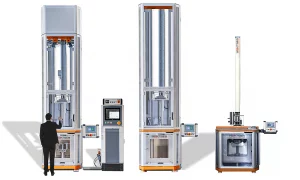
ISO 18352 typically points to an integrated equipment path that supports both the impact event and the post-impact compression test.
Common equipment families:
- Drop-weight impact tester (instrumented impact tower): Used to deliver the specified impact-energy level in a controlled, repeatable way.
- CAI compression fixture: A dedicated anti-buckling/support fixture designed for impacted plates, used to apply in-plane compression while controlling global buckling and edge conditions.
- Universal testing machine (UTM) or servo-hydraulic test frame: Provides the compressive load capacity and control needed to reach failure of impacted plates.
- Load measurement and data acquisition: Calibrated load cell and test software capable of capturing peak load and relevant compression test data.
If you are comparing impact energy targets, fixture styles, or test-frame capacity for ISO 18352 work, you can request a detailed quote for a configuration aligned with your specimen size range and expected failure loads.
How to Read This Designation or Revision
ISO 18352:2009 identifies the ISO standard number (18352) and the publication year (2009). For procurement documents and test plans, the year matters because fixture requirements, specimen details, and reporting expectations may depend on the cited edition.
ISO standards are periodically reviewed; when a contract, customer specification, or internal procedure references ISO 18352, follow the exact edition and any additional program requirements called out in that document set.
Related Standards, Methods, or Frameworks
CAI programs are often paired with other impact and compression-after-impact standards and internal OEM methods, depending on industry and customer requirements. When aligning test results across teams or suppliers, it is important to confirm whether the impact method, specimen geometry, and CAI fixture approach are consistent between the cited documents.
Common pairing concept: Impact damage creation (specified energy) followed by a controlled compression test of the impacted plate to determine residual strength.
Get Help Selecting a CAI Test Setup
If you are planning ISO 18352 testing and need to align impact energy, fixture constraints, and compression capacity to your laminate thickness and expected CAI strength, contact our team to map the standard to a practical equipment and lab workflow.