GB/T 228-2002 is a Chinese national recommended standard that describes a method for determining tensile properties of metallic materials at ambient (room) temperature.
It is often encountered in legacy drawings, supplier certifications, and older procurement specifications. If you need help matching a cited GB/T 228 reference to a current test plan or deciding what edition applies, contact our team.
GB/T 228-2002 — Metallic materials—Tensile testing at ambient temperature
GB/T 228-2002 is a tensile test method standard for metallic materials tested at ambient temperature. It is primarily used to generate tensile properties for material qualification, production lot acceptance, and quality control reporting.
Document type: Method (test method).
Quick Definition
GB/T 228-2002 outlines how to run a room-temperature tensile test on metallic specimens and report key tensile properties such as strength and ductility values derived from the stress–strain response.
What This Standard Covers
This standard focuses on uniaxial tensile testing of metallic materials at ambient temperature, including test execution and result reporting for tensile properties.
Typical outputs: Tensile strength-related results and elongation/ductility-related results derived from a controlled tensile pull to fracture (as applicable to the material and specimen form).
Why This Standard Matters in Testing
Room-temperature tensile results are widely used to compare materials, validate heat treatment or processing, and demonstrate conformance to product or material specifications. In many purchasing and QA/QC workflows, the tensile test report is a core document for release decisions.
For laboratories and production sites, the standard also influences practical choices around specimen geometry, strain measurement approach, and how test speed is controlled and recorded.
Common Materials, Product Types, or Applications Covered
GB/T 228-2002 is used broadly across metallic materials where room-temperature tensile properties are required, including common ferrous and nonferrous metals supplied as plate/sheet, bar, rod, wire, tube, and forgings (when a suitable tensile specimen can be prepared).
Common use cases: Incoming inspection, mill certification verification, process validation, weld procedure or joint evaluation when tensile testing is specified by a governing procedure, and periodic quality audits.
Common Test or Verification Workflow
Most labs follow a workflow that starts with defining the required specimen type and measurement basis, then executing the tensile pull under controlled conditions, and finally calculating and reporting tensile properties.
Common workflow steps: Specimen preparation and dimensional measurement, grip selection and alignment check, optional extensometer setup for strain-based properties, tensile loading to yield/ultimate/fracture as required, result calculation, and generation of a test report tied to the referenced edition of the standard.
Equipment Commonly Used for This Standard
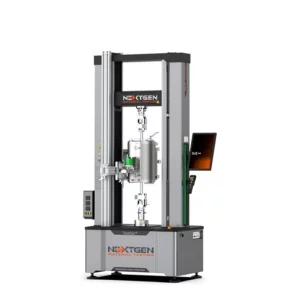
GB/T 228 tensile testing is typically performed on a calibrated universal testing machine (UTM) configured for tension, with fixtures and instrumentation matched to the specimen geometry and required strain measurement.
Common equipment: Electromechanical or servo-hydraulic UTM, tensile grips (wedge grips or other appropriate gripping), suitable grip inserts for the material/form, load cell, crosshead displacement measurement, and extensometers (clip-on or non-contact) when strain-based results are required.
Common accessories: Specimen machining/blanking capability (as applicable), measurement tools for width/thickness/diameter, and test software for method control and reporting.
How to Read This Designation or Revision
GB/T indicates a recommended (non-mandatory) national standard of the People’s Republic of China.
GB/T 228-2002 identifies the numbered standard and the year of issue for that edition. In many documents the year may be omitted (written simply as “GB/T 228”), so it is important to confirm which edition is being referenced before finalizing test control settings, instrumentation, and reporting fields.
Status note: GB/T 228-2002 has been withdrawn and was fully replaced by GB/T 228.1-2010 (and later revisions of GB/T 228.1).
Related Standards, Methods, or Frameworks when useful
In practice, legacy references to “GB/T 228” commonly point to the tensile-testing series now maintained under GB/T 228.1 for room-temperature tensile testing. If a specification cites GB/T 228 without a year or without the part designation, confirm whether the intent is the withdrawn 2002 edition or a current GB/T 228.1 edition before testing.
Get help configuring a GB/T tensile test setup
If you are selecting a universal testing machine, grips, or extensometry for GB/T tensile testing—especially when you need to match a legacy GB/T 228 callout—you can request a detailed quote for a configuration sized to your force range, specimen types, and reporting needs.